AI Moderation for Live Football Communities: Stopping Abuse and Brigading in Real Time
How live football apps can use multi-layer AI moderation, pre-filters and crowd signals to stop harassment, fraud and brigading in real time — keeping the flow of a matchday.
Published: February 23, 2026 | Updated: February 23, 2026
In a football chat, it’s very easy to cross the line between backing your team and going after the people on the other side. As the platform owner, and as the person responsible for overall football fan engagement, this is where you have to be careful: you want the noise and energy from fans, but you don’t want the room turning into a haven for hate, scams or “brigading” by rival supporters.
A simple list of bad words, or a small moderation team, doesn’t hold up in this setting. If response times are measured in minutes, people already feel like the conversation has broken down.
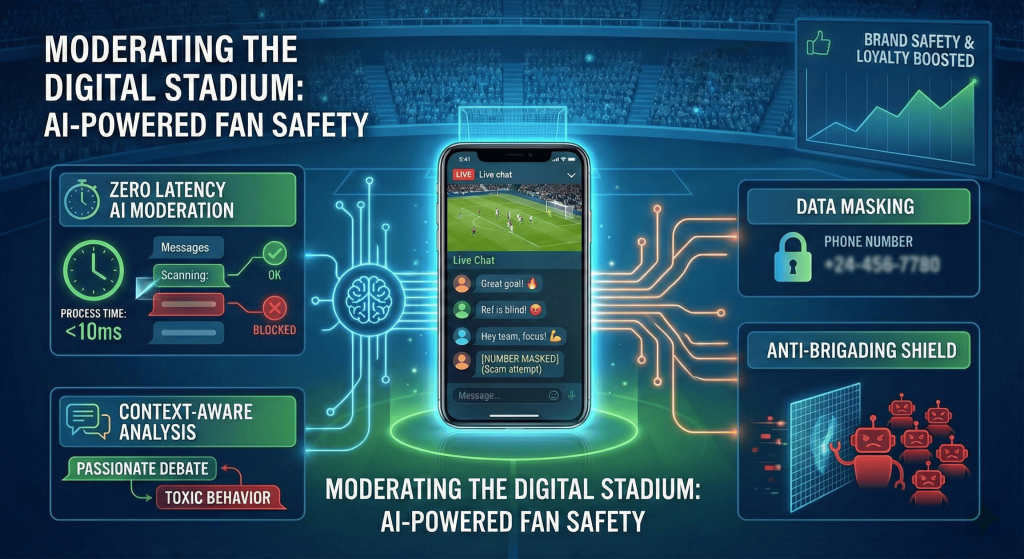
Zero Latency
Football moves fast, and the chat follows the match, not the other way around. Moderation has to keep up. If it takes half a second to scan a single message, the chat stops feeling truly “live”.
Effective AI chat moderation at this scale usually relies on a multi-layer system that processes messages in milliseconds and keeps the room under control without killing the flow:
Pre-moderation and instant warnings. Filters in more than 30 languages check a message before it’s sent. If a user tries to post something clearly over the line, they see a short warning before publication and can edit or cancel the message.
Context-aware AI models. Toxicity is rarely about one word; it’s about intent. Smart models can analyse the surrounding conversation and tell the difference between a fan venting about a bad tackle and someone targeting another person in the chat.
Automated data masking. Football communities are easy targets for fraud. When a user posts a phone number, email address or bank details into a public room, those fragments are automatically masked. People stay reachable inside the platform, but their raw data is much harder to abuse.
Stopping the “Brigade”
“Brigading” — when organised groups or competitors flood a chat to lure away the audience or simply cause chaos — can wreck the experience very quickly. New users see a wall of spam, not a community.
The room needs a couple of simple tools to protect itself:
User self-regulation. Any participant can hide messages from specific authors so they don’t see them again. That gives each person a personal safe zone while they stay inside the main chat with everyone else.
Collective reports. If several people complain about the same account in a short time window, that account is automatically put “on pause” until someone reviews what’s going on. One bad actor doesn’t get to hold the entire room hostage.
Why Safety Shows Up in Your Numbers
Safety isn’t a “nice to have” that lives in a separate slide deck. It shows up directly in engagement and revenue.
Research consistently finds that around four in ten adults have experienced online harassment. When that happens in your product, many of those people quietly stop posting, stop buying, or just leave.
An automated moderation layer helps brands to:
Protect the brand. Keep the chat at a level that leagues, sponsors and partners are comfortable putting their names next to.
Boost loyalty. Users who feel safe in the chat come back more often, stay longer on matchdays and are more willing to interact, subscribe or buy.
Stay compliant. Meet the expectations of laws like the UK Online Safety Act 2023, which pushes services to deal with illegal and harmful content quickly, without building a huge manual moderation team around every fixture.
The crowd in a digital stadium will always be loud — that’s the whole point. The job of the platform is to let that emotion through, without letting the worst behaviour take over.
A multi-layer AI moderation system makes that possible: fans argue about penalties, tactics and managers in real time, while the technology quietly keeps brigading, harassment and fraud in check in the background. For clubs and platforms that don’t want to assemble this stack from scratch, vendors like watchers.io offer it as a plug-in social layer that can be added to an existing app without a full redesign.
Mike Paul, an authoritative author, specializes in AI tools, Education and Business productivity. With comprehensive knowledge and practical insights, his blog offers credible guidance on the latest advancements. Mike's expertise is evident in his clear and concise writing style, supported by real-world examples and case studies. As a trusted industry voice, he actively engages with professionals, fostering a vibrant community. With meticulous research and fact-checking, Mike ensures accurate and up-to-date information. His blog www.mikepaul.com serves as a reliable resource for leveraging AI tools effectively.
Share This Article
JOIN OUR COMMUNITY
Receive the latest AI insights directly to your inbox.