How to Build and Monetize an Anime Series with Vidu AI (Without Animating a Single Frame)
Build a monetizable anime series with Vidu AI — no animation skills, no team, no $100K budget. Workflow, character consistency, and income breakdown.
Alexi Carmichael
Business, Mentorship, and AI Verified By Expert
Published: May 16, 2026 | Updated: May 16, 2026
The anime YouTube and TikTok economy is enormous. Channels producing AI-generated anime content are pulling six and seven-figure annual revenue from a workflow that, three years ago, didn’t exist. Independent creators are running entire series — recurring characters, multi-episode arcs, viral short-form clips — without a single frame of hand-animation.
The bottleneck used to be technical. Producing anime required a team, a year, and a budget. The new bottleneck is creative direction — and the tool most serious anime creators are using to clear it is Vidu AI.
This guide walks through how to build an anime series from scratch with Vidu AI, how to keep character consistency across episodes, and the monetization paths that turn this from a hobby into income.
Why Anime Is the Best AI Video Niche Right Now
Most creators chasing AI video are trying to compete with photorealistic content — and losing. Sora 2 and Veo 3.1 still produce more convincing live-action footage than what’s accessible to independent creators.
Anime is a different game. The audience expects stylization. Hand-animated anime takes months per minute of footage, which means the supply curve is permanently constrained. AI-generated anime fills a gap the traditional industry cannot scale into.
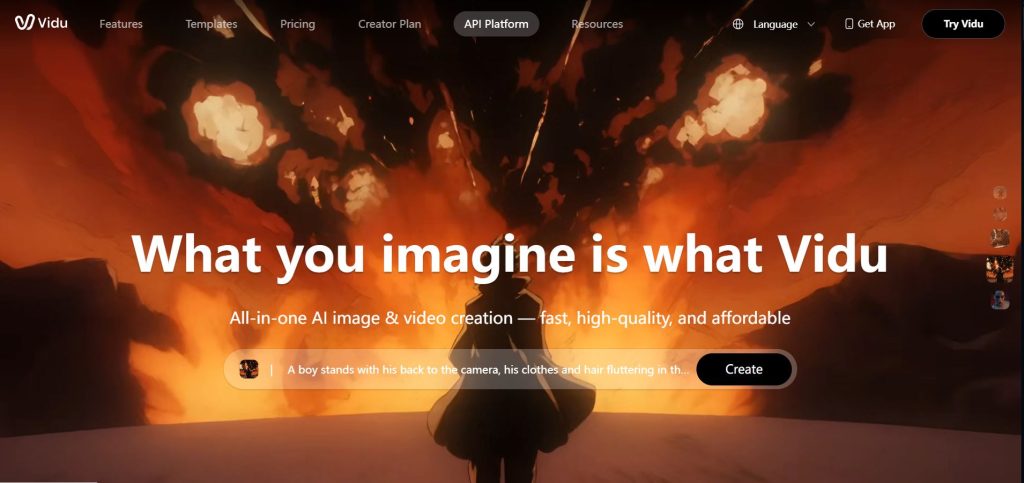
Vidu AI is specifically strong here. Creators across YouTube, TikTok, and Instagram consistently rank it as one of the best AI tools for anime-style output. The character animation feels fluid in ways most general-purpose video tools don’t match. The action sequences — fight scenes, transformations, high-energy combat — render with the kinetic intensity anime audiences expect.
That’s the opening. Anime is a category where AI video doesn’t need to fake quality. It can genuinely produce content that holds up against viewer expectations.
The Series Production Workflow
Here’s how to actually build it. Step by step, designed for a solo creator with no animation background.
Step 1: Design Your Characters (1-2 days)
Before generating any video, define your cast. Two or three recurring characters is enough for a viable series. Each character needs:
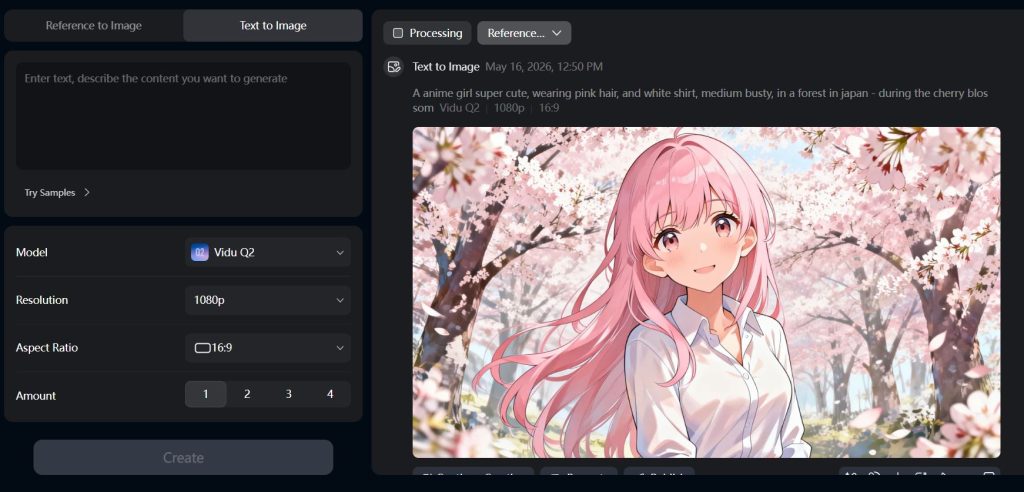
A clear visual reference (illustrated in your preferred style, or generated via Vidu’s AI Image Generator)
3-5 reference images from different angles (front, side, profile, action pose, close-up)
Distinct visual markers — hair color, outfit, accessories — that make them instantly recognizable across episodes
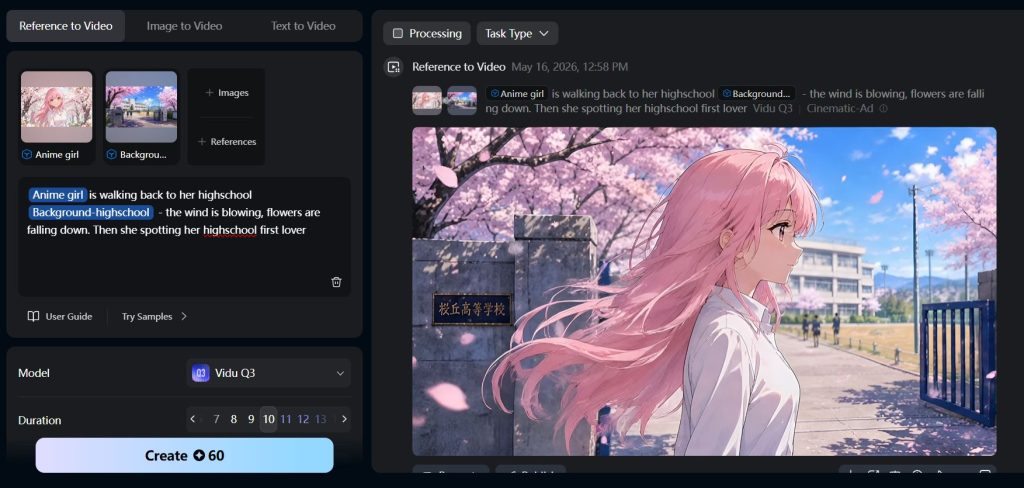
Upload these to Vidu’s My References library. This is the feature that turns episodic series production from impossible into routine. Your characters are now saved and instantly available across every future generation. No re-uploading, no drift, no “why does she look different in episode 4” problem.
Step 2: Build a Visual World (1 day)
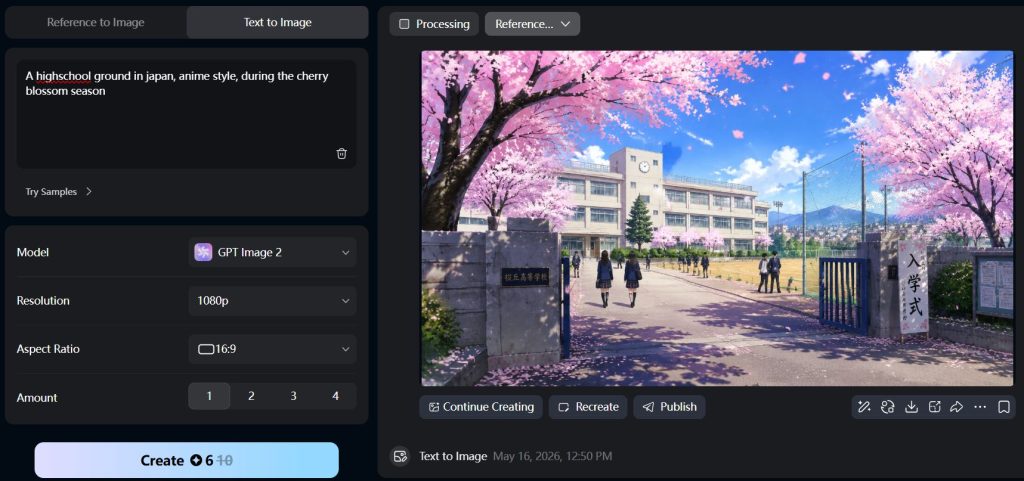
Same process for your locations and environments. Generate 5-10 reference images of the recurring settings in your series — a school, a cityscape, a battle arena, a character’s bedroom. Save them as scene references in Vidu AI’s library.
You’re not building everything at once. You’re building enough to make episode 1 visually coherent, then expanding the reference library as the series develops.
Step 3: Storyboard Each Episode (2-4 hours per episode)
Anime YouTube and TikTok works on short, complete narrative units. For short-form, that’s 60-90 seconds with a clear hook, conflict, and payoff. For long-form, 5-10 minute episodes built from stitched multi-shot sequences.
Break each episode into 8-15 shots. For each shot, write:
Which character(s) appear
Which environment
What happens — emotional beat, action, dialogue
Camera direction — close-up, wide, tracking, action shot
This is your shot list. With Vidu AI, each shot becomes one generation.
Step 4: Generate Shot by Shot (2-4 hours per episode)
Open Vidu AI’s Reference-to-Video mode. For each shot in your storyboard:
Pull in the relevant character and scene references from My References
Write a prompt describing the action, camera, and emotion
Generate
Vidu’s multi-reference consistency keeps your characters looking right across every shot. The 16-second single-pass generation on Vidu Q3 lets you produce longer continuous sequences — useful for action scenes, dialogue exchanges, or emotional beats that need to play out without cuts.
The native audio generation in Q3 is the part that changes the math on long-form anime. Dialogue, sound effects, and music all generate together in one pass. You’re not separately commissioning voice acting and sound design — it ships ready to publish.
For dialogue-heavy scenes, Vidu Q3’s multilingual support (English, Japanese, Chinese) covers most of the audiences serious anime creators care about. Multi-speaker conversations render natively without needing to splice clips together.
Step 5: Assemble and Publish (1-2 hours per episode)
Drop the generated clips into any basic editor — CapCut, Premiere, DaVinci Resolve. Add titles, transitions, and any final music layering. Export.
Total time per episode: roughly 6-10 hours for a solo creator. That’s the kind of production speed that makes a weekly series feasible without burning out.
How Anime Creators Are Monetizing in 2026
The series isn’t the product. The audience is. Here’s how anime AI creators are actually generating revenue.
YouTube Ad Revenue + Memberships
The baseline. A YouTube channel publishing 2-3 anime shorts per week, plus one long-form episode per week, can hit monetization eligibility within 90 days if the content is consistent and the character work resonates. Channels in this space report RPMs in the $3-$8 range, with the upper end driven by audiences in US/UK/Japan.
YouTube Memberships add a second revenue stream — exclusive episodes, early access, behind-the-scenes prompt breakdowns. The anime audience is unusually willing to pay for exclusive access to creators they follow.
TikTok Creator Fund + Live Gifts
Short-form anime hits the TikTok algorithm harder than almost any other AI video category. Viral clips routinely cross 1-5M views, which drives Creator Fund payouts and follower growth. Live streams featuring character lore discussions, prompt walkthroughs, or episode reveals generate gift revenue from engaged fans.
Patreon and Subscription Tiers
This is where serious anime creators build the income floor. A Patreon with 200 supporters at $5/month is $1,000/month. At 500 supporters at $7/month, you’re at $3,500/month. The anime audience supports creators because they want the series to keep going — the production model creates natural subscription stickiness.
Tier rewards typically include:
Early episode access
Exclusive side stories or character backstories
Voting on plot directions
Custom character commissions
Behind-the-scenes prompt techniques
Merchandise Drops
Character-based merchandise is the highest-margin play. Once a character builds a following, T-shirts, posters, stickers, and figurines move through print-on-demand or limited drops. The margin on a $25 character print at $4 cost is the kind of math that makes this a real business.
Sponsorships and Brand Integration
Anime creators with established audiences attract sponsorship from gaming companies, manga publishers, AI tool platforms, and lifestyle brands targeting the anime demographic. Mid-tier creators (100K-500K followers) report sponsorship rates of $1,000-$5,000 per integration.
Licensing and IP Development
The longest-term play. Original anime characters that build cultural traction become licensable IP. Independent AI anime creators are starting to negotiate licensing deals with merchandise companies, mobile games, and even traditional anime studios looking for fresh character concepts.
The Realistic Income Picture
For a solo creator publishing consistently for 12 months:
Months 1-3: Building. Channel growth, no revenue. Treat as R&D.
Months 4-6: Monetization eligible. Early Patreon supporters. $200-$1,000/month range.
Months 7-12: Compound growth. $1,500-$8,000/month range depending on niche and consistency.
Year 2+: Established creators commonly cross $10,000/month combining all revenue streams.
These aren’t guaranteed numbers. They’re the realistic range for creators who treat this as a business — consistent publishing schedule, character development, audience engagement, and proper monetization stack.
Where Vidu AI Specifically Earns Its Place in This Workflow
Where Vidu AI Specifically Earns Its Place in This Workflow
You can build an anime series with several tools. The reason Vidu AI specifically shows up in serious creators’ workflows:
My References library: Save characters once, reuse across every episode. Solves the consistency problem that kills most AI anime series.
Three creation modes in one platform: Text-to-Video for establishing shots, Image-to-Video for animating concept art, Reference-to-Video for character scenes — every shot type covered.
Anime-style rendering quality: Stylized output that holds up against what audiences expect from the genre.
High-speed action and emotion-driven close-ups: Fight scenes, transformations, and subtle character emotion all render cleanly — the moments anime audiences care about.
Frame-accurate camera control: Push-ins, tracking shots, low-angle hero frames directable through prompts. Camera language is half of what makes anime feel like anime.
Native audio in one pass (Vidu Q3): Dialogue, voiceover, sound effects, and music generated together — eliminates the voice acting and sound design bottleneck.
Multilingual dialogue (EN/JP/CN): Multi-speaker conversations for the audiences serious anime creators actually target.
In-scene text rendering: Sound effect text, title cards, dialogue captions baked into the generation — no external editor step.
16-second single-pass with ~10-second generation speed: Longer scenes play out without cuts. Weekly publishing schedules become realistic for solo creators.
Cost-effective at scale: API pricing as low as $0.015/sec makes high-volume production viable, and the free tier with unlimited off-peak generation lets you validate the workflow before paying anything.
For an anime creator deciding whether to commit, the answer isn’t whether the tools exist — they do. It’s whether you’ll start before the next wave of creators does.
Getting Started
Sign up at vidu.com, spend a weekend designing two characters and a scene, and produce a 60-second pilot. If the pilot works — if the characters feel consistent, the action lands, the audio doesn’t ruin it — you’ve validated the workflow. From there it’s a publishing cadence.
Alexi Carmichael
Business, Mentorship, and AI Verified By Expert
Alexi Carmichael is a tech writer with a special interest in AI's burgeoning role in enhancing the efficiency of American SMEs. With her know-how and experiences, she has since taken on the role of mentor for fellow entrepreneurs striving for digital optimization and transformation. With Tech Pilot, she shares her insights on navigating the complexities of AI and how to leverage its capabilities for business success.
Share This Article
JOIN OUR COMMUNITY
Receive the latest AI insights directly to your inbox.