How AI Conversation Intelligence Is Turning Every Sales Call Into a Coaching Opportunity
Most sales managers hear only a handful of the calls their reps make in any given week. The rest disappear into voicemail transcripts nobody reads and CRM notes that say little more than “good call, follow up.” Those unheard conversations are where deals get won or quietly lost, and until recently there was no practical […]
Alexi Carmichael
Business, Mentorship, and AI Verified By Expert
Published: September 16, 2026 | Updated: September 16, 2026
Most sales managers hear only a handful of the calls their reps make in any given week. The rest disappear into voicemail transcripts nobody reads and CRM notes that say little more than “good call, follow up.” Those unheard conversations are where deals get won or quietly lost, and until recently there was no practical way to listen to all of them.
That’s changing fast. AI conversation intelligence, once a niche feature bolted onto enterprise call centers, has become one of the most widely adopted AI applications in business today. It doesn’t just record calls anymore. It reads tone, flags objections, tracks talk-time ratios, and turns every conversation into a data point a manager can actually coach against.
The Sales Call Problem AI Is Solving
Manual call review was never built to scale. A sales manager with eight reps making forty calls a week each would need to listen to over 1,500 calls a month just to catch every conversation once, and that’s before accounting for meetings, forecasting, and everything else on their plate. Even the most hands-on managers join only 4 to 6 percent of their team’s calls, according to Allego’s Conversation Intelligence Guide, which means the overwhelming majority of customer conversations go completely uncoached.
There’s a second, quieter problem too: context switching. Reps spend a chunk of every day toggling between the call itself, their notes app, and the CRM, trying to capture what a prospect said while still paying attention to what they’re saying next. That’s exactly the gap tools like Cirrus Insight were built to close. As a Salesforce-native productivity layer, it sits directly inside a rep’s email and calendar workflow rather than asking them to open a separate app, so the AI assistance shows up where the rep already works instead of adding one more tab to check.
From Call Recording to Real-Time Coaching
Conversation intelligence didn’t arrive fully formed. It evolved in three fairly distinct stages. First came manual note-taking, where reps typed or scribbled whatever they could catch mid-conversation, usually missing half of it. Next came post-call AI analysis: recordings got transcribed and tagged automatically, surfacing keywords, sentiment shifts, and competitor mentions after the fact. The current stage, real-time in-call guidance, is the one reshaping how teams sell. Instead of waiting until after the call to learn a prospect raised a pricing objection, the rep sees a prompt on their screen the moment it happens.
This progression matters because it changes who benefits. Post-call analysis mostly helps managers coach retroactively. Real-time guidance helps the rep in the room, closing the gap between what a top performer would say and what a newer rep actually says under pressure. For teams building out a broader AI toolkit, it’s worth looking beyond conversation intelligence alone. We’ve rounded up the best AI tools for sales teams covering everything from prospecting to forecasting, since conversation intelligence usually works best as one piece of a connected stack rather than a standalone purchase.
The Business Case: What the Data Shows
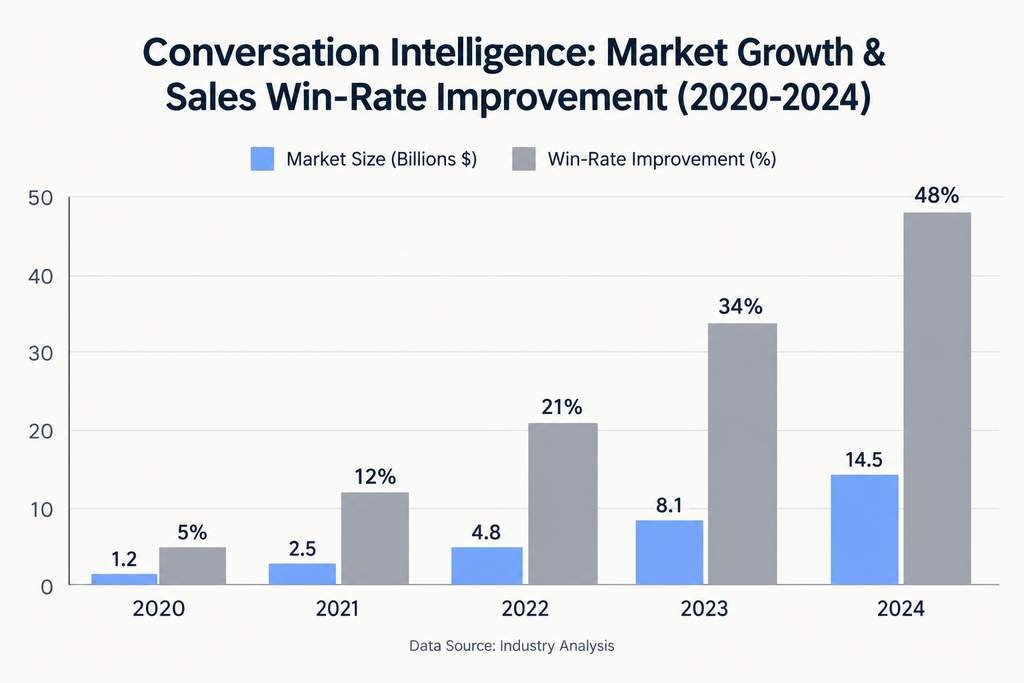
Sales organizations using conversation intelligence report significantly higher win rates than those without it.
None of this would matter if the return weren’t measurable, and increasingly it is. Grand View Research valued the conversation intelligence market at $1.6 billion in 2023 and projects it will reach $8.4 billion by 2030, a 26 percent compound annual growth rate that outpaces the broader CRM software market. That kind of growth doesn’t happen because a feature is nice to have; it happens because finance teams can trace it to results.
Gong Labs analyzed more than a million sales opportunities across 1,418 organizations and found that teams using AI-driven deal guidance based on conversation data saw 35 percent higher win rates than teams without it. That’s not a marginal edge. For a mid-sized sales org closing a few hundred deals a year, a 35 percent lift in win rate is the difference between hitting quota and missing it across an entire team. Numbers like these are why conversation intelligence has moved off the “innovative extras” list and onto the standard sales tech budget line, right next to the CRM itself.
None of this happens in a vacuum either. Better conversation coaching only pays off if the pipeline feeding those calls is healthy in the first place, which is why growing teams often pair coaching investments with dedicated AI-driven prospecting tools that keep reps talking to the right prospects to begin with.
Bringing Conversation Intelligence Into Your Sales Stack
Buying the software is the easy part. Getting real value out of it takes a bit of discipline. Start by making sure call data actually syncs into the CRM record automatically, rather than sitting in a separate dashboard nobody checks. Build a shared library of your top performers’ best calls so newer reps have real examples to study instead of generic training scripts. Set clear rules up front about what gets recorded, who can access it, and how it’s used in performance reviews, since skipping this step is the fastest way to make a team distrust the tool. Finally, measure ramp time and win rate before and after rollout so you know whether the investment is actually paying off rather than just assuming it is.
This is precisely where a dedicated capability like Cirrus Insight’s Conversation Intelligence Software fits into the picture: it’s built to plug into that existing CRM-embedded workflow rather than force a rep to learn a new platform on top of everything else, so coaching becomes part of the daily routine instead of a separate initiative.
Conclusion
Conversation intelligence isn’t a novelty feature anymore. It’s becoming core infrastructure for revenue teams the same way the CRM did two decades ago, and the tools that win adoption are the ones that fit naturally into a rep’s existing email and CRM habits rather than demanding a whole new workflow. Managers still can’t listen to every call themselves, but they no longer have to. The calls are being heard, tagged, and turned into coaching material automatically, and that shift alone is changing how fast newer reps ramp to full productivity. Real-time in-call guidance is quickly becoming table stakes rather than a competitive edge, so teams still relying on quarterly call reviews are the ones most likely to fall behind in the next year or two.
Alexi Carmichael
Business, Mentorship, and AI Verified By Expert
Alexi Carmichael is a tech writer with a special interest in AI's burgeoning role in enhancing the efficiency of American SMEs. With her know-how and experiences, she has since taken on the role of mentor for fellow entrepreneurs striving for digital optimization and transformation. With Tech Pilot, she shares her insights on navigating the complexities of AI and how to leverage its capabilities for business success.
Share This Article
JOIN OUR COMMUNITY
Receive the latest AI insights directly to your inbox.