Best Vibe Coding Tool for Non Technical Founders: 6 Ranked on Login and Billing
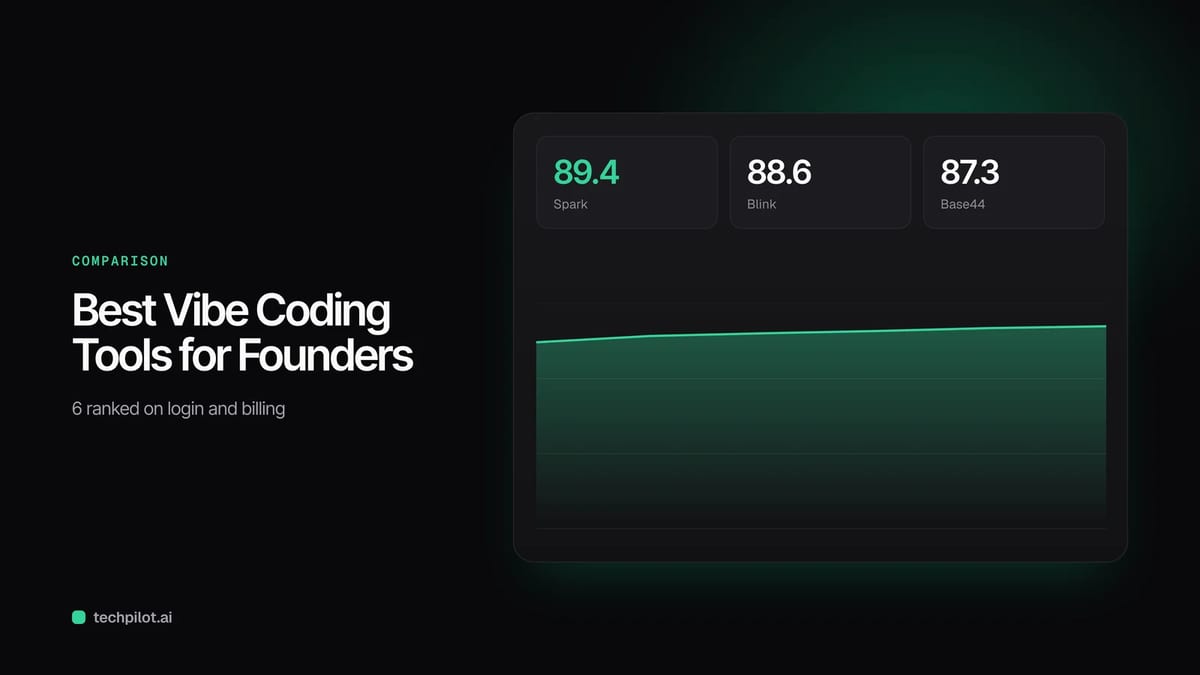
We ranked six vibe-coding tools for non-technical founders on login and Stripe billing. Spark leads, then Blink, Base44, Lovable, Emergent, and Replit.
 Eimantas Kazėnas Marketing & Tech
- Published
- 8 min read
On this page The six best vibe-coding tools at a glance
- The six best vibe-coding tools at a glance
- Why login and billing, not design, decide whether your AI-built app becomes a business.
- How we ranked the tools
- 1. Spark: best overall for going from idea to a paying customer
- 2. Blink: best for founders who plan web and mobile apps on one credit plan
- 3. Base44: best for founders who want auth and payments built in
- 4. Lovable: best for polished apps and code the founder owns
- 5. Emergent: best for building web and mobile apps side by side
- 6. Replit: best for founders who expect engineers to join later
- Conclusion
Independent and reader-supported. Some links may earn us a commission; it never changes our rankings. Editorial policy
Our desk research points to Spark when speed to your first dollar matters most. We ran six leading AI app builders through a “login-to-revenue” test (secure sign-in, Stripe billing depth, and time to a paid user), and the scoreboard landed:
- Spark
- Blink
- Base44
- Lovable
- Emergent
- Replit
The sections below unpack those scores so you can match the right platform to your idea, budget, and growth plan.
The six best vibe-coding tools at a glance
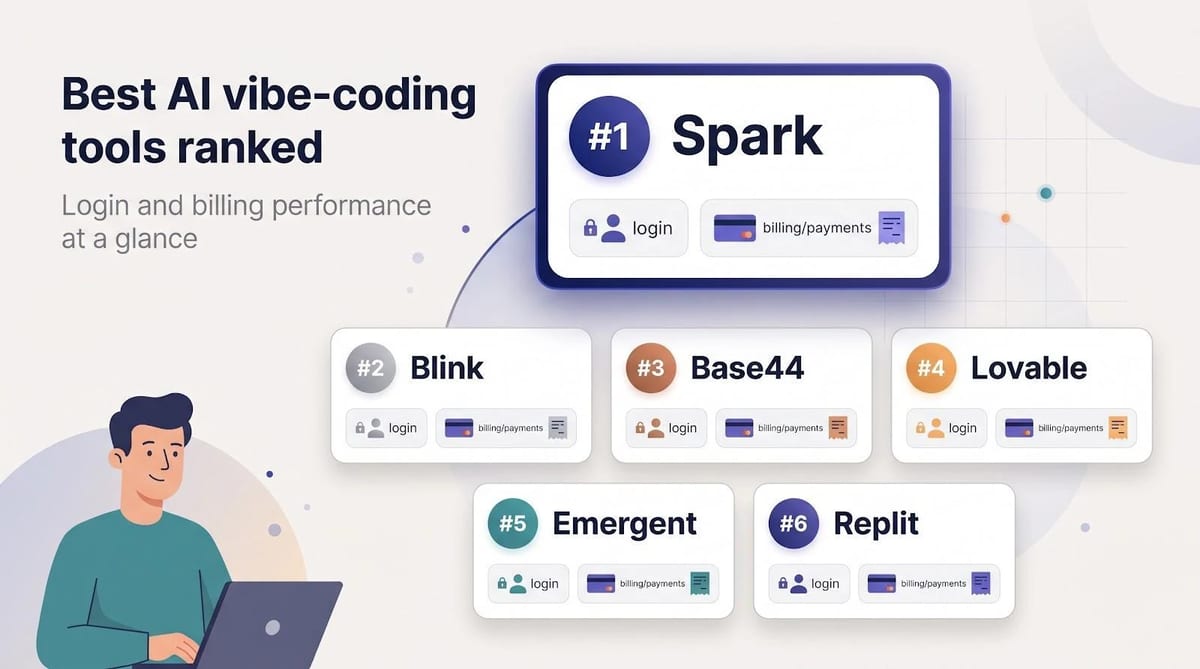
Sometimes a table tells the story faster. Here’s how the six platforms compare on the essentials: login style, billing depth, realistic entry price, and our weighted score (criteria: auth 18 percent, billing 22 percent, linkage 12 percent, launch speed 15 percent, founder bundle 10 percent, security 10 percent, price 8 percent, portability 5 percent; prices and features checked on November 7, 2026).
| Rank | Tool | Best for | Auth style | Billing depth | First paid tier | Score |
|---|---|---|---|---|---|---|
| 1 | Spark | Fastest path from idea to income | Email codes | Stripe one-off + subscriptions | Starter $25 per month + 10 percent fee | 89.4 |
| 2 | Blink | Automated Stripe lifecycle, no platform cut | Email/password + social | Stripe products, webhooks, portal | Pro $50 per month (or $25 per month on annual) | 88.6 |
| 3 | Base44 | Published security page and trust center | Email/password + MFA + social | Base44 Payments or Stripe | Builder $40 per month (annual) | 87.3 |
| 4 | Lovable | Polished UI, clean developer hand-off | Broad social + SAML/OIDC | Stripe or Paddle, code export | Pro $25 per month | 86.3 |
| 5 | Emergent | Managed Stripe sandbox + mobile breadth | Email/password + Google | Stripe sandbox, RevenueCat | Standard $20 per month ($17 per month on annual) | 85.1 |
| 6 | Replit | Technical runway for future growth | Clerk tenant + SSO | Stripe payments or storefront, RevenueCat | Core $20 per month | 82.3 |
Not sure which lane fits you?
- Want the fewest moving parts? Spark
- Refuse to share revenue? Blink
- Expect compliance questionnaires? Base44, Replit
- Care most about design and later hand-off? Lovable, Replit
- Need native mobile soon? Blink, Emergent
- Selling a simple membership or class? Spark
Why login and billing, not design, decide whether your AI-built app becomes a business.
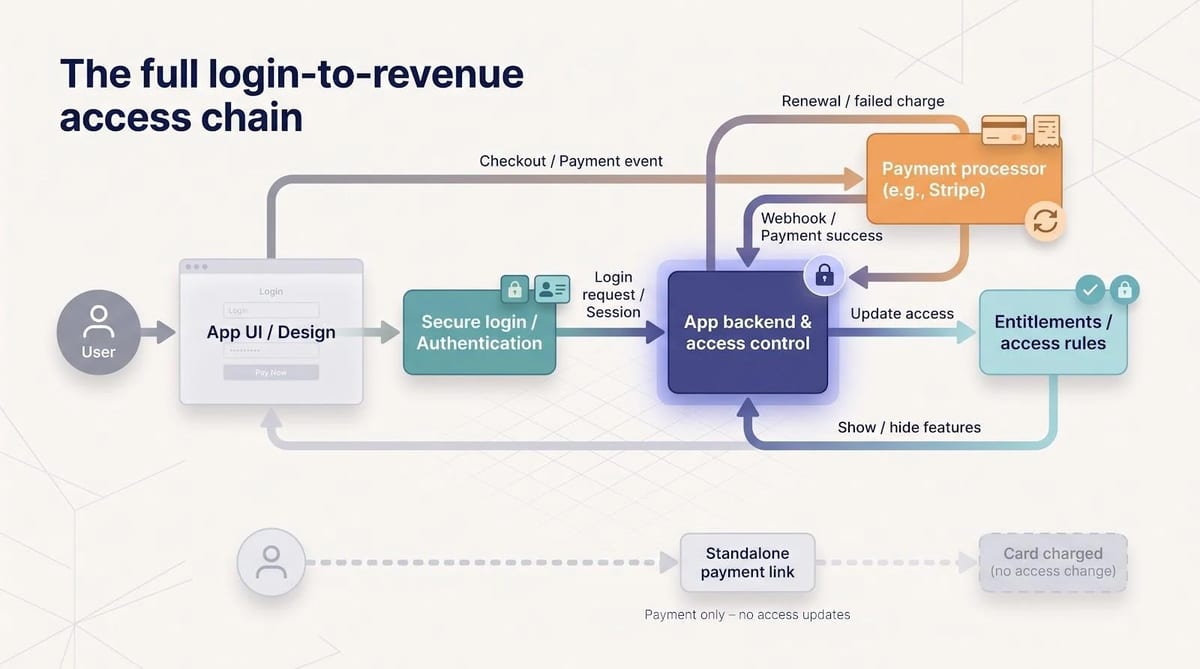
Getting paid hinges on two back-end facts, not front-end pixels:
- Can a user sign in securely?
- Does the app keep their access in sync with Stripe after every charge, renewal, or refund?
Authentication answers who the visitor is. Business value appears only when the server also controls what that person may do, which is authorization. The OWASP Authorization Cheat Sheet advises validating permissions on every request and running those checks on the server, not in the browser.
A working setup ties three pieces together: Stripe checkout, signed webhooks, and user-access toggles. A bare Stripe Payment Link covers just one of them: collecting the card.
Founders often stumble here. A 2024 RAND Corporation report on why AI projects fail cites estimates that more than 80 percent of them do, about twice the failure rate of IT projects without AI. With AI app builders, the security-billing chain is where many founder projects stall.
Our ranking rewards any platform that bakes in the full chain (secure login, real Stripe objects, automatic entitlement updates, and hands-off renewal handling) so you can sleep through a failed charge.
Focus on that chain and treat design as finishing trim, not the foundation.
How we ranked the tools
We asked one question first: Can a first-time founder go from sign-up to a stable, paid product without a developer?
Only platforms that met all four baseline tests made the scorecard dated November 7, 2026.
- Ship a deployable web or mobile app, not just code snippets.
- Switch on customer login with no scripts.
- Take real one-off or recurring payments with published docs.
- Be live, priced, and documented on November 7, 2026.
Anything that failed (or folded, like Mocha) stayed out.
Eligible tools then earned points across eight weighted criteria:
Authentication out of the box (18 percent) • billing completeness (22 percent) • payment-to-access linkage (12 percent) • time to first paid deployment (15 percent) • founder-ops bundle (10 percent) • security evidence (10 percent) • pricing transparency (8 percent) • portability/support depth (5 percent).
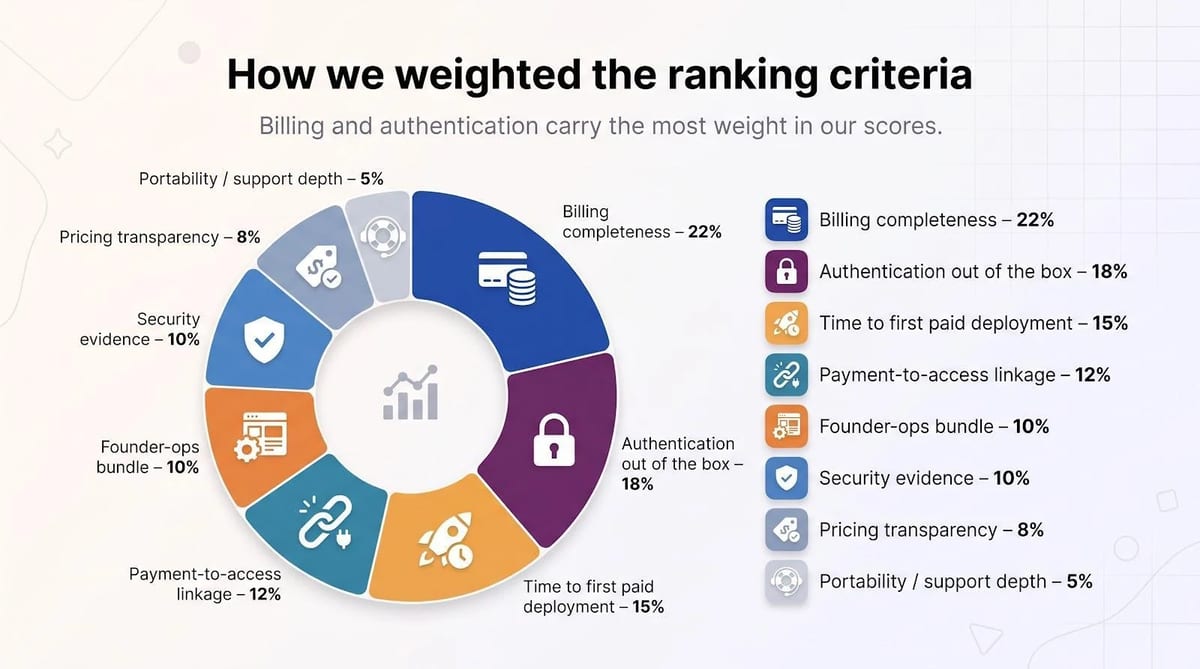
Each column scores out of ten; the weighted total decides rank. A flashy UI cannot hide missing webhook signatures or undocumented cancellations; the math drops the score.
Finally, we pressure-tested the numbers against real founder headaches such as migration cost, hidden platform fees, and compliance hurdles. That’s why Spark tops the speed column yet trails Blink on billing depth, and why Base44 edges Lovable when security questionnaires loom.
1. Spark: best overall for going from idea to a paying customer
Spark, built by Plus Docs, Inc., makes one promise: wake up with an idea, go to bed with your first Stripe receipt. It bundles hosting, email-code login, and checkout so a non-technical founder can publish and charge in hours, not weeks.
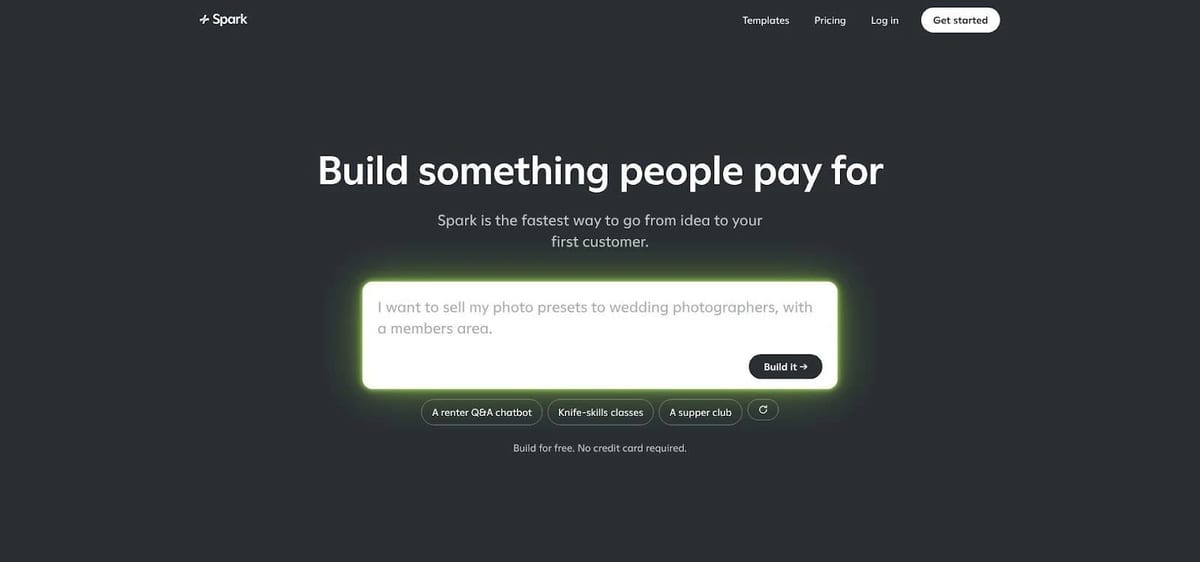
Overview
Describe your business, and Spark spins up a site, SSL, branded email domain, and a ready-to-share checkout. The platform stays commerce-first: memberships, courses, and digital downloads sit at the center.
Stand-out features
- Toggle-on customer accounts with password-less email codes
- Automatic product, price, and hosted checkout inside your own Stripe account
- Built-in CRM notes and broadcast email (sent only to signed-in customers) so founders work from one dashboard
- Domain connection, SSL, and hosting handled behind the scenes
Login and billing flow
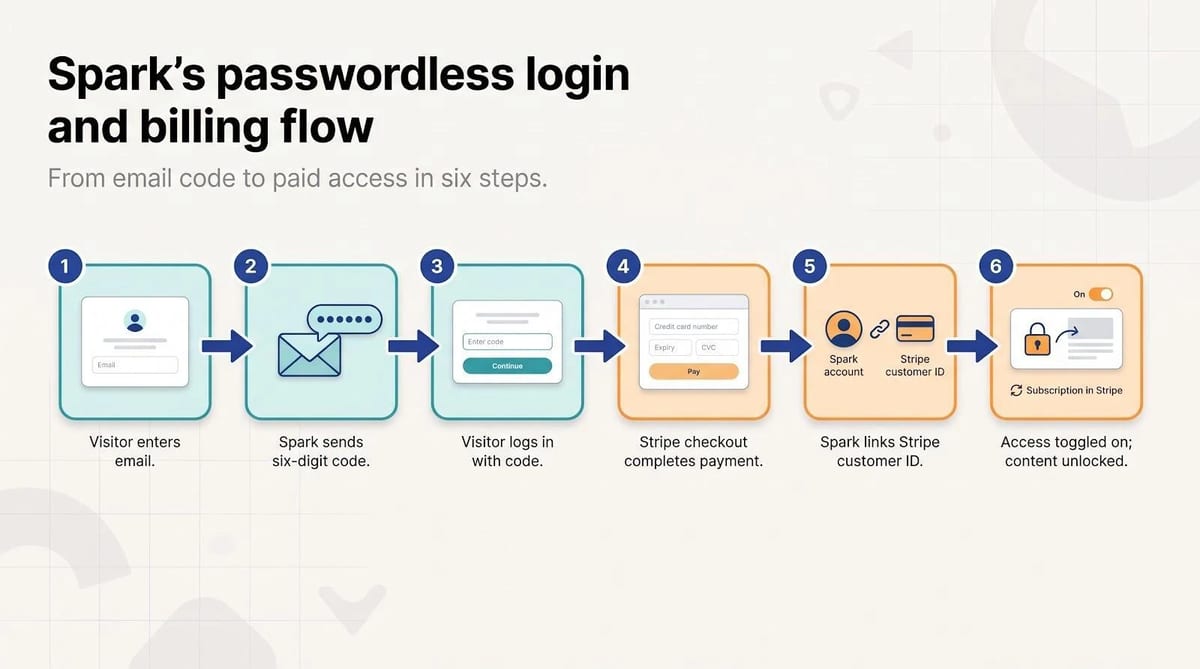
Customers sign in to their accounts with email codes. When a purchase goes through, the customer gets the access you set for it under Features in your project’s Payments section. Payments, refunds, and payouts are managed in your own Stripe dashboard.
If your Spark plan ends, your site stays published but payments are disabled, and customer subscriptions pause while customers keep access; starting a paid plan again turns payments back on.
Real-world uses
Pretty Postcard sells $5 digital postcards. FatFIRE Math locks a $399 per year membership behind Spark’s email-code login. SeattleCrime maps public data while reserving premium layers for supporters, all without custom code.
Pricing (checked November 7, 2026)
- Free tier: design and preview only
- Starter: $25 per month + 10 percent platform fee
- Pro: $200 per month + 5 percent fee
Stripe still charges its own processing fees on each payment. The plans cross at about $3,500 in monthly gross sales: below that, Starter costs less; above it, Pro keeps more margin.
Pros
- Fastest path to first dollar
- One dashboard for login, billing, and light CRM
- One Stripe connection shared across your projects
Cons
- Revenue share rises with growth
- No code export or self-hosting
- Shipping is US-only, and checkout doesn’t add sales tax
Best for: Coaches, paid newsletters, and simple memberships that favor speed over deep customization.
Focus on the product, not the plumbing. Choose Spark if you need to sell classes, memberships, or digital goods this week and can live with the fee curve. Need zero platform cut or deeper webhook control? Blink, ranked second, is the better fit.
2. Blink: best for founders who plan web and mobile apps on one credit plan
Blink builds web apps, websites, and native iOS and Android apps from a prompt. Every plan includes a database, sign-in, and a live web address with SSL, and its founder page pitches a SaaS “with billing on day one.” Blink charges for build credits, not seats, so members are unlimited on every plan.
- Starter: $25 per month ($13 per month on annual), production hosting, custom domains, code download
- Pro: $50 per month ($25 per month on annual), 200 credits plus 5 a day, in-app code editing, backend jobs, Git on your own GitHub repo
- Max: from $200 per month, adds App Store and Google Play publishing
Production hosting is paid from credits. Blink fits founders who want web now and mobile later.
3. Base44: best for founders who want auth and payments built in
Base44 describes itself as a no-code AI platform that builds “frontend, backend, database, user auth, payments, all of it” from a plain-language description. Every plan includes authentication and user management, and the company publishes a security page and trust center for founders facing security questionnaires.
- Free: up to 5 apps, 25 message credits per month
- Starter: $16 per month, billed annually
- Builder: $40 per month, billed annually, 250 message credits, GitHub integration, in-app code edits
Plans are metered by message and integration credits, so heavy AI use moves a founder up a tier.
4. Lovable: best for polished apps and code the founder owns
Lovable calls itself an AI software engineer that builds websites and web apps through chat. Its pricing page lists “Add authentication with sign up and login” as a single prompt costing about 1.2 credits. Lovable states that users own their code, apps, and customer data, which matters when a developer takes over later.
- Free: 5 build credits a day, up to 30 a month
- Pro: $25 per month, 100 credits, custom domains, user roles and permissions
- Business: $50 per month, adds SSO and a security center
Hosting is covered by an included grant for most small apps. For payments, Lovable’s built-in option provisions a Stripe or Paddle account on a paid plan, or you can connect a Stripe account you own, which also works on the Free plan.
5. Emergent: best for building web and mobile apps side by side
Emergent builds web and mobile apps from a prompt and includes one-click LLM integration on every plan, Free included.
- Free: 10 credits per month
- Standard: $20 per month ($17 per month on annual), 100 credits, private project hosting, GitHub integration
- Pro: $200 per month ($167 per month on annual), 750 credits, 1M context window, custom AI agents
Single sign-on and role-based access sit on the custom-priced Business plan. Emergent suits founders who want web and mobile from one tool.
6. Replit: best for founders who expect engineers to join later
Replit pairs its AI Agent with a full development environment, which gives an app the most technical room to grow. Replit notes that its Agent “may occasionally make mistakes,” so review what it builds.
- Core: $20 per month ($18 per month on annual), $20 of usage toward more powerful models
- Pro: $100 per month ($90 per month on annual), up to 15 collaborators, database rollback up to 28 days
- Enterprise: custom pricing with SSO, SCIM, and audit logs
Usage beyond the included amount is billed on effort-based, pay-as-you-go pricing, so costs scale with how much the Agent builds.
Conclusion
For a non-technical founder, the right builder is the one that gets a paying customer through sign-in, checkout, and access without a developer. Spark does that fastest, which is why it ranks first, and the trade-off is a platform fee that grows with revenue. Blink suits founders who want no revenue share and more Stripe control, Base44 fits teams that expect security questionnaires, and Lovable or Replit make sense when a developer will take over the code later. Match the tool to your first offer and your next year of growth, and recheck pricing before you commit, because plans in this category change often.
Found this useful? Share it with someone comparing AI tools.