Best AI Roleplay for Sci-Fi: 6 Apps That Won’t Forget Your Ship’s Name by Chapter 3
Ever spent hours crafting a star-cruiser—only to have your AI sidekick call it "the vessel" five scenes later? We have too. That's why we selected the best AI roleplay for sci-fi!
Alexi Carmichael
Business, Mentorship, and AI Verified By Expert
Published: August 19, 2026 | Updated: August 19, 2026
Ever spent hours crafting a star-cruiser—only to have your AI sidekick call it “the vessel” five scenes later? We have too. Today’s strongest storytelling models now track sprawling lore, juggle multiple characters, and keep every warp-drive quirk straight.
In this guide, we rank six standout platforms built—or hacked—for science-fiction adventures. We tested the best AI Roleplay platforms for their memories, probed their content controls, and compared their free tiers so you can pick the right copilot—whether you want a one-click chat app or a DIY local model with no limits.
Ready to plot a galaxy that sticks? Here’s where to start.
How We Picked the Six Standout Tools
Choosing an AI sidekick for your space saga is like selecting a crew member: skill, reliability, and cost all matter. We ran more than a dozen contenders through the same stress test and graded them against specific sci-fi needs.
We started with memory. Long-form adventures fall apart if the model forgets the captain’s name halfway to Andromeda, so we pushed each platform past 40 turns and checked how many core facts survived.
Next came world-building muscle. We looked for built-in lorebooks, codices, or other ways to lock in alien cultures, starship specs, and invented tech jargon. If a tool forced you to re-explain basics every scene, it slid down the list.
Creative freedom was our third yardstick. Some services interrupt every blast and blush; others hand you the keys. We noted how often content controls cut the narrative and whether users could adjust tone for darker themes.
Model quality still counts. Bigger or better-trained brains usually write sharper prose, so we logged each platform’s top context size, supported model families, and any style controls like temperature or genre presets.
Accessibility rounded out the scorecard. A generous free tier, a friendly interface, or a mobile app can tip the scales for students on a budget, while pricey plans with thin trials hurt otherwise capable tools.
We also gave bonus credit for features that make sci-fi shine, such as multi-character chat, dice rolls, image generation, or multiplayer campaigns.
Add those numbers together, and a clear top six emerged. The next sections break them down, one warp-drive at a time.
1. DreamGen: Your Galaxy-Building Powerhouse
As an independently operated platform with no external funding, DreamGen earns the captain’s chair for one clear reason: it stays on course. With more than 1 million registered users and 5,000+ Discord members, it has built a large community by remembering ship names, side quests, and relationship arcs after forty consecutive turns without a single hiccup. That long-haul memory keeps multi-chapter sagas feeling smooth rather than stitched together.
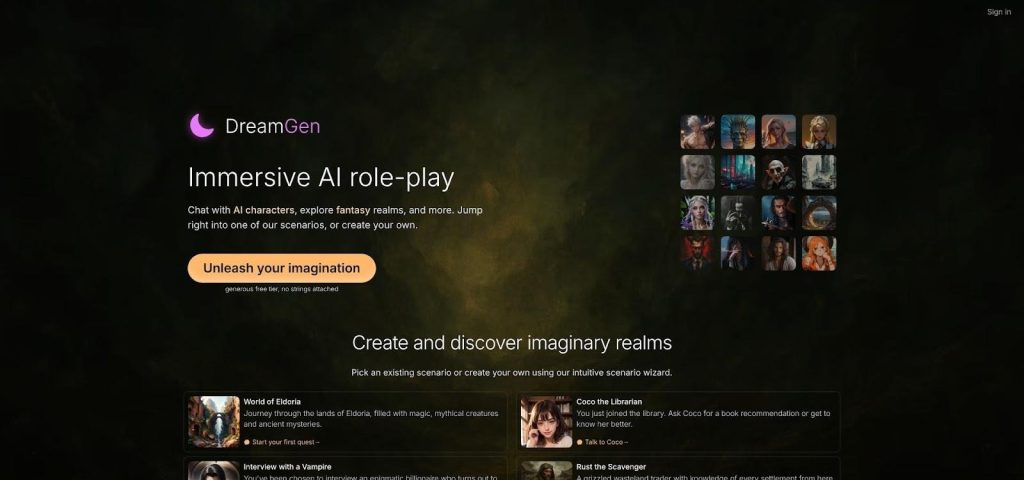
DreamGen AI roleplay chat interface and Scenario Codex screenshot
Jump in and you’ll see a clean chat window plus two standout features. The Scenario Codex is a wiki-style drawer where you can store everything from plasma-rifle specs to the precise shade of a planet’s twin suns. First-time creators can also spin up an entire world in seconds thanks to the DreamGen scenario wizard, an optional setup flow that turns your one-line prompt into a full setting, complete with factions, plot hooks, and starter dialogue before your coffee cools.
DreamGen also allows multiple AI characters to speak at once. Need the ship’s doctor, a stubborn alien diplomat, and your snarky onboard computer in the same scene? Open a group chat and watch them riff while a narrator ties it together. Few rivals even attempt this, and none match the fluid back-and-forth we saw.
Creative freedom stands out as well. DreamGen hosts its own first-party models such as GLM 4.7 (the flagship) and Lucid Max, and it offers optional third-party engines like DeepSeek 3.2. The result is a broad storytelling range: public scenarios stay family-friendly, while private scenarios can explore tough moral choices, darker battles, or mature themes.
Cost will not ground new pilots. The free tier provides a 5,000-token context window, roughly 2,000 role-play messages each month on Lucid Base (with about 250 daily messages once credits run out), and around 150 images per month. The Pro tier grants unlimited first-party models, raises context limits to 30,000 tokens on GLM 4.7, and includes a 60 percent discount on third-party models plus a 20 percent credit-pack discount.
Drawbacks? There is no dedicated mobile app, though the site is mobile-friendly, and the public scenario library is smaller than Character.AI’s sea of fan bots. Still, if your priority is a consistent, flexible story engine that treats lore as law, DreamGen is the clear flagship.
2. NovelAI: The Co-Author That Sweats Every Sentence
If you treat world-building like a thesis and agonize over cadence, NovelAI feels less like software and more like a silent writing partner. Its newest 70-billion-parameter model stretches active context to roughly 28,000 tokens, enough to keep an entire novella’s groundwork in view while you draft new chapters.
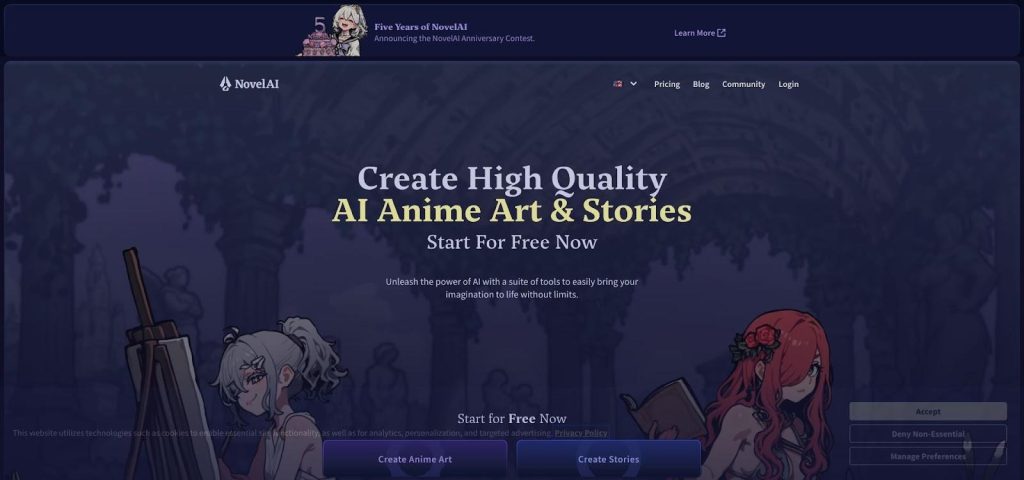
NovelAI writing editor and Lorebook panel screenshot for sci-fi authors
That headroom pairs with a detailed Lorebook. Drop in ship schematics, alien linguistics, or a two-page treaty, then lock each entry with a token budget so the AI references it without flooding the scene. You get the precision of hand-tooled notes with the spontaneity of a large language model.
Prose quality stands out. Because NovelAI is fine-tuned on published fiction, dialog reads snappy, descriptions land vivid, and tone stays consistent across rewrites. Tweak slider presets for noir grit or hopeful space opera, and the engine responds in seconds.
Privacy also matters here. Stories and images live in your vault, not a public feed, and NovelAI states it doesn’t retrain on user data. That makes it a safe lab for authors eyeing commercial publication.
Downsides? There’s no enduring free tier. After a brief trial you’ll need a subscription. While you can role-play through dialog, NovelAI is essentially a solo text editor. It won’t juggle multiple AI crewmates or roll dice for a boarding action. Think of it as Scrivener with a thinking cursor, not a game table.
Still, for writers who want master-level prose and ironclad lore control, NovelAI is hard to beat. It remembers your universe because you’ve literally built it into its memory.
3. Character.AI: Endless Personas, PG-13 Rails
Character.AI is the bustling spaceport of role-play. Millions of user-made bots greet you when you dock, from a wise-cracking android mechanic to a spot-on Darth Vader. Pick one and you’re chatting in seconds; swipe alternate replies if the first answer misses the mark.
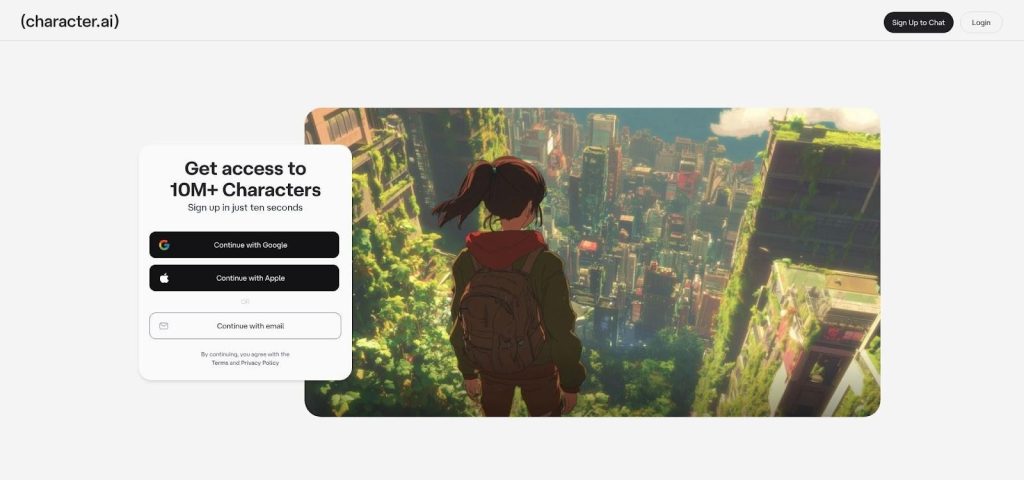
Character.AI sci-fi roleplay chat and character selection screenshot
Speed and variety headline the appeal, yet short-term memory holds up too. The system trims older messages and feeds the AI a rolling summary, so a 60-turn scene stays coherent without manual recap. For one-shot adventures or classroom demos, that’s usually enough.
Moderation is the trade-off. In late 2025 the company barred users under eighteen from open-ended chats and tightened its content controls after legal scrutiny. Graphic violence, explicit romance, or morally grey plots prompt refusals. Perfect for PG-friendly sci-fi; less helpful if your tale runs dark.
Character.AI also limits you to one persona per chat. Want your captain, first officer, and chatty ship AI riffing together? You’ll juggle multiple tabs or set up work-arounds. And without a lorebook, technical jargon and alien names may drift once a conversation grows long.
Even so, the platform is free, mobile-ready, and plain fun. Use it for brainstorming, a quick role-play fix, or a low-stakes test bed before moving to a heavier tool.
4. Deep Realms: World-Lore First, Controls Last
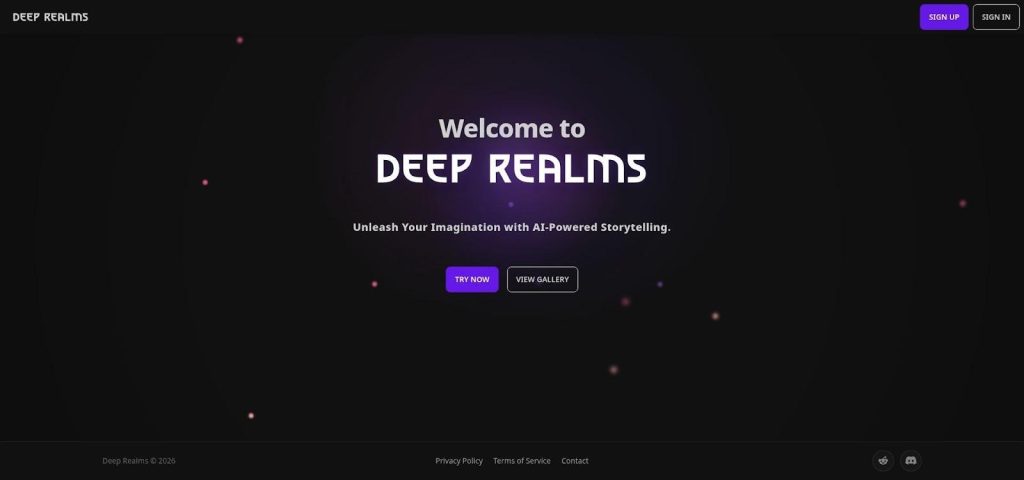
Deep Realms feels like a blank canvas that already has the grid drawn. You start by creating a “World” shell, then drop lore entries—planets, factions, faster-than-light rules—into tidy side panels. Each note sits just outside the live story, ready for retrieval when the plot brushes against it. The AI remembers wormhole physics without forcing you to restate the equation every twenty lines.
Deep Realms AI world and lore editor interface screenshot
Flip the mature-content toggle and the canvas widens. Because Deep Realms leans on open-weight models plus its own fine-tunes, mature or darker sci-fi themes flow uninterrupted. No surprise content blocks, no cryptic refusals; you control tone and boundaries.
Quality holds up thanks to solid underlying models (GPT-grade for paid tiers, lighter engines for the free plan). Dialogue feels natural, and the engine rarely slips out of voice as long as your lore angles are clear. There is even a choose-your-own-adventure mode if you crave branching options instead of pure improv.
Trade-offs exist. The community is young, so prefab worlds are scarce, and the browser-only interface lacks Character.AI’s mobile polish. Long-term viability will hinge on how the team balances API costs with its generous free tier. Still, if you want to architect a galaxy once and watch the AI respect every detail, Deep Realms is a promising frontier.
5. Friends & Fables: When You Want Dice With Your Diplomacy
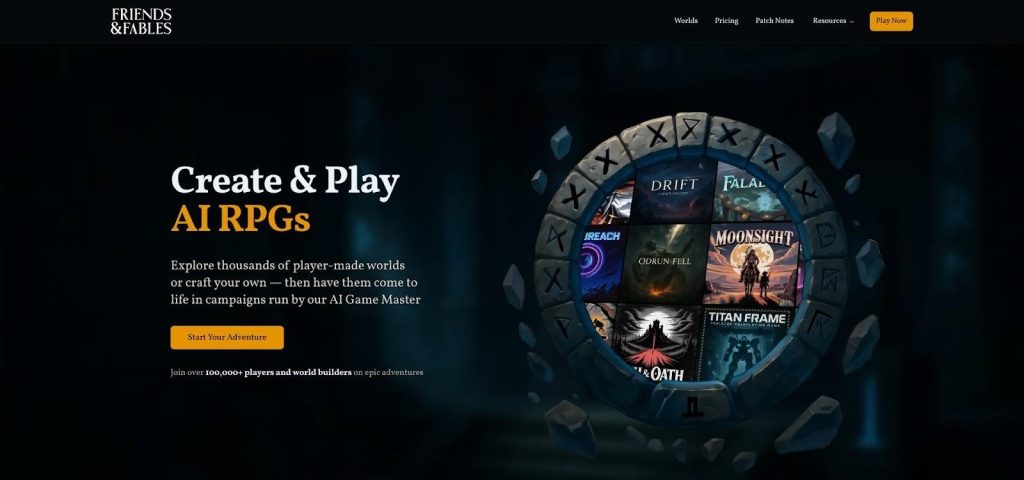
Most AI story tools feel like improv theatre; Friends & Fables feels like game night. Start a session and the platform assigns an AI gamemaster who tracks stats, rolls virtual dice, and nudges the plot with classic tabletop logic. Every risky EVA, negotiation with insectoid royalty, or over-charged plasma cannon shot gains clear stakes you can quantify.
Friends & Fables AI gamemaster tabletop RPG session screenshot
That structure is the main draw. Character sheets sit in a side panel, hit points tick down when blaster fire lands, and the quest log updates the moment you accept a salvage contract. Because rules and state live outside the language model, continuity survives context churn; damaged thrusters stay damaged until you find parts.
Multiplayer is the other hook. Invite a few friends, pick roles on the same starship, and let the AI referee turns so no one argues over initiative. It feels like having a reliable dungeon master who never cancels.
The trade-offs echo traditional RPGs. The turn-based flow can slow pure narrative momentum, and complex maneuvers sometimes require rule-book syntax (“/roll piloting vs DC 15”). Sci-fi modules exist, but you may spend an evening tweaking homebrew stats to match your universe.
Pricing lands in the middle ground: a free tier for one-shots, subscriptions for unlimited campaigns, and optional module purchases. If dice excite you as much as dialogue, Friends & Fables bridges chatbots and tabletop.
6. KoboldAI + SillyTavern: Total Control, Zero Hand-Holding
Sometimes you don’t want an app. You want a lab. KoboldAI supplies the back-end server, SillyTavern provides a friendly chat UI, and together they turn your own PC (or a rented cloud GPU) into a private story forge.
SillyTavern and KoboldAI local AI roleplay interface screenshot
Because you choose the model, every dial is yours. Load a 70-billion-parameter Llama variant for grand space opera, or a lightweight Pygmalion fine-tune for quick banter. Tweak temperature, repetition penalties, or add community memory scripts that pin key facts beyond normal context windows. No other option offers this level of control.
Freedom extends to content. With no platform moderation watching over your shoulder, you set the boundaries. That choice empowers writers tackling mature, horror, or ethically messy themes mainstream tools often block. Remember, you’re also the safety team.
The price of freedom is complexity. First-time setup means downloading large model files, installing Python dependencies, and possibly paying cloud fees if your laptop can’t handle heavyweight models. Expect occasional troubleshooting for model mismatches, GPU memory errors, or slow response times on smaller hardware.
UX is serviceable rather than sleek. SillyTavern mimics Character.AI’s paneled layout (character cards, swipeable alt replies, markdown styling), yet you’ll still edit JSON or hop into Discord to fetch plugins for voice or image generation.
If you enjoy tinkering, this stack future-proofs your storytelling. New open-source models drop weekly, and you can swap them in minutes. For everyone else, the steep launch checklist makes hosted platforms the quicker route to deep-space drama.
Quick Comparison at a Glance
Need the TL;DR? The table below lines up the essentials—memory limits, multi-character chops, content policy, and cost—so you can match tonight’s flight plan.
#
Platform
Free tier
Max active memory
Multi-character
Content policy
Stand-out perk
1
DreamGen
~2,000 msgs/mo + daily refill
5k free / 30k Pro
Yes (group chat)
Family-friendly public / mature themes private
Scenario Codex + Wizard
2
NovelAI
Trial only
~28k tokens
Narrative only
Permissive but private
Lorebook + author-grade prose
3
Character.AI
Unlimited chat
~8k-token rolling summary
One bot per chat
Strict PG-13
Huge public character library
4
Deep Realms
Limited daily runs
4k–8k tokens
Single POV
User-controlled mature-content toggle
World/Lore split for consistency
5
Friends & Fables
Intro missions
Rule-based game state
Yes (human co-op)
Moderate (OpenAI rules)
Built-in dice and quest logs
6
KoboldAI + SillyTavern
Free software
Model-dependent (4k–100k)
Via prompts
No platform moderation
Full model and privacy control
Conclusion
AI role-play is no longer a party trick. With the right tool, you can spin up a persistent crew, chart a multi-season arc, and finish the journey without losing a single line of lore.
Pick DreamGen if you crave multi-character chatter and ironclad memory. Reach for NovelAI when polished prose and detailed lorebooks matter more than game mechanics. Let Character.AI scratch the casual, PG-friendly itch, or head to Deep Realms when you want mature storytelling inside a structured world hub. Friends & Fables bridges chatbots and tabletop, while KoboldAI + SillyTavern hands you the keys to the engine room.
Each platform excels at a different slice of science-fiction play. Try the free tiers, stress-test their memories, and see which interface feels like home. One thing is clear: the days of your ship’s name vanishing by chapter three are behind us.
Alexi Carmichael
Business, Mentorship, and AI Verified By Expert
Alexi Carmichael is a tech writer with a special interest in AI's burgeoning role in enhancing the efficiency of American SMEs. With her know-how and experiences, she has since taken on the role of mentor for fellow entrepreneurs striving for digital optimization and transformation. With Tech Pilot, she shares her insights on navigating the complexities of AI and how to leverage its capabilities for business success.
Share This Article
JOIN OUR COMMUNITY
Receive the latest AI insights directly to your inbox.