Test an AI agent on one task first: what a small pilot should prove
Test an AI agent on one task before you scale. Learn to pick a safe task, set pass marks, run a four-week pilot and decide whether to go, narrow or stop.
 Alexander Rocket AI agents & software development
- Published
- 5 min read
On this page A demo proves very little
Independent and reader-supported. Some links may earn us a commission; it never changes our rankings. Editorial policy
Stanford’s 2026 AI Index reports that agents went from about 12% to 66.3% on OSWorld, a test of computer tasks, during 2025. The same report says they still fail roughly one attempt in three on structured benchmarks. The Remote Labor Index, published in October 2025, used real freelance projects, and the best agent reached an automation rate of 2.5%. Salesforce researchers measured about 58% success on CRM tasks done in one turn, dropping to about 35% when the task took several turns.
None of those numbers is yours. Your task, your data and what a mistake costs you decide that, and models keep changing anyway. A small pilot is the cheap way to find out.
It also guards against a common ending. Gartner expects more than 40% of agentic AI projects to be canceled by the end of 2027 because of rising costs and unclear business value, Reuters reported. A good pilot puts a number on both before you commit to more.
A demo proves very little
A demo shows that an agent can do a task once, on a good example, with someone steering. A pilot has a harder question to answer: can we trust this with real work, at what cost, and who checks it?
Pick a task that can fail safely
Look for a job like this:
- It repeats every week and eats real hours.
- You could explain the steps to a new hire.
- You have past cases with known right answers.
- A person can check the result faster than doing the work.
- A wrong answer can be caught before it reaches a customer or the books.
Sorting support requests, scoring leads and categorizing bank transactions all fit. Promising refunds to customers with nobody watching doesn’t.
A bookkeeping product my team built works this way. AI suggests a category for each bank transaction, with how sure it is and a one-line reason. A bookkeeper approves it. The next charge from the same merchant is sorted from memory, with no AI call. A bad guess gets caught at review, and the number of AI calls falls over time.
Write the pass mark before anyone builds
Agree on this on paper first. Honesty gets harder once a team has spent weeks on something it wants to work.
| What to measure | How to measure it | Example pass mark |
|---|---|---|
| Right answers | Run past cases and compare with the known answer | 90 right out of 100 |
| Serious mistakes | Define “serious” first, then count them on their own | None reach a customer |
| Review time | Time a person checking against a person doing the job | Checking takes half as long |
| Cost per task | AI usage, tools and the reviewer’s time | Less than the job costs today |
| Odd inputs | Feed it messy, incomplete and off-topic cases | It hands them to a person |
| Private data | Ask it for things it shouldn’t share | It refuses every time |
Those pass marks are placeholders. Set yours by what a mistake costs you. The last row comes from that same Salesforce study, where agents showed near-zero built-in awareness of what’s confidential.
Five things the pilot should prove
- It beats the simple option. Anthropic’s guide to building agents advises finding the simplest solution and adding complexity only when you need it, and says that can mean no agent at all. So run a fixed rule or a single prompt on the same cases. If that gets close, stop there.
- It works on your mess. Use forwarded email chains, scanned PDFs and half-filled forms. A clean sample set tells you little about a normal Tuesday.
- People catch its errors. Reviewers get tired of approving answers that are usually right. Slip in a few wrong answers on purpose and see how many get through. That number matters as much as the agent’s accuracy.
- The math still works. Count review hours as a cost. If the agent saves ten minutes on a task and checking it takes eight, you’ve gained very little.
- The damage has a ceiling. OWASP traces what it calls excessive agency to three causes: too much functionality, too many permissions and too much autonomy. During a pilot, give the agent read-only access where you can, and have a person approve anything high-impact.
You’ll answer for the agent’s mistakes either way. When Air Canada’s chatbot gave a customer wrong fare advice, the airline argued the bot was a separate legal entity. The tribunal held the airline responsible for everything on its website, chatbot included, CBS News reported.
A four-week shape
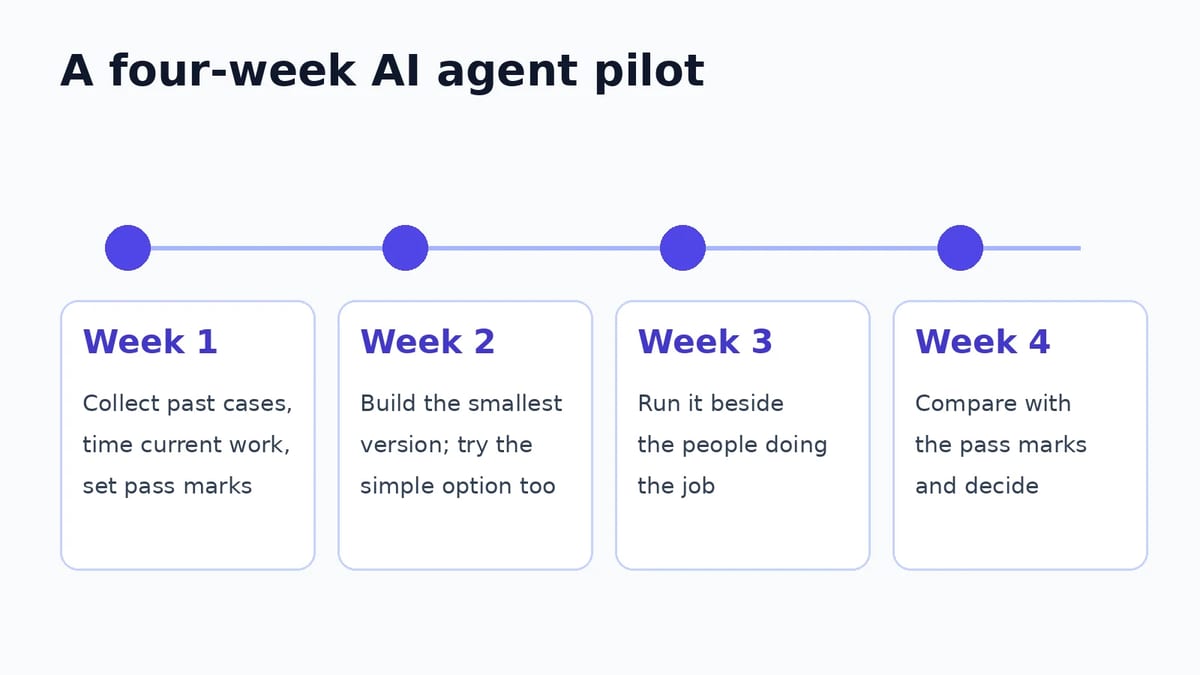
- Week 1: collect real past cases with known answers, time the current work and set the pass marks.
- Week 2: build the smallest version for that one task, and try the simple option next to it.
- Week 3: run it beside the people doing the job. They work as usual, and nothing the agent produces goes out on its own.
- Week 4: compare the results with the pass marks and decide.
If you hire outside help for AI agent development, ask for this shape in writing: one task, a fixed price, tests on your real examples and a decision at the end. At Rocketech, where I’m the founder, a pilot costs $5,000-15,000 and takes 2-4 weeks. Prices elsewhere differ. But anyone you hire should be able to tell you what the pilot will test before you pay.
Who signs off
Two people should. Whoever owns the task decides whether the numbers are good enough. An engineer decides whether it’s safe. AI alone doesn’t reach production quality, so a senior engineer has to read the work, including the prompts, the permissions and the failure logs, and decide what is safe to ship. If nobody at your company can do that, line someone up before rollout.
How it can end
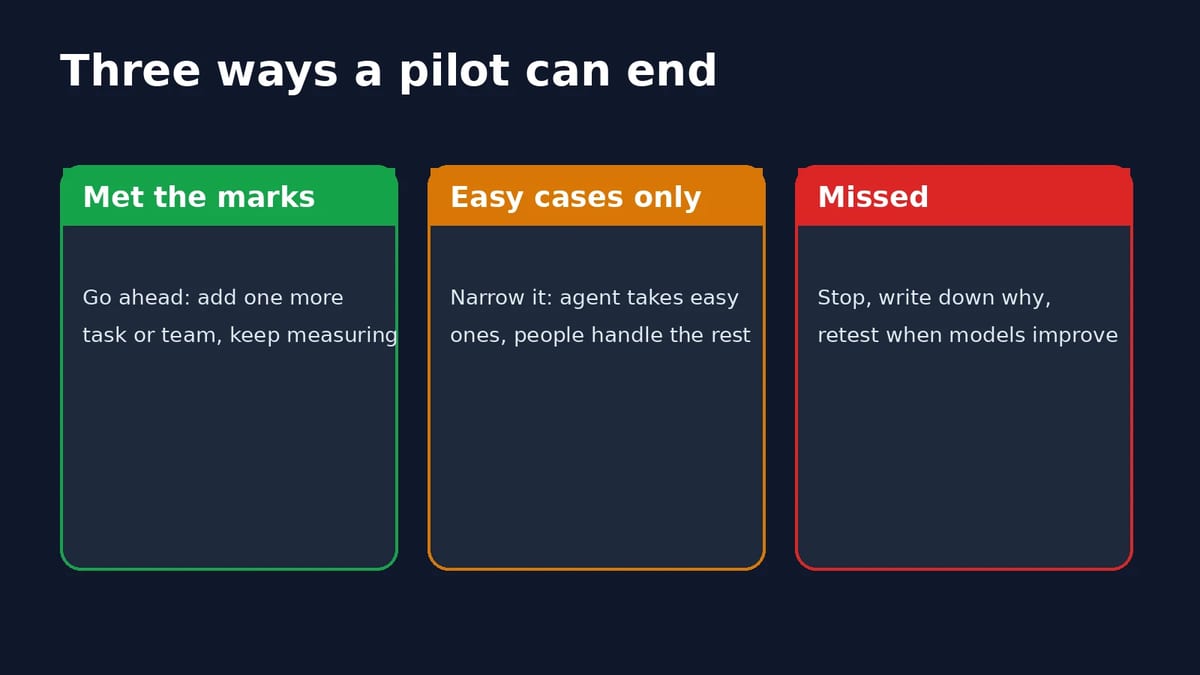
If it met the marks, go ahead. Add one more task or one more team, and keep measuring.
If it handled the easy cases and failed the rest, narrow it. Let it take the easy ones and send everything else to a person.
If it missed, stop. You found that out in weeks. Write down why, because the task may be worth another test when the models improve.
Found this useful? Share it with someone comparing AI tools.