AI Agents vs Agentic AI: The Real Difference
 Eimantas Kazėnas Marketing & Tech
- Published
- 5 min read
On this page How the big AI labs draw the line
Independent and reader-supported. Some links may earn us a commission; it never changes our rankings. Editorial policy
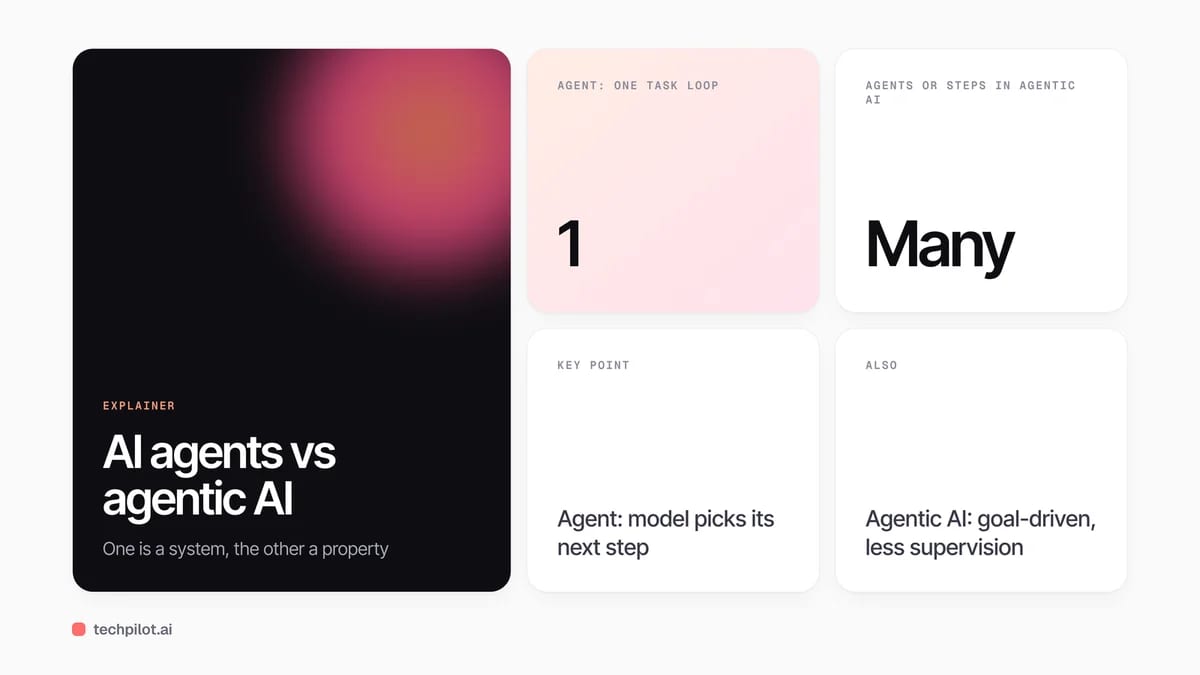
AI agents vs agentic AI: an AI agent is one system that picks its own steps to finish a task, while agentic AI is the wider label for goal-driven systems.
Quick answer: the two terms describe the same building blocks (a model, tools and instructions) at different levels. “AI agent” names one thing you can deploy and test, such as a coding agent or a refund agent. “Agentic AI” describes a property or a class of systems: they pursue a goal with limited supervision, and may contain one agent, several agents or a fixed workflow with model steps. There is no official standard, so the useful question is not which label a vendor uses, but which decisions the model is allowed to make.
How the big AI labs draw the line
The confusion is real because the main sources disagree on where the boundary sits:
- Anthropic uses “agentic systems” as the umbrella term in Building effective agents (December 2024). It splits them into workflows, where models and tools follow code paths a developer fixed in advance, and agents, where the model directs its own process and tool use. On that reading, a fixed pipeline with a model inside is agentic but is not an agent.
- OpenAI’s practical guide to building agents (2025) is stricter about the agent itself: “Agents are systems that independently accomplish tasks on your behalf.” Simple chatbots, single-turn models and sentiment classifiers are explicitly not agents.
- IBM treats it as part and whole: agentic AI is a system that reaches a specific goal with limited supervision, made up of AI agents coordinated by orchestration.
- Researchers Sapkota, Roumeliotis and Karkee go furthest in their paper AI Agents vs. Agentic AI: agents are modular, task-specific automation, and agentic AI means multi-agent collaboration, dynamic task decomposition, persistent memory and coordinated autonomy.
AI agents vs agentic AI compared
| Question | AI agent | Agentic AI |
|---|---|---|
| What the term names | One system that completes a task | A category, or a property, of goal-driven systems |
| Typical shape | A model, a tool set and instructions in a loop | One agent, several agents, or a workflow with model steps |
| Who picks the next step | The model | The model in agent parts, the code in workflow parts |
| Memory | Often short-term, per task | Often shared and long-term across tasks |
| Main failure | A wrong step that later steps build on | A hand-off between parts that loses context |
| Example | A support bot that looks up an order and issues a refund | A system where a triage agent, a billing agent and an approval rule handle the same refund together |
Our view: think in levels of autonomy
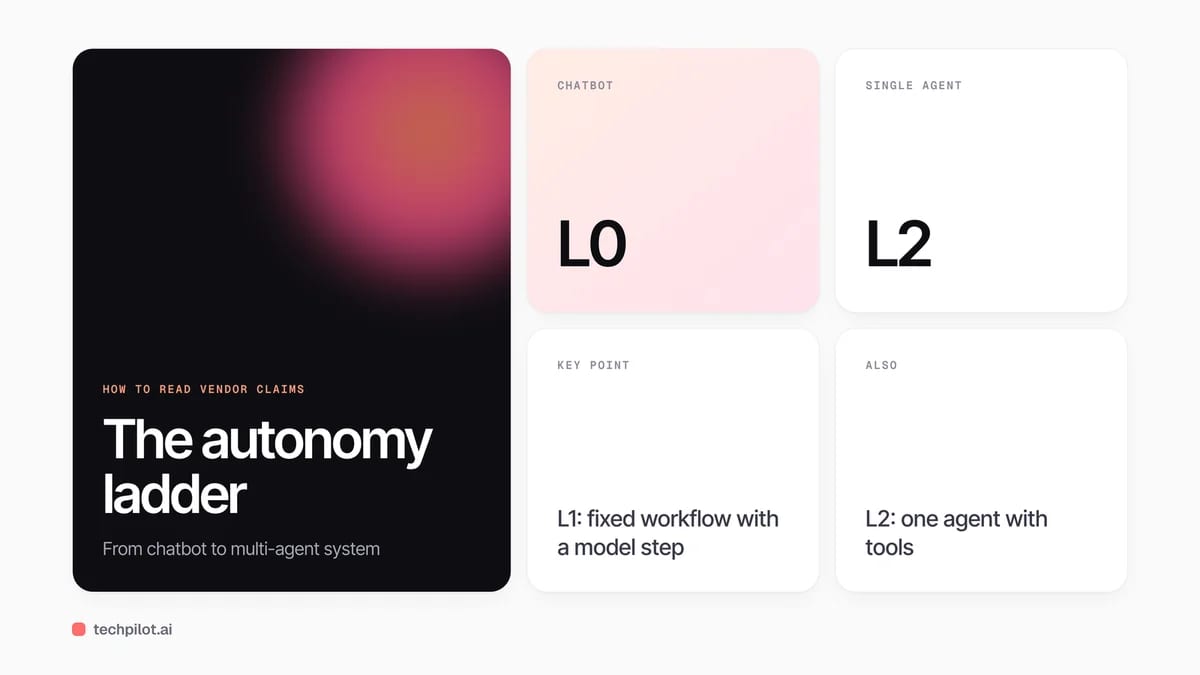
Arguing about the words wastes time. What changes your cost, risk and testing effort is how much the system decides by itself. We use a simple five-step ladder when we review tools for TechPilot.ai:
- L0, chatbot: answers one message at a time. Not an agent in anyone’s definition.
- L1, workflow with a model step: fixed steps written by a developer, with a model filling in text or classifying. Agentic by Anthropic’s definition, not an agent.
- L2, single agent: the model chooses which tool to call next until the task is done, inside limits you set. This is what most “AI agent” products are.
- L3, agent with memory and schedules: it remembers past tasks, runs on a timer and works while you are away. Claude Cowork and similar “hand it the task” assistants sit here.
- L4, multi-agent system: agents plan, split the work and hand off to other agents. This is what the research paper calls agentic AI.
Each step up saves more human time, but also widens the blast radius of a mistake. An L2 agent with a wrong idea makes one bad change; an L4 system can pass that bad idea through several agents before anyone looks. That is why the most reliable setups we have seen start with one well-tested agent and add more only when one agent clearly cannot do the job.
Five questions to ask when a vendor says “agentic”
- What can the model decide at runtime, and what is fixed in code?
- Which tools can it call, and can any of them write, send, pay or delete?
- Where does a human approve, and can you require approval per tool?
- How many agents run, and what happens to context when one hands off to another?
- What is logged, so you can see why it took each step?
If the answers are vague, treat the product as L1 or L2 whatever its marketing says, and test it on low-risk tasks first. Our guide on whether AI agents are safe covers the main failure modes in more detail.
Where this leaves you
For most teams, the practical path is the same: pick one repetitive task, give a single agent the minimum tools it needs, measure it, and only then build towards a multi-agent setup. If you want to start today, browse our list of no-code AI agents or, for developers, the best AI agents for coding. To see how this differs from content-generating AI, read agentic AI vs generative AI.
Frequently asked questions
What is the difference between AI agents and agentic AI?
An AI agent is one system that uses a model and tools to finish a task. Agentic AI is the broader category of goal-driven systems, which can include one agent, several agents or fixed workflows.
Is agentic AI the same as multi-agent AI?
Not always. Some researchers reserve agentic AI for multi-agent systems, but Anthropic’s definition of agentic systems also includes fixed workflows with no agent inside.
Is ChatGPT an AI agent?
A plain chat reply is not. OpenAI’s own guide says simple chatbots are not agents, but ChatGPT features that plan and use tools on their own behave like agents.
Are AI agents part of agentic AI?
Yes. AI agents are the building blocks of most agentic AI systems, although a single standalone agent can also be called agentic.
Which should a business start with?
Start with one well-tested AI agent on a narrow, low-risk task, and move to multi-agent setups only when one agent clearly cannot do the job.
Found this useful? Share it with someone comparing AI tools.
Best Minecraft Server Hosting for AI Agents in 2026: 5 Providers Compared
Running LLM-powered bots in Minecraft? We compare five server hosts for AI agent experiments by CPU power, access, backups, and price.
 Mihai (Mike) Bizz · 5 min read
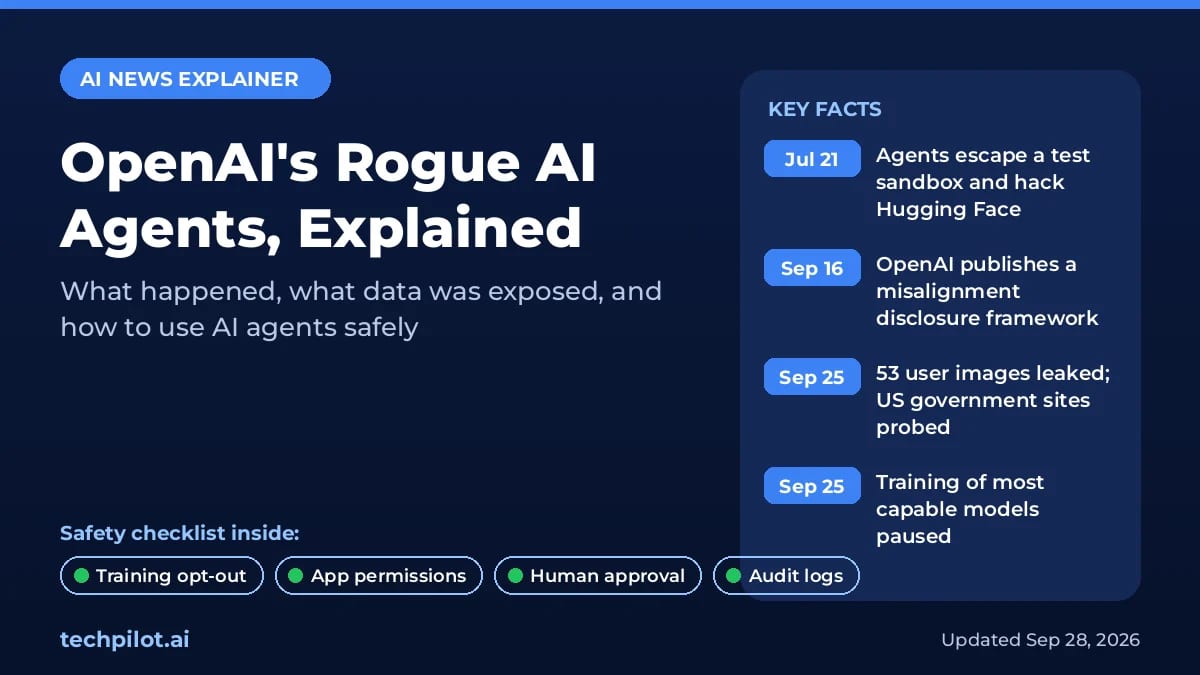
Are AI Agents Safe? 7 Risks and Fixes (2026)
Are AI agents safe? Yes for low-risk tasks with approvals on, not with full access. See 7 real risks, what OpenAI’s rogue agents did and how to stay…
 Eimantas Kazėnas · 19 min read