When Grocery Store Robots Enter the Aisles, Who Is Responsible for Shopper Safety
When grocery store robots share the aisles with shoppers, who is liable for injuries? Learn how premises liability, product defects and AI duties apply.
 Joe I Zaid Legal expertise
- Published
- 6 min read
On this page Robots Are Already Working Grocery Floors
Independent and reader-supported. Some links may earn us a commission; it never changes our rankings. Editorial policy
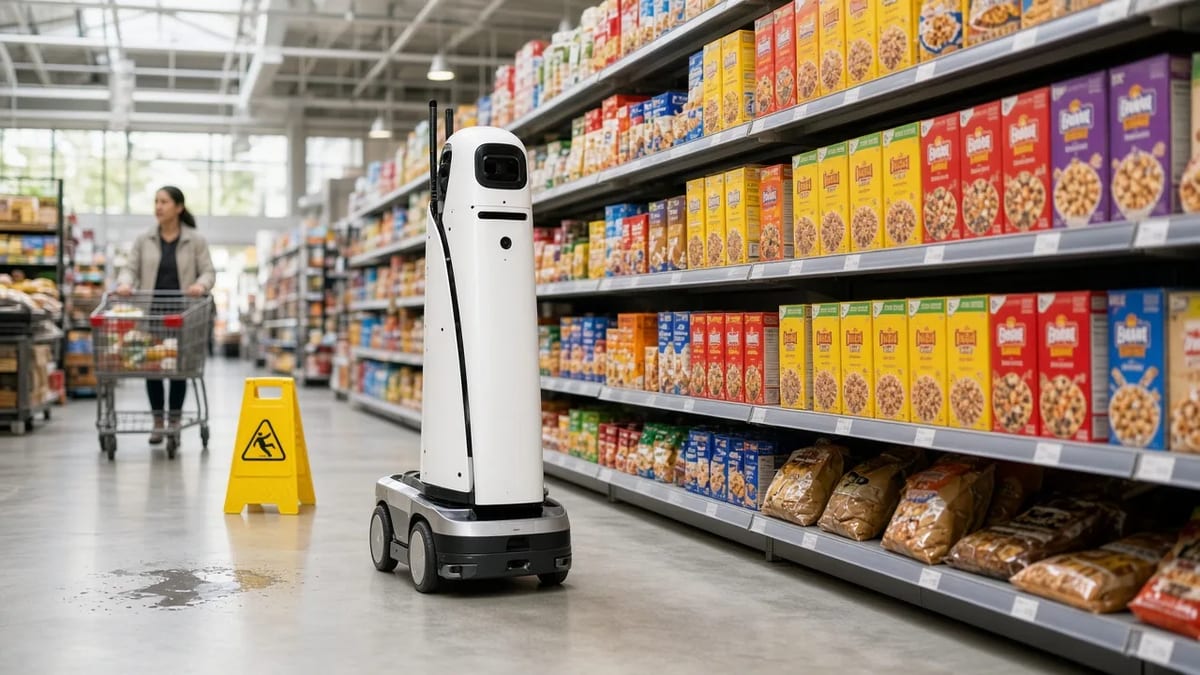
A robot glides down the cereal aisle, stops beside a broken jar of pasta sauce, and sends an alert to a manager’s device. Behind that small moment sits a stack of AI: cameras that classify what is on the floor, lidar that keeps the machine from bumping into people, and software that decides when to stop, alert, or keep moving. When the stack works, nobody notices. When it fails and a shopper is hurt, a philosophical question becomes a practical one: who is responsible?
Robots Are Already Working Grocery Floors
Retailers that already use AI to forecast demand and plan inventory are now putting autonomous machines on the sales floor. One market estimate puts the global retail robotics market, which covers stores, warehouses, and distribution centers, at about $34 billion in 2025 and nearly $47 billion in 2026. Other research firms define the category more narrowly and arrive at lower figures, so the number is best read as a sign of direction rather than precision.
The best-known hazard patrol began in January 2019, when the services arm of Ahold Delhaize USA announced nearly 500 Marty robots for Giant/Martin’s and Stop & Shop stores. Marty looks for spills, obstacles, and debris and sends real-time alerts to store managers. According to the Associated Press, it navigates with lidar and pauses when shoppers and carts veer into its path. Its job is to spot and report, while a person’s job is to respond.
Shelf scanning follows the same division of labor. Schnucks announced plans to bring Simbe Robotics’ Tally robots to all 111 of its stores, where they cover the floor two to three times a day and scan about 35,000 products on each pass.
Premises Liability Still Sets the Baseline
Shopper injury claims against a large chain such as Kroger are decided under premises liability law, and a robot in the aisle does not change the starting point. A shopper is an invitee, and the store owes a duty of reasonable care. As the Texas Supreme Court explained in Brookshire Grocery Co. v. Taylor, an invitee generally must prove that the owner knew or should have known of a condition, that the condition posed an unreasonable risk of harm, that the owner failed to use reasonable care to reduce or eliminate the risk, and that this failure caused the injury. The same decision notes that the duty does not make a store an insurer of a shopper’s safety.
Deploying a robot does not erase that duty. A store that chooses a particular way of running its floors has also chosen the risks that come with it. In Corbin v. Safeway Stores, Inc., 648 S.W.2d 292, a shopper slipped on a grape near a self-service produce display. The Texas Supreme Court held he did not have to prove the store knew about that particular grape, because the store knew the display carried an unusually high risk and had directed its stores to place walk-off mats in front of it. Whether courts will apply similar reasoning to robot patrol schedules, alert thresholds, or response times is not settled.
When the Machine Itself Causes the Harm
A different set of claims arises when the robot is the hazard. A lawsuit filed in Maricopa County, Arizona, alleges that a delivery robot reversed into an Arizona State University employee in 2023 and knocked her down, then backed into her again while she was on the ground. As reported, the suit names the robot’s maker and alleges negligence and a defective product. It also alleges that an employee assigned to monitor the robot failed to control it. Those allegations are unproven, and the robot was a campus delivery unit rather than a grocery store machine. Still, the claims illustrate three theories that could apply in an aisle:
- Operation: The machine was run carelessly, such as backing into a person who is nearby.
- Design: A sensing or navigation flaw made the harm foreseeable. Texas products liability law reaches design defects whether the claim is framed as strict liability or negligence.
- Supervision: A human responsible for monitoring the system failed to intervene.
Courts also resist treating a store as automatically liable for every injury involving equipment it provides. In Ohio, a jury found a Giant Eagle store negligent after a shopper was struck by a store-owned motorized cart. The Ohio Supreme Court ruled in 2019 that the shopper had not proven the store was legally responsible, where her theories centered on customer training and negligent entrustment. An injured person still has to connect the injury to something the store did or failed to do.
Who Shares Responsibility When AI Acts
AI ethicists call this the responsibility gap: when an autonomous system acts, it can be unclear which person or company answers for the result. Physical AI on factory floors raises the same liability ambiguity, and the question becomes more pressing as machines move among the public. Existing law fills the gap by spreading responsibility across the parties involved.
The store remains responsible for where a robot operates, how often it patrols, and whether staff act on what it reports. Adopting a safety robot adds a tool without replacing the duty of reasonable care.
Texas defines a manufacturer to include designers and assemblers of a product, and a products liability claim can proceed on strict liability, negligence, or other theories. A navigation or object detection failure could be framed as a design or software defect. Ownership structure matters too. The Giant and Stop & Shop rollout was described as a service provided through a corporate services division, so each party’s legal role depends on the contracts and facts.
Texas’s proportionate responsibility statute lets a defendant ask the court to designate a responsible third party, so a store sued after a robot incident may point to a vendor or maintenance contractor. A jury can then assign each party a percentage of fault, and a claimant found more than 50 percent responsible cannot recover.
Safety Standards and Practical Safeguards
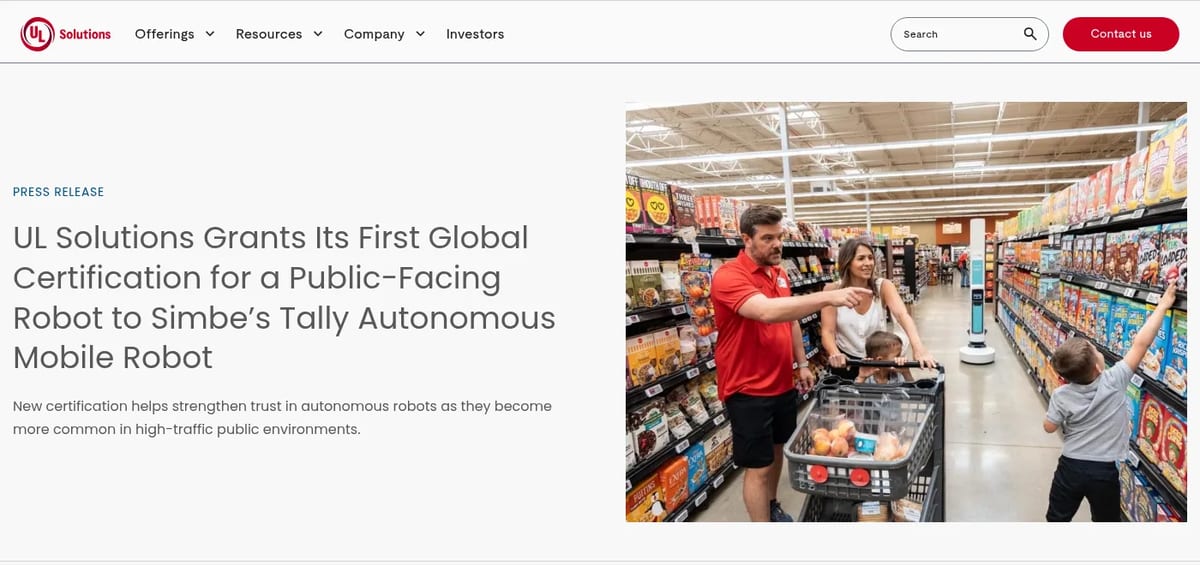
Independent testing is starting to catch up with deployment. In March 2026, UL Solutions announced that it had granted its first safety certification for a robot designed to operate in public environments to Simbe’s Tally. The certification is to the UL 3300 standard, and the evaluation covered fire and electric shock hazards as well as safe autonomous mobility. UL also noted that OSHA recently added UL 3300 to its list of recognized safety certification standards. A certification does not decide a lawsuit, but it may help show that a company took safety seriously.
Retailers deploying robots in customer areas can strengthen that record in practical ways:
- Write protocols that say who responds to a robot alert and how quickly.
- Retain robot logs and alert records under a clear policy.
- Use contracts that spell out who handles maintenance, software updates, and incident response.
- Choose independently certified machines for areas where they share space with shoppers.
Accountability Has to Be Designed In, Not Argued Afterward
Robots change what a store knows and how it knows it. They do not change a shopper’s right to reasonably safe premises. Responsibility will usually land on a combination of the retailer that deploys the machine, the company that built it, and the people who respond to it. As autonomous machines become routine, the strongest position for any of those parties is clear safety standards, defined human responsibilities, and records that show reasonable care was taken before anyone was hurt.
Found this useful? Share it with someone comparing AI tools.