MiniMax vs DeepSeek: M3.1 Flash vs V4.1 Flash
 Eimantas Kazėnas Marketing & Tech
- Published
- 6 min read
On this page MiniMax M3.1 Flash vs DeepSeek V4.1 Flash at a glance
Independent and reader-supported. Some links may earn us a commission; it never changes our rankings. Editorial policy
MiniMax vs DeepSeek: M3.1 Flash and V4.1 Flash cost the same per token on paper. See who wins on real bills, free access, open weights and benchmarks.
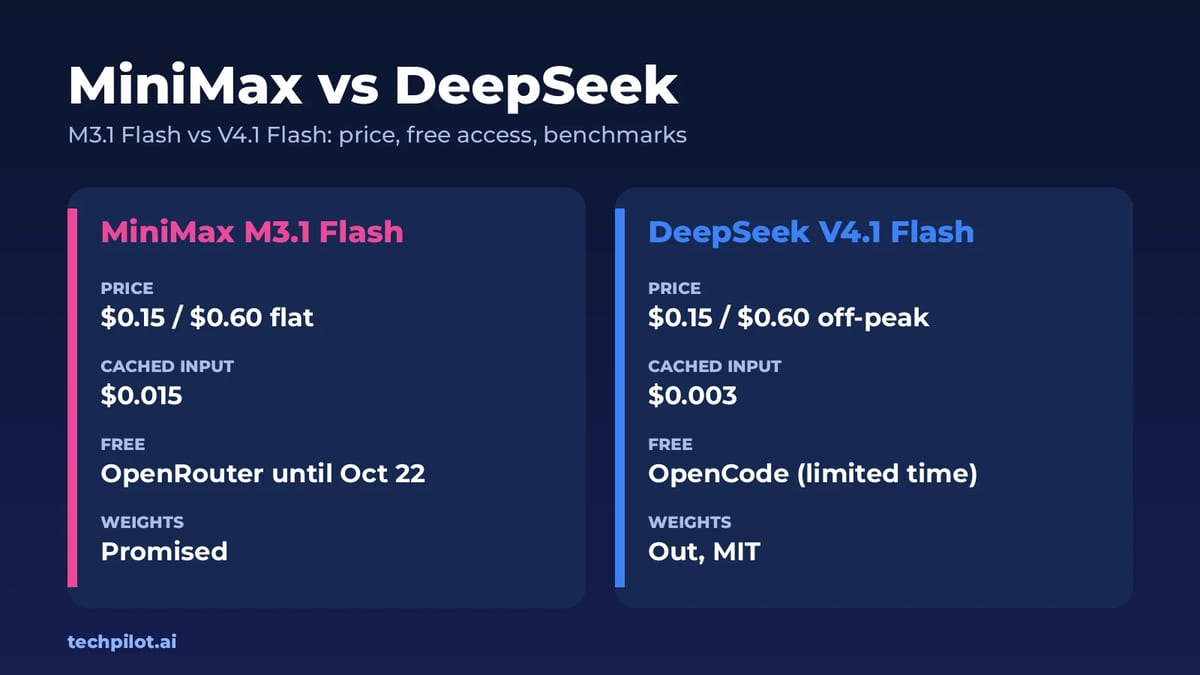
Quick answer: both models list at $0.15 per million input tokens and $0.60 per million output tokens, so the sticker price is a tie. The bills are not. DeepSeek V4.1 Flash doubles its price during weekday peak hours but charges five times less for cached input, and its weights are already open under MIT. MiniMax M3.1 Flash charges one flat rate around the clock, is free on OpenRouter until October 22, and leads on office automation, but its weights are only promised. Pick DeepSeek for cache-heavy coding agents and batch jobs you can run off-peak. Pick MiniMax if you work during Asian business hours and want a predictable bill.
MiniMax launched M3.1 Flash on October 19, 2026, five weeks after DeepSeek shipped V4.1 Flash, and pitched it straight at the same buyers: people running agents and coding tools that burn through millions of tokens a day. Here is how they compare, with prices checked on both companies’ official pages on October 21, 2026.
MiniMax M3.1 Flash vs DeepSeek V4.1 Flash at a glance
| MiniMax M3.1 Flash | DeepSeek V4.1 Flash | |
|---|---|---|
| Released | October 19, 2026 | September 10, 2026 (API now serves the 1017 update) |
| Input, per 1M tokens | $0.15 at all hours | $0.15 off-peak, $0.30 peak |
| Output, per 1M tokens | $0.60 at all hours | $0.60 off-peak, $1.20 peak |
| Cached input, per 1M | $0.015 | $0.003 off-peak, $0.006 peak |
| Context window | 1M tokens | 1M tokens |
| Max output | 524,288 tokens on OpenRouter | 384K tokens |
| Image input | Yes (multimodal) | Yes (vision) |
| Open weights | Promised, no licence yet | Yes, MIT licence |
| Free option | OpenRouter until Oct 22, 12:00 UTC | OpenCode Zen, for a limited time |
Pricing: same sticker, different bills
The headline rates match, so the real difference comes from two details: when you run your jobs and how much of your input is cached.
Peak hours. DeepSeek’s pricing page sets peak hours at 01:00 to 04:00 and 06:00 to 10:00 UTC, Monday to Friday. In Vietnam (UTC+7) that is 8:00 to 11:00 and 13:00 to 17:00, which is most of a working day. Across most of Asia, interactive work in a coding agent lands in DeepSeek’s expensive window. MiniMax has no peak pricing at all.
Caching. Agents re-send the same system prompt, files and history on every step, so most of their input is usually cached. DeepSeek charges $0.003 per million cached tokens off-peak, against MiniMax’s $0.015. On long agent runs that gap adds up.
To see how this plays out, take one big agent job: 10 million input tokens, 80% of them cached, plus 1 million output tokens.
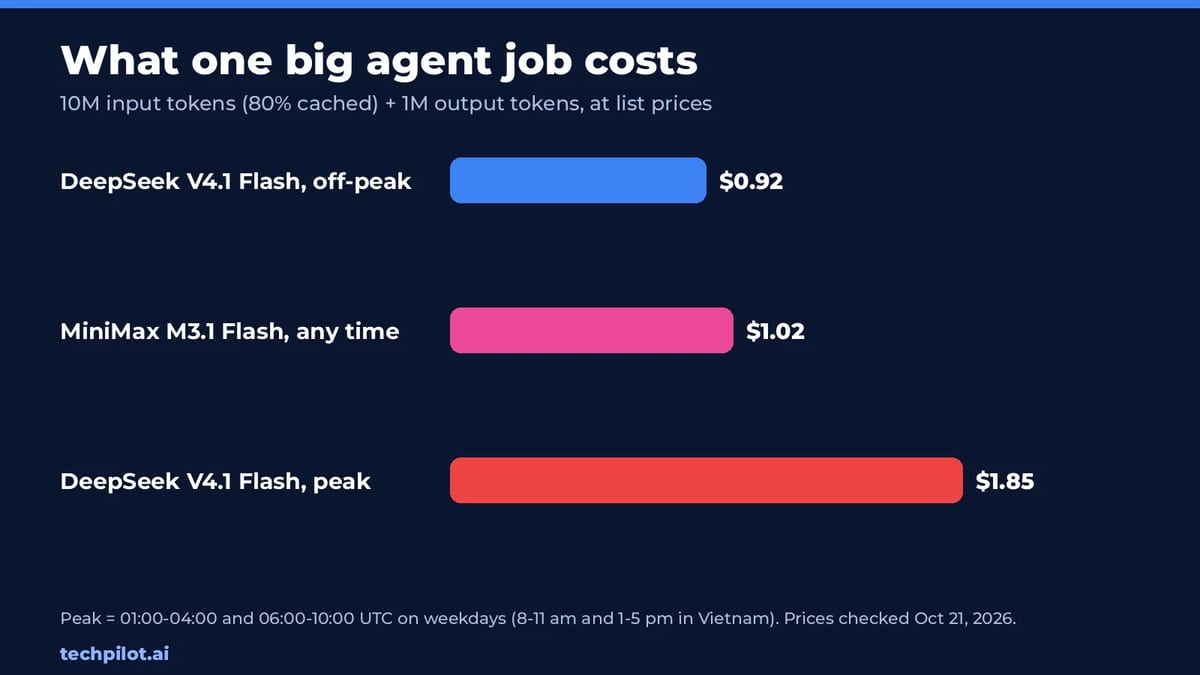
- DeepSeek off-peak: $0.30 for fresh input + $0.024 for cached input + $0.60 for output = $0.92.
- MiniMax, any time: $0.30 + $0.12 + $0.60 = $1.02.
- DeepSeek peak: $0.60 + $0.048 + $1.20 = $1.85.
Our take: if you can schedule work, DeepSeek is about 10% cheaper. If your team uses an agent live during the Asian workday, MiniMax costs roughly half as much as DeepSeek at peak. Both are cheap enough that the model’s success rate on your tasks matters more than the price: a model that needs two attempts costs double.
Free access: which one can you use for $0?
- MiniMax M3.1 Flash is free on OpenRouter as
minimax/minimax-m3.1-flash:freeuntil Thursday, October 22, 2026 at 12:00 UTC (19:00 in Vietnam). After that the free model is retired and you must switch to the paid slug. - DeepSeek V4.1 Flash is free inside the OpenCode coding agent as “DeepSeek V4.1 Flash Free”, with no API key in our test, but with a smaller 200K context and 32K output, and only inside OpenCode. We walk through the setup in how to use DeepSeek V4.1 Flash free in OpenCode. DeepSeek’s own chat app is also free.
If you just want to compare them on your own prompts today, run the same tasks through both free options before Thursday evening.
Benchmarks: who is smarter?
The most direct comparison comes from MiniMax itself. Its launch table includes both the original DeepSeek V4.1 Flash and the newer V4.1 Flash-1017 that DeepSeek’s API serves today. Against the newer version:
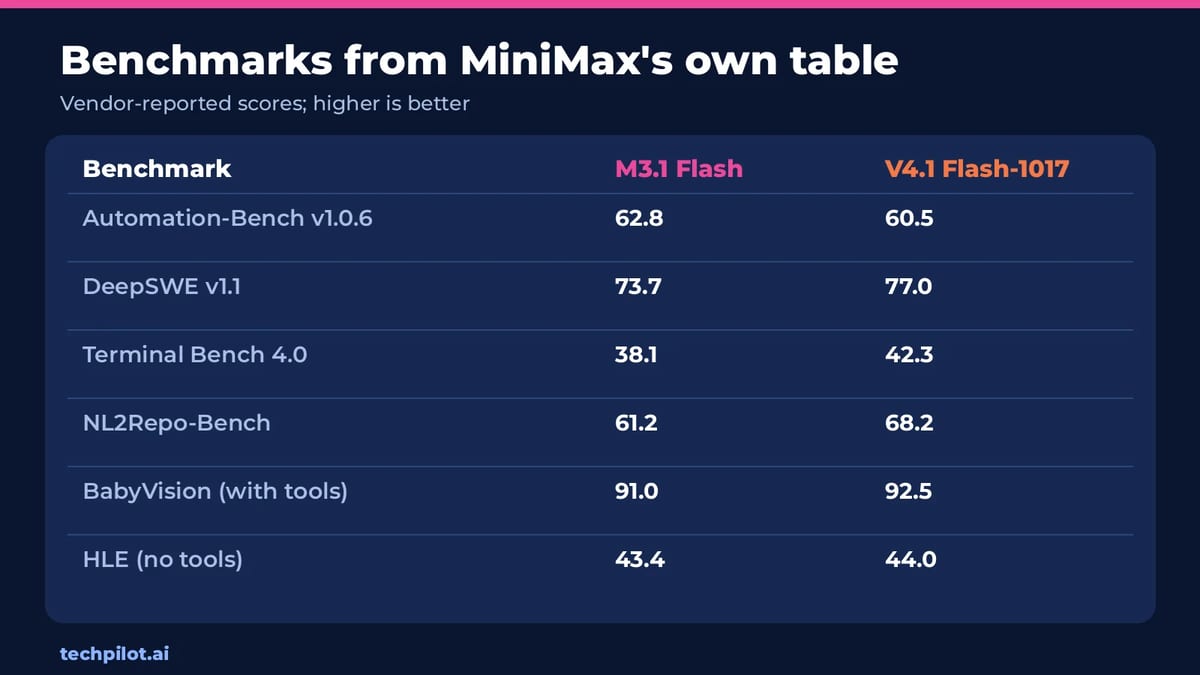
- MiniMax wins on Automation-Bench (62.8 vs 60.5), which tests end-to-end business workflows across SaaS tools.
- DeepSeek wins on DeepSWE v1.1 (77.0 vs 73.7), Terminal Bench 4.0 (42.3 vs 38.1) and NL2Repo-Bench (68.2 vs 61.2), the coding and terminal tests.
- They’re close on visual reasoning and general knowledge: BabyVision 92.5 vs 91.0 and HLE 44.0 vs 43.4, both slightly in DeepSeek’s favor.
Against the original V4.1 Flash, M3.1 Flash looks much better, for example 62.8 vs 54.8 on Automation-Bench and 61.7 vs 54.3 on OSWorld 2.0. That’s worth knowing because some comparison sites still list the older numbers. Keep in mind that every score here is vendor-reported.
One independent data point: Plotly ran M3.1 Flash on its 43-question data analysis exam and it passed 41, tying several frontier models, at a total cost of $4.09. DeepSeek wasn’t part of that writeup, so it doesn’t settle the head-to-head, but it suggests M3.1 Flash holds up outside MiniMax’s own tests.
Open weights and self-hosting
DeepSeek has the clear lead today. V4.1 Flash weights are on Hugging Face under the MIT licence, with vLLM and SGLang instructions, although with a 552B-parameter backbone it’s a data-center model. MiniMax says M3.1 Flash weights “will be released later”, with October 23 reported as the date, and no licence has been published yet. MiniMax did release weights for its earlier M2 and M3 models, so the promise is credible, but don’t plan a self-hosted deployment until the licence is out.
Speed and limits
MiniMax says M3.1 Flash outputs 200+ tokens per second, with a median above 170. When we checked, OpenRouter’s free endpoint showed about 83 tokens per second, which is normal for a heavily used free route. DeepSeek caps a single reply at 384K output tokens, while OpenRouter lets M3.1 Flash produce up to 524,288 tokens in one reply. Both have 1M-token context windows on their paid APIs.
Which should you choose?
- Choose DeepSeek V4.1 Flash for coding agents, terminal work, cache-heavy workloads, overnight or weekend batch jobs, and anything that needs open weights now.
- Choose MiniMax M3.1 Flash for office and SaaS automation, computer use, live work during Asian business hours, and teams that want one flat price to budget against.
- Use both if your tool supports routing: send coding steps to DeepSeek off-peak and keep MiniMax as the daytime default. Both work through OpenAI-compatible APIs, so switching is a one-line model change.
For the bigger picture of which models lead overall, see our best AI model roundup.
Frequently asked questions
Is MiniMax cheaper than DeepSeek?
On list price they’re the same: $0.15 per 1M input and $0.60 per 1M output tokens. DeepSeek is cheaper off-peak for cache-heavy work, because cached input costs $0.003 instead of $0.015. During DeepSeek’s weekday peak hours, MiniMax is about half the price.
Which is better for coding, MiniMax M3.1 Flash or DeepSeek V4.1 Flash?
DeepSeek V4.1 Flash. Even in MiniMax’s own table, DeepSeek’s 1017 version scores higher on DeepSWE (77.0 vs 73.7), Terminal Bench 4.0 and NL2Repo-Bench. MiniMax leads on business workflow automation.
Is MiniMax M3.1 Flash free?
Yes, until October 22, 2026 at 12:00 UTC on OpenRouter, through minimax/minimax-m3.1-flash:free. After that you need the paid model at $0.15 and $0.60 per 1M tokens.
Is DeepSeek V4.1 Flash free?
Its weights are free under the MIT licence, and it’s free for a limited time inside the OpenCode coding agent. DeepSeek’s chat app is free too. The API is paid.
Are MiniMax M3.1 Flash weights open source?
Not yet. MiniMax says the weights will be released later, with October 23 reported as the date, and no licence has been published. DeepSeek V4.1 Flash weights are already available under MIT.
When are DeepSeek’s peak hours in Vietnam?
DeepSeek’s peak hours are 01:00 to 04:00 and 06:00 to 10:00 UTC on weekdays, which is 8:00 to 11:00 and 13:00 to 17:00 in Vietnam (UTC+7). Prices double during those hours.
Found this useful? Share it with someone comparing AI tools.