Best AI Model in 2026: Top LLMs Ranked
Find the best AI model for your job in 2026. We rank GPT-6, Claude Opus 5.5, Gemini 4 Argon, Grok 4.7 and open models on coding, agents, price, free use.
 Eimantas Kazėnas Marketing & Tech
 - Updated
- 16 min read
On this page Quick answer: the best AI model for each job
Independent and reader-supported. Some links may earn us a commission; it never changes our rankings. Editorial policy
The best AI model in 2026 depends on the job. No single model leads on everything. Claude Opus 5.5 is the strongest all-rounder for most people. GPT-6 Astra is the one to beat for agents that operate a computer. Gemini 3.8 Flash is the best fit for long, mixed-media research and has a free API tier. Gemini 4 Argon, generally available since October 13, is the new pick for long, multi-step work. GPT-6.1 Sol and DeepSeek V4.1 Flash bring near-frontier ability at a fraction of the price, and Meta’s new Muse Spark Open is the most capable US open-weight model. Prices fell and context windows grew to about a million tokens in September 2026, which changes the answer for anyone paying per token.
This guide ranks the current flagship models from OpenAI, Anthropic, Google, xAI and the leading open-weight labs. It is written for everyday users choosing a subscription and for builders choosing an API. Every model name, price and context window below comes from the vendor’s own documentation, checked today.
Last updated: October 18, 2026 (UTC+7). Model lineups change almost weekly, so we’ll update this page when a major model ships or a price changes.
Quick answer: the best AI model for each job
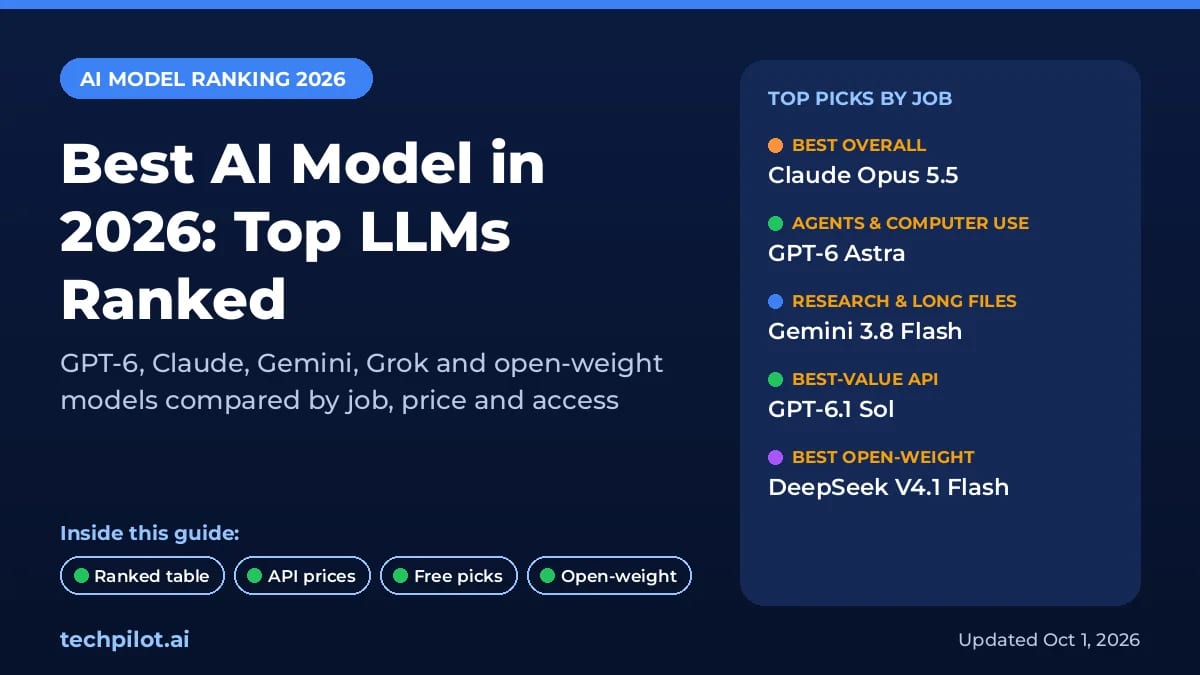
- Best overall: Claude Opus 5.5 (Anthropic). It has a 1M-token context and costs $4/$20 per million tokens, and it’s on Claude Pro.
- Best for coding: Claude Opus 5.5, with GPT-6.1 Sol as the value pick.
- Best for agents and computer use: GPT-6 Astra (OpenAI).
- Best for writing: Claude Opus 5.5, or Sonnet 5.5 when speed matters. This is our editorial pick, because no standard writing benchmark exists.
- Best for research and long documents: Gemini 3.8 Flash (Google).
- Best for long, multi-step work: Gemini 4 Argon (Google). It has a unified 1M-token window and costs $2/$10 until November 30, then $4/$20.
- Best value API: GPT-6.1 Sol at $2/$10. For the lowest prices, look at GPT-6 Luna and DeepSeek V4.1 Flash.
- Best free option: Gemini, which offers a free app and a free API tier for Gemini 3.8 Flash.
- Best open-weight model: DeepSeek V4.1 Flash (MIT license) for price, Muse Spark Open (Meta) for raw capability. For local use, Qwen3.8-27B is a good choice.
Key takeaways
- About a million tokens is now standard. GPT-6 Astra, GPT-6.1 Sol, Claude Opus 5.5 and Gemini 3.8 Flash all accept roughly 1M tokens. Grok 4.7 accepts 500K.
- The mid-tier models are the story of the month. OpenAI says GPT-6.1 Sol “nearly matches” GPT-6 Astra at one-fifth of the price. Anthropic says Opus 5.5 performs at the level of its pricier Fable 5.1 on most work.
- Your subscription matters as much as the model. Since October 7, ChatGPT’s regular Chat runs GPT-6 instead of GPT-5.6: GPT-6 Sol on paid plans (labeled just “GPT-6” in the model menu) and GPT-6 Luna on Free and Go. GPT-6 Astra appears there as “GPT-6 Pro” only on Pro, Business and Enterprise. Claude’s Free plan doesn’t include Opus.
- Benchmarks are vendor-reported. Each lab tests with its own settings, so treat cross-vendor comparisons as a guide, not a verdict.
- Two big October launches. Google made Gemini 4 Argon generally available on October 13, and Meta released the weights of Muse Spark Open on October 15. Our Muse Spark Open vs Gemini 4 Argon comparison puts them side by side. OpenAI has said it won’t release GPT-6.1 Astra.
How we ranked the models
We didn’t run our own benchmark suite to pick the best LLM in 2026. We ranked each model on three things you can check: what the vendor’s published evaluations show, what it costs per million tokens, and how easy it is to use today in an app or API. When we quote a benchmark score, we name the lab that reported it. Vendors pick their own tests and settings, and Anthropic itself says “benchmark margins have become a less reliable guide to real-world differences.” For writing, no reliable public benchmark exists, so that pick is our editorial judgment.
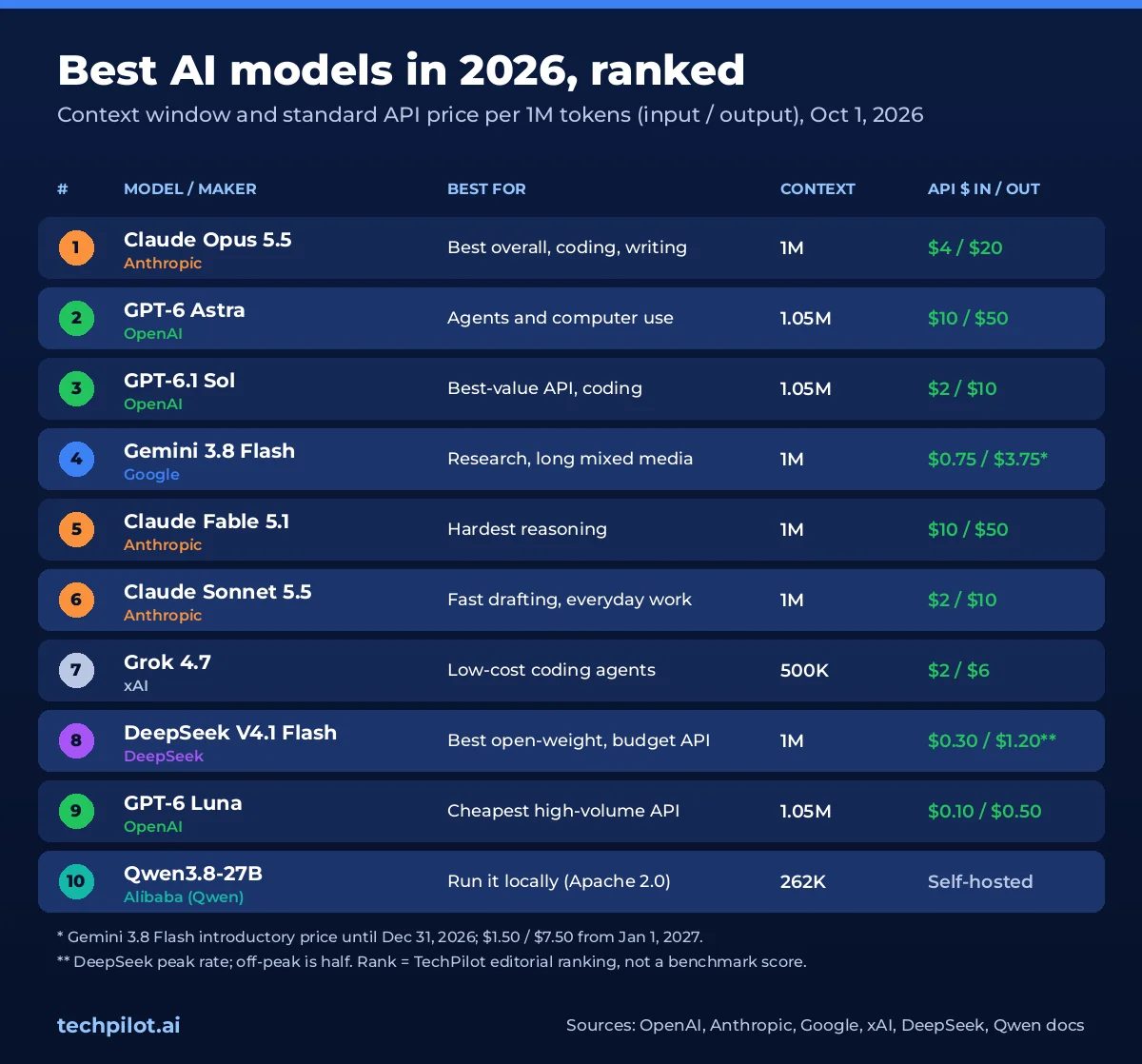
Best AI models in 2026: ranked comparison table
| # | Model | Maker | Best for | Context | API price per 1M (in / out) | Consumer access / plan |
|---|---|---|---|---|---|---|
| 1 | Claude Opus 5.5 | Anthropic | Best overall, coding, writing | 1M | $4 / $20 | Claude Pro ($20/mo), Max, Team, Enterprise; not on Free |
| 2 | GPT-6 Astra | OpenAI | Agents and computer use | 1.05M | $10 / $50 | “GPT-6 Pro” on ChatGPT Pro (from $100/mo), Business, Enterprise; Plus in Work and Codex only |
| 3 | GPT-6.1 Sol | OpenAI | Best-value API, coding | 1.05M | $2 / $10 | ChatGPT Work and Codex (Plus and up); not in Chat yet |
| 4 | Gemini 3.8 Flash | Research, long mixed-media input | 1,048,576 | $0.75 / $3.75 (intro, to Dec 31, 2026) | Google AI Pro ($19.99/mo) and Ultra; free API tier | |
| 5 | Gemini 4 Argon | Long multi-step work, coding agents, security fixes | 1M (input + output) | $2 / $10 (intro, to Nov 30, 2026); $4 / $20 from Dec 1 | Google AI Pro and Ultra (Gemini app); paid API tier only | |
| 6 | Claude Fable 5.1 | Anthropic | Hardest reasoning and long-horizon work | 1M | $10 / $50 | Claude Pro (usage credits), Max, Team, Enterprise |
| 7 | Claude Sonnet 5.5 | Anthropic | Fast drafting, everyday work | 1M | $2 / $10 | Claude apps; Free plan includes Sonnet |
| 8 | Grok 4.7 | xAI | Low-cost coding agents | 500K | $2 / $6 | API, Cursor, Grok Build; SuperGrok app lists Grok 4.6 |
| 9 | DeepSeek V4.1 Flash | DeepSeek | Best open-weight, budget API | 1M | $0.30 / $1.20 (peak; half off-peak) | Open weights (MIT); DeepSeek API |
| 10 | Muse Spark Open | Meta | Most capable US open-weight model, coding agents | 1M | $1.25 / $4.25 (OpenRouter, Together AI) | Open weights (Muse Model License); hosted APIs |
| 11 | GPT-6 Luna | OpenAI | Cheapest high-volume API | 1.05M | $0.10 / $0.50 | API; ChatGPT Work and Codex; Chat on Free and Go |
| 12 | Qwen3.8-27B | Alibaba (Qwen) | Running a model locally | 262K native | Self-hosted (free weights) | Apache 2.0 download |
API prices are standard rates per million input and output tokens, before batch discounts or caching. OpenAI charges 2x input and 1.5x output on prompts over 272K tokens. Muse Spark Open prices are from hosted providers, since Meta does not sell its own API. xAI charges higher rates on Grok 4.7 requests over 200K tokens.
The best AI model for each job
Best overall: Claude Opus 5.5
Claude Opus 5.5 launched on September 22, 2026. It offers the best balance of capability, price and access available right now. Anthropic’s model page lists a 1M-token context window, 128K output tokens and $4/$20 per million tokens. That’s less than half of GPT-6 Astra’s $10/$50. Anthropic says it “performs at the level of Claude Fable 5.1 on most work and costs 40% less to run than Opus 5.” Anthropic’s own results put it ahead of GPT-6 Astra on Terminal-Bench 4.0 (66.4% vs 57.9%) and Humanity’s Last Exam with tools (67.7% vs 57.2%). Astra stays slightly ahead on AutomationBench (41.4% vs 40.0%). Everyday users get it on Claude Pro, which costs $20 a month, or $17 a month billed annually, and on Max plans from $100. If you’ve used Claude before through the API, see our Claude vs Gemini API comparison for how the two platforms differ in practice.
Watch out for: thinking is always on and can’t be turned off, and the Free plan doesn’t include Opus.
Best for coding: Claude Opus 5.5 (value pick: GPT-6.1 Sol)
Anthropic describes Opus 5.5 as built “for long-running agentic coding.” On Anthropic’s own published table, it beats GPT-6 Astra on Terminal-Bench 4.0 (66.4% vs 57.9%) and FrontierCode v1.1 (54.4% vs 53.3%), and it scores 57.8% on CursorBench 4.0. For comparison, xAI reports 46.3% on CursorBench 4.0 for Grok 4.7. If cost matters more, GPT-6.1 Sol is the pick: OpenAI says it matches GPT-6 Astra on DeepSWE v1.1 at about one-fifth of the cost. Grok 4.7 is another budget option for coding agents. At $2/$6, its output tokens cost less than GPT-6.1 Sol’s or Claude Sonnet 5.5’s $10. For the tools that wrap these models, see our guide to the best AI agents for coding.
Best for agents and computer use: GPT-6 Astra
GPT-6 Astra is OpenAI’s flagship, released September 3, 2026. OpenAI’s API page says it is built “for the hardest end-to-end work,” including computer use. Its Responses API tools include computer use, a hosted shell, MCP and web search. OpenAI reports 72.6% on the OSWorld 2.0 offline set and says Astra “remains the world’s best model for computer use.” Astra also powers OpenAI’s new always-on Dots agents. Anthropic claims its own lead in computer use for Opus 5.5, but the two labs report different OSWorld variants, so the numbers can’t be compared directly. Astra costs $10/$50 in the API. In ChatGPT it appears as “GPT-6 Pro” on Pro plans (from $100 a month), Business and Enterprise. Plus subscribers get it only in ChatGPT Work and Codex. Our GPT-6 Astra vs Sol breakdown covers the OpenAI lineup in detail.
Watch out for: OpenAI has shelved GPT-6.1 Astra, so the September 3 model remains the flagship for now.
Best for writing: Claude Opus 5.5 or Sonnet 5.5 (editorial pick)
No public benchmark measures writing quality reliably, so this pick is our judgment rather than a score. Claude gives writers the most room: a 1M-token context to hold a whole manuscript or brand guide, up to 128K tokens of output, and Projects to keep material organised. Claude Sonnet 5.5 came out on September 28. Anthropic calls it “the best combination of speed and intelligence,” and it costs $2/$10 in the API. It is a good fit for fast drafting, while Opus 5.5 suits editing and long documents. If you already pay for ChatGPT Plus ($20 a month), its Chat now runs GPT-6 Sol (labeled “GPT-6” in the model menu since October 7). Try the same brief in both before you switch.
Best for research and long documents: Gemini 3.8 Flash
Gemini 3.8 Flash was released on September 2. It accepts up to 1,048,576 input tokens, and it takes text, images, video, audio and PDFs in one request. That makes it the most flexible model here for research across mixed sources such as recordings, slide decks and long reports. Google calls it “our most intelligent Flash model.” It is also cheap: $0.75/$3.75 per million tokens at the introductory rate through December 31, 2026, then $1.50/$7.50 from January 1, 2027. Consumers get it in the Gemini app on Google AI Pro ($19.99 a month) and Ultra (from $99.99). One limit: its output is capped at 65,536 tokens, well below the 128K of the OpenAI and Anthropic flagships.
Best value API: GPT-6.1 Sol (budget picks: GPT-6 Luna, DeepSeek V4.1 Flash)
For builders, GPT-6.1 Sol is the best price-to-capability deal of the month. It launched at DevDay on September 29 at $2/$10, with cached input at $0.10. It has the same 1.05M-token context and 128K output as Astra. OpenAI says it comes “within 2.1 percentage points” of Astra on OSWorld 2.0 offline at roughly one-seventh of the cost per task. For high-volume, simpler work, GPT-6 Luna costs $0.10/$0.50. DeepSeek V4.1 Flash costs $0.30/$1.20 at peak hours and half that off-peak. Also on the shortlist: Claude Sonnet 5.5 ($2/$10), Grok 4.7 ($2/$6) and Gemini 3.8 Flash ($0.75/$3.75 until the end of 2026).
Watch out for: in ChatGPT, GPT-6.1 Sol is available only in ChatGPT Work and Codex, not in regular Chat yet.
Best free option: Gemini
Google has the most generous free access across both apps and APIs. The free Gemini app includes Gemini 3.6 Flash, “varying access” to Gemini 3.1 Pro, Deep Research and Canvas. Google AI Studio’s free tier lets developers call Gemini 3.8 Flash at no charge. In return, Google says free-tier data is “used to improve our products,” so keep confidential data on the paid tier. The other free plans are narrower. ChatGPT Free offers unlimited text chats with GPT-6 Luna (since October 8), subject to abuse limits. Claude Free includes Sonnet and Haiku but not Opus. Grok has a free plan, and its pricing page lists Grok 4.6 for the app. For a closer look at the app, see our Grok AI review. Before pasting anything personal into a free chatbot, read our guide on whether ChatGPT is safe. The same privacy rules apply to its rivals.
Best open-weight model: DeepSeek V4.1 Flash (local pick: Qwen3.8-27B)
Open-weight models let you download the weights and run them on your own hardware or cloud. That matters for privacy, fine-tuning and cost control at scale. DeepSeek V4.1 Flash was released on September 10 under the permissive MIT license. It is a 552B-parameter multimodal mixture-of-experts model that activates only 8B parameters per token for input and 16B for output. It supports contexts up to 1M tokens. It’s far too big for a laptop, though. For local use, Qwen3.8-27B is a dense Apache 2.0 model with vision and a 262,144-token native context. Other strong options:
- Meta Muse Glimmer 30B (Apache 2.0, August 2026). Meta’s small open model, no longer branded Llama. Meta built it for local agents that run on a single GPU.
- Meta Muse Spark Open (Muse Model License, October 2026). Meta’s most capable open model: 816B parameters, 42B active and a 1M-token context, at $1.25/$4.25 per million tokens hosted. See our Muse Spark Open review.
- Mistral Small 4 and Mistral Large 3 (both Apache 2.0, 256K context). Note that Mistral Medium 3.5 uses a modified MIT license that excludes companies with more than $20 million in monthly revenue.
- Qwen3.8-2.4T-A95B, Alibaba’s first open Max-class model. It’s open-weight, but under a custom Qwen license rather than Apache 2.0, so read the terms before you build on it.
New this month: Gemini 4 Argon and Muse Spark Open
Best for long, multi-step work: Gemini 4 Argon
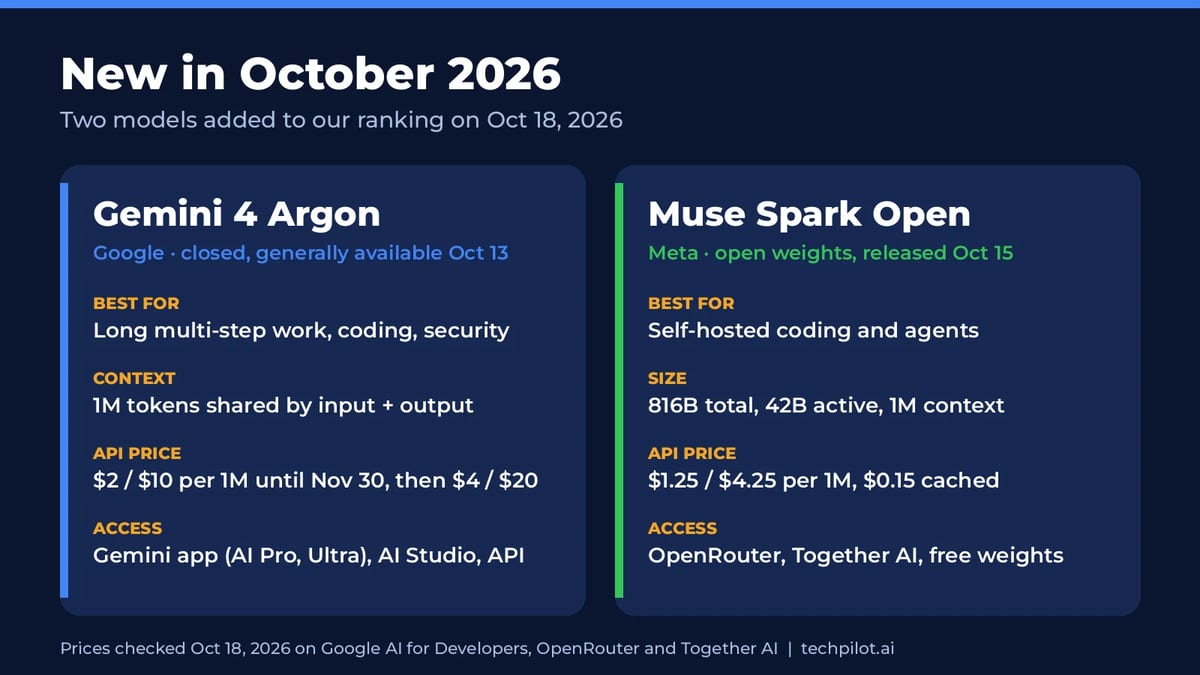
Google made Gemini 4 Argon generally available on October 13, after two weeks limited to cyber defenders. It is built for long jobs such as codebase refactors, finance and legal analysis, and security fixes. Input, thinking and output share a 1M-token window, and long decode lets one response run far past the usual 64K-token cap. Google reports first place on the Vals Index and a tie for first on CWE-bench v1 at 68%. API pricing on the paid tier is $2/$10 per million tokens until November 30, 2026, then $4/$20, with cached input at 95% off. There is no free API tier. In the Gemini app it comes with Google AI Pro and Ultra.
Watch out for: thinking tokens are billed as output, and hard prompts at high thinking can take several minutes.
Most capable open-weight model: Muse Spark Open
Meta released the weights of Muse Spark Open on October 15, calling it “the most capable US open-weight model to date.” It is an 816B-parameter mixture-of-experts model with 42B active parameters, a 1M-token context and native multimodal input, tuned for coding and agent work. Hosted, it costs $1.25 per million input tokens, $4.25 per million output tokens and $0.15 for cached input on both OpenRouter and Together AI. The weights are free on Hugging Face, but they ship under the Muse Model License with limited commercial terms rather than Apache 2.0 or MIT, and running it yourself takes server GPUs or two high-memory Mac Studios.
Choosing between the two? Our Muse Spark Open vs Gemini 4 Argon comparison covers price, benchmarks and when an open model makes more sense.
Still coming: Qwen 4
Alibaba said at its Apsara Conference on September 22 that Qwen 4 is still in training, and it has not given a release date. Until it ships, it doesn’t belong in a ranking of models you can actually use.
How to choose the right AI model
If you’re choosing a subscription
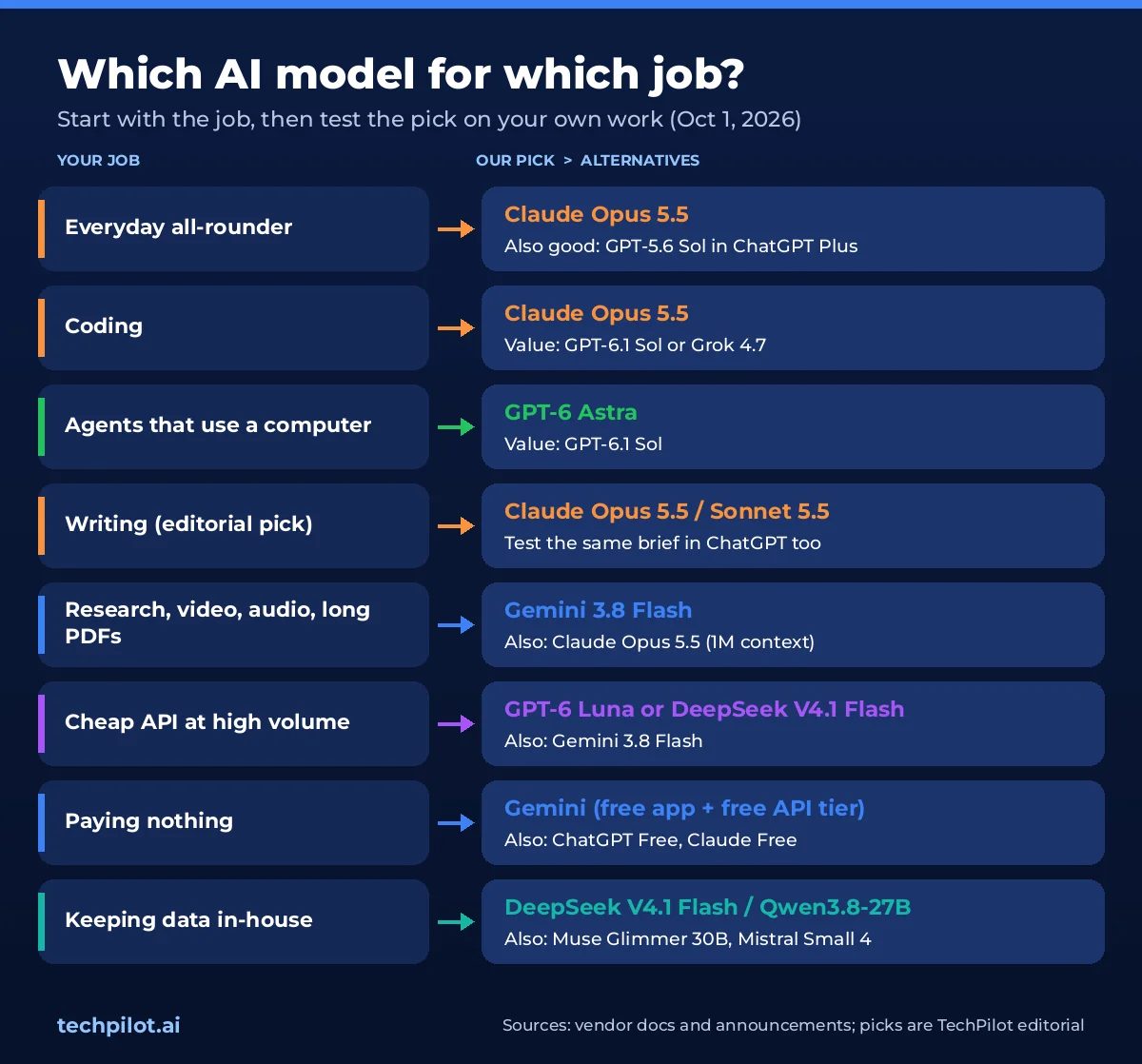
Choose the app first, then the model. For $20 a month, Claude Pro gets you Opus 5.5. ChatGPT Plus gets you GPT-6 Sol in Chat, plus GPT-6 Astra and GPT-6.1 Sol in Work and Codex. Google AI Pro, at $19.99, gets you Gemini 3.8 Flash in the Gemini app. If you want several models without several subscriptions, a multi-model workspace like Lorka AI bundles them in one plan.
If you’re choosing an API
Start with the cheapest model that passes your own evals, and move up only where it fails. A sensible ladder is GPT-6 Luna or Gemini 3.8 Flash, then GPT-6.1 Sol or Claude Sonnet 5.5, then Claude Opus 5.5, then GPT-6 Astra or Claude Fable 5.1 for the hardest tasks. Check long-prompt surcharges, and check whether batch or caching discounts apply to your workload. These often matter more than list price.
If you need control over your data
Self-host an open-weight model, such as DeepSeek V4.1 Flash on a server, or a smaller model like Qwen3.8-27B or Muse Glimmer 30B, which Meta says runs on a single GPU. Or use a cloud platform where the vendor offers data residency. OpenAI lists US and EU data residency for GPT-6.1 Sol. Anthropic’s models also run on Amazon Bedrock, Google Cloud and Microsoft Foundry.
Frequently asked questions
Which AI model is best in 2026?
For most people, Claude Opus 5.5 is the best AI model in 2026. It combines frontier-level results on Anthropic’s published tests, a 1M-token context window and API pricing of $4/$20 per million tokens, and it’s included in the $20-a-month Claude Pro plan. GPT-6 Astra is the stronger pick for agents that operate a computer, and Gemini 3.8 Flash is the better choice for research across video, audio and long PDFs.
Which AI model is best for coding?
Claude Opus 5.5 is our pick for coding. Anthropic reports 66.4% on Terminal-Bench 4.0 against 57.9% for GPT-6 Astra, and 57.8% on CursorBench 4.0. If cost matters more, GPT-6.1 Sol costs $2/$10 per million tokens, and OpenAI says it matches GPT-6 Astra on DeepSWE v1.1 at about one-fifth of the cost. Grok 4.7, at $2/$6, is another budget option.
Is GPT-6 better than Claude?
It depends on the task. OpenAI reports that GPT-6 Astra leads on computer use and business automation (72.6% on OSWorld 2.0 offline, 41.4% on AutomationBench). Anthropic reports that Claude Opus 5.5 leads on Terminal-Bench 4.0 and Humanity’s Last Exam with tools, at less than half of Astra’s API price. Each lab runs its own tests, so try both on your own work before you commit.
What is the best free AI model?
Gemini offers the most free access. The free Gemini app includes Gemini 3.6 Flash and limited access to Gemini 3.1 Pro, and Google AI Studio has a free API tier for Gemini 3.8 Flash. Free-tier API data may be used to improve Google’s products. ChatGPT Free offers unlimited text chats with GPT-6 Luna, and Claude Free includes Sonnet and Haiku but not Opus.
What is the cheapest good AI model for developers?
GPT-6 Luna costs $0.10 per million input tokens and $0.50 per million output tokens. DeepSeek V4.1 Flash costs $0.30/$1.20 at peak hours and half that off-peak. Gemini 3.8 Flash costs $0.75/$3.75 until December 31, 2026. If you need near-flagship quality, GPT-6.1 Sol at $2/$10 is the best value.
What is the best open-source AI model?
DeepSeek V4.1 Flash is the strongest open-weight model we found. It was released on September 10, 2026 under the MIT license, with a 1M-token context, but it needs server-class hardware. For smaller models you can run on your own hardware, look at Qwen3.8-27B (Apache 2.0) or Meta’s Muse Glimmer 30B (Apache 2.0), which Meta says runs on a single GPU. Mistral Small 4 and Large 3 are also Apache 2.0.
Is Gemini 4 available now?
Yes. Google made Gemini 4 Argon generally available on October 13, 2026. You can use it in the Gemini app with Google AI Pro or Ultra, and in Google AI Studio and the Gemini API on the paid tier. API pricing is $2 per million input tokens and $10 per million output tokens until November 30, 2026, then $4/$20.
Verdict
The best AI model in 2026 for most people is Claude Opus 5.5. It combines frontier-level results on Anthropic’s published tests, a 1M-token context and a $20 subscription price. Pick GPT-6 Astra if your work is agents that operate software, and Gemini 3.8 Flash if you research across video, audio and long PDFs, or want the best free tier. Builders should start with GPT-6.1 Sol or DeepSeek V4.1 Flash and move up only when their own tests demand it. For long, multi-step jobs, try Gemini 4 Argon, and if you need open weights with frontier-level ability, look at Muse Spark Open. With Qwen 4 still to come, expect this ranking to keep changing. Pick the model that fits today’s job, and design your stack so you can switch easily.
Found this useful? Share it with someone comparing AI tools.
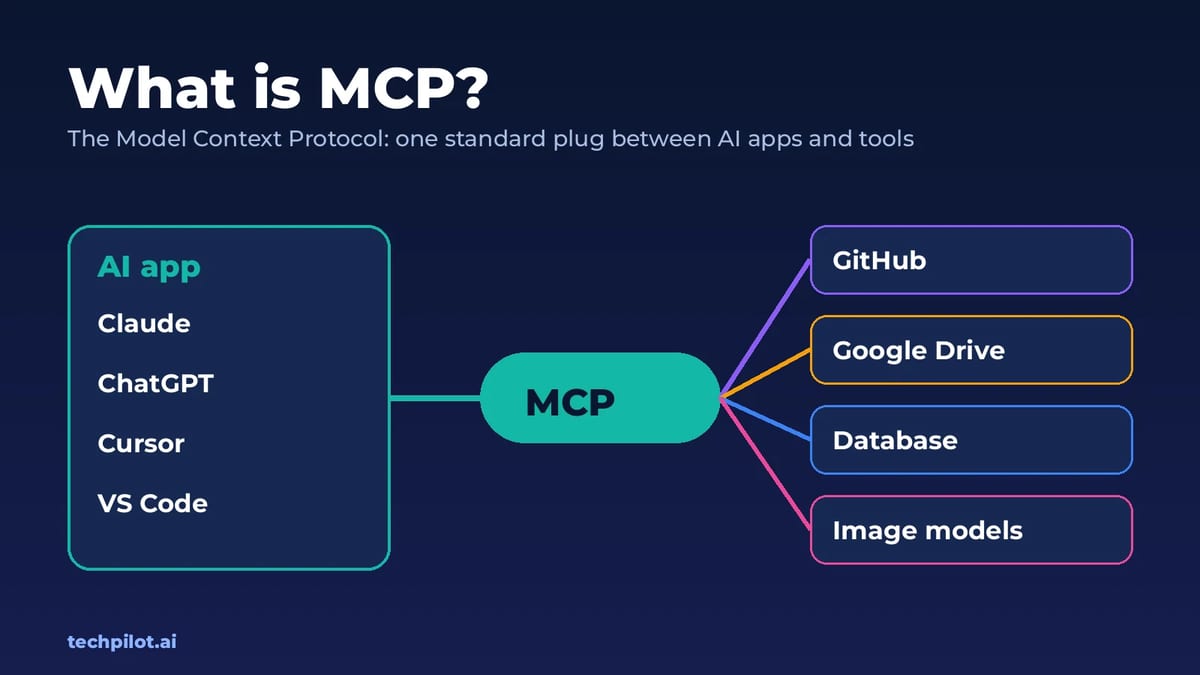
What Is MCP? Model Context Protocol Explained
What is MCP? The Model Context Protocol is an open standard that lets AI apps like Claude and ChatGPT use outside tools and data. Here’s how it works.
 Eimantas Kazėnas · 7 min read

Best Minecraft Server Hosting for AI Agents in 2026: 5 Providers Compared
Running LLM-powered bots in Minecraft? We compare five server hosts for AI agent experiments by CPU power, access, backups, and price.
 Mihai (Mike) Bizz · 5 min read