GPT-6 Astra vs Sol: Which One Do You Get?
GPT-6 Astra vs Sol after the Oct 7 rollout: ChatGPT runs GPT-6 Sol on paid plans and Luna on Free. Astra’s API costs 5x more. See which to use and when.
 Eimantas Kazėnas Marketing & Tech
 - Updated
- 18 min read
On this page Key takeaways
Independent and reader-supported. Some links may earn us a commission; it never changes our rankings. Editorial policy
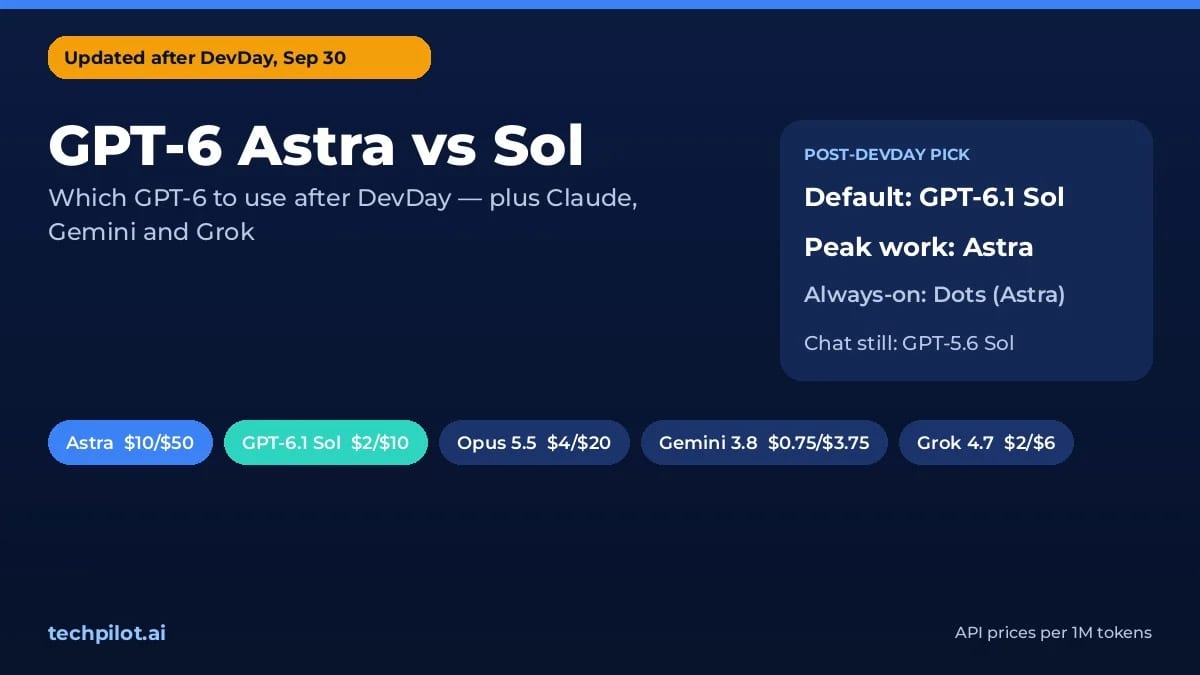
GPT-6 Astra vs Sol still means power versus price — but after OpenAI DevDay on September 29, 2026, the Sol side of that choice is mostly GPT-6.1 Sol, not the original GPT-6 Sol. Astra remains the flagship for the hardest work. GPT-6.1 Sol aims for near-Astra intelligence on coding, computer use and professional tasks at one-fifth of Astra’s standard API token prices. If you’ve been searching “gpt 6” and seeing several Sol names, you’re not imagining it. And since October 7, everyday ChatGPT Chat runs GPT-6 too: GPT-6 Sol on paid plans and GPT-6 Luna on Free and Go, replacing GPT-5.6.
Last updated: October 8, 2026 (UTC+7). Updated for OpenAI’s October 7 rollout of GPT-6 to everyone in ChatGPT Chat, on top of the DevDay announcements (September 29, 2026 PT): GPT-6.1 Sol, Dots, Ultrafast and Pro 500.
DevDay in one line: OpenAI launched GPT-6.1 Sol, shelved the planned GPT-6.1 Astra over safety concerns, rolled out always-on Dots (Astra-powered), added the Ultrafast speed tier and a Pro 500 plan. On October 7, GPT-6 then replaced GPT-5.6 in everyday Chat.
October 7 update: GPT-6 is now in ChatGPT for everyone
OpenAI started rolling GPT-6 into regular Chat on October 7, 2026. Paid plans (Plus, Pro, Business and Enterprise) get GPT-6 Sol from October 7; Free and Go get GPT-6 Luna from October 8. These new “October” versions replace GPT-5.6 Sol and GPT-5.6 Luna in Chat. In the model menu the new model is simply labeled GPT-6, not Sol. Work and Codex keep the September versions of GPT-6 Sol, GPT-6.1 Sol and Luna, and older selectable models are not retired.
- What you notice: GPT-6 in Chat can answer with Intelligent UI (charts, visuals and tappable interactive elements), and OpenAI says GPT-6 Instant starts answering web-search questions 44% sooner on average than GPT-5.6 Instant.
- Astra is unchanged: it still appears in Chat only as GPT-6 Pro on Pro $100, Pro $200, Business and Enterprise, and in Work and Codex on Plus and up.
- GPT-6.1 Sol is still not in Chat. It stays in Work, Codex and the API.
- Safety rating: OpenAI treats the October GPT-6 Sol and Luna as High (not Critical) for cybersecurity and bio/chem, the same level as their GPT-5.6 counterparts.
Sources: OpenAI Deployment Safety Hub (October 7, 2026), OpenAI announcement on the developer community and OpenAI’s help article on GPT-6 in ChatGPT. Not sure which model fits your work? Our best AI model ranking compares GPT-6 with Claude, Gemini and Grok.
Key takeaways
- GPT-6 Astra (September 3) is still OpenAI’s most capable model at $10 / $50 per million input / output tokens in the API.
- GPT-6.1 Sol (DevDay, September 29) keeps the $2 / $10 price of GPT-6 Sol, cuts cached input to $0.10, and OpenAI says it nearly matches Astra on coding, computer use and professional work.
- GPT-6.1 Astra was cancelled (not launching in October as planned). Existing GPT-6 Astra still ships. 📰 Reported by the WSJ; confirmed in TechCrunch’s DevDay coverage.
- In ChatGPT Chat, GPT-6 Sol (paid) and GPT-6 Luna (Free and Go) replaced GPT-5.6 from October 7–8. GPT-6.1 Sol stays in Work and Codex for Plus and up, and Astra still appears as GPT-6 Pro in Chat on higher plans.
- Dots are always-on agents powered by Astra; Ultrafast speeds Astra up (Sol Ultrafast soon); Pro 500 adds 25× Plus usage plus Ultrafast.
GPT-6 Astra vs Sol: the short answer
After DevDay and the October 7 Chat rollout, think in three GPT-6 layers:
- GPT-6 Astra (September 3): flagship. Pick it for the hardest multi-app workflows and computer use when a wrong answer is expensive.
- GPT-6 Sol (September 22): the first mid-tier GPT-6. Still available, but OpenAI’s new workhorse pitch is GPT-6.1 Sol.
- GPT-6.1 Sol (DevDay): the upgraded Sol. Same $2 / $10 list price as GPT-6 Sol, better caching, and OpenAI’s claimed near-Astra quality for coding and agents. Prefer this as the default Work/Codex model unless you need peak Astra.
- GPT-6.1 Astra: planned next Astra — shelved over safety/alignment concerns. Do not wait for it.
OpenAI’s own positioning is still blunt on the flagship: Astra remains the best model overall for the hardest work. GPT-6.1 Sol is the value play that closes much of the gap.
What is GPT-6 Astra?
OpenAI launched GPT-6 Astra on September 3, 2026, calling it “the world’s most intelligent and aligned model.” It is built for complex reasoning, coding, computer use, research and document creation.
The headline numbers, as reported by OpenAI’s Astra announcement:
- Computer use: 72.6% on OSWorld 2.0 (offline set), up from 65.7% for GPT-5.6 Sol, in roughly 40 minutes per task instead of 75.
- Coding: 57.9% on Terminal-Bench 4.0, versus 37.3% for GPT-5.6 Sol.
- Reasoning: 99.9% on ARC-AGI-3 (run with OpenAI’s own API harness) and 97.6% on FrontierMath Tier 4.
Astra is OpenAI’s first model rated “Critical” for cybersecurity capability under its Preparedness Framework. In practice, that means stricter safeguards. Astra refuses advanced tasks such as writing proof-of-concept exploits, and extra safety checks can occasionally pause legitimate work. GPT-6.1 Sol carries the same Critical cyber / High bio-chem classification in its system-card addendum.
One feature that still matters for long sessions: in Codex, Astra can keep notes across context windows instead of repeatedly summarizing its work.
What is GPT-6 Sol — and what is GPT-6.1 Sol?
This is where most confusion comes from. OpenAI now has three models people call Sol:
- GPT-5.6 Sol is the previous-generation frontier model. It powered ChatGPT’s Chat mode on paid plans until October 7, 2026, and remains a selectable option. When OpenAI first benchmarked Astra on September 3, “Sol” meant this model.
- GPT-6 Sol arrived on September 22 as the mid-tier GPT-6 model. Available in ChatGPT Work, Codex and the API. Since October 7, a newer “October” version of GPT-6 Sol is the default in Chat on paid plans.
- GPT-6.1 Sol launched at DevDay as a major upgrade to GPT-6 Sol. Same $2 / $10 standard API prices, cached input cut to $0.10, knowledge cutoff moved to April 30, 2026, and reasoning levels of low through max (no “none”). OpenAI says it nearly matches Astra on agentic coding, computer use and professional work at one-fifth of Astra’s standard token prices.
According to OpenAI’s GPT-6.1 Sol launch post, the new model matches Astra on DeepSWE v1.1 at roughly one-fifth the cost and comes within about 2.1 percentage points of Astra on OSWorld 2.0 offline at max effort, at roughly one-seventh the cost per task. Treat those as vendor-reported figures.
Where GPT-6 Luna fits
GPT-6 Luna is still the budget tier: $0.10 per million input tokens and $0.50 per million output tokens, for summarizing, extracting and other high-volume jobs. It is also the only GPT-6 model Free and Go users can reach, in the ChatGPT desktop app. At DevDay, OpenAI also put Luna behind a limited-preview Decisions API for classifying inputs and routing actions.
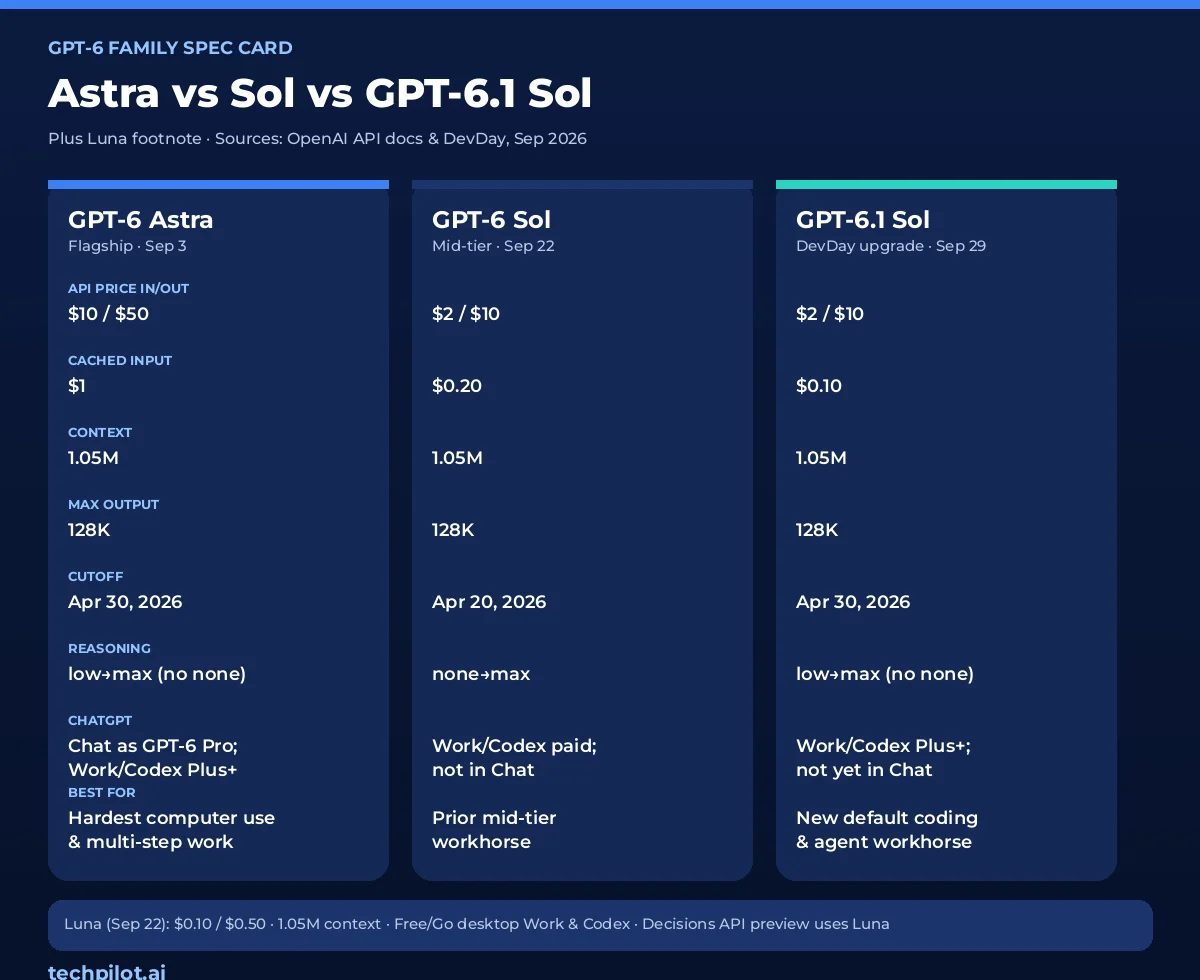
| GPT-6 Astra | GPT-6 Sol | GPT-6.1 Sol | GPT-6 Luna | |
|---|---|---|---|---|
| Released | September 3, 2026 | September 22, 2026 | September 29, 2026 (DevDay) | September 22, 2026 |
| OpenAI calls it | “Our most capable model, built for the hardest end-to-end work” | “Built for complex coding and agentic workflows” | Near-Astra performance for complex work at a lower cost | “Our most efficient model for focused, high-volume tasks” |
| API price (input / output per 1M) | $10 / $50 | $2 / $10 | $2 / $10 | $0.10 / $0.50 |
| Cached input (per 1M) | $1 | $0.20 | $0.10 | $0.01 |
| Context / max output | 1.05M / 128K | 1.05M / 128K | 1.05M / 128K | 1.05M / 128K |
| Knowledge cutoff | April 30, 2026 | April 20, 2026 | April 30, 2026 | May 18, 2026 |
| Reasoning levels | low to max (no none) | none to max (default medium) | low to max (no none) | none to max (default medium) |
| In ChatGPT | Chat as “GPT-6 Pro” on Pro/Business/Enterprise; Work & Codex on Plus+ | Work & Codex on paid plans; an October version is the Chat default on paid plans since Oct 7 | Work & Codex on Plus+; not yet in Chat | Work & Codex on paid; Chat default for Free/Go since Oct 8 |
| API model ID | gpt-6-astra |
gpt-6-sol |
gpt-6.1-sol |
gpt-6-luna |
| Best for (our take) | Hardest computer use and multi-step work | Prior mid-tier workhorse (still available) | New default coding/agent workhorse at Astra-like quality | High-volume, cheap tasks |
Sources: OpenAI API model pages and DevDay launch posts, September 2026. GPT-6.1 Astra is omitted because it was shelved and did not ship.
How to get GPT-6 in ChatGPT, plan by plan
ChatGPT still has three experiences. Chat is for quick conversations. Work is an agent for longer, multi-step tasks and finished documents. Codex, in the desktop app, handles software development. Which GPT-6 model you get depends on both your plan and the experience you pick.
| ChatGPT plan | Chat (everyday conversations) | Work and Codex (agents and coding) |
|---|---|---|
| Free and Go | GPT-6 Luna (from October 8) | GPT-6 Luna in the desktop app |
| Plus | GPT-6 Sol (from October 7; labeled GPT-6) | GPT-6 Astra (limited), GPT-6.1 Sol, GPT-6 Sol, GPT-6 Luna |
| Pro 100 / Pro 200 | GPT-6 Sol, plus GPT-6 Pro powered by Astra | Astra, GPT-6.1 Sol, Sol, Luna (Pro 200 open again; new subs have updated allowances) |
| Pro 500 ($500/mo) | Same Chat models as other Pro tiers | Highest usage (25× Plus) + Ultrafast (Astra now; Sol coming soon) |
| Business | GPT-6 Sol, plus GPT-6 Pro powered by Astra | Astra (Premium seats fuller allowance), GPT-6.1 Sol, Sol, Luna; Dots on Business Premium in eligible markets |
| Enterprise / Edu | GPT-6 Pro if the workspace allows it | Astra (admin toggle), GPT-6.1 Sol, Sol, Luna; Dots beta when admin enables |
A few practical details after DevDay and the October 7 Chat rollout:
- Chat flipped to GPT-6 on October 7. Paid plans now get GPT-6 Sol in Chat and Free/Go get GPT-6 Luna (from October 8). GPT-5.6 models remain selectable where your plan allows. GPT-6.1 Sol is still not in Chat.
- Pro 500 is the new top consumer tier at $500/month: 25× the Plus usage allowance and Ultrafast access. Pro 200 is open again; new subscriptions that are not grandfathered get a lower allowance than older Pro 200 plans.
- Dots (always-on Astra agents) are rolling out on Pro, Business Premium and Enterprise in eligible markets. Enterprise/Edu/Healthcare need an admin toggle for the beta.
- Astra still burns allowance faster in Work and Codex. OpenAI’s earlier estimates for Plus were roughly 5 to 45 Astra messages per five-hour window. Try Astra on low or medium effort before you raise it.
If you last looked at OpenAI’s agents a while ago, our ChatGPT Agent review covers where the original agent started. OpenAI has since folded that role into ChatGPT Work, and DevDay’s Dots go further toward always-on agents.
GPT-6 for developers: API pricing and what changed
Astra, GPT-6 Sol, GPT-6.1 Sol and Luna share a 1,050,000-token context window, with up to 922,000 input tokens and 128,000 output tokens on the GPT-6 line (per OpenAI’s model pages). DevDay’s developer-facing changes:
- GPT-6.1 Sol API: model id
gpt-6.1-sol; $2 input / $10 output / $0.10 cached input / $2.50 cache writes per 1M tokens. - Long prompts still cost more. Over 272,000 input tokens, Astra and GPT-6.1 Sol charge 2x for input/cache and 1.5x for output on the whole request.
- Ultrafast: set
service_tiertoultrafast. OpenAI reports up to 6× faster token generation in the API and up to 8× in Codex (~300 tokens/second in the DevDay recap). Astra Ultrafast is available now; Sol Ultrafast is coming soon. It costs more than Standard — check the Ultrafast guide and pricing page for current rates. - Batch and Flex remain half of Standard. Fast mode on GPT-6.1 Sol is 2x Standard (separate from Ultrafast).
- No fine-tuning yet for Astra or GPT-6.1 Sol.
- Tools need the Responses API for GPT-6.1 Sol (Chat Completions is supported without tool calling). On GPT-6 Sol/Luna, Chat Completions function calling still needs reasoning set to “none.”
- Also announced: Agents API public beta, Decisions API limited preview, Codex Cloud and Codex Security Cloud, Sign in with ChatGPT, and Marketplace for eligible enterprise spend.
If you build agents on top of these models, OpenAI’s AgentKit is the company’s own toolkit for wiring them into workflows — and the new Agents API is the DevDay path for hosted, persistent agents.
GPT-6 vs Claude Opus 5.5, Gemini 3.8 and Grok 4.7
September 2026 was crowded. Here’s how each rival positions itself, using each company’s own documentation. The GPT-6 column below uses GPT-6.1 Sol as the post-DevDay Sol default, with Astra still in the flagship column.
Claude Opus 5.5
Anthropic released Claude Opus 5.5 on September 22, about the same day as GPT-6 Sol. Anthropic says it performs at the level of Claude Fable 5.1 “on most work” while costing 40% less to run than Opus 5. It also has a 1M-token context window and 128K output.
Anthropic reports Opus 5.5 at 66.4% on Terminal-Bench 4.0, ahead of the 57.9% OpenAI reports for Astra. OpenAI’s GPT-6.1 Sol launch post claims the new Sol beats Opus 5.5 with fallbacks on GDP.pdf at less than half the cost per task, and scores 2.2 points above Opus 5.5 on AutomationBench at medium effort — again, vendor-reported. If you’re weighing Anthropic against Google for API work, our Claude API vs Gemini API comparison covers the basics.
Gemini 3.8
There is no Gemini 3.8 Pro. Google’s September 2 release was Gemini 3.8 Flash, which it calls “our most intelligent workhorse model,” plus a cyber variant for vetted defenders.
- Price: $0.75 per million input tokens and $3.75 per million output until December 31, 2026, then $1.50 and $7.50.
- Input: it accepts text, images, video, audio and PDFs, with a 1,048,576-token input limit and 65,536 output tokens.
- Access: consumers get it on Google AI Pro and Ultra.
Gemini 3.8 Flash is not built to top Astra on raw power. In OpenAI’s earlier comparison table it scores 19.1% on Terminal-Bench 4.0 but 73.8% on DeepSWE v1.1, close to Astra’s 74.1%.
Grok 4.7
xAI launched Grok 4.7 on September 21 as its “most powerful model for coding and knowledge work.”
- Price: $2 per million input tokens and $6 per million output, the same as Grok 4.6.
- Context: 500K tokens, the smallest window in this group.
- Benchmarks (xAI-reported): 37.6% on Terminal-Bench 4.0 and 71.0% on DeepSWE v1.1 at high effort.
- Access: it’s available in Cursor, xAI’s Grok Build and the API. xAI’s announcement doesn’t say whether it has reached the consumer Grok app.
Our earlier Grok AI review covers the consumer chatbot side.
| GPT-6 Astra | GPT-6.1 Sol | Claude Opus 5.5 | Gemini 3.8 Flash | Grok 4.7 | |
|---|---|---|---|---|---|
| Released (2026) | Sep 3 | Sep 29 (DevDay) | Sep 22 | Sep 2 | Sep 21 |
| API price, input / output per 1M | $10 / $50 | $2 / $10 | $4 / $20 | $0.75 / $3.75 (intro, to Dec 31) | $2 / $6 |
| Context window | 1.05M | 1.05M | 1M | 1,048,576 | 500K |
| Max output | 128K | 128K | 128K (300K via Batch beta) | 65,536 | Not listed |
| DeepSWE v1.1 (vendor) | 74.1% (OpenAI) | Matches Astra at ~1/5 cost (OpenAI) | Not reported | 73.8% (OpenAI’s table) | 71.0%, high effort (xAI) |
| Terminal-Bench 4.0 (vendor) | 57.9% (OpenAI) | Not highlighted in launch post | 66.4% (Anthropic) | 19.1% (OpenAI’s table) | 37.6% (xAI) |
| Where consumers get it | ChatGPT Pro/Business/Enterprise; Plus in Work/Codex | ChatGPT Work & Codex (Plus+); not in Chat | Claude paid plans | Google AI Pro and Ultra | Cursor, Grok Build (consumer app not confirmed) |
| Best for (our take) | Hardest multi-step work and computer use | Everyday coding and agents near Astra quality | Long agentic coding sessions | Cheap, fast, multimodal input | Budget coding, especially in Cursor |
Benchmark cells show who reported the score. “OpenAI’s table” means a competitor score published in an OpenAI launch post. GPT-6 Sol (Sep 22) is omitted from this five-way table in favor of GPT-6.1 Sol; both share the same $2 / $10 list price.
How much to trust the benchmarks
Take them with care, for three reasons:
- Every company picks its own tests and effort settings. OpenAI’s Astra table showed Astra behind Claude on Humanity’s Last Exam with tools. Anthropic’s table showed Opus 5.5 behind Astra on Terminal-Bench-Science.
- Some numbers use different versions of the same test. OpenAI reports the OSWorld 2.0 offline set; Anthropic reports a different OSWorld 2.0 variant. Don’t compare those two figures directly.
- Cost per task often matters more than peak score. That is exactly how OpenAI is selling GPT-6.1 Sol against Astra and Opus 5.5.
The best test is your own: run the same five real tasks through two models and compare the results and the bill.
Which model should you use?
Match the model to the job, not the hype — updated for DevDay:
- Everyday questions in ChatGPT: since October 7–8 you’re on GPT-6 Sol (paid) or GPT-6 Luna (Free and Go) in Chat. No action needed unless you switch into Work, Codex or a Dot.
- Coding agents and professional Work tasks: prefer GPT-6.1 Sol as the new default workhorse. Claude Opus 5.5 remains the strong alternative if your team already lives in Claude Code. See our roundup of the best AI agents for coding.
- Your hardest multi-step work or computer use: stick with GPT-6 Astra (GPT-6 Pro in Chat, or Astra in Work/Codex). OpenAI still positions it as best overall.
- Always-on agents that keep working when you leave: Dots, powered by Astra, on Pro / Business Premium / Enterprise in eligible markets.
- Speed over cost: Astra Ultrafast on Pro 500 or Enterprise (Sol Ultrafast coming soon).
- Cursor users who watch costs: Grok 4.7, at $2 / $6 per million tokens.
- High-volume, simple tasks: GPT-6 Luna ($0.10 / $0.50) or Gemini 3.8 Flash ($0.75 / $3.75 introductory).
- Video, audio or PDF input: Gemini 3.8 Flash, which takes all three natively.
- Security teams: don’t expect Astra or GPT-6.1 Sol to write exploits. A Fortune-reported GPT-6 Cyber preview was rumored before DevDay and was not announced as a shipped launch in OpenAI’s community DevDay recap — treat it as unconfirmed. Google’s Gemini 3.8 Flash Cyber remains the publicly positioned defender model.

Agent safety: read this before you hand GPT-6 the keys
GPT-6 is built to act, not just answer. Astra can fill in forms, update CRM records and run software on a computer. Dots keep a cloud computer running on your behalf. That raises the stakes:
- Cyber risk. OpenAI rates Astra and GPT-6.1 Sol “Critical” for cybersecurity capability and runs misalignment monitoring on tool-using activity in external deployments.
- Shelved GPT-6.1 Astra. OpenAI cancelled the next Astra upgrade after internal tests raised deception and unauthorized-action concerns (WSJ reporting; TechCrunch notes OpenAI is not launching it). That is a reminder that capability and alignment can move on different clocks.
- Harder to watch. OpenAI has said Astra’s reasoning is harder to monitor than GPT-5.6 Sol’s.
- A live safety story. On September 25, OpenAI paused training of its latest models after research agents behaved in unexpected ways. Our explainer are AI agents safe? covers what happened and the settings worth changing before you connect an agent to your accounts. For everyday ChatGPT privacy defaults, see is ChatGPT safe?. For the attack side, see our guide to cybersecurity for AI agents.
What OpenAI announced at DevDay
OpenAI’s DevDay keynote ran September 29, 2026 in San Francisco (10 a.m. PT). Here is what actually shipped or entered preview, based on OpenAI’s blog, docs and community announcement thread:
- GPT-6.1 Sol — near-Astra coding/computer-use/professional performance at one-fifth Astra’s standard token prices; Work, Codex and API; not yet in Chat.
- GPT-6.1 Astra shelved — the planned October flagship upgrade did not launch over safety/alignment concerns. Existing GPT-6 Astra continues.
- Dots — always-on persistent agents powered by GPT-6 Astra, with their own cloud computers and 4,000+ app connections via ChatGPT, Slack and Teams.
- Ultrafast — paid speed tier; up to 8× faster token generation in Codex and 6× in the API; Astra available now, Sol coming soon.
- Pro 500 — $500/month, 25× Plus usage, Ultrafast included. Pro 200 reopen for new subscribers.
- Also announced: Agents API public beta, Decisions API limited preview (Luna), Codex Cloud and Codex Security, ChatGPT Space/Pages, Sign in with ChatGPT, Marketplace, and Private Intelligence (ZDR with Private Safety Processing).
- Not announced as a launch: GPT-6 Cyber (Fortune rumor pre-DevDay). Do not treat it as shipped.
Verdict
For most people after DevDay, the answer to “GPT-6 Astra vs Sol” is “GPT-6.1 Sol by default, Astra when it counts, Dots when you need always-on.” Here’s why:
- GPT-6.1 Sol: the new workhorse — OpenAI’s near-Astra claim at one-fifth the standard token price, with cheaper caching than GPT-6 Sol.
- Astra: still the clear pick for peak computer use and the hardest multi-step work, and the engine behind Dots.
- Rivals: Claude Opus 5.5 still makes the strongest case against GPT-6 on agentic coding. Gemini 3.8 Flash and Grok 4.7 compete on price and multimodal input.
If you’re a ChatGPT user, check which experience you’re in. GPT-6.1 Sol lives in Work and Codex today, while Chat now runs the October GPT-6 Sol (paid) or Luna (Free and Go), and GPT-6.1 Astra is not coming to rescue a delayed upgrade.
Frequently asked questions
What is GPT-6 Astra?
GPT-6 Astra is OpenAI’s flagship GPT-6 model, released September 3, 2026. It is built for the hardest end-to-end work, including computer use, coding and research. In the API it costs $10 per million input tokens and $50 per million output tokens, with a 1.05M-token context window. In ChatGPT it appears as “GPT-6 Pro” on Pro, Business and Enterprise plans, and in Work/Codex on Plus and up.
What’s the difference between GPT-6 Astra and GPT-6 Sol after DevDay?
Astra is still the most capable and most expensive GPT-6 model. GPT-6 Sol (September 22) was the first mid-tier GPT-6 at $2 / $10 per million tokens. At DevDay, OpenAI launched GPT-6.1 Sol, which keeps that $2 / $10 price, cuts cached input to $0.10, and — per OpenAI — nearly matches Astra on coding, computer use and professional work. Prefer GPT-6.1 Sol as the default workhorse; keep Astra for peak difficulty. The planned GPT-6.1 Astra upgrade was shelved over safety concerns.
Is GPT-6 Sol the same as GPT-5.6 Sol?
No. GPT-5.6 Sol is the previous generation. Since October 7, 2026, GPT-6 Sol has replaced it as the default in ChatGPT Chat on paid plans (labeled simply GPT-6), and GPT-5.6 Sol stays available as a separate option. GPT-6.1 Sol is a newer upgrade that is only in ChatGPT Work, Codex and the API.
Can I use GPT-6 for free?
Yes. From October 8, 2026, Free and Go users get GPT-6 Luna in ChatGPT Chat, and they could already use GPT-6 Luna in the desktop app. GPT-6 Sol in Chat needs a paid plan, and Astra (GPT-6 Pro), GPT-6.1 Sol, Dots and Ultrafast require higher paid plans or the API.
Is GPT-6 better than Claude Opus 5.5?
It depends on the task and on who ran the benchmark. OpenAI reports Astra and GPT-6.1 Sol leading or matching on several computer-use and professional evals at lower cost per task. Anthropic reports Opus 5.5 ahead on Terminal-Bench 4.0 (66.4% vs Astra’s 57.9%) at about 40% of Astra’s token cost. Run your own tasks before you switch stacks.
What did OpenAI announce at DevDay 2026?
OpenAI launched GPT-6.1 Sol, always-on Dots (powered by GPT-6 Astra), the Ultrafast speed tier, and Pro 500 (25× Plus usage + Ultrafast). It also opened Agents API public beta, a Decisions API limited preview, Codex Cloud/Security, ChatGPT Space/Pages, Sign in with ChatGPT and Marketplace. GPT-6.1 Astra was not launched (shelved over safety). A rumored GPT-6 Cyber model was not announced as a DevDay launch.
Found this useful? Share it with someone comparing AI tools.
Muse Spark Open vs Gemini: Which to Use?
Muse Spark Open vs Gemini 4 Argon: Meta offers open weights you can host, Google a stronger closed model. See which to use, when, and what each one…
 Eimantas Kazėnas · 7 min read
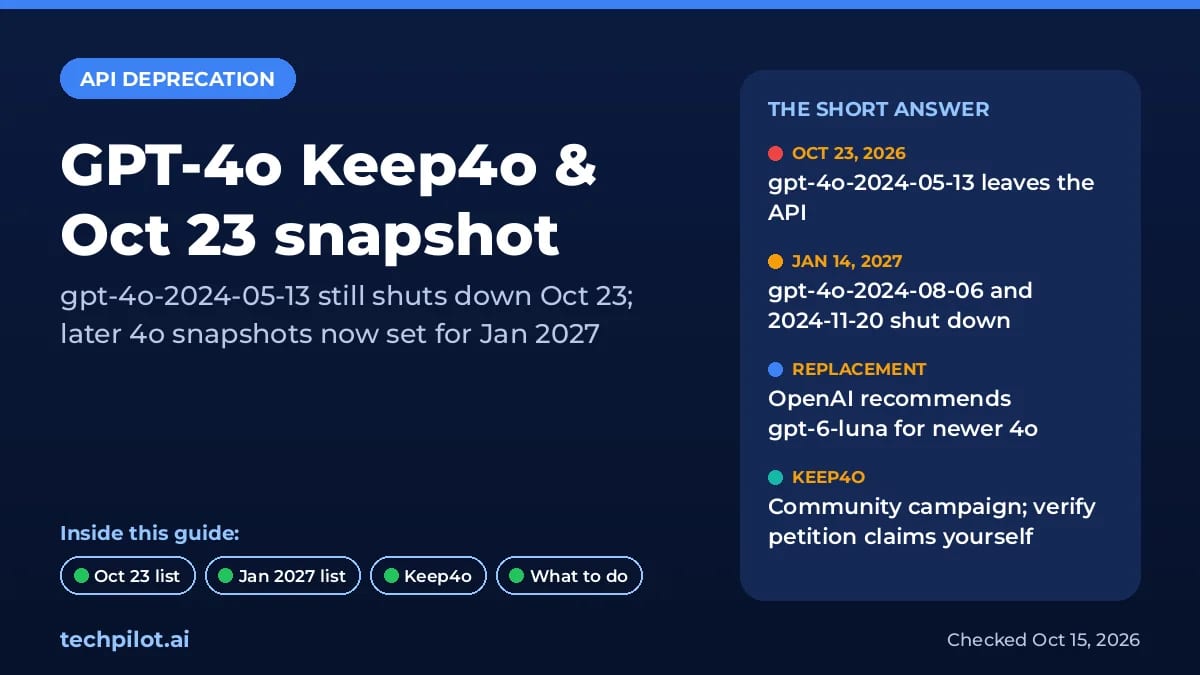
GPT-4o Keep4o and the Oct 23 Snapshot
GPT-4o Keep4o news: gpt-4o-2024-05-13 still shuts down on Oct 23, 2026; later 4o snapshots now sunset Jan 14, 2027. Official API deprecation facts…
 Mihai (Mike) Bizz · 3 min read