Muse Spark Open vs Gemini: Which to Use?
 Eimantas Kazėnas Marketing & Tech
 - Published
- 7 min read
On this page What each model is
Independent and reader-supported. Some links may earn us a commission; it never changes our rankings. Editorial policy
Muse Spark Open vs Gemini 4 Argon: Meta offers open weights you can host, Google a stronger closed model. See which to use, when, and what each one costs.
Both landed within days of each other. Google made Gemini 4 Argon generally available in the Gemini API on October 13, 2026, and Meta released the weights for Muse Spark Open on October 15. They are not really rivals for the same buyer, though. One is a model you can download, fine-tune and run on your own hardware. The other is a frontier model you rent by the token. Picking the right one depends on what you’re building, not on a leaderboard.
Quick verdict:
- Choose Gemini 4 Argon for the hardest coding, agent and reasoning work when sending data to Google is fine. It scores higher on independent tests.
- Choose Muse Spark Open when you need the weights: on-premises or air-gapped use, fine-tuning, no vendor lock-in, or a cheaper API for high-volume agent loops.
- Price: Muse Spark Open costs $1.25 per million input tokens and $4.25 per million output tokens on OpenRouter. Argon is $2 and $10 until November 30, then $4 and $20.
- Local use: only Muse Spark Open can run locally, and even its smallest builds need hundreds of gigabytes of memory.
What each model is
Muse Spark Open (Meta)
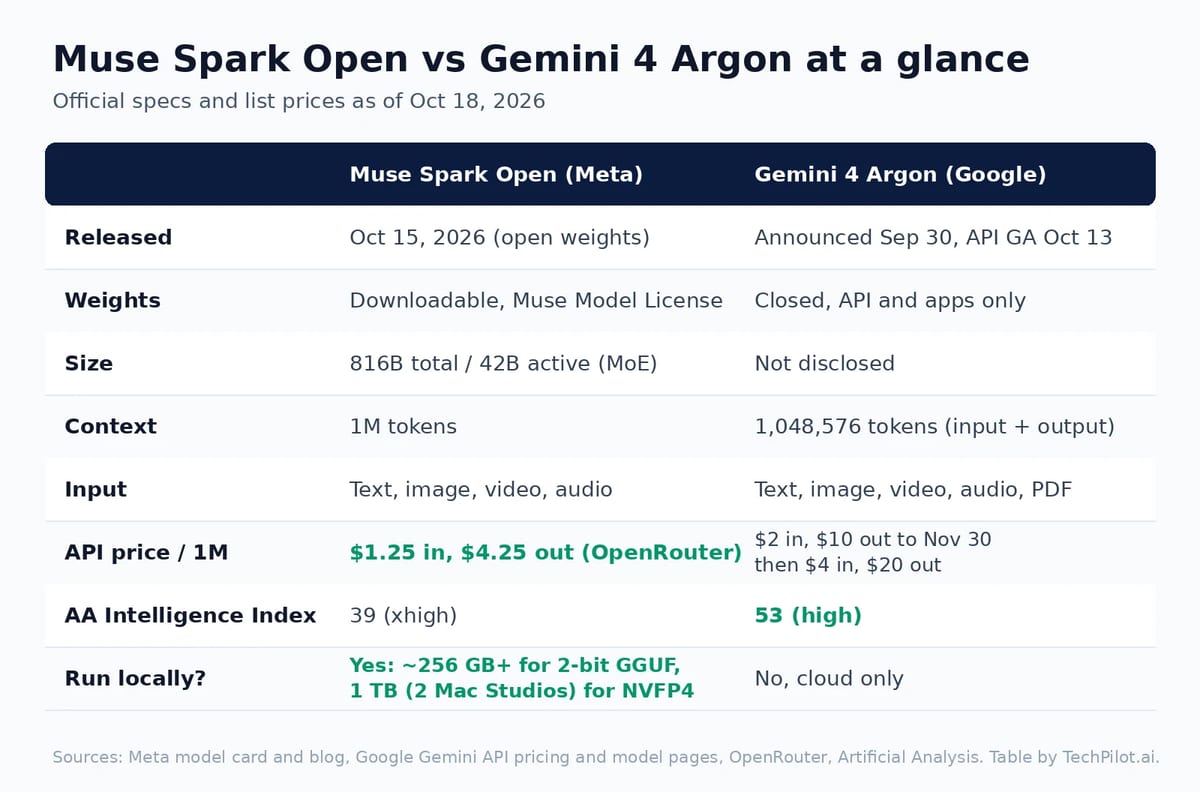
Muse Spark Open is the open-weight version of Meta’s Muse Spark. Per the official model card, it’s a mixture-of-experts model with 816B total parameters and 42B active per token, a 1M-token context window, and text, image, video and audio input with text output. Meta calls it “the most capable US open-weight model to date” and built it for coding and long agentic tasks. Reasoning effort is set to low, medium, high or xhigh, with xhigh as the default.
“Open” comes with conditions. The Muse Model License lets you use, modify, fine-tune and sell products built on it for free, but you must display “Built with Muse Spark Open” in your product or its docs. And if you sell model access as an API and your company’s revenue tops $20 million over 12 months, you need a separate agreement with Meta first. Internal use and features inside your own product are exempt from that clause.
If you’re comparing Meta’s own lineup, Muse Spark Open is not Meta’s top model. Its closed flagship, Muse Wonder, costs $4 and $20 per million tokens on OpenRouter, the same as Argon’s post-promo price. Our Meta Muse overview explains how the family fits together.
Gemini 4 Argon (Google)
Gemini 4 Argon (model ID gemini-4-argon) is Google’s flagship reasoning model. Google’s model page lists text, image, video, audio and PDF input, a 1,048,576-token context window shared by input and output, and “long decode” that lets one response run up to 1M output tokens instead of the default 65,536. Thinking levels are low, medium (default) and high. Google doesn’t disclose its parameter count, and there are no weights to download.
We first covered Argon when Google announced it on September 30 and only security partners could use it; see our Gemini 4 Argon release date and access guide for that backstory. Since October 13 it has been open to paid API customers.
Access: where you can use each one
| Route | Muse Spark Open | Gemini 4 Argon |
|---|---|---|
| Download weights | Yes, Hugging Face (gated: request access with a form), plus SageMaker, Google Cloud Model Garden and Microsoft Foundry | No |
| Pay-per-token API | Baseten, Fireworks AI, Groq (limited preview), Modal, Nebius, OpenRouter, Together AI | Gemini API paid tier only (not the free tier), also via OpenRouter |
| Chat app | No official Meta chat app for the open model; Ollama and LM Studio offer hosted cloud versions | Gemini app and AI Mode in Search for Google AI Pro and Ultra subscribers |
| Coding tools | Any OpenAI-compatible tool via your provider or local server | Google AI Studio, Antigravity (Ultra subscribers), plus tools like OpenCode and Vercel |
| Fine-tuning | Yes: TorchTitan, Hugging Face TRL, NeMo AutoModel, managed LoRA on Fireworks and Together AI | Not listed on Google’s Argon model page |
Cost: what you’d actually pay
Token prices, per million tokens, checked October 18, 2026:
- Muse Spark Open: $1.25 input, $4.25 output, $0.15 cached input (OpenRouter list price; Ollama Cloud and LM Studio Cloud list the same).
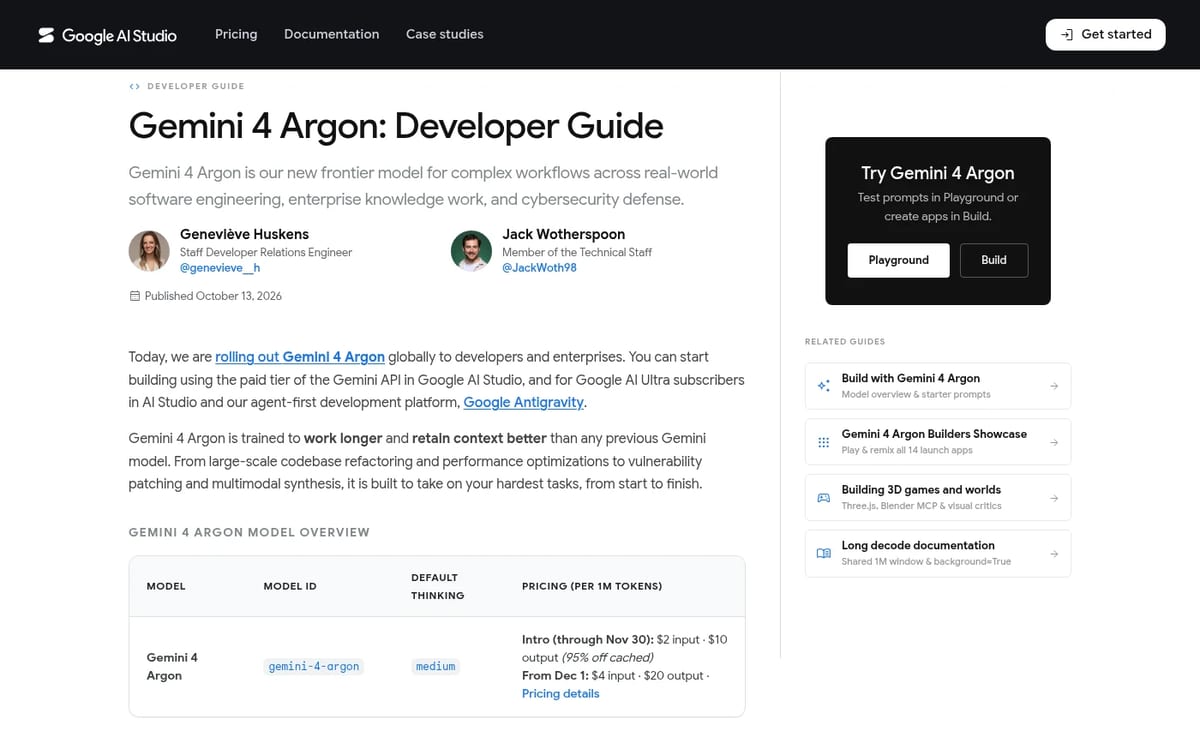
- Gemini 4 Argon: $2 input and $10 output through November 30, 2026, then $4 and $20 from December 1, per Google’s pricing page. Output includes thinking tokens. Cached input is $0.10, rising to $0.20.
A worked example: an agent job that reads 1 million tokens and writes 200,000 tokens costs about $2.10 on Muse Spark Open, $4.00 on Argon at the intro price, and $8.00 on Argon from December. Artificial Analysis, which runs both through the same test suite, puts the cost of one of its Intelligence Index tasks at $0.84 for Muse Spark Open and $1.99 for Argon.
Self-hosting is a different budget. Meta says its NVFP4 build serves on four Blackwell Ultra GPUs or eight H200s, and its model card asks for at least 700 GB of GPU memory for NVFP4. Unless you already own that hardware or have strict data rules, the API is far cheaper for most teams.
Benchmarks: what the numbers do and don’t say
The cleanest comparison comes from a third party. On Artificial Analysis’s Intelligence Index, Gemini 4 Argon (high) scores 53 and Muse Spark Open (xhigh) scores 39. That is a real gap. Argon ranks 8th of the 217 models in that comparison, while Muse Spark Open doesn’t even top the open-weight field: Meta’s own table shows GLM 5.3 at 45 and Kimi K3 at 44 on the same index.
The vendor numbers are harder to compare. Meta’s model card benchmarks Muse Spark Open only against other open-weight models, not Gemini. Highlights it reports: 89.2 on MCP-Atlas, 80.4 on OSWorld Verified, 76.4 on Terminal-Bench 2.1 and 60 on DeepSWE 1.1. Google reports 77.9% for Argon on DeepSWE v1.1. Both numbers come from each company’s own runs with different harnesses and settings, so treat them as a direction, not a head-to-head result.
Our take: if raw capability on the hardest tasks is the only thing that matters, Argon wins. Muse Spark Open’s case is control and cost, not topping charts.
Which one to use for what
- Hard coding agents and long refactors: Argon, especially with long decode for outputs past 65K tokens.
- High-volume agent loops and tool calling: Muse Spark Open. It’s cheaper per token and fast on hosted providers; Artificial Analysis measured about 131 output tokens per second.
- Regulated or private data: Muse Spark Open on your own servers or a private cloud instance, so prompts never leave your control.
- Custom behaviour: Muse Spark Open, since you can fine-tune the weights. Google’s Argon model page lists no tuning option.
- Audio or video understanding: both accept audio and video input. Argon also takes PDFs directly.
- Everyday chat, no code: Argon through the Gemini app if you already pay for Google AI Pro or Ultra.
Local vs API
“Open weights” doesn’t mean “runs on your laptop”. The full BF16 weights are about 1.6 TB, and even the smallest community 2-bit builds are over 200 GB. Meta’s showcase setup is two Mac Studios with M5 Ultra and 512 GB of memory each, linked over Thunderbolt 5. If that’s in reach, our step-by-step guide on how to run Muse Spark Open locally covers hardware, downloads and fixes. For everyone else, a hosted API gives you the same model without the hardware, and you can still switch providers or self-host later. For specs and pricing at a glance, see our Muse Spark Open tool page.
Frequently asked questions
Is Muse Spark Open better than Gemini 4 Argon?
Not on raw capability. Artificial Analysis scores Gemini 4 Argon (high) at 53 on its Intelligence Index and Muse Spark Open (xhigh) at 39. Muse Spark Open wins on control and price: you can download and fine-tune it, and its API costs less per token.
How much does Muse Spark Open cost?
The weights are free to download under the Muse Model License. Hosted, OpenRouter lists it at $1.25 per million input tokens, $4.25 per million output tokens and $0.15 for cached input.
How much does Gemini 4 Argon cost?
On the Gemini API paid tier, $2 per million input tokens and $10 per million output tokens through November 30, 2026, then $4 and $20 from December 1. It is not available on the free tier.
Can I run Gemini 4 Argon locally?
No. Google does not release Argon’s weights. You can only use it through the Gemini API, Google AI Studio, Antigravity, the Gemini app or partner platforms.
Is Muse Spark Open free for commercial use?
Mostly. The license allows commercial use for free but requires a visible Built with Muse Spark Open notice. Companies with more than $20 million in revenue that sell model access as an API need a separate agreement with Meta.
Do both models have a 1M-token context window?
Yes. Muse Spark Open supports 1M tokens at inference. Gemini 4 Argon has a 1,048,576-token window shared between input and output, with long decode allowing up to 1M output tokens in one response.
Found this useful? Share it with someone comparing AI tools.
OpenUI vs v0: Which One Do You Need?
OpenUI vs v0: OpenUI 1.0 turns AI agent replies into live UI inside your app, while v0 builds the app itself. Pricing from $0, use cases, who needs…
 Eimantas Kazėnas · 6 min read
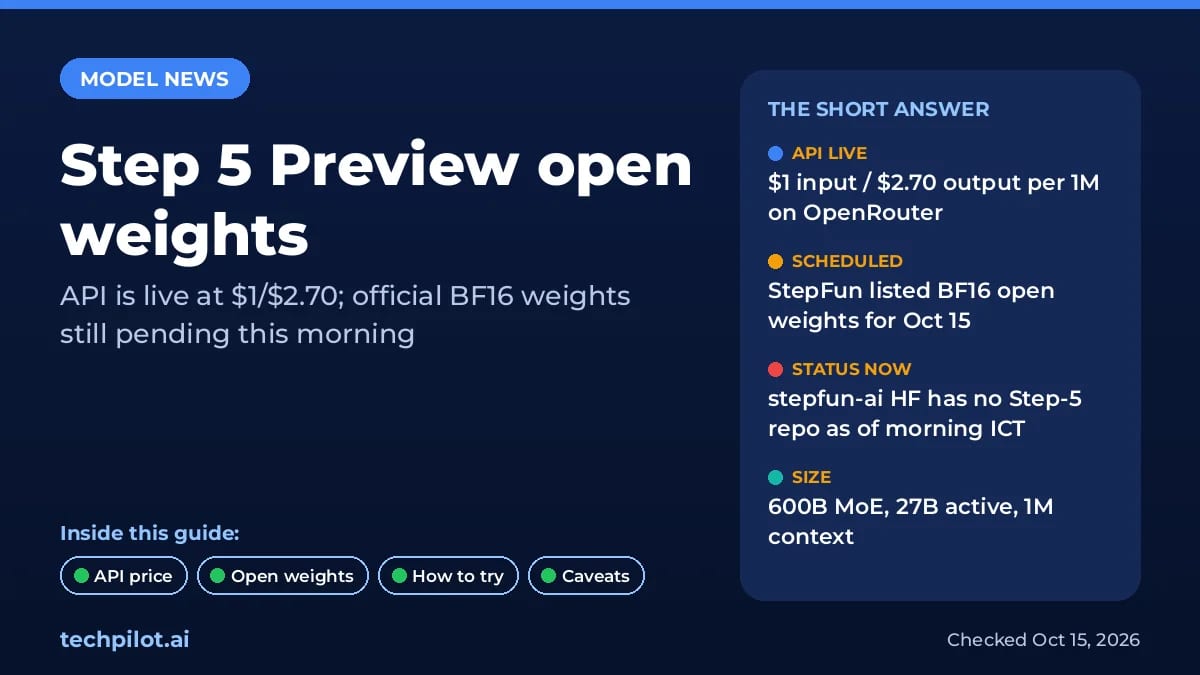
Step 5 Preview Open Weights Status
Step 5 Preview open weights were scheduled for Oct 15; the API is live at $1/$2.70 per 1M. Official HF status, pricing, and how to try it on StepFun…
Eimantas Kazėnas · 3 min read