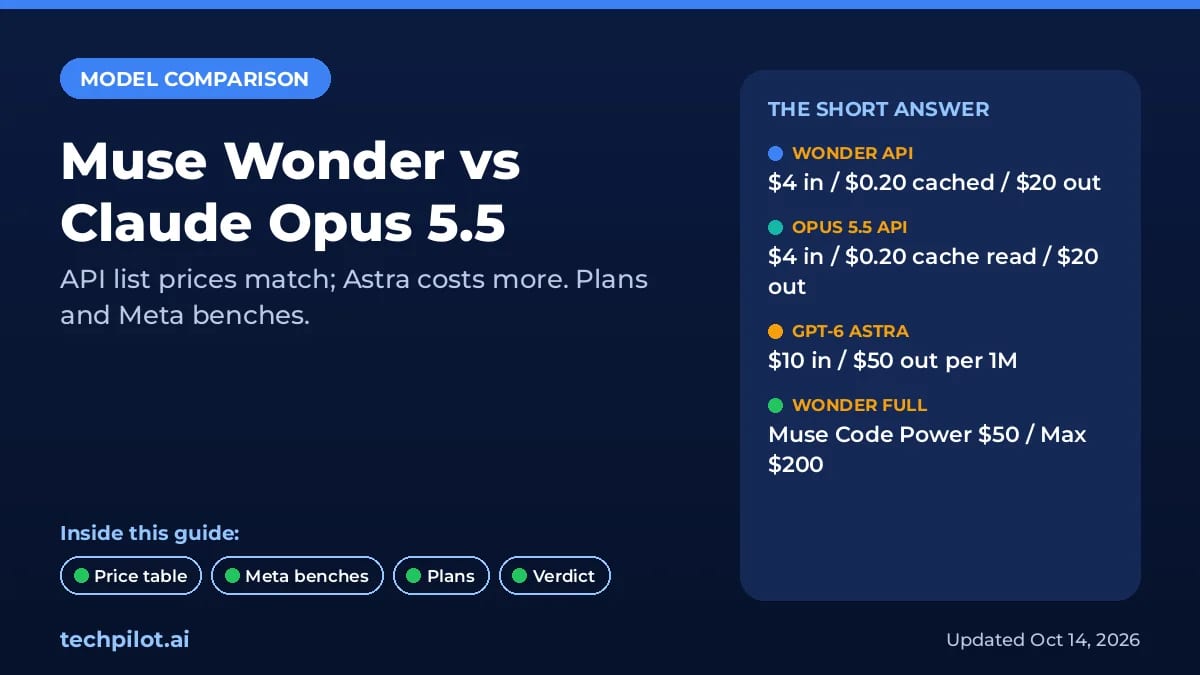
Muse Wonder puts Meta in the frontier race for agent and coding work, and the 1M context with cheap cached input suits long-running agents. At $4/$20 it is priced like Claude Opus 5.5, and on Meta’s own table Opus 5.5 still wins more rows.
AI Agents · Tool review
Muse Wonder: Pricing, Full & API (2026)
 TechPilot.ai review team Hands-on testing, one published method
 - Last updated
- How we test
Summary
Pros and cons
What we like
- Strong long-horizon coding Leads DeepSWE 1.1 and SWE-Marathon in Meta's table.
- 1M-token context Handles large codebases and long documents.
- Cheap cached input $0.20 per 1M tokens for repeated context.
- Several ways in Meta Model API, OpenRouter and Muse Code.
- Agent-ready Sub-agents, parallel tools and computer use.
What could be better
- Wonder Full is gated Only on $50 and $200 Muse Code plans.
- Not a budget model Same $4/$20 list price as Claude Opus 5.5.
- Self-reported benchmarks Few independent tests so far.
- Region limits Meta's developer site isn't available everywhere.
Key features
- Active Memory: Carries important details across conversations.
- Active Focus: Keeps working toward a goal and recovers from errors.
- Sub-agents: Plans long tasks and delegates parts to helper agents.
- Computer use: Operates browsers, desktop and mobile apps.
- Multimodal input: Text, images, video, audio and PDF documents.
- 1M-token context: Large repositories and long files in one request.
Screenshots
Full review
Independent and reader-supported. Some links may earn us a commission; it never changes our scores. Editorial policy
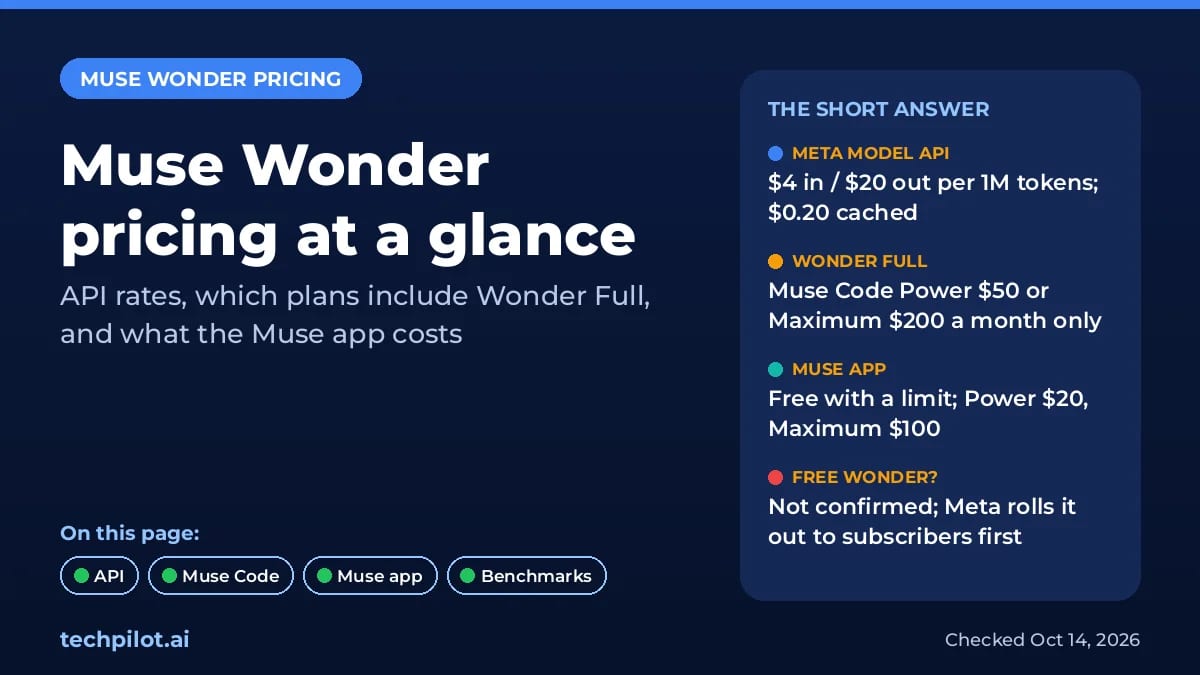
Muse Wonder pricing starts at $4 per 1M input tokens on Meta Model API, while Muse Wonder Full needs a $50 or $200 Muse Code plan. See each plan and limit.
Released on October 12, 2026, Muse Wonder and Muse Wonder Full are Meta’s most capable models so far, built for agents that work through long tasks rather than one-off answers. This page explains how the two models differ, what each one really costs, where you can use them today and what Meta’s own benchmark table does and doesn’t prove.
What is Muse Wonder?
Muse Wonder is a frontier reasoning model from Meta Superintelligence Labs and the successor to Muse Spark. Meta pitches it at personal and professional agent work: navigating an insurance claim, reading a lease, untangling finances or building a working app. It accepts text, images, video, audio and PDF files, returns text and has a context window of about 1 million tokens, according to its OpenRouter listing.
Two features stand out in Meta’s description. Active Memory carries the details that matter across conversations, and Active Focus keeps the model working toward a goal when a task gets hard, trying other approaches and checking in before anything important. Meta also says it plans long jobs, hands parts to sub-agents, calls tools in parallel and can operate browsers, desktop and mobile apps.
Don’t confuse the model with the app. Meta Muse is Meta’s personal AI agent for consumers, and it currently runs on Muse Spark. Meta says Muse Wonder will soon power more of Muse, starting with paying subscribers.
Muse Wonder vs Muse Wonder Full
- Muse Wonder (muse-wonder-1.0): the model developers can call today on Meta Model API, on OpenRouter and inside Muse Code. It has a public per-token price.
- Muse Wonder Full (muse-wonder-full-1.0): Meta calls it its most advanced model yet. It has no per-token price and isn’t offered on the API. You get it only through a Muse Code subscription on the Power or Maximum plan.
- Same context window: both are listed with a 1M-token context on Meta’s developer site.
In practice, Wonder is the model you build products on, while Wonder Full is a perk for developers who pay for Meta’s coding agent.
Muse Wonder Pricing (2026)
We checked Meta’s Muse Wonder model page and Muse Code plans on October 14, 2026. Meta’s developer site is region-restricted and showed us an unavailable notice from our location, so we confirmed the API rates against the archived page from October 13 and the live OpenRouter listing, which match.
| Muse Wonder on the API | Input | Cached input | Output | Context |
|---|---|---|---|---|
| Meta Model API (muse-wonder-1.0) | $4.00 per 1M tokens | $0.20 per 1M tokens | $20.00 per 1M tokens | 1M tokens |
| OpenRouter (meta/muse-wonder) | $4.00 per 1M tokens | $0.20 per 1M tokens | $20.00 per 1M tokens | 1M tokens, plus web search at $2.50 per 1,000 queries |
| Plan | Price | Muse Wonder | Muse Wonder Full | Usage |
|---|---|---|---|---|
| Muse Code Everyday | $5/month | Yes | No | 10 to 50 prompts every 5 hours |
| Muse Code High | $15/month | Yes | No | 5x Everyday |
| Muse Code Power | $50/month | Yes | Yes | 20x Everyday, early features |
| Muse Code Maximum | $200/month | Yes | Yes | 80x Everyday |
| Muse app Power / Maximum | $20 / $100 a month | Coming, subscribers first | Not announced | 500M / 3B Muse tokens a week |
What does that mean in money? A request with 100,000 input tokens and 10,000 output tokens costs about $0.60 on the API ($0.40 in, $0.20 out). If the 100,000 input tokens are cached, the input part drops to $0.02. That caching discount matters for agents, which resend the same long context many times.
For comparison, OpenRouter lists Claude Opus 5.5 at the same $4 and $20, while GPT-6 Astra and Claude Fable 5.1 cost $10 and $50 per 1M tokens. So Muse Wonder isn’t a budget model; it’s priced like Anthropic’s Opus tier. See our GPT-6 Astra vs Sol breakdown for OpenAI’s side.
Is Muse Wonder free? Not in any confirmed way. There’s no free API tier, and Meta says Wonder will reach the Muse app first for subscribers. Reports that free Muse users already get Wonder aren’t confirmed by Meta, so plan on paying.
Muse Wonder benchmarks: Meta’s own numbers
Meta published a comparison table on the model page. These are Meta’s figures, not an independent test, though Meta says its DeepSWE and SWE-Marathon results come from third-party runs. All models were scored at their highest reasoning setting.
| Benchmark | Wonder Full | Wonder | Claude Opus 5.5 | GPT-6 Astra | Claude Fable 5.1 |
|---|---|---|---|---|---|
| DeepSWE 1.1 (long coding) | 79.0 | 78.8 | 74.2 | 74.1 | 67.4 |
| SWE-Marathon | 57.5 | 53.1 | 46.3 | 42.5 | 45.6 |
| Terminal-Bench 4.0-AA | 57.1 | 52.0 | 59.6 | 59.1 | 52.0 |
| ProgramBench | 59.0 | 50.0 | 70.5 | 52.5 | 55.5 |
| OSWorld V2.1 (partial) | 78.4 | 72.6 | 81.8 | 75.8 | 80.7 |
| Artificial Analysis Index | 56 | 52 | 58 | 53 | 53 |
Our read: Wonder Full leads the long-horizon coding tests Meta highlights, but Claude Opus 5.5 still wins Meta’s own table on terminal coding, programming from scratch, computer use and the Artificial Analysis Index. The cheaper Wonder you can buy per token trails Opus 5.5 on most rows at the same price. Check our best AI model guide before switching.
How to use Muse Wonder
- Meta Model API: point an OpenAI SDK-compatible client at Meta Model API and use the model name muse-wonder-1.0. Meta opened the API as a preview for US developers.
- OpenRouter: call meta/muse-wonder with your OpenRouter key. This is the easiest route if Meta’s developer site isn’t available where you are.
- Muse Code: install Meta’s coding agent for macOS or Windows and pick a plan; Power or Maximum unlocks Wonder Full.
- Muse app: Meta says Wonder is coming to Muse soon, starting with subscribers.
Limitations
- Wonder Full is subscription-only: no API access and no per-token price.
- Region limits: Meta’s developer site and Muse aren’t available everywhere.
- Benchmarks are self-reported: independent results are still thin.
- Not cheap: same list price as Claude Opus 5.5, and output tokens cost five times input.
- No free access confirmed: free Muse users haven’t been promised Wonder.
Muse Wonder alternatives
- Claude Sonnet 4.5: Anthropic’s mid-tier model for coding and agents at a lower price.
- GPT-6 Astra and Sol: OpenAI’s flagship pair, with Sol much cheaper than Astra.
- Meta Muse: Meta’s consumer agent, free to start, if you want tasks done rather than an API.
TechPilot.ai’s Verdict on Muse Wonder
Muse Wonder puts Meta in the frontier race for agent and coding work, and the 1M context with cheap cached input suits long-running agents. At $4/$20 it is priced like Claude Opus 5.5, and on Meta’s own table Opus 5.5 still wins more rows.
Try it through OpenRouter on a real task before switching. Pay for a $50 Muse Code plan only if Wonder Full’s long-horizon coding results matter to your work.
Muse Wonder FAQ
Is Muse Wonder free?
No, not in a confirmed way. Meta Model API charges per token, Wonder Full needs a paid Muse Code plan, and Meta says Wonder will reach the Muse app first for subscribers.
•
How much does Muse Wonder cost?
On Meta Model API and OpenRouter, Muse Wonder costs $4 per 1M input tokens, $0.20 per 1M cached input tokens and $20 per 1M output tokens. Muse Code plans run from $5 to $200 a month.
•
What is Muse Wonder Full?
Muse Wonder Full is Meta’s most advanced model. It isn’t sold per token: you get it only with the Muse Code Power plan at $50 a month or the Maximum plan at $200 a month.
•
Is Muse Wonder available in the Muse app?
Not yet for everyone. Meta said on October 12, 2026 that Muse Wonder will soon power more of Muse and roll out first to subscribers on the $20 Power and $100 Maximum plans.
•
Is Muse Wonder better than Claude Opus 5.5?
On Meta’s own table, Wonder Full leads DeepSWE 1.1 and SWE-Marathon, but Claude Opus 5.5 scores higher on Terminal-Bench, ProgramBench, OSWorld and the Artificial Analysis Index, at the same $4/$20 price.
Flova AI
AI Agents
Flova is one of the more complete AI video agents we have looked at: it plans the whole project, uses current top models and lets you fix…

Coral
AI Agents
Coral is the first agent we’ve seen built for a whole family rather than one person, and the flat $20 for unlimited members is fair if your…

Solid
AI Agents
Solid takes the idea of an AI agent further than most: instead of stopping when it needs a server, an account or a payment, it gets those…