Muse Wonder vs Claude Opus 5.5
 Eimantas Kazėnas Marketing & Tech
 - Published
- 5 min read
On this page Muse Wonder vs Claude Opus 5.5 at a glance
Independent and reader-supported. Some links may earn us a commission; it never changes our rankings. Editorial policy
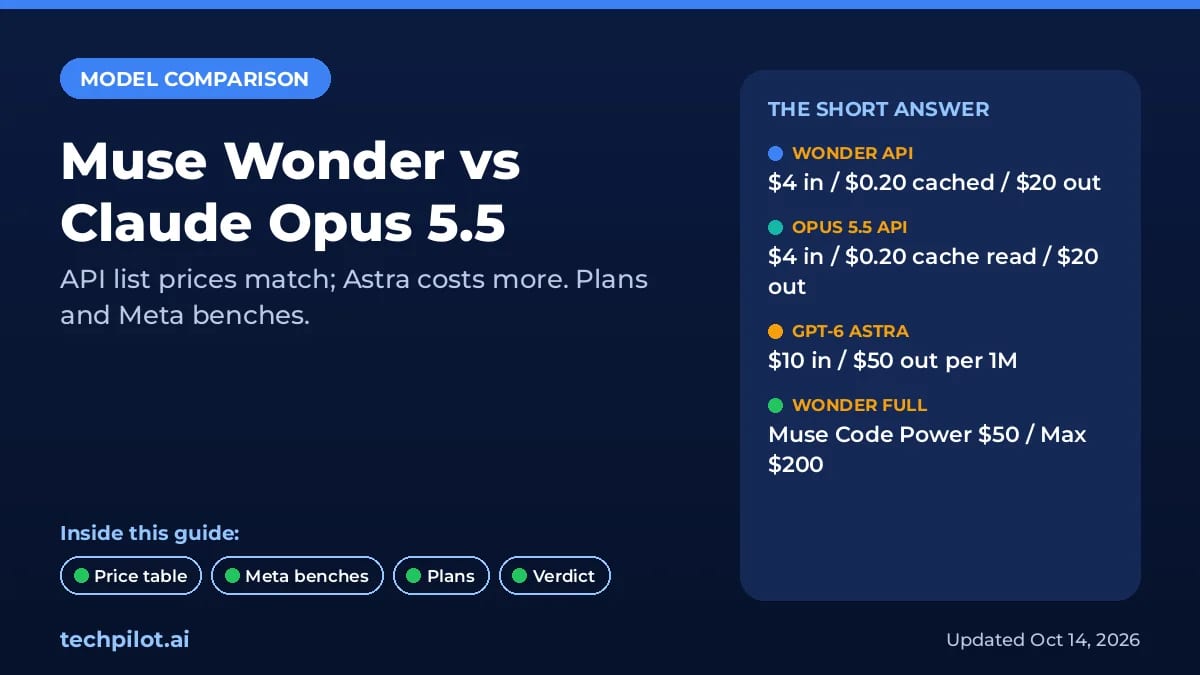
Muse Wonder vs Claude Opus 5.5: Meta and Anthropic both list $4/$20 per 1M API tokens; GPT-6 Astra is $10/$50. Plans, Meta’s benches, who should switch.
Meta launched Muse Wonder on October 12, 2026 for agentic coding, long-running agents and computer use. The question people ask next is simple: should you switch from Claude Opus 5.5 or GPT-6 Astra? We checked Meta, Anthropic and OpenAI pricing pages on October 14, 2026, and we treat Meta’s benchmark table as Meta’s numbers only.
Muse Wonder vs Claude Opus 5.5 at a glance
| Muse Wonder | Claude Opus 5.5 | GPT-6 Astra | |
|---|---|---|---|
| API input / 1M | $4 | $4 | $10 |
| API output / 1M | $20 | $20 | $50 |
| Cache read / 1M | $0.20 | $0.20 | $1 (Astra) |
| Cache write / 1M | — (not listed like Opus) | $5 | $12.50 |
| Context | 1M tokens | Up to 1M (varies by model) | ~1.05M |
| Best fit (our take) | Meta stack, long agents, computer use | Daily agentic coding on Anthropic | Hardest reasoning when budget allows |
Verified API prices (Oct 14, 2026)
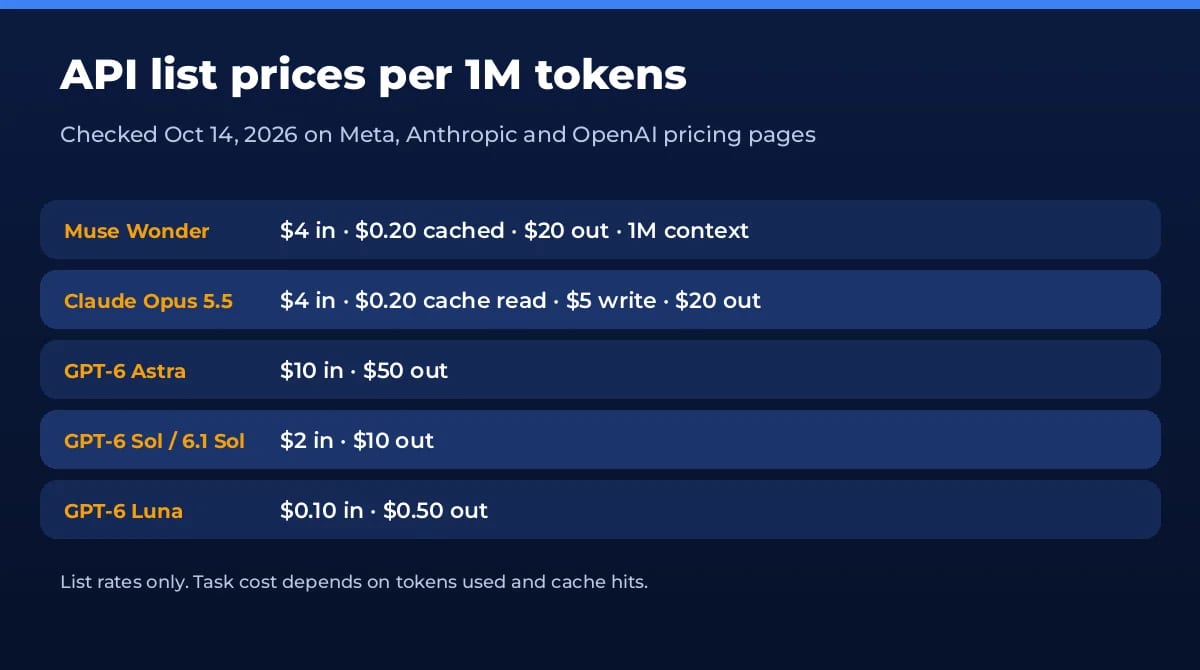
On Meta Model API pricing, Muse Wonder (muse-wonder-1.0) is $4 input, $0.20 cached input and $20 output per 1M tokens in Standard mode. Contributor mode is not available for Wonder on the API. Context is 1M tokens.
On Anthropic pricing, Claude Opus 5.5 lists $4 input and $20 output per MTok, with prompt-cache read at $0.20 and write at $5 (5-minute TTL). Those input and output list rates match Muse Wonder dollar for dollar.
For context against OpenAI, our GPT-6 Astra vs Sol post uses official list rates of $10 / $50 for Astra, $2 / $10 for GPT-6 Sol and GPT-6.1 Sol, and $0.10 / $0.50 for Luna. Astra is the expensive option on paper; Sol undercuts both Meta and Anthropic on list input and output.
Important: list rates are not task costs. A model that uses fewer tokens, hits cache more often, or finishes a coding job in fewer turns can still be cheaper even when sticker prices match. We are not claiming Muse Wonder is cheaper than OpenAI or Anthropic overall — only that Wonder and Opus share the same $4 / $20 API list.
Meta’s own benchmarks (label as Meta’s)
Meta publishes a comparison table on the Muse Wonder model page. Below are selected rows from that table (max scores). These are Meta-reported figures, not independent TechPilot.ai runs, and they should not be framed as proven wins.
| Benchmark (Meta table) | Wonder Full (max) | Wonder (max) | Opus 5.5 (max) |
|---|---|---|---|
| Artificial Analysis Index | 56 | 52 | 58 |
| DeepSWE 1.1 | 57.1 | 52.0 | 59.6 |
| SWE-Marathon | 79.0 | 78.8 | 74.2 |
| Terminal-Bench 4.0-AA | 85.5 | 85.6 | 81.5 |
| OSWorld V2.1 | 75.3 | 70.5 | 75.4 |
| Personal Superintelligence Index | 59.1 | 54.3 | 55.2 |
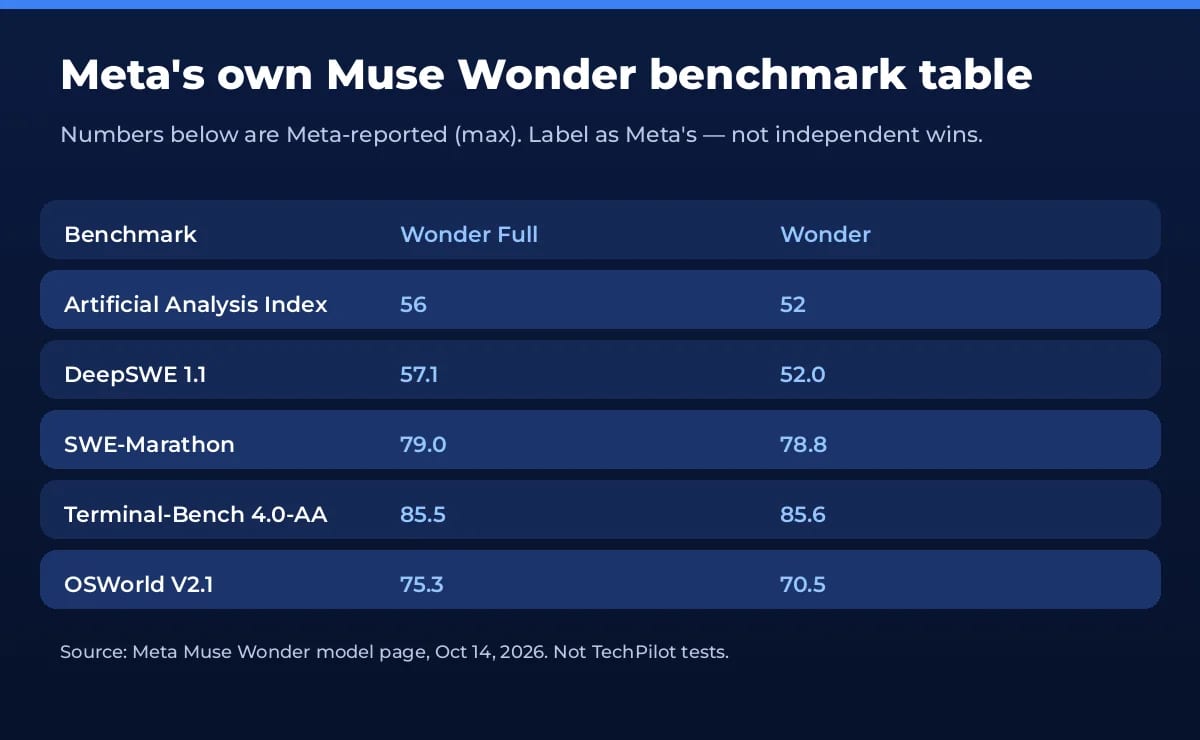
Reading Meta’s table honestly: Wonder Full leads several long-horizon coding rows Meta highlights (including SWE-Marathon), while Opus 5.5 leads Artificial Analysis Index and DeepSWE in the same sheet. GPT-6 Astra also appears in Meta’s columns on some agent rows. Pick the row that matches your workload; do not flatten the sheet into “Wonder beats everyone.”
Muse Wonder Full and app plans
Muse Wonder Full is Meta’s larger sibling. Meta says it is included with Muse Code on Power Usage at $50/month and Maximum Usage at $200/month — not on everyday pay-as-you-go Model API. Do not claim free Wonder Full access.
For product context on Meta’s Muse lineup, see our Meta Muse page and the new Muse Wonder tool page. If you are already deep in Claude for coding agents, our Claude Sonnet 4.5 review covers the Anthropic side of the stack.
Who should switch?
- Stay on Opus 5.5 if your agents, evals and team tooling already sit on Anthropic, and you want the same $4/$20 list without a vendor move.
- Try Muse Wonder if you want Meta Model API / Muse Code, long-running sub-agent workflows, or computer-use agents, and you are fine treating Meta’s benches as vendor data.
- Keep Astra for the hard cases when quality matters more than the 2.5x list premium, and use Sol ($2/$10) for volume work.
- Do not switch for “free Wonder” — API Wonder is paid; Full needs Muse Code Power or Maximum.
Our take: on sticker price, Muse Wonder and Opus 5.5 are peers. The real decision is ecosystem (Meta vs Anthropic vs OpenAI), agent tooling, and whether Meta’s long-horizon coding rows matter more to you than the rows where Opus still leads on Meta’s own sheet.
Frequently asked questions
Is Muse Wonder cheaper than Claude Opus 5.5?
On Meta Model API and Anthropic’s public API list prices, both charge $4 input and $20 output per 1M tokens. Cache reads are $0.20 on both. Opus also lists a $5 cache-write rate. Same list rates does not mean the same bill: token use and cache hits decide the invoice.
What does Muse Wonder Full cost?
Muse Wonder Full is not on Meta Model API pay-as-you-go. Meta says it is included with Muse Code on the Power Usage ($50/month) and Maximum Usage ($200/month) plans.
How does GPT-6 Astra compare on price?
OpenAI lists GPT-6 Astra at $10 input / $50 output per 1M tokens — 2.5x the input and output list rates of Muse Wonder and Opus 5.5. GPT-6 Sol / 6.1 Sol list at $2 / $10; Luna at $0.10 / $0.50.
Should I trust Meta’s Muse Wonder benchmarks?
Treat them as Meta’s own numbers. On Meta’s table (max), Wonder Full leads some coding rows such as SWE-Marathon, while Opus 5.5 leads others such as Artificial Analysis Index and DeepSWE. We do not claim independent wins.
Where can I try Muse Wonder?
Muse Wonder runs on Meta Model API (model muse-wonder-1.0) and Muse Code. See our Muse Wonder tool page for plans. For the broader Muse lineup, see Meta Muse.
Found this useful? Share it with someone comparing AI tools.