Ultramarine 1 Flash is a cheap, focused model worth testing if you build agents that produce spreadsheets, decks and memos. At $0.15 / $0.50 per 1M tokens, a long multi-step task costs cents.
AI Agents · Tool review
Ultramarine 1 Flash: Pricing & Open Weights
 TechPilot.ai review team Hands-on testing, one published method
 - Last updated
- How we test
Summary
Pros and cons
What we like
- Very low cost $0.15 input and $0.50 output per 1M tokens.
- Built for deliverables Trained on Excel, PowerPoint and Word style professional tasks.
- Familiar APIs OpenAI SDK compatible, plus an Anthropic-style Messages endpoint.
- Strong vendor results Leads 3 of 6 charts on Paper Instruments' own benchmarks.
- Open weights promised Self-hosting should follow.
What could be better
- Weights not released yet Coming soon with no official date.
- Self-reported benchmarks One of the six tests is internal.
- Single API provider Only Paper Instruments' own endpoint.
- Prepaid balance needed Requests reserve their maximum cost first.
Key features
- Knowledge-work focus: Finance, law, consulting and operations tasks.
- Office deliverables: Built to produce Excel workbooks, PowerPoint decks and Word documents.
- Low token prices: $0.15 input, $0.03 cached, $0.50 output per 1M tokens.
- OpenAI-compatible API: Model ultramarine-1-flash at api.paperinstruments.com/v1.
- Max reasoning by default: Recommended setting for best results.
- GLM-5.3 Flash base: Reinforcement learning on top of an open model.
Screenshots
Full review
Independent and reader-supported. Some links may earn us a commission; it never changes our scores. Editorial policy
Ultramarine 1 Flash costs $0.15 input and $0.50 output per 1M tokens on the Paper Instruments API. See what the open model does, benchmarks and weights.
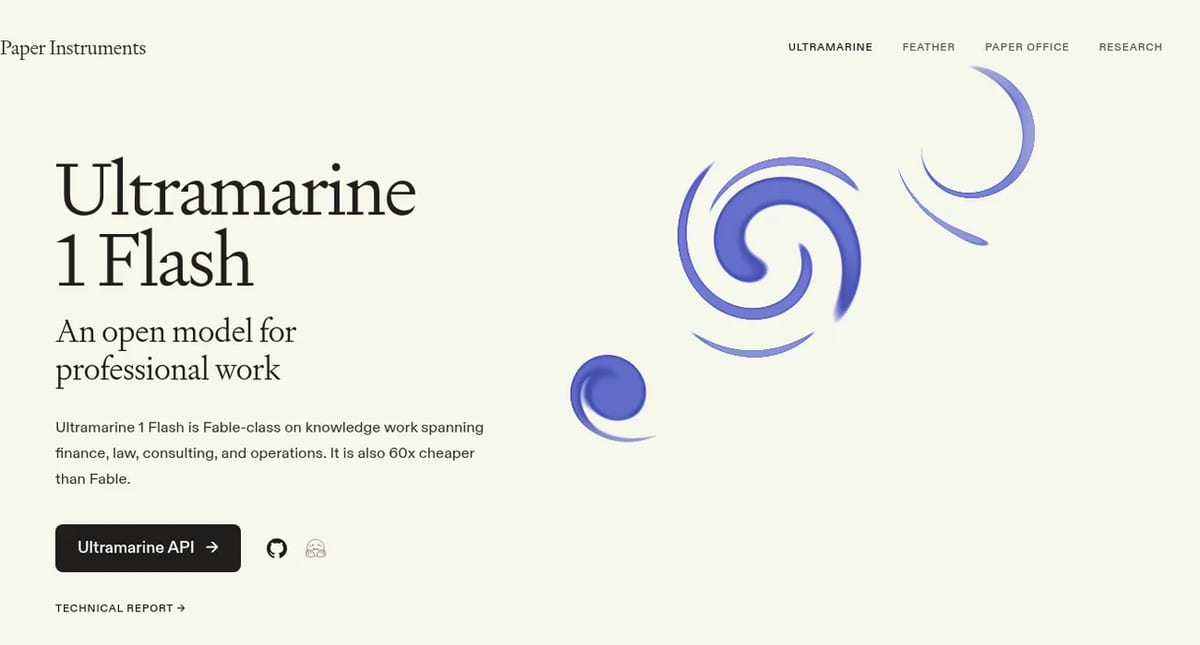
Paper Instruments, a small AI lab, released Ultramarine 1 Flash on October 14, 2026. It is an agentic model trained for professional knowledge work in finance, law, consulting and operations, and the company pitches it as close to frontier quality at a tiny fraction of the cost. The API is live now; the open weights are not out yet. This page covers verified API pricing, what the model is built to do, the vendor’s benchmark claims and how to call it.
What is Ultramarine 1 Flash?
Ultramarine 1 Flash is a post-trained version of an existing open model. According to Paper Instruments’ technical report, the team applied large-scale reinforcement learning to GLM-5.3 Flash as the base, using expert-written tasks graded with detailed rubrics instead of answers that can be checked automatically. The goal is client-ready deliverables: the model’s tasks ask it to produce finished Excel workbooks, PowerPoint decks and Word documents, and to work inside business systems.
Paper Instruments ships tools around the model too. Feather is its agent harness and app, and Paper Office includes paper-docx, paper-pptx and paper-xlsx, forks of the common Python libraries for Word, PowerPoint and Excel files. The company says Ultramarine also generates 6.5% fewer output tokens than its GLM-5.3 Flash base across its six benchmarks.
Ultramarine 1 Flash Pricing (2026)
We checked the Ultramarine API billing docs, the product page and the public pricing endpoint on October 16, 2026. All three show the same rates:
| Token type | Price per 1M tokens |
|---|---|
| Input (uncached) | $0.15 |
| Cached input | $0.03 |
| Output, including reasoning | $0.50 |
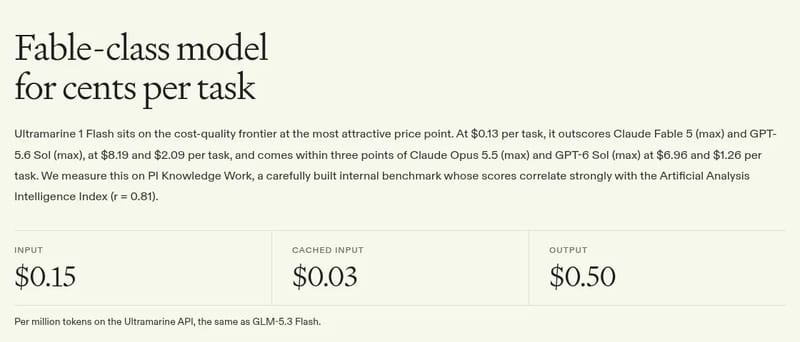
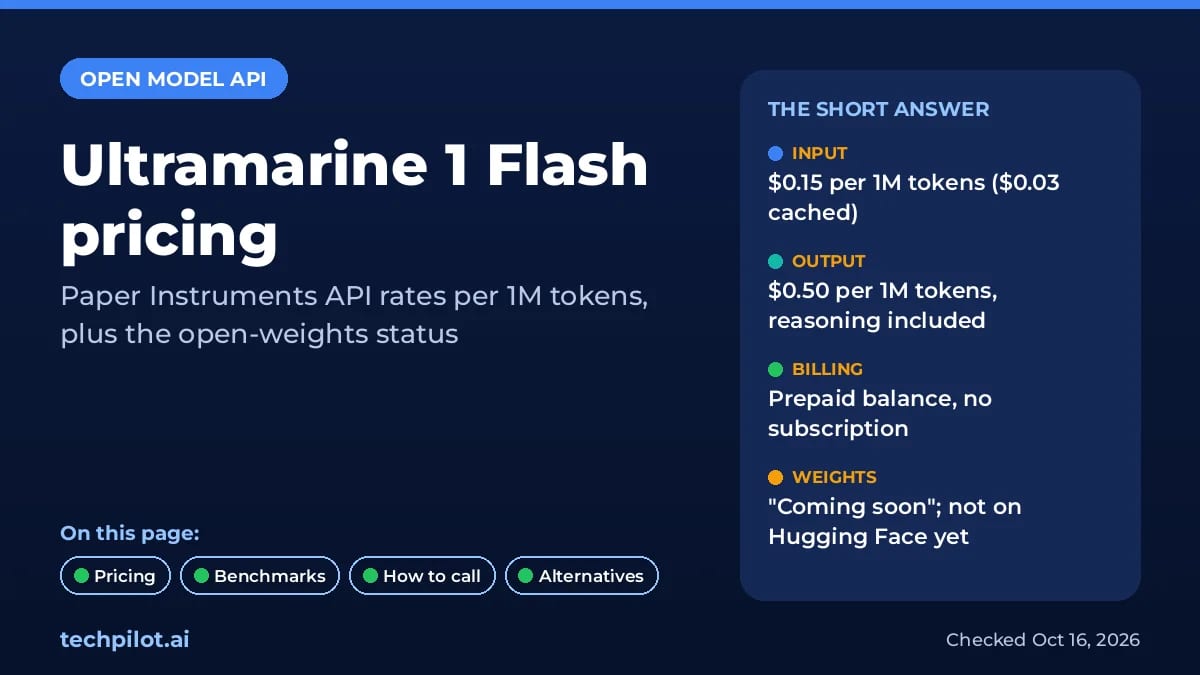
Billing is prepaid. You add funds through Stripe in the console (auto top-up is optional), and each request reserves its maximum possible cost before it runs, then releases what it didn’t use. Setting max_completion_tokens keeps that reservation small; if you leave it out, the API reserves funds for the full output ceiling. Paper Instruments’ own example: 20,000 uncached input tokens and 1,000 output tokens cost $0.0035.
The headline cost claim is the vendor’s: on its internal PI Knowledge Work benchmark, Paper Instruments says Ultramarine costs about $0.13 per task, against $8.19 for Claude Fable 5 and $2.09 for GPT-5.6 Sol at max reasoning, which is where the “60x cheaper than Fable” line comes from. For comparison with other low-cost models we cover, see Step 5 Preview at $1.00 / $2.70 per 1M tokens.
Benchmarks (Paper Instruments’ own numbers)
These results come from Paper Instruments’ product page and technical report, not an independent leaderboard. One of the six, PI Knowledge Work, is the company’s internal benchmark.
| Benchmark | Ultramarine 1 Flash | Top score in the vendor’s chart | Ultramarine’s place |
|---|---|---|---|
| JobBench | 62.9 | Ultramarine 1 Flash (62.9) | 1st |
| PI Knowledge Work (internal) | 59.3 | Ultramarine 1 Flash (59.3) | 1st |
| FrontierFinance | 53.3 | Ultramarine 1 Flash (53.3) | 1st |
| AutomationBench | 50.2 | DeepSeek V4.1 Flash (51.3) | 2nd |
| DiligenceBench | 50.6 | Gemini 3.8 Flash (53.1) | 3rd |
| APEX-Agents 1.1 | 57.0 | Gemini 3.8 Flash (64.3) | 3rd |
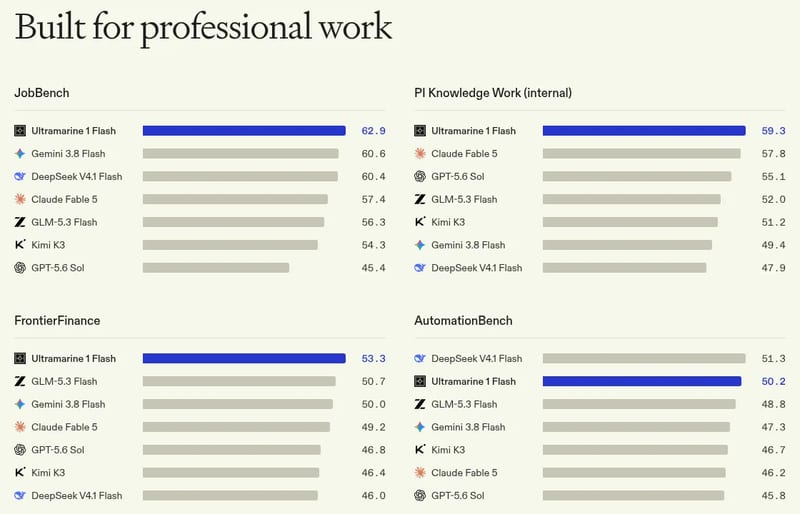
Read it honestly: Ultramarine leads three of the six charts, including the internal one, and trails Gemini 3.8 Flash and Claude Fable 5 on the agent-heavy APEX-Agents test. The report also says it comes within about three points of Claude Opus 5.5 and GPT-6 Sol at max reasoning on PI Knowledge Work. That’s a strong showing for a cheap model, but test it on your own documents before you trust it with client work.
Open weights status
The product page calls Ultramarine 1 Flash “an open model”, but its Hugging Face link still read “Model weights coming soon” on October 16, 2026, and we found no Ultramarine repository on Hugging Face. Launch-week coverage on X put the release at about two weeks after launch; Paper Instruments’ own page gives no date. Until the weights land, the hosted API is the only way to use it. Our open-source vs closed-source AI guide explains what open weights do and don’t give you.
How to call Ultramarine 1 Flash
- Create an account in the Paper Instruments console, add funds on the Billing page and create an API key.
- Use the OpenAI SDK with base URL https://api.paperinstruments.com/v1 and model ultramarine-1-flash.
- Keep the defaults: the API uses max reasoning effort by default, and Paper Instruments recommends it with streaming on.
- Set max_completion_tokens to cap the reserved cost per request.
- Anthropic-style clients: the docs also cover a Messages endpoint for the Anthropic SDK, Claude Agent SDK and Claude Code.
Who it’s for
Ultramarine 1 Flash targets analysts, consultants, lawyers and operations teams who produce spreadsheets, decks and memos, and developers building agents for that kind of work on a tight budget. At these rates you can run long multi-step jobs for cents. If your work is mostly coding or general chat, a general-purpose model is likely a better fit.
Limitations
- No weights yet: “coming soon” with no official date, so no self-hosting today.
- Vendor benchmarks: every score above is self-reported, and one benchmark is internal.
- Single provider: we found it only on Paper Instruments’ own API.
- Prepaid only: you need a funded balance; requests fail with insufficient_quota if it can’t cover the reservation.
- Context window not listed: the API docs we checked don’t state a maximum context length.
Ultramarine 1 Flash alternatives
- Step 5 Preview: StepFun’s 1M-context agent model at $1.00 / $2.70 per 1M tokens.
- Muse Wonder: Meta’s new frontier model at $4 / $20 per 1M tokens.
- Claude Sonnet 4.5: Anthropic’s mid-tier model for agents and documents.
- Best AI model guide: how we compare models without chasing every launch score.
TechPilot.ai’s Verdict on Ultramarine 1 Flash
Ultramarine 1 Flash is a cheap, focused model worth testing if you build agents that produce spreadsheets, decks and memos. At $0.15 / $0.50 per 1M tokens, a long multi-step task costs cents.
Keep the claims in perspective: the benchmarks are Paper Instruments’ own, and the open weights aren’t out yet. Use the API for trials now and revisit self-hosting once an official release appears.
Ultramarine 1 Flash FAQ
Is Ultramarine 1 Flash free?
No. The Ultramarine API is pay as you go from a prepaid balance: $0.15 per 1M input tokens, $0.03 cached and $0.50 per 1M output tokens. Open weights are promised but were not released as of October 16, 2026.
•
How much does Ultramarine 1 Flash cost?
On the Paper Instruments API (checked October 16, 2026): $0.15 per 1M uncached input tokens, $0.03 per 1M cached input tokens and $0.50 per 1M output tokens, reasoning included. Paper Instruments’ example: 20,000 input plus 1,000 output tokens costs $0.0035.
•
Are Ultramarine 1 Flash weights available?
Not yet. The product page’s Hugging Face link said “Model weights coming soon” on October 16, 2026, and no official repository was on Hugging Face. Launch-week coverage pointed to about two weeks after the October 14 launch.
•
What model is Ultramarine 1 Flash based on?
Paper Instruments built it by applying large-scale reinforcement learning to GLM-5.3 Flash, an open base model, with training focused on professional knowledge work.
•
How do I use the Ultramarine API?
Use the OpenAI SDK with base URL https://api.paperinstruments.com/v1 and model ultramarine-1-flash, after adding funds and creating a key in the console. An Anthropic-style Messages endpoint is also documented.

Magic Patterns
AI Agents
MagicOS is a smart answer to the main problem with chat-based design tools: losing track of what you tried. Keeping every variant and…

MiniCPM-V 4.7
AI Agents
MiniCPM-V 4.7 is one of the most interesting open vision models this month: free, Apache-licensed and built to run where your data lives.…

Lucas
AI Agents
Lucas gets the hard part right: it lives where you already text, it asks before acting, and Vault keeps passwords away from the model. Its…
News  Eimantas Kazėnas · 4 min read
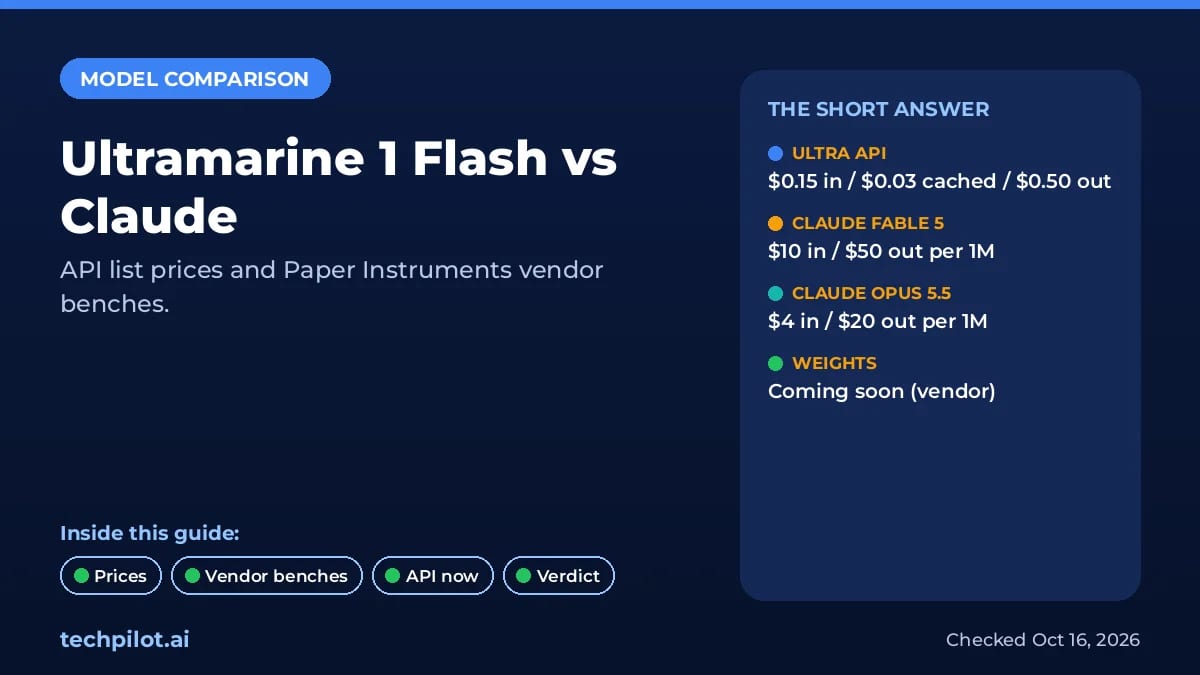
Ultramarine 1 Flash vs Claude
Ultramarine 1 Flash vs Claude: Paper Instruments lists $0.15/$0.50 API vs Claude Fable 5 at $10/$50. Vendor JobBench claims labeled; who should try…
Eimantas Kazėnas · 4 min read
AI Agents Eimantas Kazėnas · 18 min read
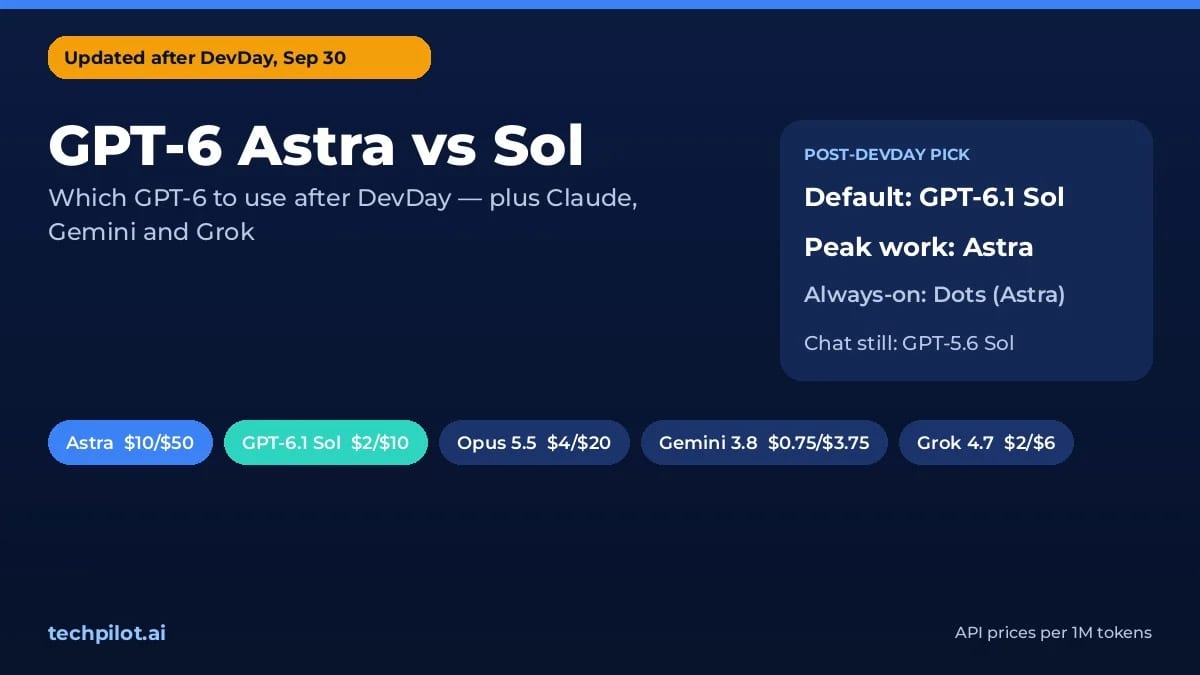
GPT-6 Astra vs Sol: Which One Do You Get?
GPT-6 Astra vs Sol after the Oct 7 rollout: ChatGPT runs GPT-6 Sol on paid plans and Luna on Free. Astra’s API costs 5x more. See which to use and…
Eimantas Kazėnas · 18 min read