OpenUI vs v0: Which One Do You Need?
 Eimantas Kazėnas Marketing & Tech
 - Published
- 6 min read
On this page OpenUI vs v0 at a glance
Independent and reader-supported. Some links may earn us a commission; it never changes our rankings. Editorial policy
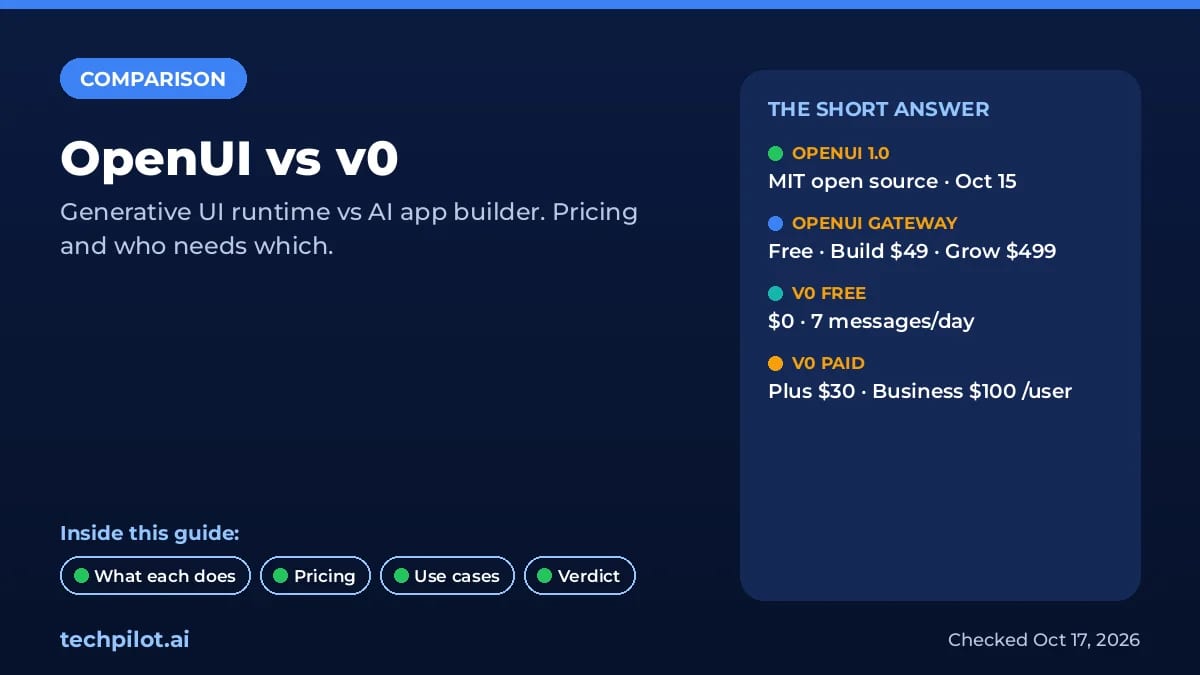
OpenUI vs v0: OpenUI 1.0 turns AI agent replies into live UI inside your app, while v0 builds the app itself. Pricing from $0, use cases, who needs which.
People searching “openui vs v0” are usually asking: do I need this new OpenUI thing, or is v0 enough? The honest answer is that they sit at different layers. OpenUI by Thesys decides how an AI model’s answer turns into interface on screen, at runtime, inside a product you already own. v0 by Vercel builds the product: you describe a site or app, it writes the code, and you ship it on Vercel. We checked both pricing pages and the OpenUI 1.0 docs on October 17, 2026.
OpenUI vs v0 at a glance
| OpenUI (Thesys) | v0 (Vercel) | |
|---|---|---|
| What it is | Open standard + runtime for generative UI | AI app and site builder |
| When it runs | At runtime, every time your agent answers | At build time, while you create the app |
| Who uses it | Developers adding UI answers to an AI product | Founders, designers, devs who want an app fast |
| License / model | MIT open source; any LLM | Hosted product; v0 Mini, Pro, Max models |
| Starting price | $0 self-hosted; Gateway from $0 | Free with 7 messages/day |
| Paid tiers | Gateway Build $49, Grow $499 /mo (annual) | Plus $30, Business $100 /user/mo |
What OpenUI actually does
Most AI apps still reply in Markdown. OpenUI lets the model reply in OpenUI Lang, a compact line-by-line format that names components from a library you register, like root = Card([title]). Your app renders those components as the response streams, so a question such as “show me my orders this week” can come back as a real table with buttons instead of a paragraph. You keep your own model, your own agent framework and your own design system.
OpenUI 1.0 landed in mid-October (the React language package hit 1.0.0 on npm on October 12 and 1.0.1 on October 15). It adds custom functions and custom actions the model can call, shorter single-action syntax, library.extend to derive a library from an existing one, and a message format for storing responses with form state. One limit to know: the 1.0 features need the React renderer. The Vue, Svelte and Angular packages stay on 0.4 for now.
Thesys also makes a speed claim on openui.com: up to 3x faster generation and 67% fewer tokens than JSON-based UI formats. Its FAQ says that across the same 46 interfaces, OpenUI Lang averaged 1,362 output tokens per screen, 58% fewer than json-render and 52% fewer than A2UI. Those are vendor benchmarks, not our tests, but the direction makes sense: fewer tokens per screen means lower LLM bills and faster first paint.
Getting started is one command, npx @openuidev/cli@latest create, and npx @openuidev/cli@latest setup-agent adds OpenUI instructions to AGENTS.md so coding agents like Claude Code or Cursor know how to use it. The code is on GitHub.
What v0 does
v0 is a chat-to-app builder. You prompt, it generates a working project, and you refine it in chat or with Design Mode for visual edits. Projects sync with GitHub and deploy to Vercel. It is a build tool for people, not a library you embed for your users. If your goal is “I need a dashboard, landing page or internal tool by Friday”, v0 is the more direct path.
Pricing compared
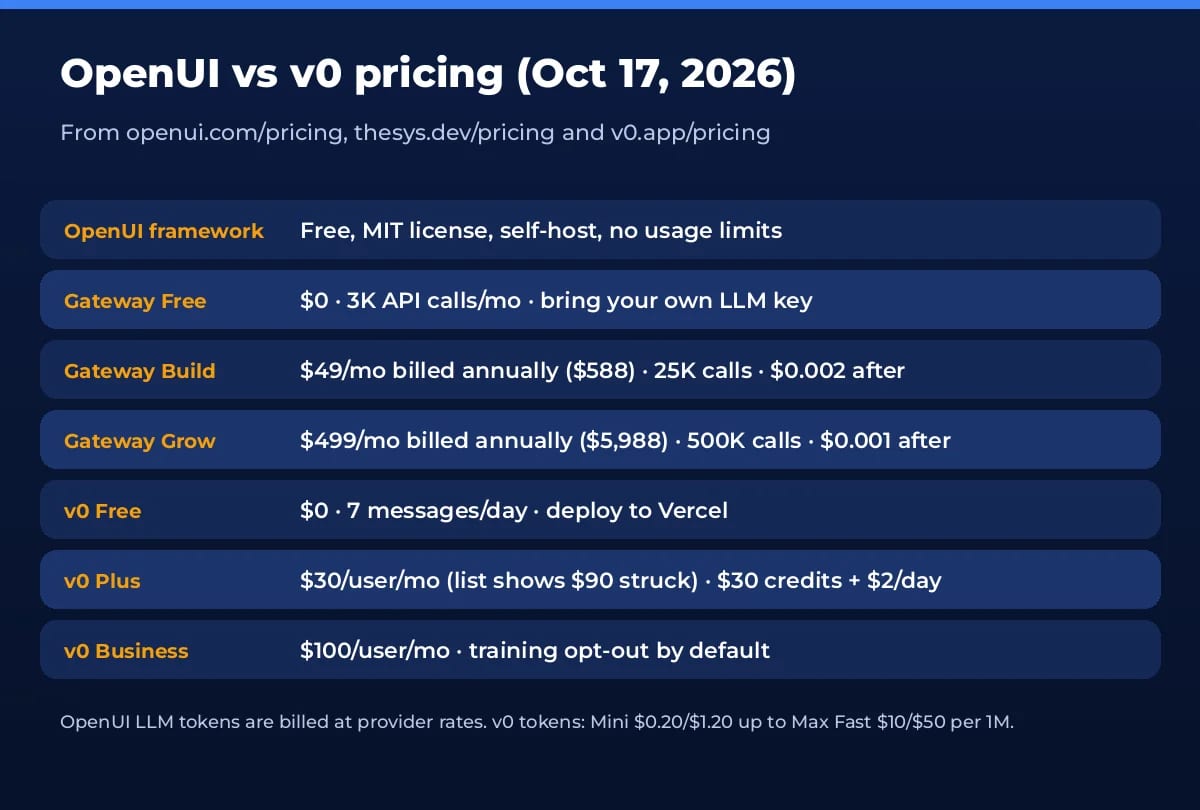
OpenUI: the framework itself is free and MIT-licensed. You pay only if you use the managed OpenUI Gateway, which repairs invalid UI output as it streams and switches providers during outages. Free is $0 with 3K API calls a month and your own LLM key. Build is $49/mo billed annually ($588 a year) with 25K calls and $0.002 per extra call. Grow is $499/mo billed annually ($5,988) with 500K calls and $0.001 per extra call. Scale is custom. LLM tokens are billed separately at provider rates, and Thesys says its limited-time free models are capped at about 100 calls a day and may use your data for training.
v0 (pricing): Free is $0 with a 7 messages per day limit. Plus is $30 per user per month, shown against a struck-through $90, with $30 of monthly credits plus $2 of free daily credits on login. Business is $100 per user per month and opts you out of training by default. Enterprise adds SAML SSO and role-based access. Usage runs on v0’s own token rates per 1M tokens: v0 Mini $0.20 in / $1.20 out, Pro $2 / $10, Max $5 / $25 and Max Fast $10 / $50.
Read the bills differently. With OpenUI, cost scales with your users, because every agent reply is a Gateway call plus LLM tokens. With v0, cost scales with how much you build, because you are paying for your own prompts while you create the app.
Who should use which
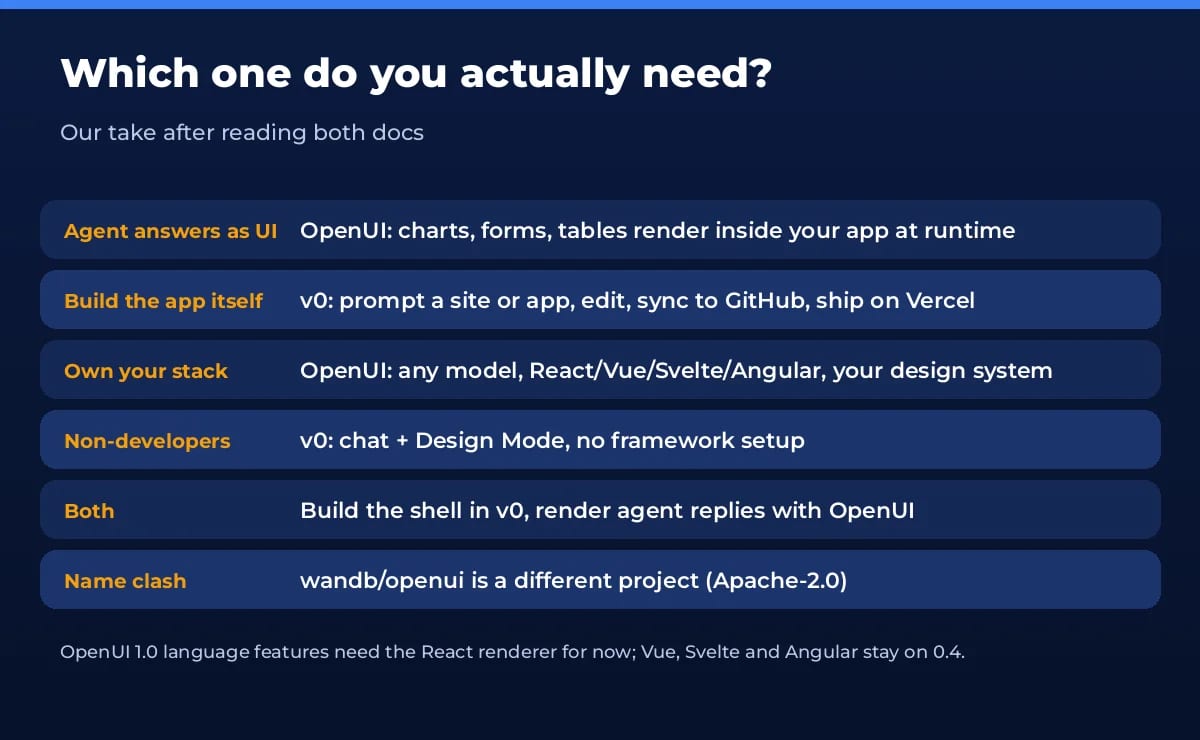
- Pick OpenUI if you already ship an AI assistant, copilot or agent and want its answers to be charts, forms and tables in your own components, with any model you like.
- Pick v0 if you need the app itself: screens, pages and a deploy target, with minimal setup, and you are happy on Vercel.
- Use both if you are building an AI product from scratch. v0 gets you the shell quickly, and OpenUI handles what the assistant shows inside it.
- Watch the name clash. wandb/openui from Weights & Biases is a separate open-source project (Apache-2.0) where you describe UI and see it rendered. That one really is a v0-style tool.
Our take: “OpenUI vs v0” is a category mix-up more than a head-to-head. If you came here looking for a v0 rival, compare prompt-to-UI tools like Magic Patterns or Google Stitch instead. If you build AI features for a living, OpenUI 1.0 is worth an afternoon, because it is free to self-host and solves a real problem. Our OpenUI tool page has the full feature list, and designers who want prototypes on the canvas should read our Figma Code Layers explainer.
Frequently asked questions
Is OpenUI a v0 alternative?
Not really. Thesys OpenUI is an open standard and runtime that lets an AI agent answer with interface components inside your own app. v0 is an AI app builder that writes and deploys the app. The wandb/openui project on GitHub is closer to v0, but it is a different product.
Is OpenUI free?
Yes. The OpenUI framework is open source under the MIT license and has no usage limits when you self-host it. The paid part is the optional OpenUI Gateway: Free with 3K API calls a month, Build at $49/mo and Grow at $499/mo, both billed annually.
How much does v0 cost?
v0 has a Free plan with a 7 messages per day limit. Plus is $30 per user per month (the page shows $90 struck through) with $30 of monthly credits, and Business is $100 per user per month. Enterprise is custom.
What is new in OpenUI 1.0?
Custom functions, custom actions, actions without an Action wrapper, library.extend for deriving component libraries, and a stored message format. The 1.0 language features need the React renderer for now; Vue, Svelte and Angular packages stay on 0.4.
Can I use OpenUI and v0 together?
Yes. They solve different layers. You could build the app shell and screens with v0, then use OpenUI inside it so your assistant replies with charts, forms or tables instead of plain text.
Found this useful? Share it with someone comparing AI tools.

Can You Use AI to Trade Stocks: What You Need to Know Before You Start
This guide explores the real capabilities of AI in trading, from its predictive accuracy to the critical risks involved, providing a clear-eyed view…
 Yuliia Bataliuk · 7 min read
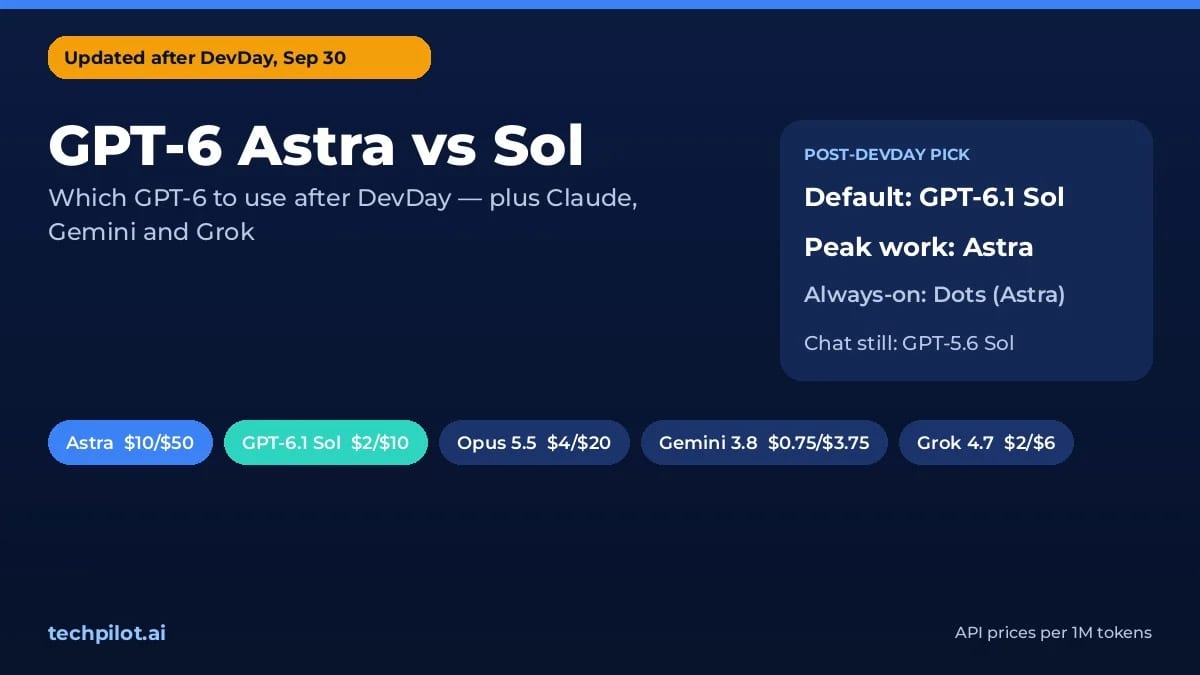
GPT-6 Astra vs Sol: Which One Do You Get?
GPT-6 Astra vs Sol after the Oct 7 rollout: ChatGPT runs GPT-6 Sol on paid plans and Luna on Free. Astra’s API costs 5x more. See which to use and…
 Eimantas Kazėnas · 18 min read