OpenUI is worth a look if you build AI agents or copilots and want answers that look like an app, not a wall of text. The framework is free, works with most models and stacks, and 1.0 adds the custom actions most real products need.
AI Agents · Tool review
OpenUI: Thesys Generative UI, 1.0 & Pricing
 TechPilot.ai review team Hands-on testing, one published method
 - Last updated
- How we test
Summary
Pros and cons
What we like
- Free and open source MIT licence, self-host with no usage limits.
- Model and stack agnostic Works with major LLMs, agent frameworks and component libraries.
- Streaming UI Renders charts, forms and tables as tokens arrive.
- Token efficient Thesys' benchmark shows about half the tokens of JSON formats.
- Optional Gateway Output repair and provider failover, with a free tier.
What could be better
- React-first for 1.0 Vue, Svelte and Angular stay on 0.4 for now.
- Vendor benchmarks Token and speed gains are self-reported.
- Learning curve You define a component library and a new UI language.
- Confusing name Unrelated projects also use OpenUI.
Key features
- OpenUI Lang: A compact, streaming-first language the model writes instead of text or JSON.
- Prompt from your library: Generates the system prompt from the components you allow.
- Streaming renderer: Draws UI progressively in React, Vue, Svelte or Angular.
- Custom functions and actions: New in 1.0: defineFunction and defineAction with typed params.
- Agent Skill: Helps Claude Code, Codex and Cursor scaffold generative-UI apps.
- OpenUI Gateway: Hosted output repair, provider failover and usage tracking.
Screenshots
Full review
Independent and reader-supported. Some links may earn us a commission; it never changes our scores. Editorial policy
OpenUI is Thesys’ free, MIT-licensed framework that lets AI agents reply with charts, forms and cards. See what OpenUI 1.0 adds, Gateway pricing and setup.
Thesys shipped OpenUI 1.0 on October 15, 2026, six months after it open-sourced the project. Founder Rabi Shanker Guha’s launch post on X passed 1.9 million views within two days. The pitch is simple: models got smarter, but most AI apps still answer in a text box. OpenUI lets the model answer with real interface components from your own design system instead. This page covers what it is, what’s free, what the paid Gateway costs and how it compares.
What is OpenUI?
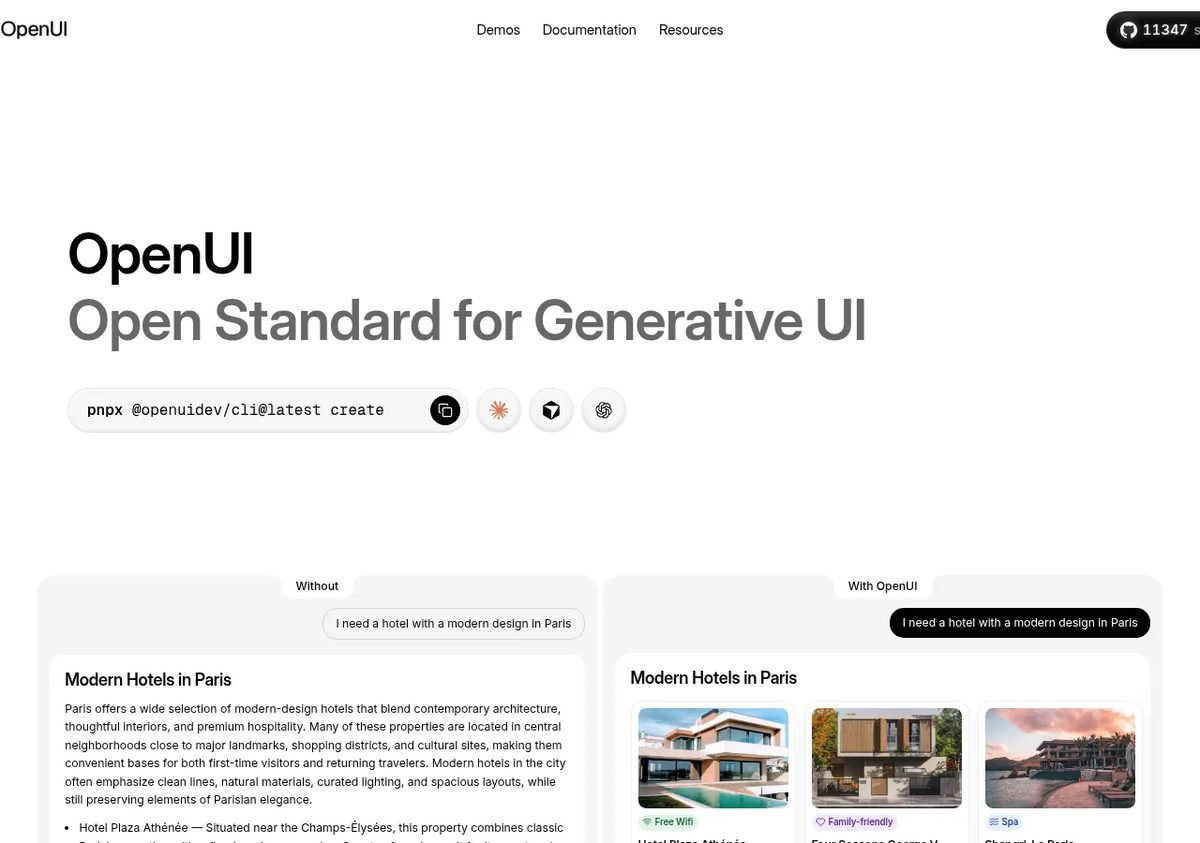
OpenUI is an open-source generative UI framework maintained by Thesys, which calls itself “the company behind OpenUI, much like Vercel is the company behind Next.js.” At its center is OpenUI Lang, a compact, line-by-line language that a model writes instead of plain text or JSON. You define which components the model may use, OpenUI generates the system prompt from that component library, and a streaming renderer draws the UI as the tokens arrive.
- Works with any model: OpenAI, Anthropic, Gemini, DeepSeek, Mistral, Qwen or a local model through Ollama.
- Fits existing agent code: listed integrations include the Vercel AI SDK, LangChain, LangGraph, CrewAI and n8n.
- Uses your components: shadcn/ui, Material UI, Ant Design, Radix, Chakra or your own library.
- Framework runtimes: React, Vue, Svelte and Angular, with ready-made chat layouts for React.
Which OpenUI is this?
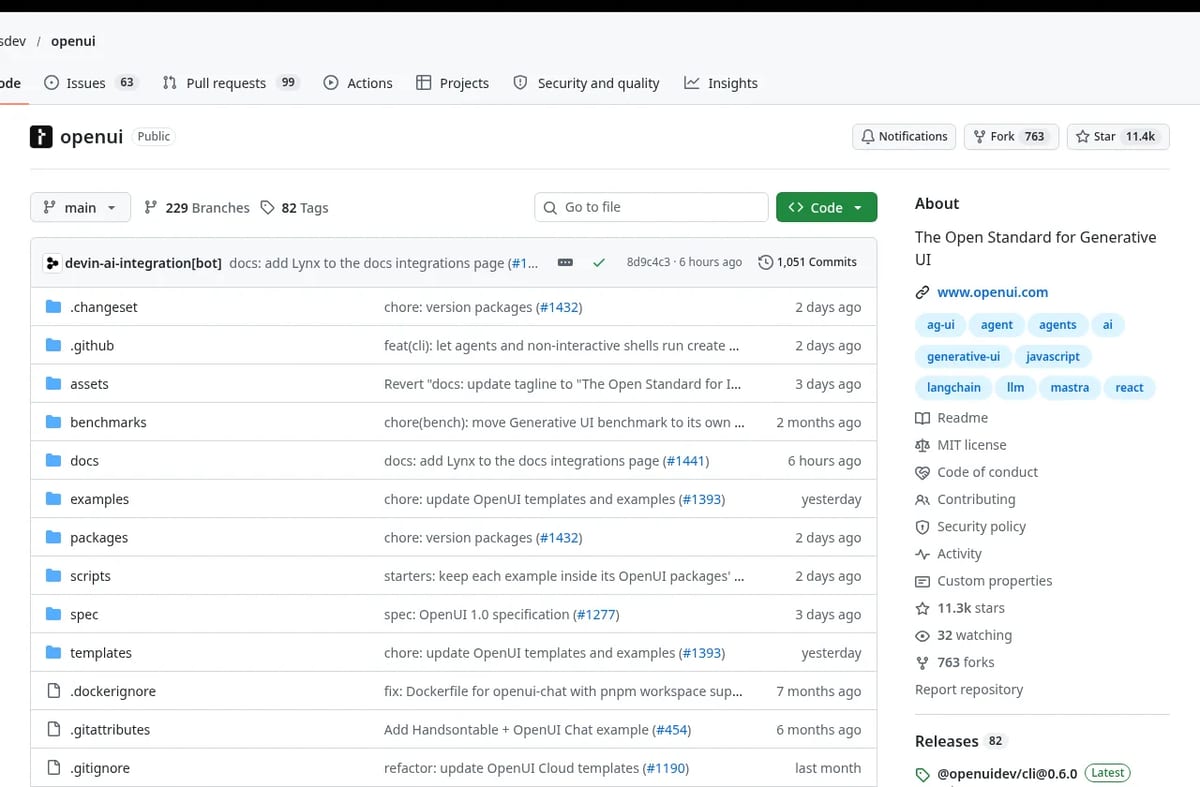
Several projects share the name, which is why searches for “openui” get messy. This page covers the Thesys project at openui.com and thesysdev/openui on GitHub (MIT licence, about 11.4k stars). It is not the older wandb/openui from Weights & Biases, an Apache-2.0 tool for describing a UI in plain words and seeing HTML rendered live (about 22.6k stars). It is also not Open UI at open-ui.org, a web-standards group behind proposals such as the Popover API and the customizable select element.
What’s new in OpenUI 1.0
According to Thesys’ What’s New in 1.0 notes, the release is about letting a component library grow and making model output easier to store:
- Custom functions: add your own @ functions with defineFunction. Arguments are type-checked, and a failed call returns null instead of breaking the page.
- Custom actions: defineAction lets the model trigger app-defined actions, such as copy to clipboard, which your onAction handler receives with typed params.
- library.extend: derive a new library from an existing one by adding, overriding or removing components.
- Message format: buildMessage and parseMessage store a response together with context such as form values.
- Agent Skill: a skill for coding agents such as Claude Code, Codex and Cursor to scaffold OpenUI apps.
One catch: the Vue, Svelte and Angular packages stay on version 0.4, so the 1.0 language features need the React renderer for now.
OpenUI Pricing (2026)
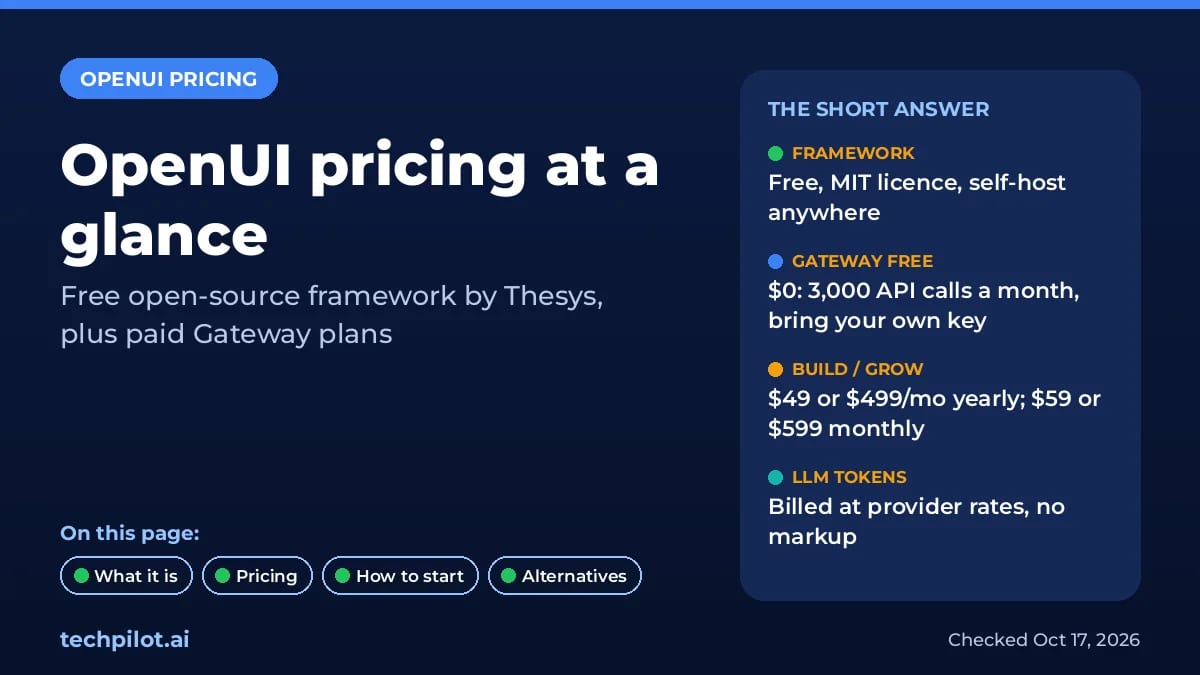
The framework itself is free. Thesys says you can run it anywhere “with no usage limits from us.” The paid product is OpenUI Gateway, a hosted layer that repairs invalid model output as it streams, fails over between providers during outages and tracks usage. We checked the OpenUI pricing page and the matching Thesys pricing page on October 17, 2026:
| Plan | Price | What you get |
|---|---|---|
| OpenUI framework | Free | MIT licence, self-host, no usage limits |
| Gateway Free | $0 | 3,000 API calls a month, bring your own LLM key, Discord support |
| Gateway Build | $49/mo billed yearly ($588), or $59 monthly | 25,000 API calls a month, then $0.002 per call, email support |
| Gateway Grow | $499/mo billed yearly ($5,988), or $599 monthly | 500,000 API calls a month, then $0.001 per call, SSO/SAML, priority support |
| Gateway Scale | Custom | VPC or self-hosting, custom limits, SLAs |
| Observability | Free in early access | Session replay and triage; waitlist |
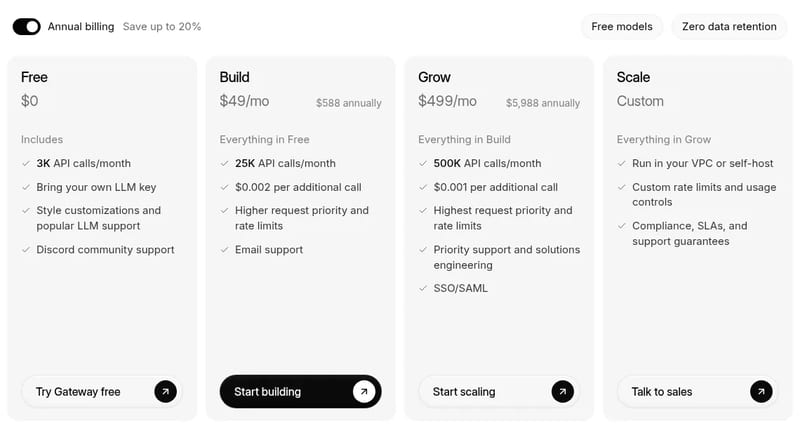
LLM tokens are billed on top of API calls, at the model provider’s own rates with no markup, or you bring your own provider key. Thesys also runs a limited-time offer of select free models with zero LLM cost. Repair calls are included in every Gateway plan. If you’d rather keep your own inference setup, the OpenUI docs also describe Autofix, which repairs invalid OpenUI Lang with one API call.
How to start with OpenUI
- Scaffold an app: run
npx @openuidev/cli@latest create --name genui-chat-appto get a streaming chat app with OpenUI Lang built in. - Or add it to React: install @openuidev/react-lang and @openuidev/react-ui. LangGraph users can use @openuidev/langchain.
- Define your library: register the components the model is allowed to use, then generate the system prompt from it.
- Try the Playground on openui.com to see output from the default component library before you write code.
- Add Gateway later if you need output repair and provider failover in production.
Benchmarks (Thesys’ own numbers)
OpenUI’s benchmark page compares the same seven UI scenarios written in OpenUI Lang, YAML, Vercel JSON-Render and Thesys C1 JSON. In total, OpenUI Lang used 4,800 tokens, against 9,122 for YAML (-47.4%), 10,180 for Vercel JSON-Render (-52.8%) and 9,948 for C1 JSON (-51.7%). Thesys also reports up to about 3x faster rendering on a contact form. These are vendor benchmarks, but the method and scenarios are published in the repo, so you can rerun them.
OpenUI vs alternatives
- Vercel AI SDK and json-render: the closest comparison for React teams. OpenUI says its format uses about half the tokens. It also plugs into the AI SDK rather than replacing it.
- Google’s A2UI: an agent-to-UI protocol. OpenUI ships an @openuidev/a2ui package for A2UI v1.0, so the two can work together.
- AI design and app builders: tools like Magic Patterns and Google Stitch generate screens for people to design with. OpenUI does something different: it renders UI inside your own agent’s answers at runtime.
- Coding agents: if you want an agent to write the app itself, see our best AI agents for coding. OpenUI’s Agent Skill helps those agents build generative-UI front ends.
Limitations
- React-first for 1.0: Vue, Svelte and Angular remain on 0.4 for now.
- Upgrade together: client packages and the server that builds the system prompt need matching versions.
- Vendor numbers: the token and speed gains come from Thesys’ own benchmark.
- Name confusion: watch out for the unrelated wandb/openui and open-ui.org projects. The GitHub repo also warns that OpenUI has no official crypto token.
TechPilot.ai’s Verdict on OpenUI
OpenUI is worth a look if you build AI agents or copilots and want answers that look like an app, not a wall of text. The framework is free, works with most models and stacks, and 1.0 adds the custom actions most real products need.
Start with the open-source package and your own components, and add Gateway only if output errors or provider outages start to hurt. If you’re not on React yet, wait for the other runtimes to reach 1.0.
OpenUI FAQ
Is OpenUI free?
Yes. The OpenUI framework is open source under the MIT licence and free to self-host with no usage limits from Thesys. Only the optional OpenUI Gateway has paid plans, and it has a free tier with 3,000 API calls a month.
•
How much does OpenUI cost?
The framework is free. OpenUI Gateway costs $0 (3,000 calls), Build $49/mo billed yearly or $59 monthly (25,000 calls), Grow $499/mo yearly or $599 monthly (500,000 calls), or custom Scale pricing. LLM tokens are billed at provider rates.
•
What is Thesys OpenUI?
OpenUI is Thesys’ open-source generative UI framework. The model writes OpenUI Lang, a compact streaming language, and the renderer turns it into charts, forms, tables and cards from your component library.
•
When did OpenUI 1.0 come out?
Thesys released OpenUI 1.0 on October 15, 2026. It adds custom functions and actions, library.extend and a stored message format. The 1.0 features currently need the React renderer.
•
Is OpenUI the same as wandb OpenUI?
No. wandb/openui is an older Apache-2.0 tool from Weights & Biases for describing a UI and seeing it rendered. Thesys OpenUI at openui.com is a runtime framework that renders UI inside AI agent responses.
Figma Code Layers
AI Agents
Code layers is the most useful AI feature Figma has shipped for teams who prototype in code. Working prototypes sit next to the designs,…

Odessia
AI Agents
Odessia is one of the more convincing AI travel agents so far because it can actually book as a registered agency and keeps watching prices…

Fish Audio
AI Agents
Fish Audio is one of the cheapest serious ways into expressive AI voice. The free tier is enough to test Drama 3, and Plus at $11 a month…
News  Mihai (Mike) Bizz · 6 min read
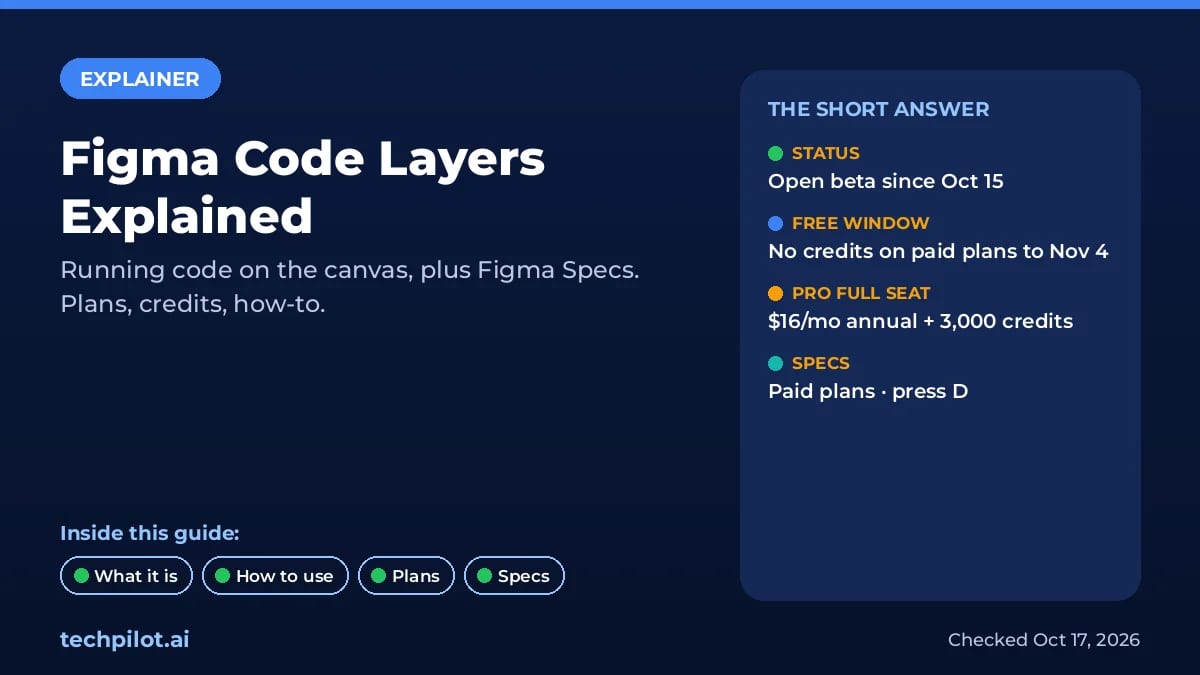
Figma Code Layers Explained (+ Figma Specs)
Figma code layers put running code on the canvas, in open beta since Oct 15. What they do, how to make one, which plans get them, credits, and Figma…
Mihai (Mike) Bizz · 6 min read
News  Eimantas Kazėnas · 6 min read
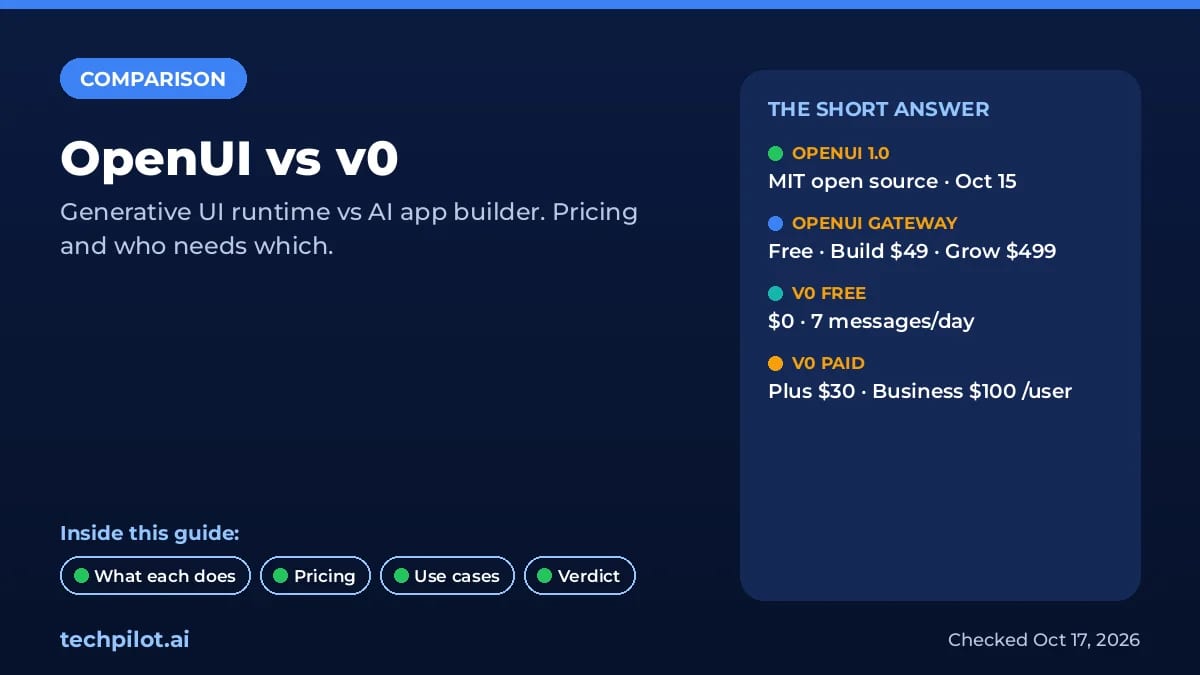
OpenUI vs v0: Which One Do You Need?
OpenUI vs v0: OpenUI 1.0 turns AI agent replies into live UI inside your app, while v0 builds the app itself. Pricing from $0, use cases, who needs…
Eimantas Kazėnas · 6 min read