AgentKit is still the OpenAI-shaped path to ship agents on their platform APIs. The Decisions API public beta is the fresh reason to revisit the page: typed routing answers on gpt-6-luna at $0.10 per 1M input with no output charge on that endpoint.
AI Agents · Tool review
OpenAI AgentKit: Agents & Decisions API
 TechPilot.ai review team Hands-on testing, one published method
- Last updated
- How we test
Summary
Pros and cons
What we like
- Accelerated Development The combination of a visual builder, SDKs, and pre-built components like ChatKit can reduce development cycles from months to weeks for new ai workflow automation.
- Enterprise-Focused Tools The OpenAI AgentKit is built for production use, offering specific features for versioning, governance, and security.
- Detailed Evaluation Framework The "Evals" feature provides specific tools for testing, grading, and improving agent performance, a critical component for reliable deployment.
- Finished User Experience ChatKit allows developers to embed a professional, customizable chat interface into any application with minimal front-end coding.
- Unified Platform It consolidates the entire agent development lifecycle into a single, cohesive environment, removing the need for fragmented third-party tools.
- Developed by OpenAI The toolkit is created and maintained by a leader in the AI industry, meaning it will likely remain current with agentic technology.
- Strong Initial Use Cases Notable clients like Klarna, Canva, and Ramp have already demonstrated significant ROI, proving the platform's real-world value.
What could be better
- Developer-Centric The platform requires coding knowledge for effective use, making it less accessible for a no code ai agent builder user or business teams.
- Potential for Vendor Lock-In The OpenAI AgentKit is optimized for its own models, limiting flexibility for teams wanting to use other LLMs.
- Unpredictable Pricing The usage-based pricing model, while flexible, can make it difficult to forecast costs, which may be a concern for businesses with variable demand.
- Learning Curve for Advanced Features While the basics are straightforward, mastering the advanced orchestration and evaluation tools requires a significant time investment.
Key features
- Agent Builder: A visual, drag-and-drop canvas for designing, versioning, and managing complex, multi-agent workflows. Being deprecated: OpenAI plans to shut it down on November 30, 2026.
- ChatKit: A front-end toolkit for embedding customizable, chat-based agent experiences directly into websites and applications.
- Connector Registry: A central location for managing secure connections to data sources and tools like Dropbox, Google Drive, and SharePoint.
- Evals Framework: A system for measuring and improving agent performance through test pipelines, trace grading, and automated prompt adjustments.
- Agents SDK: A software development kit available in Python, Node.js, and Go for programmatic control and deep integration.
- Pre-built Templates: A library of ready-to-use templates for common use cases like customer support and internal knowledge bots.
- Workflow Versioning: Allows teams to safely iterate on agent designs by managing multiple versions and rolling back changes when needed.
- Built-in Guardrails: Enterprise-level controls to keep agents operating within predefined safety and compliance boundaries.
- Multi-Agent Orchestration: Capabilities to design systems where multiple specialized agents collaborate to solve a single, complex problem.
- Thread Management: ChatKit automatically handles the complexities of managing conversation histories and user sessions.
Screenshots
Full review
Independent and reader-supported. Some links may earn us a commission; it never changes our scores. Editorial policy
OpenAI AgentKit helps developers build and ship AI agents; the Decisions API public beta adds typed answers on gpt-6-luna at $0.10 per 1M input tokens.
Update (Oct 17, 2026): Agent Builder shuts down Nov 30, 2026
OpenAI is deprecating Agent Builder, the drag-and-drop canvas in AgentKit. Per OpenAI’s deprecations page, developers were notified on June 3, 2026, and Agent Builder is scheduled to shut down on November 30, 2026. Existing users can keep using it until then. The notice covers Agent Builder only: ChatKit stays available, and OpenAI points developers to the Agents SDK.
What to use instead:
- Agents SDK (code): open your workflow, click Code, choose Agents SDK and copy the Python or TypeScript export into your app. OpenAI’s migration guide walks through it and warns that not every behaviour transfers unchanged.
- ChatGPT workspace agents (no code): on ChatGPT Business, Enterprise or Edu, paste the exported code into a new workspace agent and let the builder convert it.
- ChatKit: keep using it for the embedded chat front end.
- Other no-code builders: n8n, Zapier Agents and similar tools if you want a visual canvas. Our guide on how to build an AI agent compares the options step by step.
This OpenAI AgentKit is designed to address the common difficulties of fragmented toolchains and manual orchestration that slow down AI development. It targets AI engineers and developers across various industries, from tech startups to large enterprises like Klarna and Canva.
The platform’s primary value is its ability to reduce development time and manage the entire agent lifecycle, from initial prototype to production-level deployment. It offers an alternative to traditional, often difficult methods of building AI assistants by offering an integrated environment with visual builders, pre-built connectors, and specific evaluation tools, making the process faster and more efficient.
New: OpenAI Decisions API (public beta)
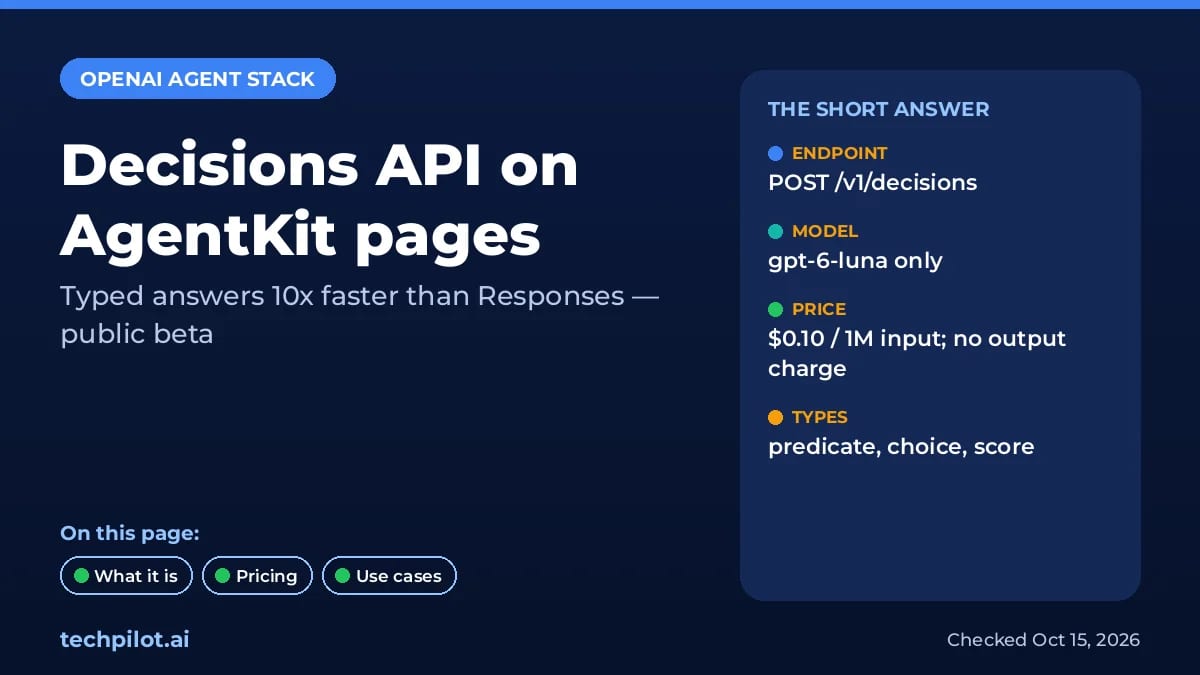
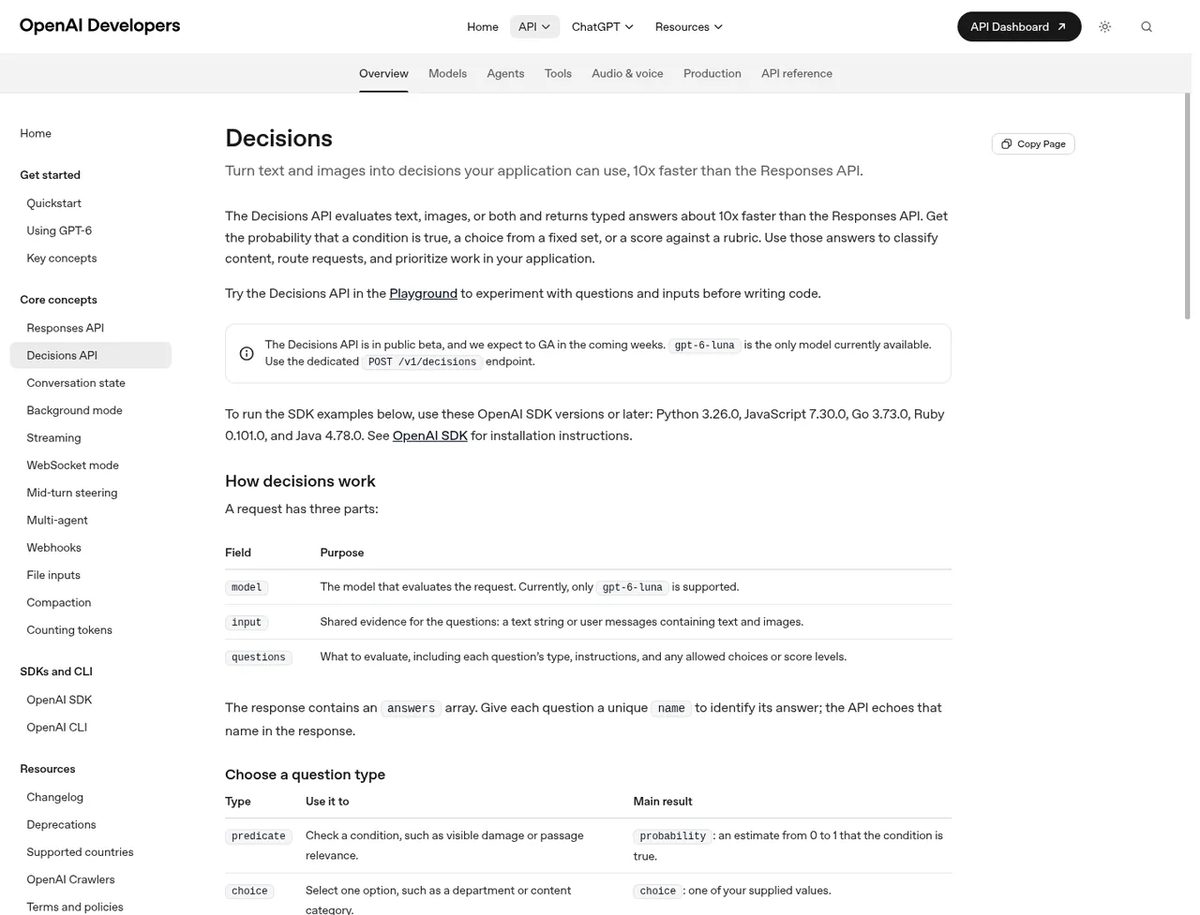
OpenAI’s Decisions API entered public beta for all developers. It returns typed answers — predicate probabilities, fixed choices or rubric scores — that OpenAI says arrive about 10x faster than the same model through the Responses API.
Use it when your app needs to classify, route or score an input, not when you need a long generated answer. The only model on Decisions today is gpt-6-luna via POST /v1/decisions.
OpenAI AgentKit Pricing (2026)
AgentKit itself is a toolkit around OpenAI’s platform APIs — you still pay for the models and endpoints you call. For Decisions specifically, OpenAI documents $0.10 per 1M input tokens on gpt-6-luna with no output, cache-read or cache-write charges on that endpoint (regional and long-context multipliers may apply). We verified this on the official Decisions guide on October 15, 2026.
| Endpoint / product | Model | Price note |
|---|---|---|
| POST /v1/decisions | gpt-6-luna | $0.10 / 1M input only; no output charge |
| Responses / Chat (gpt-6-luna) | gpt-6-luna | Standard model pricing (input + output); not the Decisions-only rule |
| AgentKit builder tooling | — | Uses your OpenAI API usage; no separate AgentKit list price published on the pages we checked |
Full how-to, question types and code examples: OpenAI Decisions API guide. Model context: GPT-6 Astra vs Sol. Safety: Are AI agents safe?.
Best Use Cases for OpenAI AgentKit
- Customer Support Automation: With this ai agent builder, support teams can construct agents to handle a high volume of customer inquiries. These agents can access knowledge bases to provide instant, factual answers, deflect common tickets, and escalate complex issues to human agents with full context. For example, an agent can handle two-thirds of all support conversations, as demonstrated by Klarna, freeing up human staff to focus on high-priority problems.
- Internal Operations & Knowledge Management: Companies can use OpenAI AgentKit to create internal assistants that help employees navigate complex processes and find information. An agent can connect to internal systems like SharePoint or Google Drive to answer questions about company policies, guide users through IT troubleshooting, or help analysts pull sales data. This centralizes knowledge and improves employee productivity.
- Sales & Marketing Automation: Sales teams can deploy OpenAI AgentKit to automate lead research and personalized outreach. An agent can analyze prospect data from various sources, generate tailored email drafts, and even score leads based on predefined criteria. This accelerates the sales cycle and allows representatives to focus on building relationships rather than on manual research.
- Data Analysis & Reporting: For business intelligence teams, this toolkit can build agents that automate data retrieval and report generation. A manager could ask an agent to “create a plan to improve sales in the Northwest region,” and the agent would analyze historical trends, seasonality, and external factors to produce a data-backed strategy, similar to the use case implemented by Albertsons.
TechPilot.ai’s Verdict on OpenAI AgentKit
AgentKit is still the OpenAI-shaped path to ship agents on their platform APIs. The Decisions API public beta is the fresh reason to revisit the page: typed routing answers on gpt-6-luna at $0.10 per 1M input with no output charge on that endpoint.
Use Decisions for classification and routing; keep Responses or Structured Outputs for generated objects and prose. Read our Decisions API guide before wiring production thresholds.
OpenAI AgentKit FAQ
What is OpenAI AgentKit?
A toolkit from OpenAI for building, deploying and evaluating AI agents, including visual builder pieces and connectors around the OpenAI platform.
•
What is the OpenAI Decisions API?
A public-beta endpoint (POST /v1/decisions) that returns typed yes/no-style probabilities, choices or rubric scores using gpt-6-luna, optimized for fast routing decisions.
•
How much does the Decisions API cost?
$0.10 per 1M input tokens on gpt-6-luna, with no output or cache charges on /v1/decisions, per OpenAI docs checked October 15, 2026.
•
Is AgentKit free?
There is no separate public AgentKit subscription price on the pages we checked; you pay for the OpenAI API usage your agents call.
•
Is Decisions the same as Microsoft Decision-1?
No. Decisions here means OpenAI’s /v1/decisions API only.

Ultramarine 1 Flash
AI Agents
Ultramarine 1 Flash is a cheap, focused model worth testing if you build agents that produce spreadsheets, decks and memos. At $0.15 /…
Magic Patterns
AI Agents
MagicOS is a smart answer to the main problem with chat-based design tools: losing track of what you tried. Keeping every variant and…

MiniCPM-V 4.7
AI Agents
MiniCPM-V 4.7 is one of the most interesting open vision models this month: free, Apache-licensed and built to run where your data lives.…
News  Eimantas Kazėnas · 3 min read
OpenAI Decisions API: How to Use
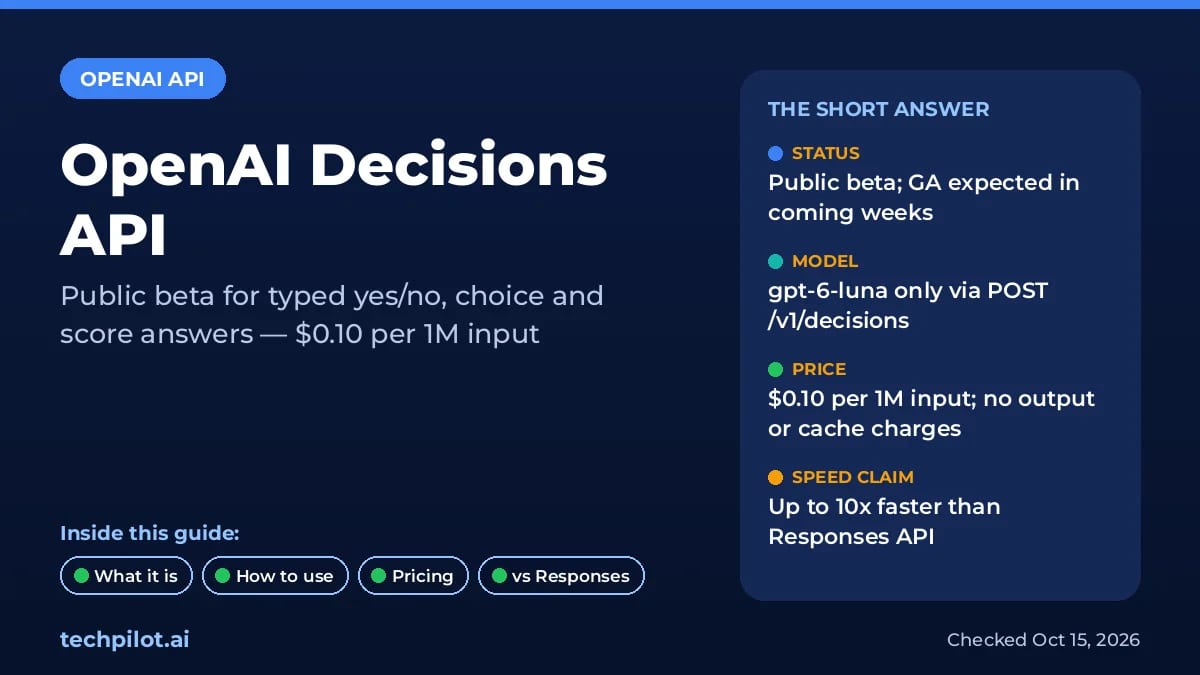
OpenAI Decisions API is in public beta for typed yes/no, choice, and score answers via gpt-6-luna at $0.10 per 1M input, with no output token charges.
Eimantas Kazėnas · 3 min read
AI Agents Eimantas Kazėnas · 18 min read
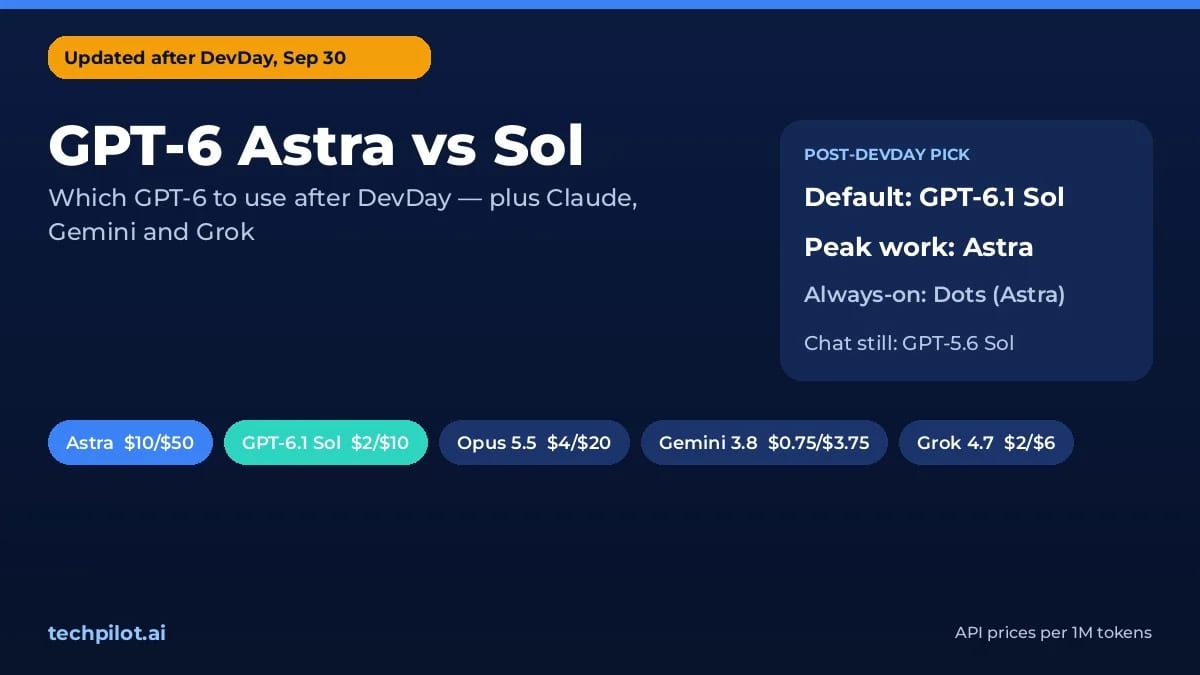
GPT-6 Astra vs Sol: Which One Do You Get?
GPT-6 Astra vs Sol after the Oct 7 rollout: ChatGPT runs GPT-6 Sol on paid plans and Luna on Free. Astra’s API costs 5x more. See which to use and…
Eimantas Kazėnas · 18 min read