Best Local AI Models (October 2026)
 Eimantas Kazėnas Marketing & Tech
 - Published
- 4 min read
On this page Fresh open-weight releases (mid-October 2026)
Independent and reader-supported. Some links may earn us a commission; it never changes our rankings. Editorial policy
Best local AI models this October: LFM2.5-24B-A2B, MiniCPM-V 4.7, Drama 3, Fluid Speech Mini, plus verified Qwen/Gemma picks, VRAM, and how to run them.
Best local AI models in October 2026 are not just “whatever is big on Hugging Face.” We checked official cards for fresh open-weight drops from the last few days — Liquid LFM2.5-24B-A2B, MiniCPM-V 4.7, Fish Audio Drama 3, Fluid Speech Mini — and paired them with established families you can actually run: Qwen3, Gemma 4, Llama 4 Scout-class MoEs, and OpenAI gpt-oss. No invented benchmarks.
Fresh open-weight releases (mid-October 2026)
| Model | Size / type | License note | Why it matters |
|---|---|---|---|
| LFM2.5-24B-A2B | 24B MoE · 2B active | Liquid model license | Fast on-device agents; Liquid claims 184 tok/s on M5 Max |
| MiniCPM-V 4.7 | 1B + 35B-A3B MoE | Apache-2.0 | On-device vision; Ollama / llama.cpp / vLLM |
| Fish Drama 3 | 35B MoE TTS · ~3B active | Fish Community License | Open-weight emotive TTS; needs serious GPU to self-host |
| Fluid Speech Mini | ~0.6B STT | Open weights (vendor) | 253 MB Core ML dictation; ONNX/GGUF ports |
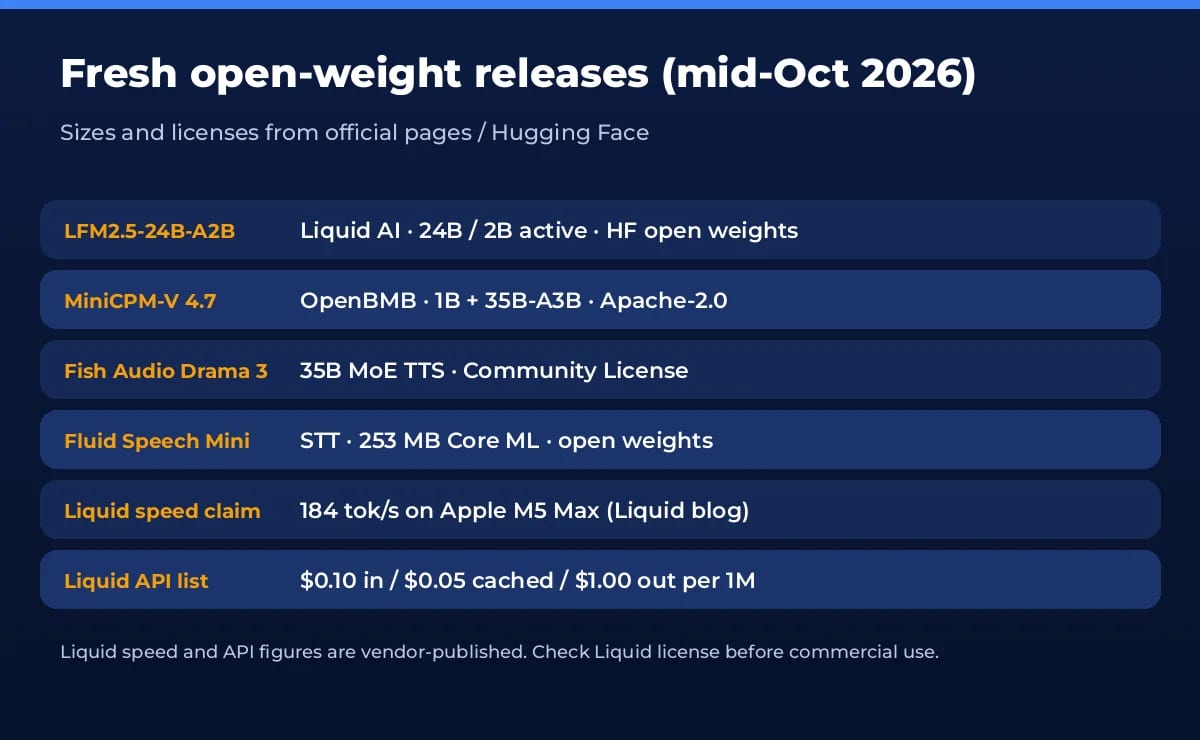
Liquid AI released LFM2.5-24B-A2B on October 13, 2026: a 24B-parameter MoE with 2B active, 131K context, open weights on Hugging Face, day-one llama.cpp / MLX / vLLM / SGLang support. Liquid lists API pricing at $0.10 / $0.05 cached input and $1.00 output per 1M tokens. Speed claims (184 tok/s on M5 Max) are Liquid’s — not our re-run.
MiniCPM-V 4.7 from OpenBMB ships 1B and 35B-A3B variants under Apache-2.0, with GGUF/AWQ/GPTQ builds and Ollama support. See our MiniCPM-V 4.7 tool page for the on-device vision angle.
Fish Audio Drama 3 (Oct 13) is open-weight TTS: 35B MoE, ~3B active, Community License with a US$500k commercial revenue cap. Great if you want local voice later; today most creators will still use fish.audio. Fluid Speech Mini is open-weight English STT aimed at phones and laptops (253 MB Core ML native package).
Established local picks still worth running
- Qwen3-8B — Apache-2.0 on Hugging Face; strong everyday chat/coding size for a single consumer GPU. Watch our Qwen 4 release date page for the next family move.
- Gemma 4 — Google open weights in E2B, E4B, 12B, 26B-A4B MoE and 31B dense sizes (Gemma 4 model card). Multimodal on several sizes; use Google’s Gemma license terms.
- Llama 4 Scout — Meta MoE (~109B total / 17B active, long context). Open weights under Meta’s Llama license; hardware hungry even quantized.
- gpt-oss-20b — Apache-2.0 reasoning-oriented open weights from OpenAI’s gpt-oss line; practical middle size for private infra.
- Step 5 Preview — API-first today; open-weights status was still unsettled on our Step 5 Preview and open weights status posts. Do not claim official weights until StepFun publishes them.
Hardware and how to run

Rough Q4/GGUF guidance (measure yourself): 1–2B models fit phones and light laptops; 7–9B usually want 5–8 GB VRAM; 12–14B want ~8–12 GB. A 24B MoE with 2B active can feel fast on Apple Silicon if the runtime is good, but you still store the full expert set on disk. Drama 3’s published streaming numbers use H200-class GPUs — treat self-host TTS as a server project.
Practical runners we can verify exist and are commonly used with these weights: Ollama, llama.cpp (GGUF), LM Studio, MLX on Apple Silicon, and vLLM / SGLang for multi-user GPU servers. Prefer official model cards for the exact command lines.
How we picked (and what we skipped)
We only listed models with downloadable weights on official or Hugging Face pages we could open today. We skipped unverified X rumors, closed APIs posing as “local,” and anything without a clear size or license pointer. Vendor speed and bench numbers stay labeled as vendor claims.
Our take: if you want one new on-device agent brain this week, start with LFM2.5-24B-A2B. If you need vision on-device, MiniCPM-V 4.7. For everyday chat on a laptop GPU, Qwen3-8B or a mid Gemma 4 size still make more sense than forcing a 35B TTS MoE onto a MacBook.
Frequently asked questions
What are the best local AI models right now?
For mid-October 2026, strong verified picks include Liquid LFM2.5-24B-A2B (fast on-device MoE), MiniCPM-V 4.7 (vision, Apache-2.0), Qwen3-8B and Gemma 4 sizes for chat, gpt-oss-20b for Apache reasoning, Fish Audio Drama 3 for open-weight TTS, and Fluid Speech Mini for on-device STT.
How much VRAM do I need?
As a rough Q4 guide: ~1-2B needs a few GB, ~7-9B often fits in 5-8 GB, ~12-14B wants ~8-12 GB. MoE models still need disk for all experts even when only a few billion parameters are active per token.
Can I run Drama 3 on a laptop?
Probably not comfortably. Drama 3 is a 35B MoE TTS model; Fish publishes streaming benches on H200 GPUs. Use fish.audio for hosted generation unless you have server-class GPUs.
What runners should I use?
Common verified stacks: Ollama, llama.cpp/GGUF, LM Studio, Apple MLX, vLLM/SGLang for servers. Liquid documents llama.cpp, MLX, vLLM, SGLang and ONNX for LFM2.5. MiniCPM-V lists Ollama, llama.cpp, vLLM and SGLang.
Are these free for commercial use?
Not all. MiniCPM-V and Qwen3-8B are Apache-2.0. gpt-oss-20b is Apache-2.0. Gemma uses Google’s Gemma license. Llama uses Meta’s license. Drama 3 uses Fish Community License with a revenue cap. Liquid uses its own model license — read it before shipping a product.
Found this useful? Share it with someone comparing AI tools.