Fish Audio is one of the cheapest serious ways into expressive AI voice. The free tier is enough to test Drama 3, and Plus at $11 a month billed yearly (half that in the first year during the launch deal) covers most solo creators.
AI Agents · Tool review
Fish Audio: Drama 3, Pricing & Free Plan
 TechPilot.ai review team Hands-on testing, one published method
 - Last updated
- How we test
Summary
Pros and cons
What we like
- Directable voices Drama 3 takes plain-language directions, sounds and word-level tags.
- Multi-speaker scenes Whole dialogues generated in one pass.
- Real free tier 8,000 credits a month with no card needed.
- Low entry price Plus is $11 a month billed yearly, less during the launch deal.
- Open weights Drama 3 can run on your own hardware under its licence.
What could be better
- Preview quality varies Generate several takes per line.
- Free plan is personal use only Commercial rights start on Plus.
- Restrictive licence $500K revenue cap and no hosted TTS service without a deal.
- Launch prices are temporary Discounts end when the offer countdown does.
Key features
- Drama 3 directions: Describe delivery in your own words inside square brackets.
- Sounds and pauses: Place sighs, laughs, breaths and pauses exactly where you want them.
- Scoped word tags: Whisper, Emphasis, Soft, Faster, Slower, Stress or Forceful on selected words.
- Auto Tag: Adds directions to a plain script for you to edit.
- Voice cloning: Clone a voice you have rights to, or use the public voice library.
- API and SDKs: REST and WebSocket API with Python and TypeScript SDKs; model header drama-3.
Screenshots
Full review
Independent and reader-supported. Some links may earn us a commission; it never changes our scores. Editorial policy
Fish Audio pricing starts free with 8,000 credits a month; Plus is $15 monthly or $11 a month yearly. See what Drama 3 adds and how its open weights work.
Fish Audio is a voice AI platform for text-to-speech, voice cloning and transcription, used through a web app or an API. On October 13, 2026 it released Drama 3 in preview: a text-to-speech model you can direct like an actor, with the weights published on Hugging Face. This page covers what Fish Audio does, what Drama 3 changes, every plan price we checked on October 16, 2026, and the licence terms you should read before you build on the open weights.
What is Fish Audio?
Fish Audio started as a text-to-speech and voice cloning service and now covers most of the voice workflow in one account. The product menu lists text-to-speech, speech-to-text, voice cloning, a voice changer, Story Studio for long-form narration, audio separation, audio translation and sound effects. Developers get a REST and WebSocket API with official Python and TypeScript SDKs.
The company also has an open-model track. Its earlier models (fish-speech, S1 and S2) shipped as open weights with a paid commercial licence, and Drama 3 continues that pattern. In the app you pick a voice from the public library or clone your own, paste a script and generate speech.
What’s new: Drama 3 (October 2026)
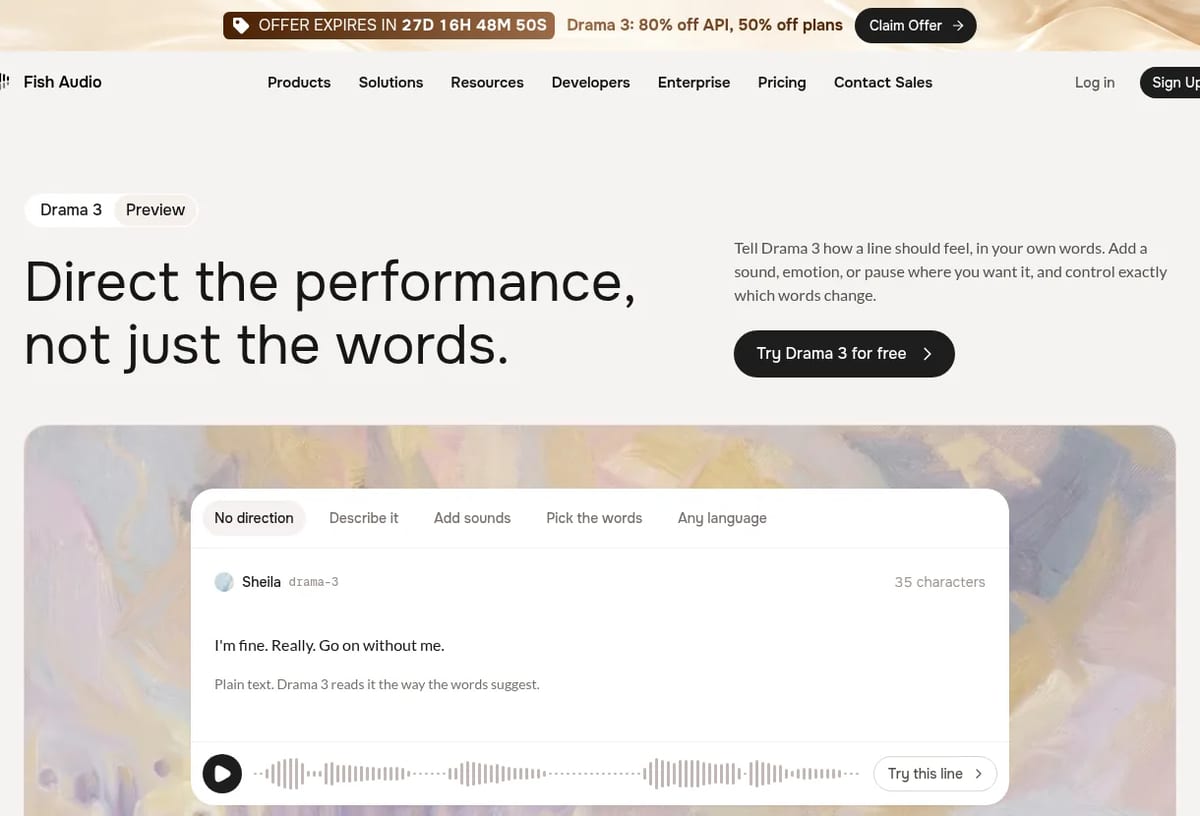
Most text-to-speech models read a line the way the words suggest. Drama 3 lets you tell it how the line should be performed. Fish Audio’s Drama 3 page shows five ways to direct a take, and you can mix them in the same line:
- Describe it in your own words: write a direction in square brackets, such as [warm and relaxed, like talking to an old friend], and the delivery follows it.
- Add sounds and pauses: drop a [sigh], a laugh, a breath or a [pause] exactly where it should happen.
- Control selected words: select a few words and apply a scoped tag (Whisper, Emphasis, Soft, Faster, Slower, Stress or Forceful). Only those words change.
- Direct in any language: directions can be written in English or your own language.
- Auto Tag: paste plain dialogue and let Auto Tag add the directions, then keep or rewrite them.
Drama 3 also handles multi-speaker scenes in one pass. In the editor you add speakers and give each a voice; the Hugging Face model card says one text can carry up to 16 characters. Fish Audio labels the model a preview and says results vary between takes, so plan to generate a few and pick the best.
Fish Audio Pricing (2026)
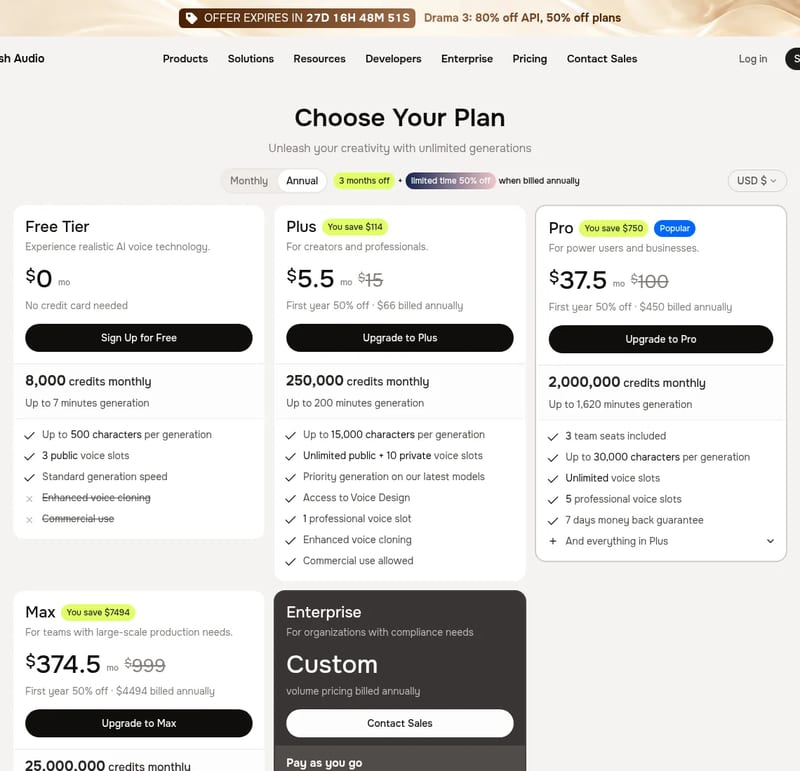
We checked the Fish Audio pricing page on October 16, 2026. App plans are monthly credit allowances; Fish Audio’s FAQ says one minute of generated speech costs roughly 600 to 625 credits. These are the standard list prices:
| Plan | Monthly billing | Annual billing | Credits / month | Key limits |
|---|---|---|---|---|
| Free | $0 | $0 | 8,000 (about 7 minutes) | 500 characters per generation, 3 public voice slots, no commercial use |
| Plus | $15 / mo | $11 / mo ($132 a year) | 250,000 (about 200 minutes) | 15,000 characters, 10 private voice slots, Voice Design, commercial use |
| Pro | $100 / mo | $75 / mo ($900 a year) | 2,000,000 (about 1,620 minutes) | 3 team seats, 30,000 characters, 5 professional voice slots, 7-day money-back |
| Max | $999 / mo | $749 / mo ($8,988 a year) | 25,000,000 (about 6,250 minutes) | 10 team seats, 15 professional voice slots |
| Enterprise | Custom | Custom | Volume pricing | Zero data retention, on-premise deployment, SOC 2 |
Drama 3 launch deal: on October 16 the pricing page showed a banner reading “Drama 3: 80% off API, 50% off plans” with a countdown of about 27 days. Under that offer, Plus showed $7.50 for the first month on monthly billing, or $5.50 a month for the first year on annual billing ($66). Pro showed $50 for the first month, or $37.50 a month for the first year ($450). The discount applies to the first month or first year only, then standard prices apply.
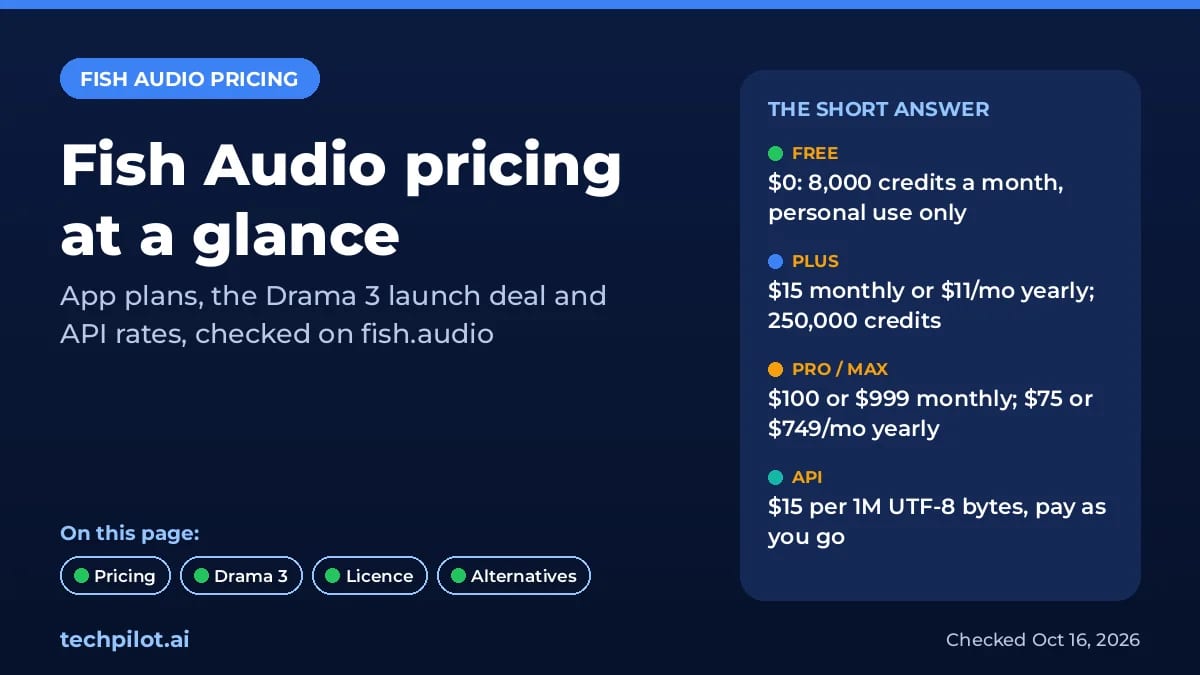
API pricing is separate and pay as you go, with no subscription or monthly minimum. Fish Audio’s API pricing docs list $15 per 1M UTF-8 bytes of input text for its S2.1 Pro and S2 Pro voice models (1M bytes is roughly 180,000 English words, or about 12 hours of speech), a free s2.1-pro-free model, $0.36 per audio hour for transcription, and $0.01 per Voice Design request. That table did not list drama-3 as its own line when we checked. The 80% API discount in the banner was the only Drama 3 API offer we saw, so check your console for the rate on your own account.
Two details matter for budgeting. Unused credits don’t roll over to the next month. And the FAQ says free plan users may use generated audio only for personal, non-commercial projects. Commercial use starts on Plus.
Is Fish Audio free?
Yes, with limits. The Free tier needs no credit card and gives 8,000 credits a month, enough for about seven minutes of speech, with 500 characters per generation and three public voice slots. You can try Drama 3 in the app for free. The free plan doesn’t include enhanced voice cloning or commercial rights, so it works for testing voices and personal projects but not for client work or monetised content.
Drama 3 open weights and licence
The fishaudio/drama-3 repository on Hugging Face holds the full weights. According to the model card, Drama 3 has 35B parameters with 3B active per token (a mixture-of-experts text backbone), FP8 expert weights, and an audio decoder that predicts 10 codebooks. It runs on SGLang-Omni from launch, and Fish Audio added an int4 version (fishaudio/drama-3-int4) on October 14.
Open weights don’t mean open source. The repository’s LICENSE file is the Fish Audio Community License, version 1.0, dated October 13, 2026. In plain terms:
- Research and non-commercial use: free.
- Commercial use: allowed free only while your company’s total annual revenue is under $500,000. Above that you need a separate written licence from Fish Audio.
- Hosted services: offering Drama 3 to others as a text-to-speech, voice cloning or voiceover API or app always needs a separate licence, whatever your revenue. Using it for your own content, product characters or client voiceover work is not a hosted service.
- Attribution: products that use it must display “Built with Fish Audio”.
- Restrictions: no cloning a real person’s voice without consent, no removing watermarks, and no using the model or its outputs to train other speech or foundation models.
If you just want finished audio, the app or API is simpler. Self-hosting makes sense for researchers, small studios under the revenue cap, and teams that need audio to stay on their own hardware.
How to use Fish Audio Drama 3
- Sign up free at fish.audio and open Text to Speech.
- Pick a voice from the library, or clone one you have rights to.
- Choose Drama 3 as the model, paste your script, and add directions in square brackets or run Auto Tag.
- Generate several takes and keep the best; the preview model varies between runs.
- For developers: call POST /v1/tts with the header model: drama-3. The same tags work in API requests.
- To self-host: serve fishaudio/drama-3 with SGLang-Omni (sgl-omni serve), after reading the licence.
Who Fish Audio is for
Fish Audio suits YouTubers, audiobook and podcast producers, game and animation teams that need many character voices, and developers adding speech to apps. Drama 3’s scene mode and direction tags fit dialogue-heavy work like audio drama, dubbing and explainer scripts. If you mostly edit spoken recordings rather than generate new speech, an editor like Descript is a better fit.
Limitations
- Preview model: Drama 3 output varies between takes, and Fish Audio says it will keep changing the model.
- Tight free plan: about seven minutes a month, 500 characters per generation, and no commercial use.
- Licence limits on the weights: the $500,000 revenue cap and the hosted-service ban rule out many business uses without a deal.
- Temporary prices: the 50% plan and 80% API discounts end when the countdown does. Budget on the standard prices.
- Credits expire monthly: unused credits don’t carry over.
Fish Audio alternatives
- ElevenLabs: the best-known voice AI platform, with a free plan and a broad voice library.
- Fish Audio vs ElevenLabs: our head-to-head comparison of price, voice quality and licensing.
- Descript: edit audio and video by editing the transcript, with AI voices built in.
- MiniMax Speech 2.5: another multilingual TTS model with voice cloning.
- Best ElevenLabs alternatives: our wider roundup of voice generators.
TechPilot.ai’s Verdict on Fish Audio
Fish Audio is one of the cheapest serious ways into expressive AI voice. The free tier is enough to test Drama 3, and Plus at $11 a month billed yearly (half that in the first year during the launch deal) covers most solo creators.
Drama 3’s direction tags are the reason to try it now. Treat it as a preview, generate a few takes per line, and read the Community License before you build a product on the open weights.
Fish Audio FAQ
Is Fish Audio free?
Yes. The Free tier costs $0 with no credit card and gives 8,000 credits a month (about 7 minutes of speech), 500 characters per generation and 3 public voice slots. Free output is for personal, non-commercial use only.
•
How much does Fish Audio cost?
Standard prices on fish.audio/plan (checked October 16, 2026): Plus $15 a month or $11 a month billed yearly, Pro $100 or $75, Max $999 or $749, Enterprise custom. A Drama 3 launch deal cut first-month and first-year prices by 50%. The API is $15 per 1M UTF-8 bytes.
•
What is Fish Audio Drama 3?
Drama 3 is Fish Audio’s text-to-speech model built for direction, released in preview on October 13, 2026. You can describe how a line should sound, add sighs, laughs and pauses, change only selected words, and generate multi-speaker scenes in one pass.
•
Is Fish Audio Drama 3 open source?
The weights are public on Hugging Face (fishaudio/drama-3), but under the Fish Audio Community License, not an open-source licence. Research and non-commercial use are free; commercial use is free only under $500,000 annual revenue, and hosted TTS services need a separate licence.
•
Can I use Fish Audio for commercial projects?
Yes, on a paid plan. Plus and higher allow commercial use; the Free plan does not. If you self-host the Drama 3 weights, commercial use is limited by the licence’s $500,000 revenue cap.

Odessia
AI Agents
Odessia is one of the more convincing AI travel agents so far because it can actually book as a registered agency and keeps watching prices…

Voyager
AI Agents
Voyager is the most ambitious creative agent of the month: instead of another prompt box, it does the production work inside real editors…

Rene
AI Agents
Rene makes a personal agent feel like a contact in your phone. You text it, it handles the email and calendar shuffle, and it can even…
News  Eimantas Kazėnas · 4 min read
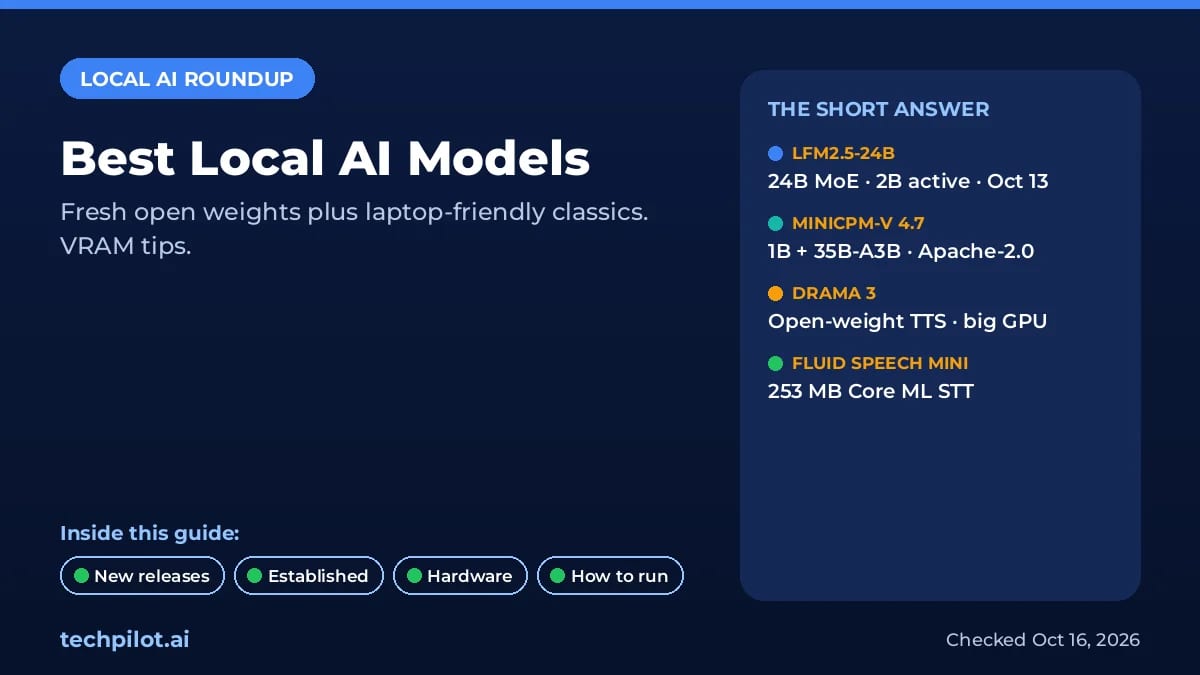
Best Local AI Models (October 2026)
Best local AI models this October: LFM2.5-24B-A2B, MiniCPM-V 4.7, Drama 3, Fluid Speech Mini, plus verified Qwen/Gemma picks, VRAM, and how to run…
Eimantas Kazėnas · 4 min read
News  Mihai (Mike) Bizz · 4 min read
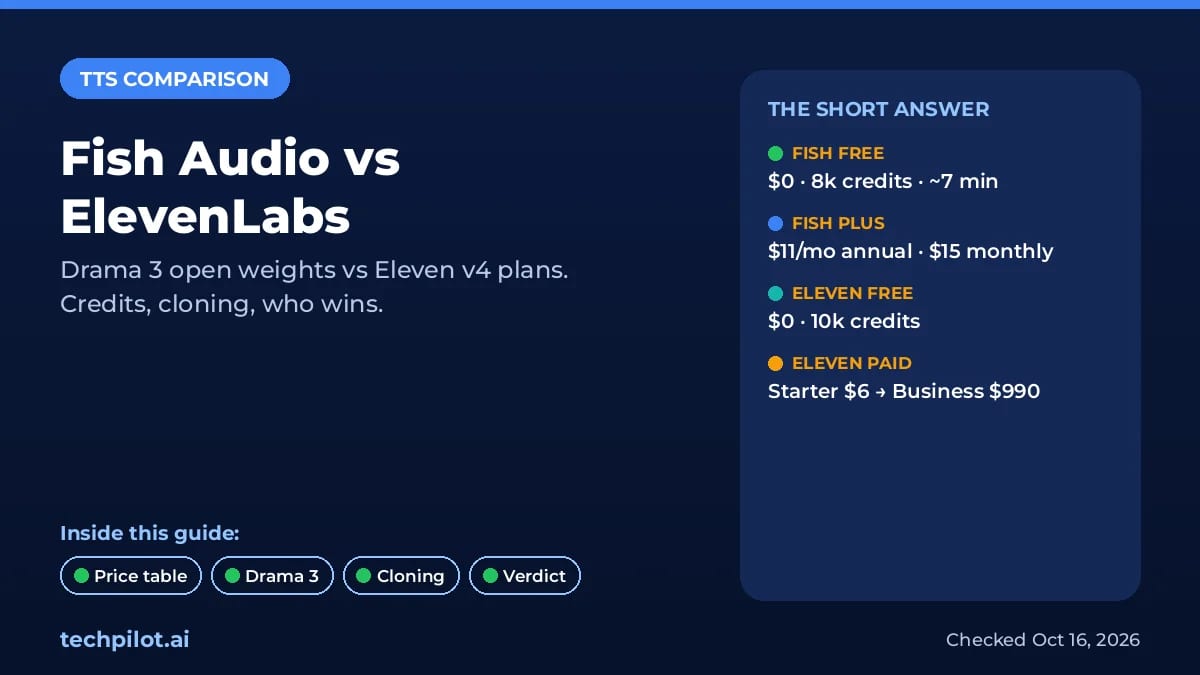
Fish Audio vs ElevenLabs
Fish Audio vs ElevenLabs: Drama 3 open weights and Plus from $11/mo vs ElevenLabs Free to Business at $0-$990. Plans, cloning, who should pick which…
Mihai (Mike) Bizz · 4 min read