ElevenLabs is the AI voice platform (elevenlabs.io) most creators use as the quality benchmark: expressive text to speech with the new Eleven v4 model, voice cloning, dubbing, Studio for long-form narration, music, sound effects and voice agents, now including Eleven Realtime speech-to-speech models, all on one shared credit pool. Plans start at $6/month (Starter, commercial use) after a non-commercial free tier; Creator at $22/month adds Professional Voice Cloning. Pick it when voice quality is the product; pick a cheaper engine when it isn’t.
AI Agents · Tool review
ElevenLabs: Pricing, Realtime & v4 (2026)
 TechPilot.ai review team Hands-on testing, one published method
- Last updated
- How we test
The AI news that actually mattered this week.
One short email every Friday: the biggest AI stories, what they mean for you, and the tools worth trying. A 3-minute read, no hype.
Free. Unsubscribe anytime.
You're in. Watch for the brief on Friday. Free. Unsubscribe anytime.
Summary
Pros and cons
What we like
- Benchmark voice quality Eleven v3 delivers expressive, natural narration in 70+ languages with inline audio tags for emotion and delivery.
- Voice cloning at every paid level Instant Voice Cloning from the $6 Starter plan and Professional Voice Cloning from Creator ($22).
- Complete audio suite Studio for long-form, Dubbing Studio, Eleven Music, sound effects, voice changer, voice isolator and speech-to-text in one account.
- Huge voice library 10,000+ community and designed voices, plus Voice Design to create new voices from a text prompt.
- Developer-grade API Eleven Realtime speech-to-speech models (OpenAI Realtime compatible), low-latency Flash models, and ElevenAgents for phone, chat and WhatsApp agents.
- Commercial rights and credit rollover on every paid plan unused credits carry over for up to two months while you stay subscribed.
What could be better
- Shared credit pool drains fast dubbing (2,000-10,000 credits per minute), music and voice changing consume far more than text to speech.
- Free plan is non-commercial and requires attribution; audio generated before upgrading can never be used commercially.
- Re-takes cost credits only a limited number of free regenerations are offered, so pronunciation fixes add up on long scripts.
- Eleven v3 is not real-time and caps a single request at 5,000 characters; live apps need Flash or v3 Conversational instead.
- Big price jumps between tiers from Creator ($22) the next step is Pro ($99), then Scale ($299) for team seats.
- Voice cloning carries consent and policy obligations; you need rights to any voice you clone, and misuse can lead to account action.
Screenshots
Full review
Independent and reader-supported. Some links may earn us a commission; it never changes our scores. Editorial policy
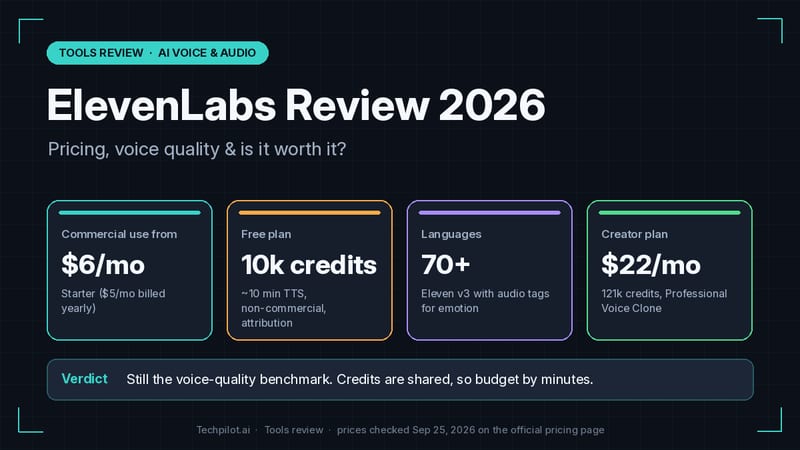
ElevenLabs pricing starts at $0 on Free or $6/month for Starter, with Creator at $22. See Eleven v4, new Eleven Realtime voice agents and which plan fits.
ElevenLabs in 30 seconds
- Is ElevenLabs worth it? Yes, if narration quality drives your content. It is still the voice benchmark rivals are measured against, and Eleven v4 (September 28, 2026) widened the gap on expression and languages.
- Price: Free (10k credits, non-commercial), Starter $6/mo, Creator $22/mo, Pro $99/mo. Yearly billing is 10 months for 12 ($5, $18.33 and $82.50 a month). Creator’s first month is $11.
- Free plan for YouTube? No for monetized videos: free output is non-commercial and must credit ElevenLabs.
- The catch: one credit pool covers everything, and dubbing or music burns it 2 to 10 times faster than text to speech.
- Cheaper if voice isn’t your edge: MiniMax Speech 2.5 or self-hosted Chatterbox; full list in our ElevenLabs alternatives guide.
For most readers the reason to care is narration. The flagship Eleven v3 model produces expressive speech in 70+ languages and accepts inline audio tags such as [whispers] or [sarcastically] to direct delivery. Instant Voice Cloning (from the $6 Starter plan) and Professional Voice Cloning (from the $22 Creator plan) let you narrate in your own voice without recording every line, and the voice library offers 10,000+ community and designed voices. That combination is why ElevenLabs anchors the voice stage of our best AI tools for faceless YouTube stack, and why our best ElevenLabs alternatives guide measures every rival against it.
What’s new (October 2026)
On September 28, 2026, ElevenLabs released Eleven v4 and Eleven v4 Turbo. v4 is built on a new architecture, gives more control over expression, covers 90+ languages (up from 70+ on v3) and improves voice cloning. v4 Turbo targets real-time voice agents with roughly 100 ms median latency. Plan prices are unchanged. A launch promo that gave Creator plans and above extra v4 TTS usage through October 12, 2026 has ended; plan prices themselves are unchanged. Sources: ElevenLabs pricing, TechCrunch.
The catch is the meter. Every plan comes with a monthly credit pool that is shared across every product. Text to speech costs roughly one credit per character on the Multilingual v2 and v3 models, while dubbing, music, voice changing, and speech-to-text draw far larger amounts per minute. A 10-minute YouTube script is about 8,000 to 9,000 characters, so the Starter plan’s 30,000 credits covers roughly three finished narrations a month before re-takes. Paid plans roll unused credits over for up to two months, which softens the blow, but budgeting by minutes of finished audio is the only way to pick the right tier.
Best Use Cases for ElevenLabs
- Faceless YouTube narration: Consistent, expressive voiceover for documentary, explainer, and list channels. Clone your own voice once and keep the channel’s sound identical across hundreds of videos. See how to build a YouTube channel with AI for the full workflow.
- Audiobooks and long-form narration: Studio (the long-form editor) handles chapters, multiple speakers, and per-paragraph regeneration, which is far easier than stitching single TTS clips together.
- Localization and dubbing: Dubbing Studio (from Starter) translates speech while keeping the original speaker’s voice characteristics, useful for turning one video into several language versions. Budget carefully: dubbing is the most credit-hungry feature.
- Podcasts and ads: Generate intros, ad reads, and corrections in your cloned voice, or add Eleven Music beds and sound effects without leaving the platform.
- Film, games, and character work: Voice Design creates new voices from a text prompt, and audio tags give directorial control over emotion. Our AI voice and dialogue tools for filmmakers roundup covers this lane.
- Developers and voice agents: Low-latency Flash models (around 75 ms per ElevenLabs) for real-time apps, v3 for pre-rendered audio, and ElevenAgents for phone, chat, email, and WhatsApp agents.
Who ElevenLabs is not for
- Anyone planning to monetize free-plan audio. Free output is for personal projects and must credit ElevenLabs, so generate final narration on a paid plan from the first monetized upload.
- High-volume narration on a tight budget. If “good enough” narration over stock footage is the goal, a cheaper engine such as MiniMax Speech 2.5 may cover it at a fraction of the cost.
- Teams that need self-hosting or full data control. Open-source options like Chatterbox run on your own hardware.
- People who want voice plus video editing in one app. Tools like Fliki or InVideo AI bundle voiceover with video assembly, trading some voice quality for fewer tools.
Eleven Realtime: speech-to-speech voice agents (October 2026)
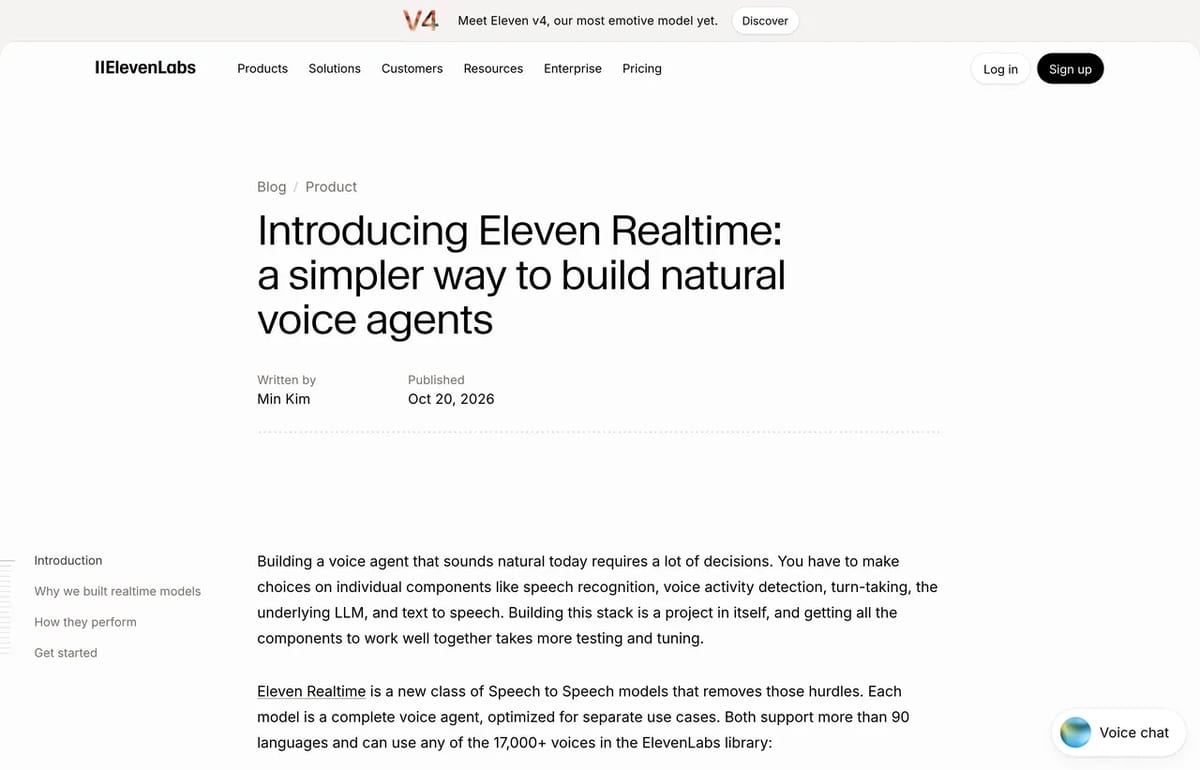
On October 20, 2026, ElevenLabs launched Eleven Realtime, a new class of speech-to-speech models. Until now, an ElevenLabs voice agent was a chain of parts: speech recognition, turn-taking, an LLM and text to speech. Each Eleven Realtime model is the whole agent in one, and both versions speak 90+ languages with any of the 17,000+ voices in the ElevenLabs library.
| Model | Best for | ElevenLabs-reported results |
|---|---|---|
| Realtime v1 Mini | Assistants, tutors, characters; the default and cheapest option | 0.62 s to first audio; 95.8% on Full-Duplex-Bench; 75.9% on Big Bench Audio |
| Realtime v1 Max | Customer support, lead qualification, multi-step tool use | 0.57 s to first audio; 98.8% on Big Bench Audio; 87.1% task success with tools |
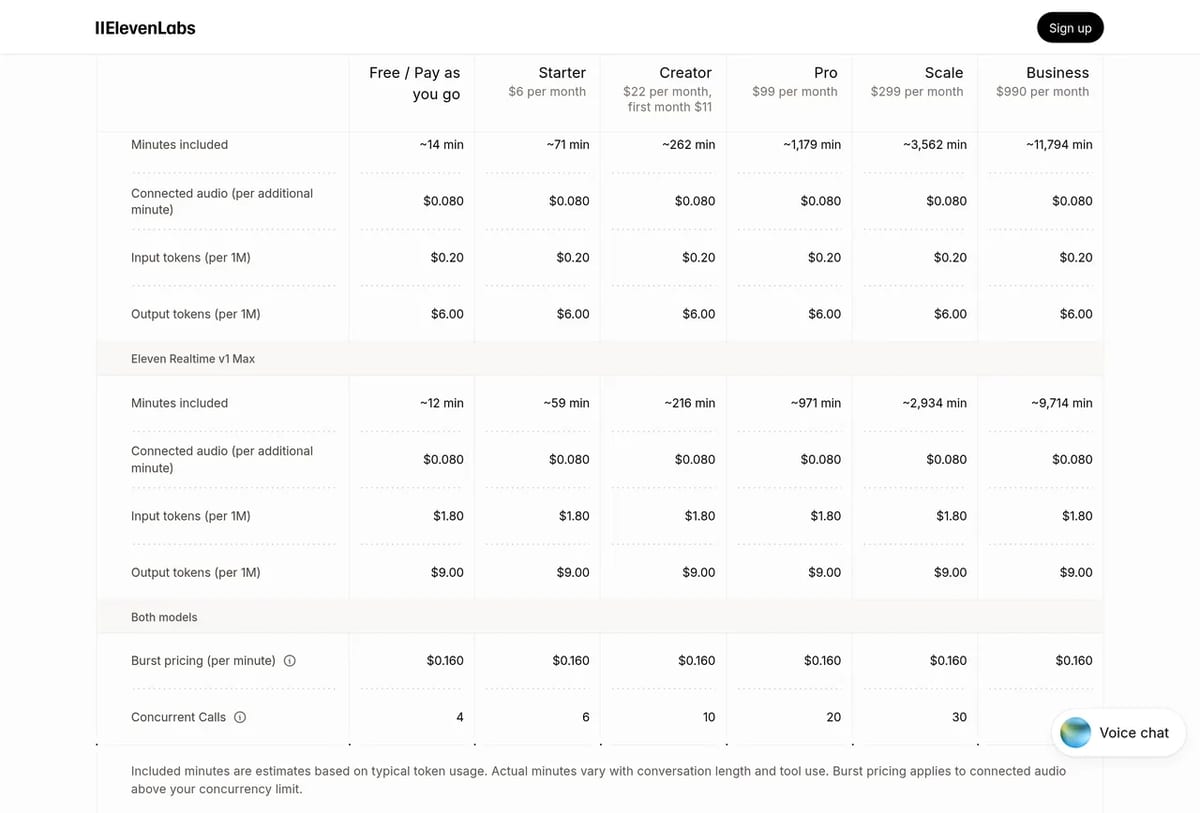
How it’s priced. In ElevenAgents, a Realtime agent costs the normal per-minute call rate ($0.08 a minute beyond your plan’s included minutes) plus LLM tokens. Through the standalone Realtime API, you pay $0.08 per minute of connected audio plus tokens: v1 Mini costs $0.20 per 1M input tokens and $6.00 per 1M output tokens, and v1 Max costs $1.80 and $9.00. Burst calls above your concurrency limit cost $0.16 a minute. The Free plan includes about 14 minutes of v1 Mini or 12 minutes of v1 Max, and Starter about 71 or 59.
OpenAI Realtime compatibility. The Realtime API follows OpenAI’s Realtime spec over WebSocket, so if you already use OpenAI’s SDK you can switch by changing the endpoint and model name (for example eleven_realtime_v1_mini). WebRTC integrations need to move to WebSocket first, and the API runs separately from ElevenAgents, so channels like phone and WhatsApp, the knowledge base and monitoring need ElevenAgents. We compare the two head to head in Eleven Realtime vs GPT-Realtime.
Limits to know: ElevenLabs says the models are rolling out gradually. According to the Realtime docs, v1 Mini isn’t available under Zero Retention Mode or HIPAA, and v1 Max isn’t available in the India and Singapore data residency environments.
October 2026 pricing re-check
We re-checked elevenlabs.io/pricing on October 22, 2026. Creative plan list prices are unchanged: Free $0 (10k credits), Starter $6/month (30k), Creator $22/month (121k; first month $11), Pro $99 (600k), Scale $299 (1.8M, 3 seats), Business $990 (6M, 10 seats). The $1 first month on Starter ended on October 18. Annual billing is still priced as 10 months for 12.
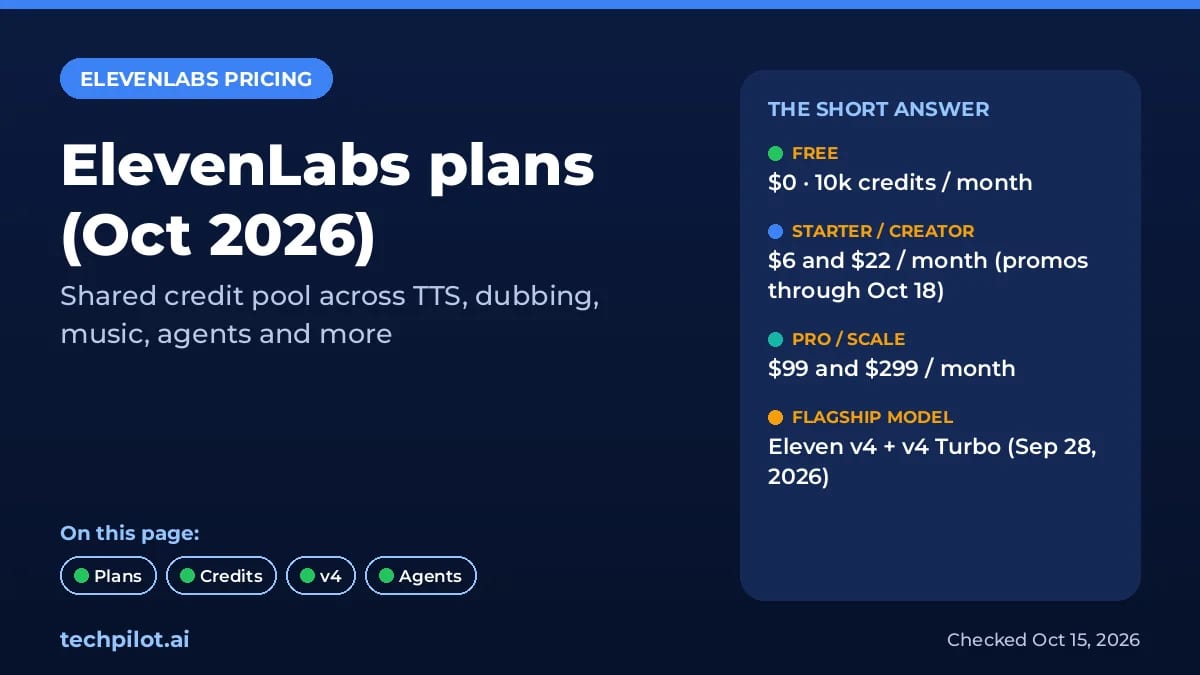
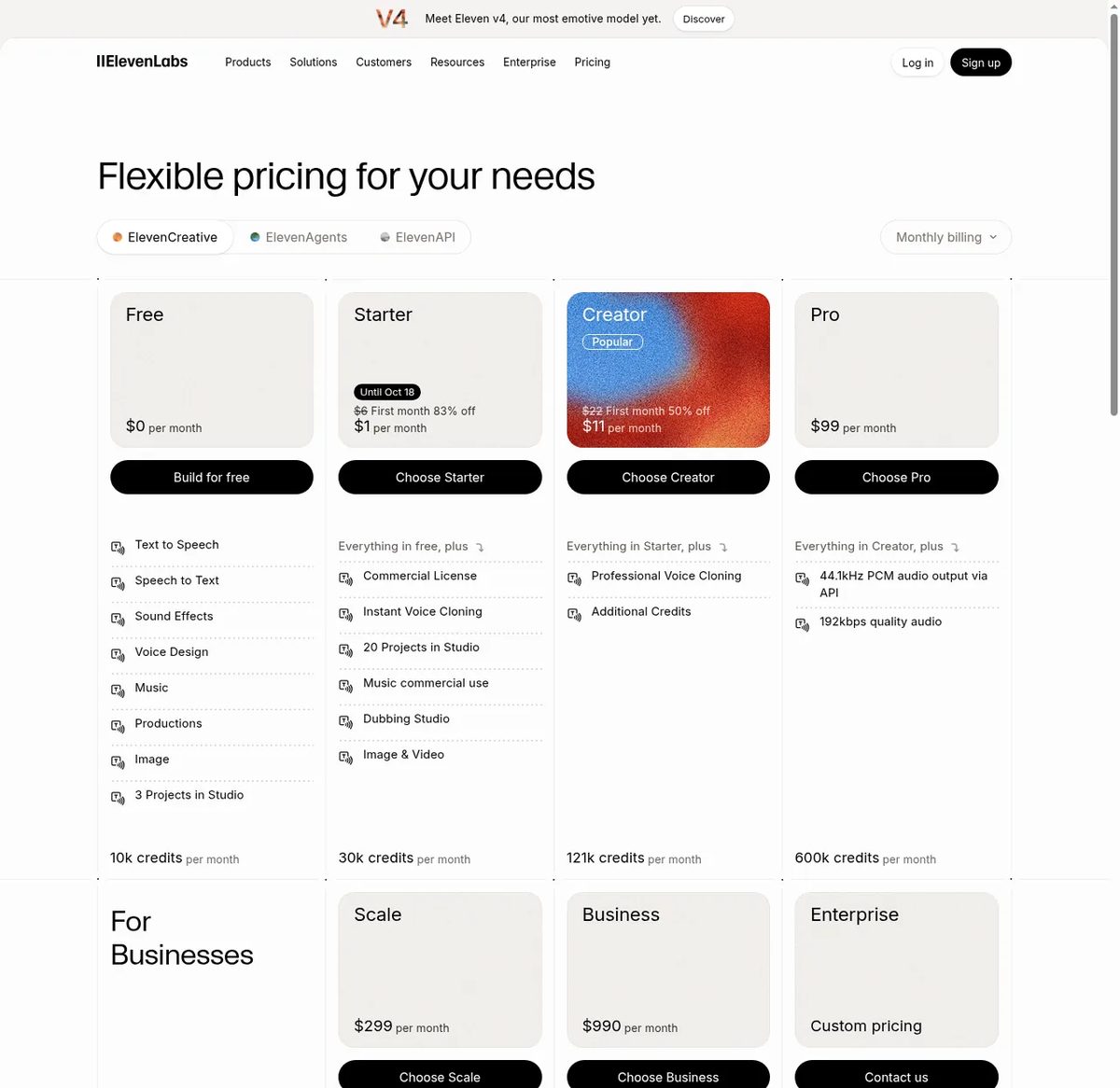
Credits remain shared across text to speech, speech to text, music, dubbing, sound effects, voice changer and agents. For voice stack alternatives, see our ElevenLabs alternatives guide and the Descript editor if you need transcript-based video cuts next to narration.
ElevenLabs Pricing (2026)
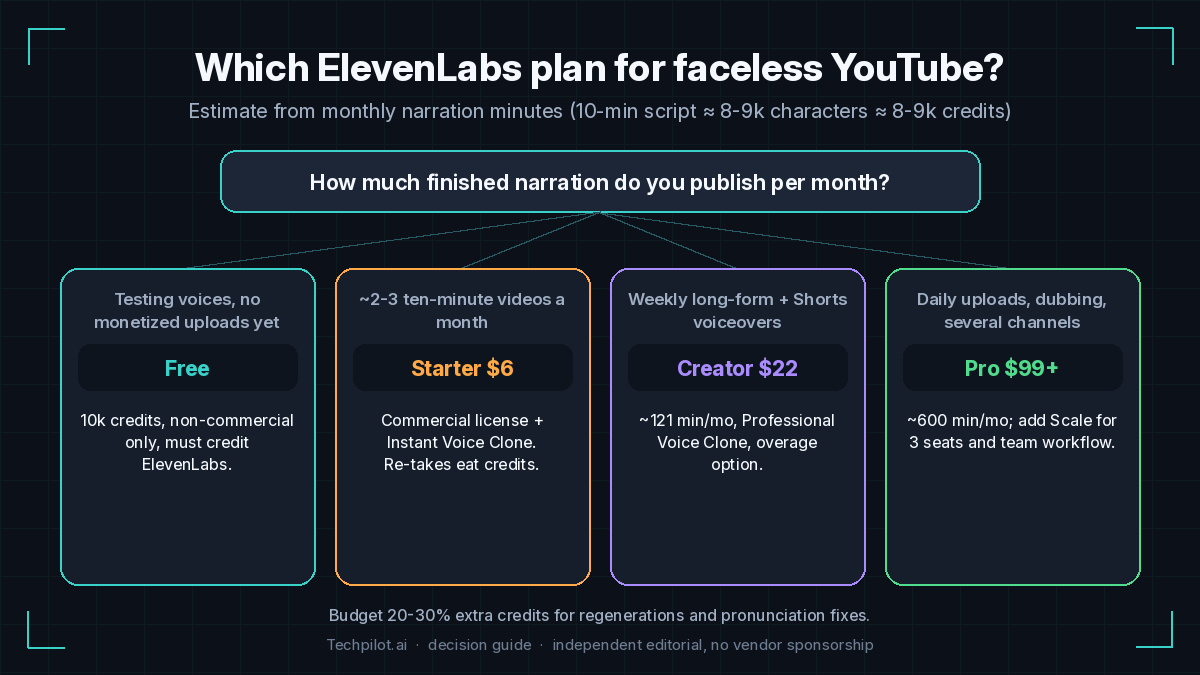
Which ElevenLabs plan fits your workflow?
The table maps common creator workloads to plans, using ElevenLabs’ pricing page (prices unchanged when we rechecked on October 8, 2026) and ElevenLabs’ own minute estimates for text to speech. Yearly billing works out to two months free.
| Your workload | Plan | Price (monthly / yearly equiv.) | Credits and rough TTS minutes |
|---|---|---|---|
| Testing voices, personal non-commercial projects | Free | $0 | 10k credits, about 10 minutes. Non-commercial, attribution required. |
| New monetized channel, 2 to 3 ten-minute videos a month | Starter | $6 / $5 | 30k credits, about 30 minutes. Commercial license, Instant Voice Cloning, Dubbing Studio. |
| Weekly long-form narration plus Shorts voiceovers | Creator | $22 / $18.33 (first month often $11) | 121k credits, about 121 minutes. Professional Voice Clone, 192 kbps audio, extra credits on demand. |
| Daily uploads, audiobooks, or multi-language channels | Pro | $99 / $82.50 | 600k credits, about 600 minutes. 44.1 kHz PCM output via API. |
| Small team or agency sharing voices | Scale | $299 / $249.17 | 1.8M credits, about 1,800 minutes, 3 seats, 3 Professional Voice Clones. |
Which ElevenLabs model should you use? v4 vs v3 vs Flash
| Model | Best for | Languages | Notes |
|---|---|---|---|
| Eleven v4 (Sep 28, 2026) | Expressive narration, audiobooks, character voices | 90+ | Newest architecture, more expression control, better cloning. Creator+ gets extra v4 TTS usage in the web and mobile apps until October 12. |
| Eleven v4 Turbo | Real-time voice agents | 90+ | Around 100 ms median latency, per ElevenLabs. |
| Eleven v3 | Pre-rendered audio with audio tags | 74 (pricing page) | Inline tags like [whispers]; 5,000 characters per request; not real-time. |
| Flash / Turbo v2.5 | Low-latency apps on a budget | Multilingual | About 75 ms; 0.5 to 1 credit per character via the API. |
What a credit buys (from ElevenLabs’ pricing FAQ): text to speech about 1 credit per character, speech to text 330 per minute, music 900 per minute, sound effects 200 per generation, voice changer or isolator 1,000 per minute, and dubbing 2,000 to 10,000 per minute. Paid plans roll unused credits over for up to two months (your balance can reach 3x the monthly quota), but downgrading or cancelling forfeits them.
Workflow tip: for Shorts, generate the voiceover here, then add animated captions in Submagic or turn long narrated videos into clips with the tools in our YouTube to Shorts AI guide. If you need translated versions of finished clips, Klap bundles AI dubbing with clipping.
TechPilot.ai’s Verdict on ElevenLabs
Is ElevenLabs worth it in 2026? If voice is the product, meaning narration people will listen to for ten minutes or more, yes. Eleven v3’s emotional range and audio-tag control, Professional Voice Cloning, and Studio’s long-form workflow still set the standard that alternatives are judged against. The platform has also become broader than any rival, with dubbing, music, sound effects, speech-to-text, and agents in one account, and the entry price for commercial use is only $6 a month.
Bottom line: Start on the free plan to pick a voice, then move to Starter the moment you publish anything monetized. Upgrade to Creator when you narrate weekly or want a Professional Voice Clone. If your monthly character count keeps pushing you toward Pro and voice is not what sets your channel apart, run the switch test in our ElevenLabs alternatives guide. For the ethics and mechanics of cloning, read AI voice cloning and the tech behind it and our tips on maintaining voice and audio consistency.
Top Alternatives to ElevenLabs
- MiniMax Speech 2.5: Choose MiniMax for cheaper voice cloning and multilingual narration with quality close to ElevenLabs. Prefer ElevenLabs for audio-tag direction, Studio, and dubbing.
- Chatterbox: Choose this open-source model from Resemble AI when you want to self-host, control costs at scale, or keep data in-house. Prefer ElevenLabs for a managed, polished workflow.
- Murf AI: Choose Murf for business voiceovers synced to slides and video in a studio interface built for teams. Prefer ElevenLabs for expressive narration and cloning.
- Fliki: Choose Fliki when you want text-to-video and voiceover in one tool. Prefer ElevenLabs when voice quality is the priority.
- Vapi: Choose Vapi to orchestrate voice agents across multiple speech providers. Prefer ElevenAgents if you want voices, agents, and telephony from one vendor.
- Pair with: HeyGen or Synthesia for avatar video, Descript for editing narration into video, and Sync.so for lip-syncing dubbed audio to footage.
- Also browse: best ElevenLabs alternatives 2026, faceless YouTube AI stack, and the TechPilot.ai tools hub.
ElevenLabs FAQ
Is ElevenLabs free?
Yes, there is a Free plan at $0 with 10,000 credits a month for non-commercial use. Paid Starter starts at $6 a month for a commercial license.
•
How much does ElevenLabs cost?
As of October 22, 2026 on elevenlabs.io/pricing: Starter $6, Creator $22 ($11 for the first month), Pro $99, Scale $299, Business $990 per month. Annual billing equals about two months free.
•
What is Eleven v4?
Eleven v4 and v4 Turbo launched September 28, 2026. v4 adds more expression control and 90+ languages; v4 Turbo targets low-latency agents (~100 ms median). Plan prices did not change with the launch.
•
What is Eleven Realtime?
Eleven Realtime is ElevenLabs’ speech-to-speech model family for voice agents, launched October 20, 2026. v1 Mini suits natural conversation at low cost; v1 Max handles complex, tool-heavy tasks. Both are OpenAI Realtime API compatible.
•
Is ElevenLabs worth it for YouTube?
If narration quality is the product, yes — start free, move to Starter when you monetize, and Creator when you narrate weekly or need a Professional Voice Clone.
DeepSeek V4.1 Flash
AI Agents
DeepSeek V4.1 Flash is one of the cheapest strong models you can call today. Off-peak it costs $0.15 / $0.60 per 1M tokens, cache hits are…

Local Code
AI Agents
Local Code is the easiest way we’ve seen to get a capable, private AI agent running on a Mac without touching a terminal.
Reflection Beam
AI Agents
Reflection Beam is a big, genuinely open coding and agent model. Try it free on Ollama Cloud or OpenCode while the offer lasts.
Audio / Voice  Eimantas Kazėnas · 5 min read
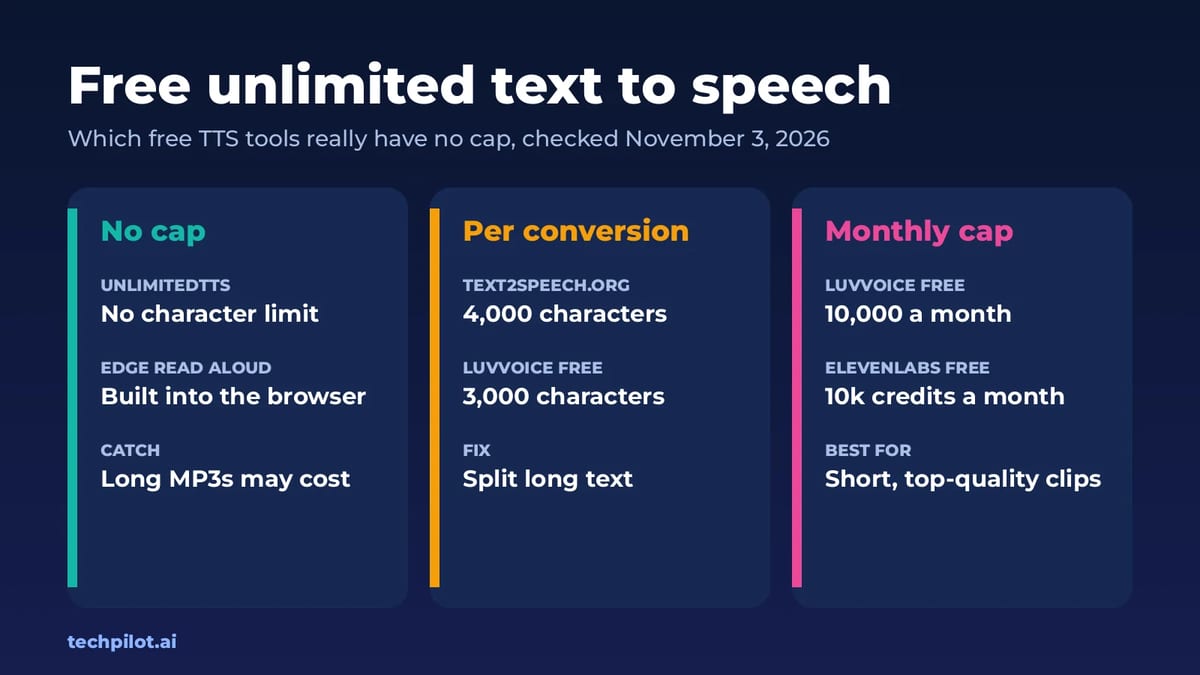
Text to Speech Online Free Unlimited (2026)
Text to speech online free unlimited: UnlimitedTTS and Edge Read Aloud have no character cap, but free AI voice plans stop at 3,000 to 10,000…
Eimantas Kazėnas · 5 min read
Audio / Voice Eimantas Kazėnas · 6 min read
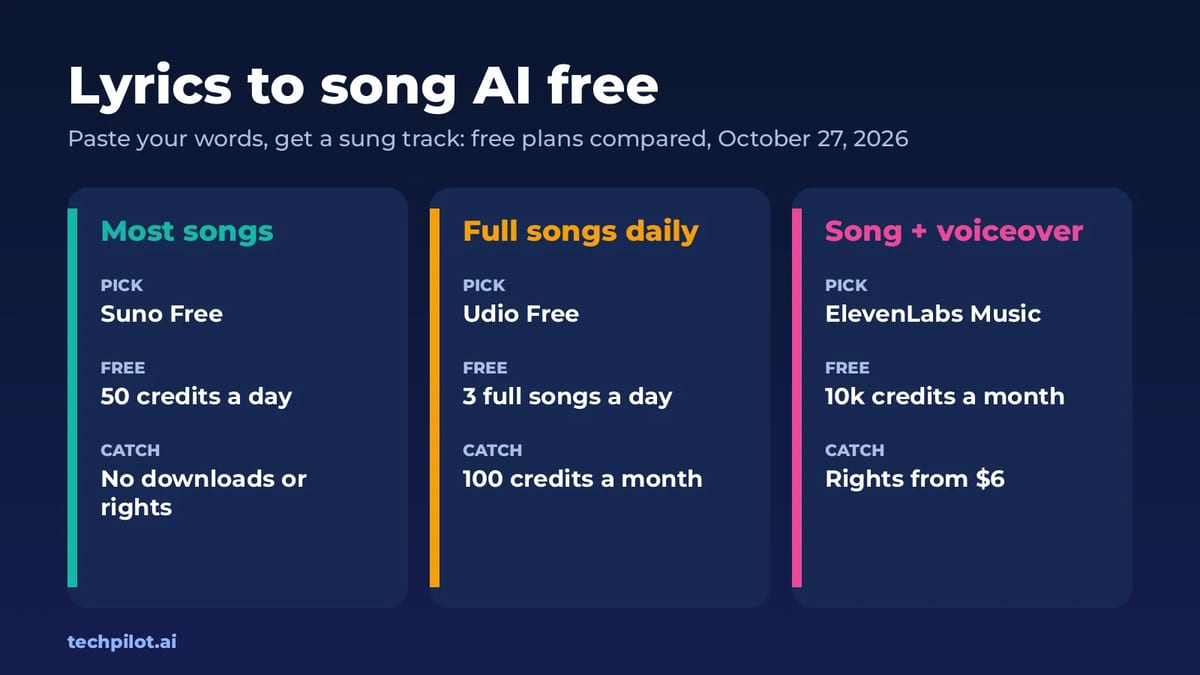
Lyrics to Song AI Free: 4 Best Tools (2026)
Lyrics to song AI free tools turn your words into a sung track in minutes. We compare Suno, Udio, ElevenLabs Music and Producer.ai free plans and…
Eimantas Kazėnas · 6 min read