Home / Guides / Audio / Voice
Eleven Realtime vs GPT-Realtime: Which Wins?
 Eimantas Kazėnas Marketing & Tech
- Published
- 5 min read
On this page What is Eleven Realtime?
- What is Eleven Realtime?
- What is GPT-Realtime?
- Eleven Realtime vs GPT-Realtime at a glance
- Speed: which one answers faster?
- Quality: reasoning, tools and natural conversation
- Eleven Realtime vs GPT-Realtime pricing
- Limits to know before you switch
- Which should you choose?
- The bottom line
- Frequently asked questions
Independent and reader-supported. Some links may earn us a commission; it never changes our rankings. Editorial policy
Eleven Realtime vs GPT-Realtime: ElevenLabs’ new voice model starts talking faster, but OpenAI’s wins on tool use. Compare speed, price, voices and access.
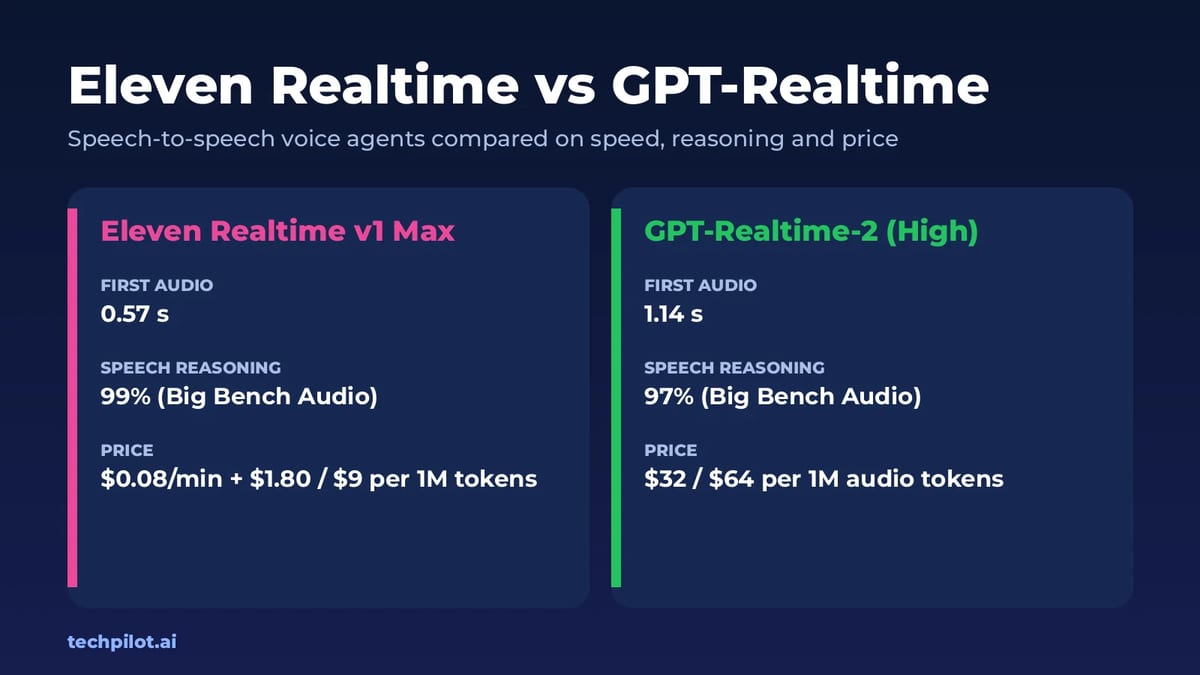
Quick answer: If you’re building a voice agent where speed, voice quality and language range matter most, Eleven Realtime v1 Max is the stronger pick today. It starts speaking in about half the time of GPT-Realtime-2 and leads independent preference tests. If your agent leans on function calls and multi-step tasks, GPT-Realtime-2 or 2.1 is still slightly ahead. Because Eleven Realtime uses the OpenAI Realtime API format, you can test both with very little code change.
What is Eleven Realtime?
Eleven Realtime is ElevenLabs’ first speech-to-speech model family for live voice conversations. It comes in two versions, v1 Mini for speed and price and v1 Max for harder reasoning. ElevenLabs says it supports 90+ languages and its library of 17,000+ voices. It speaks the OpenAI Realtime protocol over WebSocket, so apps built for GPT-Realtime can point at ElevenLabs’ endpoint instead. It’s separate from ElevenAgents, ElevenLabs’ full agent platform, and access is rolling out gradually. Our ElevenLabs review covers the wider plans.
What is GPT-Realtime?
GPT-Realtime is OpenAI’s speech-to-speech model for its Realtime API. The current versions are GPT-Realtime-2 and GPT-Realtime-2.1, plus a cheaper gpt-realtime-2.1-mini. They take audio, text and image input, have a 128K context window and up to 32K output tokens, and let you set the reasoning effort from minimal to high.
Eleven Realtime vs GPT-Realtime at a glance
| Eleven Realtime v1 Max | GPT-Realtime-2 (High) | |
|---|---|---|
| Time to first audio | 0.57 s | 1.14 s |
| Speech reasoning | 99% | 97% |
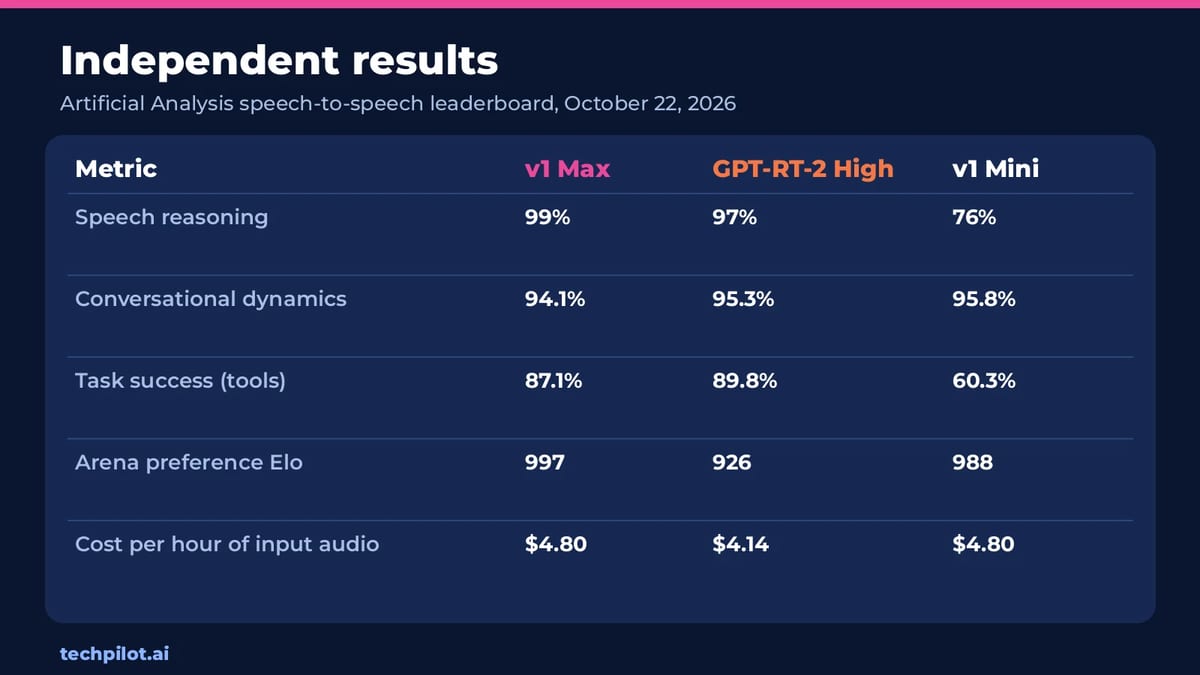
| Task success with tools | 87.1% | 89.8% |
| Preference Elo | 997 | 926 |
| Cost per hour of input audio | $4.80 | $4.14 |
| Voices | 17,000+ library voices | A small set of built-in voices |
| Connection | WebSocket | WebSocket, WebRTC and SIP |
Benchmark and cost figures are from the Artificial Analysis speech-to-speech leaderboard, checked October 22, 2026.
Speed: which one answers faster?
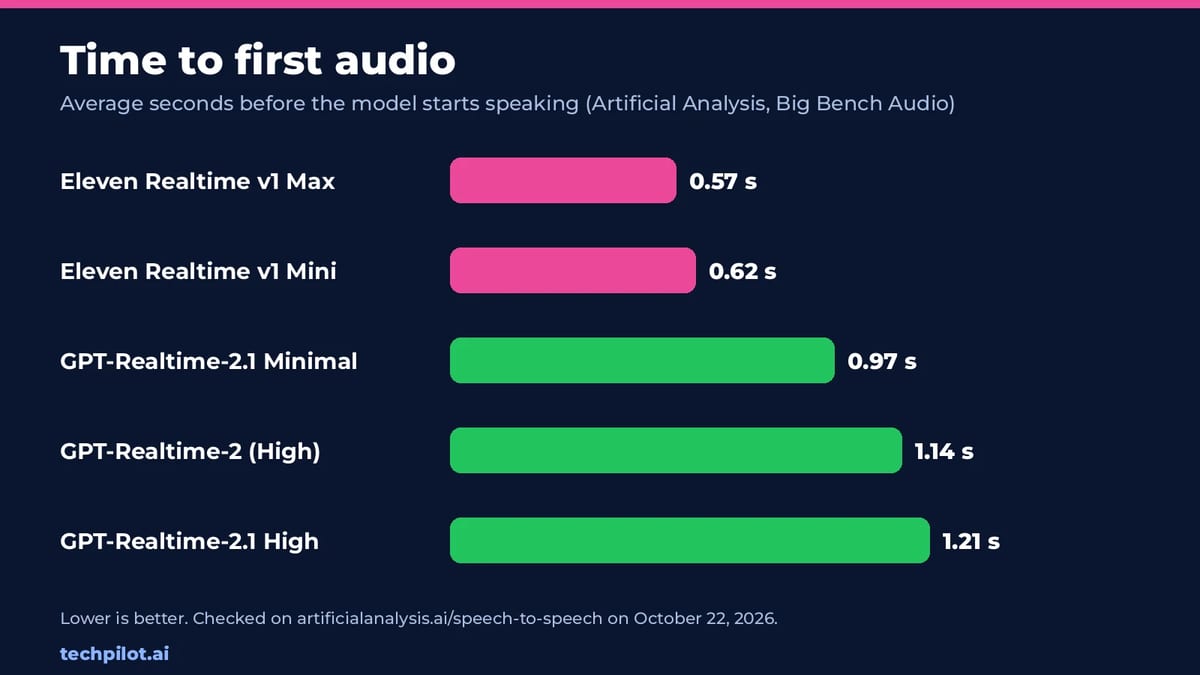
Response speed is where Eleven Realtime stands out. In Artificial Analysis testing, v1 Max starts speaking after 0.57 seconds on average and v1 Mini after 0.62 seconds. GPT-Realtime-2 at high reasoning takes 1.14 seconds, GPT-Realtime-2.1 High 1.21 seconds, and even 2.1 at minimal reasoning needs 0.97 seconds.
Half a second sounds small, but in a phone call it’s the difference between a natural reply and an awkward pause. For support lines, booking agents and anything where people talk over each other, this is the main reason to try ElevenLabs.
Quality: reasoning, tools and natural conversation
- Reasoning: v1 Max scores 99% on Big Bench Audio speech reasoning, just ahead of GPT-Realtime-2 High at 97%. v1 Mini drops to 76%, so use Max for anything that needs real thinking.
- Tool use: OpenAI leads here. GPT-Realtime-2.1 High completes 91.5% of multi-step tool tasks and GPT-Realtime-2 High 89.8%, against 87.1% for v1 Max and 60.3% for v1 Mini.
- Conversation flow: all of them handle interruptions and turn-taking well, between 94% and 96% on conversational dynamics.
- How it sounds: in blind preference tests, both Eleven models (997 and 988 Elo) are rated above GPT-Realtime-2 High (926) and 2.1 High (937). That’s ElevenLabs’ voice heritage showing.
Eleven Realtime vs GPT-Realtime pricing
The two companies price differently, so the simplest comparison is Artificial Analysis’ cost per hour of input audio: $4.80 for both Eleven models, $4.14 for GPT-Realtime-2 High and $10.75 for GPT-Realtime-2.1 High.
Eleven Realtime API charges $0.08 per minute of connected audio, plus model tokens: v1 Mini costs $0.20 input and $6.00 output per 1M tokens, and v1 Max $1.80 input and $9.00 output. ElevenLabs plans include some minutes too, roughly 14 on Free and 71 on the $6 Starter plan with Mini.
OpenAI GPT-Realtime-2 and 2.1 cost $32 per 1M audio input tokens ($0.40 cached) and $64 per 1M audio output tokens. Text is $4 in and $24 out, and image input $5 per 1M. gpt-realtime-2.1-mini drops audio to $10 in and $20 out. New to AI tokens? Our explainer shows how they turn into a bill.
Limits to know before you switch
- Eleven Realtime works over WebSocket only, so browser apps built on OpenAI’s WebRTC connection need a server in between.
- v1 Mini isn’t available under ElevenLabs’ zero-retention or HIPAA settings, and v1 Max isn’t offered in the India and Singapore data-residency regions.
- Eleven Realtime is still rolling out, so check your account before you plan a launch.
Which should you choose?
- Phone and support agents: Eleven Realtime v1 Max, for faster replies and a more natural voice.
- Branded or multilingual voices: Eleven Realtime, for the voice library and 90+ languages.
- Agents that call many tools or APIs: GPT-Realtime-2.1 High, which has the best task success.
- Lowest cost at scale: test gpt-realtime-2.1-mini and Eleven v1 Mini on your own calls, since the cheaper models trade away reasoning.
Building something bigger? See our guide to AI agents for how voice fits into agent workflows.
The bottom line
Eleven Realtime is the first serious challenger to OpenAI in speech-to-speech. It’s clearly faster and sounds better in blind tests, while GPT-Realtime keeps a small lead on tool-heavy tasks and offers more ways to connect. Since both speak the same API format, the smart move is to run your own calls through each before you commit.
Frequently asked questions
Is Eleven Realtime better than GPT-Realtime?
For speed and voice quality, yes. Eleven Realtime v1 Max starts speaking in 0.57 seconds versus 1.14 seconds for GPT-Realtime-2 High and wins blind preference tests. GPT-Realtime-2.1 is still ahead on multi-step tool tasks.
How much does Eleven Realtime cost?
The Eleven Realtime API charges $0.08 per minute of connected audio plus tokens: $0.20 input and $6.00 output per 1M tokens on v1 Mini, and $1.80 and $9.00 on v1 Max. Some minutes are included in ElevenLabs plans.
How much does GPT-Realtime cost?
GPT-Realtime-2 and 2.1 cost $32 per 1M audio input tokens and $64 per 1M audio output tokens. The cheaper gpt-realtime-2.1-mini costs $10 and $20.
Can I switch from OpenAI Realtime to Eleven Realtime?
Yes. Eleven Realtime uses the OpenAI Realtime API format over WebSocket, so most apps only need a new endpoint, key and model name. Apps using WebRTC need a server in between.
What is the difference between Eleven Realtime v1 Mini and v1 Max?
v1 Mini is cheaper and built for speed, but scores 76% on speech reasoning. v1 Max scores 99% and handles tool tasks far better, at a higher token price.
Found this useful? Share it with someone comparing AI tools.