Home / Guides / Audio / Voice
Best AI Voice and Dialogue Tools for Filmmakers
 John Daniel Corporate finance, Mathematics, GenAI
 - Published
- 8 min read
On this page Comparison table
Independent and reader-supported. Some links may earn us a commission; it never changes our rankings. Editorial policy
Dialogue is where AI audio tools get judged the hardest, because an audience has spent a lifetime learning what a real conversation sounds and looks like. A voiceover with a slightly synthetic edge can still work in an ad; a dubbed line of dialogue with mismatched emotion or lips that don’t quite match the words breaks a scene instantly. This list focuses specifically on the dialogue side of filmmaking, replacing a line, dubbing into another language, and matching a new performance to picture, rather than general narration or voiceover work.
Comparison table
| Tool | Best for | Dialogue-specific capability | Starting price |
|---|---|---|---|
| invideo agent | Dialogue that stays consistent across scenes and translated versions of a project | Auto-translation, lip-synced voiceover, and voice cloning across languages | $17/month; team and enterprise options available |
| Deepdub | Feature-length and episodic film and TV dubbing at studio scale | Emotion-preserving voice cloning maintaining performance nuance, 5,000+ titles localized | Custom enterprise pricing |
| Flawless AI | Foreign-language dialogue without reshoots or visible dubbing seams | Visual dubbing that adjusts on-screen lip movement to match new dialogue | Enterprise pricing |
| Respeecher | High-fidelity voice cloning for dialogue replacement in narrative work | Custom voice cloning combined with lip-synchronization for creative studios | Custom pricing |
| Papercup | Broadcast and documentary dubbing where quality failures are unacceptable | AI dubbing with human linguist review on every project | Custom quote |
| CAMB.AI | Real-time dubbing for live broadcast or fast-turnaround content | API-first, real-time multi-language dubbing at broadcast scale | Custom / API pricing |
| iZotope RX | Matching ADR to the original scene’s room tone | Dialogue Isolate and Ambience Match built for post-production | $49–1,199 (tiered) |
| Descript | Fixing a flubbed line without a new recording session | Overdub tied directly to transcript-based editing | $12/month (annual) |
| ElevenLabs | Stable, high-fidelity dialogue replacement in one voice | Professional Voice Cloning holding up across long passages | $5/month |
| Maestra | Multi-character dialogue needing diverse voice casting | Strong multi-speaker detection and distinct voice assignment | Subscription-based |
1. invideo agent
Dialogue in a real production has to do two things at once: sound like the same character delivered it, and, increasingly, work in more than one language. invideo agent is built around holding both of those together inside one project. When a video needs to reach a new market, the platform plans what has to change versus stay the same, auto-translates the dialogue, generates lip-synced voiceover, and uses voice cloning to keep the same voice consistent across every language version, so a character sounds like the same person in Spanish as they do in English rather than being replaced by a generic localized voice.
That consistency mechanism sits on the same persistent context engine that holds characters visually consistent across a project, and it routes each shot to whichever of its 200+ integrated models fits that particular moment, including Veo 3.1, Sora 2, Kling 3.0, Seedance 2.0, Runway, PixVerse, Hailuo, WAN, Recraft, GPT Image 2.0, and Nano Banana.
Best for: dialogue that needs to stay recognizably consistent across scenes and hold up across multiple translated language versions of the same project.
Where it falls short: it’s a project-level dialogue and localization system rather than a specialist ADR or visual-dubbing tool, so a production needing frame-accurate lip adjustment on already-shot footage will want a dedicated tool like Flawless AI for that specific job.
Pricing: plans start at $17/month, with team and enterprise options also available.
2. Deepdub
Deepdub has positioned itself as the premium choice for major studios, with over 5,000 titles localized globally and tools built specifically around the demands of episodic television and feature-length films. Its emotion-preserving voice cloning technology is designed to maintain the specific performance nuances, fear, excitement, sarcasm, that get lost in flatter dubbing approaches.
Best for: streaming originals, TV series localization, and theatrical releases where preserving an actor’s emotional performance across languages matters.
Where it falls short: it’s priced and positioned for studios and networks with significant localization budgets, with enterprise custom quotes rather than a self-serve plan.
Pricing: custom enterprise pricing.
3. Flawless AI
Flawless takes a genuinely different approach to the dialogue problem: rather than only replacing the audio, it uses AI to adjust the on-screen actor’s lip movement to match new dialogue, in the original language or a dub, without requiring a reshoot or leaving the visible mismatch traditional dubbing produces.
Best for: eliminating the visible lip-sync mismatch that gives away traditional foreign-language dubbing, without reshooting the scene.
Where it falls short: it’s enterprise-tier technology built for high-end film and streaming production rather than a self-serve tool for smaller projects.
Pricing: enterprise pricing.
4. Respeecher
Respeecher specializes in custom voice cloning combined with lip-synchronization specifically for dialogue replacement, and it’s used by creative studios, game developers, and brand teams that need a precise, high-fidelity clone of a specific voice rather than a generic synthetic alternative.
Best for: high-fidelity, custom voice cloning for dialogue replacement in narrative film and game production.
Where it falls short: it’s a specialist voice-cloning tool built around custom projects rather than a fast, self-serve dubbing platform.
Pricing: custom pricing.
5. Papercup
Papercup’s model combines AI dubbing with a human linguist review layer on every project, which costs more and moves slower than fully automated tools, but matters for content where a quality failure is genuinely unacceptable, a broadcast news package, a premium documentary, a major brand campaign.
Best for: broadcast media and documentary content where human quality assurance on every dubbed line is worth the added cost.
Where it falls short: it’s custom-quote only, and the human review layer trades speed for the reliability it’s built to guarantee.
Pricing: custom quote.
6. CAMB.AI
CAMB.AI’s real-time dubbing capability is built for live content, powering the first AI-dubbed European football match and partnering with IMAX for immersive cinema applications, with an API-first model aimed at engineering teams embedding dubbing directly into a broader product or platform.
Best for: live broadcast, sports, and fast-turnaround content needing real-time multi-language dubbing.
Where it falls short: its API-first, engineering-oriented model is a bigger commitment for a filmmaker who just wants a straightforward dubbing tool rather than infrastructure to build on.
Pricing: custom or API-based pricing.
7. iZotope RX
iZotope RX remains the professional standard for matching a re-recorded ADR line to the original production audio: Dialogue Isolate separates voice from background using machine learning, and Ambience Match analyzes a reference recording’s room tone and reverb, then applies that acoustic signature to a studio-recorded replacement line so it blends with the original location audio.
Best for: matching a studio-recorded ADR line to a scene’s original room tone and ambience.
Where it falls short: it’s a professional desktop suite with real cost and a genuine learning curve.
Pricing: RX Elements from $49; Advanced around $1,199.
8. Descript
Descript’s Overdub clones a creator’s own voice so a flubbed dialogue line can be fixed by editing text rather than scheduling a new recording session, with corrections coming from the same trained voice model as the original take.
Best for: fixing a specific dialogue or narration mistake without a new recording session.
Where it falls short: voice consistency can vary across longer projects, and unlimited Overdub access requires the Creator plan.
Pricing: Hobbyist plan from $12/month.
9. ElevenLabs
ElevenLabs’ Professional Voice Cloning trains on longer samples specifically so a cloned voice holds up across extended dialogue rather than drifting on unusual phrasing, with cross-language cloning preserving the same speaker identity across 70+ languages.
Best for: stable, high-fidelity dialogue replacement in a single consistent voice across a long project.
Where it falls short: Professional Voice Cloning requires the pricier Creator tier, and the credit system can be harder to budget than a flat plan.
Pricing: Starter plan from $5/month.
10. Maestra
Maestra is specifically noted for handling multi-character content well, with strong multi-speaker detection that automates the labor-intensive part of assigning distinct voices to different characters in a dialogue-heavy scene.
Best for: dubbing or dialogue work involving several distinct characters that each need a clearly differentiated voice.
Where it falls short: its specific strength is multi-character detection and casting, which matters less for simpler, single-narrator content.
Pricing: subscription-based.
Which one should you use
- Dialogue consistent across scenes and translated versions → invideo agent
- Studio-scale film and TV dubbing preserving emotional performance → Deepdub
- Eliminating visible lip-sync mismatch without a reshoot → Flawless AI
- High-fidelity custom voice cloning for dialogue replacement → Respeecher
- Human-reviewed dubbing for broadcast and documentary content → Papercup
- Real-time dubbing for live or fast-turnaround content → CAMB.AI
- Matching an ADR line to a scene’s original room tone → iZotope RX
- Fixing a flubbed line without re-recording → Descript
- Stable, high-fidelity single-voice dialogue replacement → ElevenLabs
- Multi-character dialogue needing diverse voice casting → Maestra
Frequently asked questions
What’s the difference between AI dubbing and AI voice cloning for dialogue? Voice cloning creates a reusable model of a specific voice; dubbing is the broader process of replacing dialogue with a translated or corrected version, which typically uses cloned voices as one component alongside translation, timing, and often lip-sync adjustment to make the new dialogue match the picture.
Can AI actually fix the lip-sync mismatch that makes dubbed films look obviously dubbed? Yes, this is specifically what Flawless AI is built for, using AI to adjust an actor’s on-screen lip movement to match new dialogue rather than only replacing the audio and leaving the visible mismatch traditional dubbing produces.
Is fully automated AI dubbing good enough for a theatrical release or premium broadcast? It depends on the tool and the stakes. For training, marketing, and corporate content, fully automated dubbing is generally considered good enough. For theatrical film and high-end broadcast, tools like Deepdub’s emotion-aware synthesis and Papercup’s human review layer are positioned as closer to traditional dubbing quality, specifically because a quality failure at that level is costly to a project’s reputation.
How does invideo agent keep a character’s voice consistent when a video is translated into another language? The platform plans what needs to change versus stay the same across a translation, auto-translates the script, generates lip-synced voiceover, and uses voice cloning to keep the same voice consistent across every language version, so the localization doesn’t require rebuilding the audio from scratch in a separate tool.
Which tool is best for a scene with several distinct characters that all need dubbing? Maestra is specifically noted for strong multi-speaker detection and distinct voice casting, which automates the labor-intensive part of assigning the right voice to each character in a multi-character dialogue scene.
Found this useful? Share it with someone comparing AI tools.
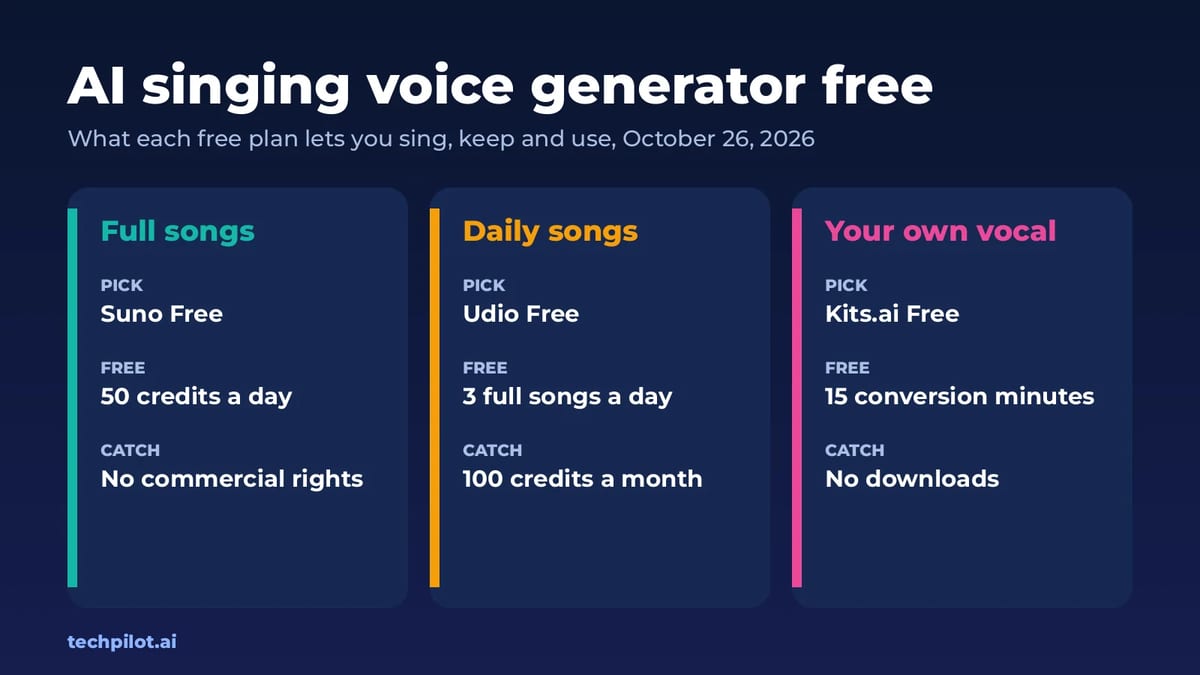
AI Singing Voice Generator Free: 5 Picks
AI singing voice generator free picks for 2026: Suno, Udio, ElevenLabs Music and Kits.ai. See their daily limits, download rules and commercial…
 Mihai (Mike) Bizz · 6 min read
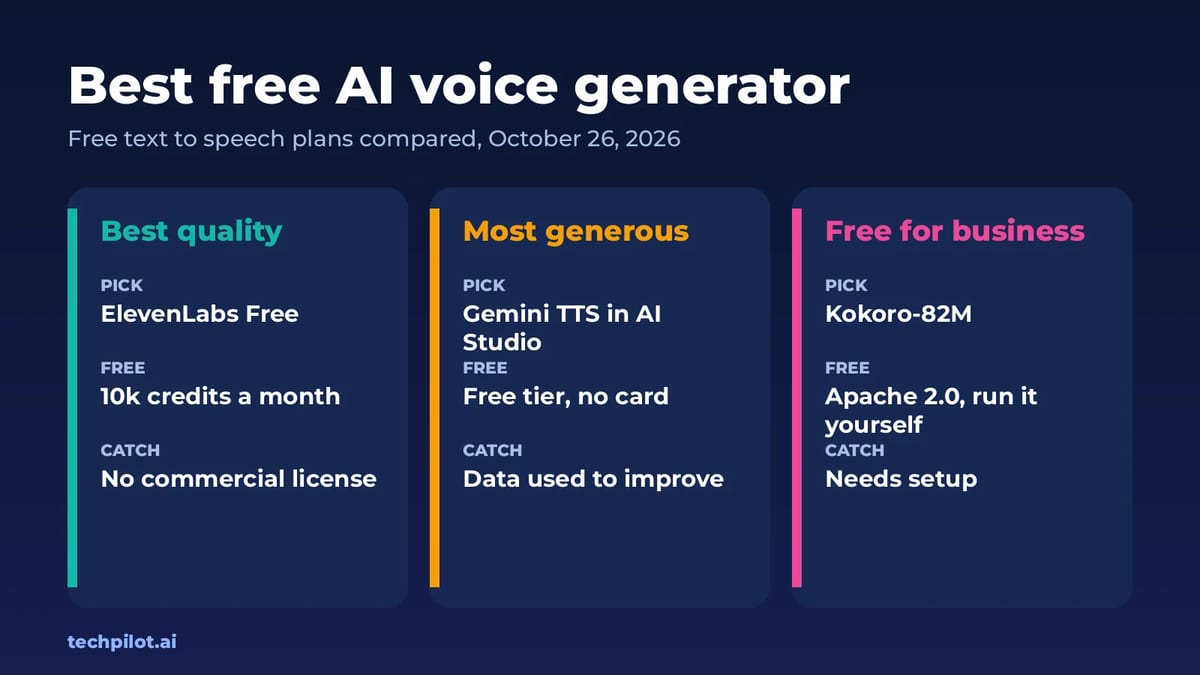
Best Free AI Voice Generator: Top 6 Picks
Best free AI voice generator options for 2026: ElevenLabs, Gemini TTS, Fish Audio, TTSMaker and Kokoro. See free limits, voice quality and commercial…
 Eimantas Kazėnas · 5 min read