Home / Guides / Audio / Voice
Best ElevenLabs Alternatives in 2026 (Voice AI Compared)
The best ElevenLabs alternative depends on your job. Compare MiniMax, Chatterbox, Murf and Cartesia for cheap cloning, open source, studio work or APIs.
 Eimantas Kazėnas Marketing & Tech
 - Updated
- 8 min read
On this page How we scored each ElevenLabs alternative
- How we scored each ElevenLabs alternative
- Quick comparison: ElevenLabs alternatives at a glance
- Lane 1 — Budget clone: MiniMax Speech 2.5
- Lane 2 — Open-source control: Chatterbox
- Lane 3 — Studio / all-in-one: Murf AI (and Fliki when video is the product)
- Lane 4 — Multilingual / emotion: MiniMax + LOVO (+ Fliki)
- Lane 5 — API / automation: Cartesia Sonic + OpenAI TTS
- ElevenLabs as incumbent — when NOT to switch
- Decision table: if you need X, pick Y
- How voice fits the faceless stack
- Frequently asked questions
- TechPilot.ai verdict
Independent and reader-supported. Some links may earn us a commission; it never changes our rankings. Editorial policy
If you are hunting for an ElevenLabs alternative in 2026, you probably do not hate ElevenLabs — you hate the bill, the credit math, or the fact that your job is not “best demo voice on the internet.” Creators building faceless YouTube automation care about consistent narration, commercial rights, cloning that does not collapse on long scripts, and a workflow that plugs into editing and clipping. ElevenLabs remains the realism benchmark. The right switch depends on the job: budget clone, open-source control, multilingual scale, studio/all-in-one, or API latency.
This guide compares active tools only. Play.ht / PlayAI shut down after Meta’s 2025 acquihire — treat old tutorials that still recommend it as outdated.
How we scored each ElevenLabs alternative
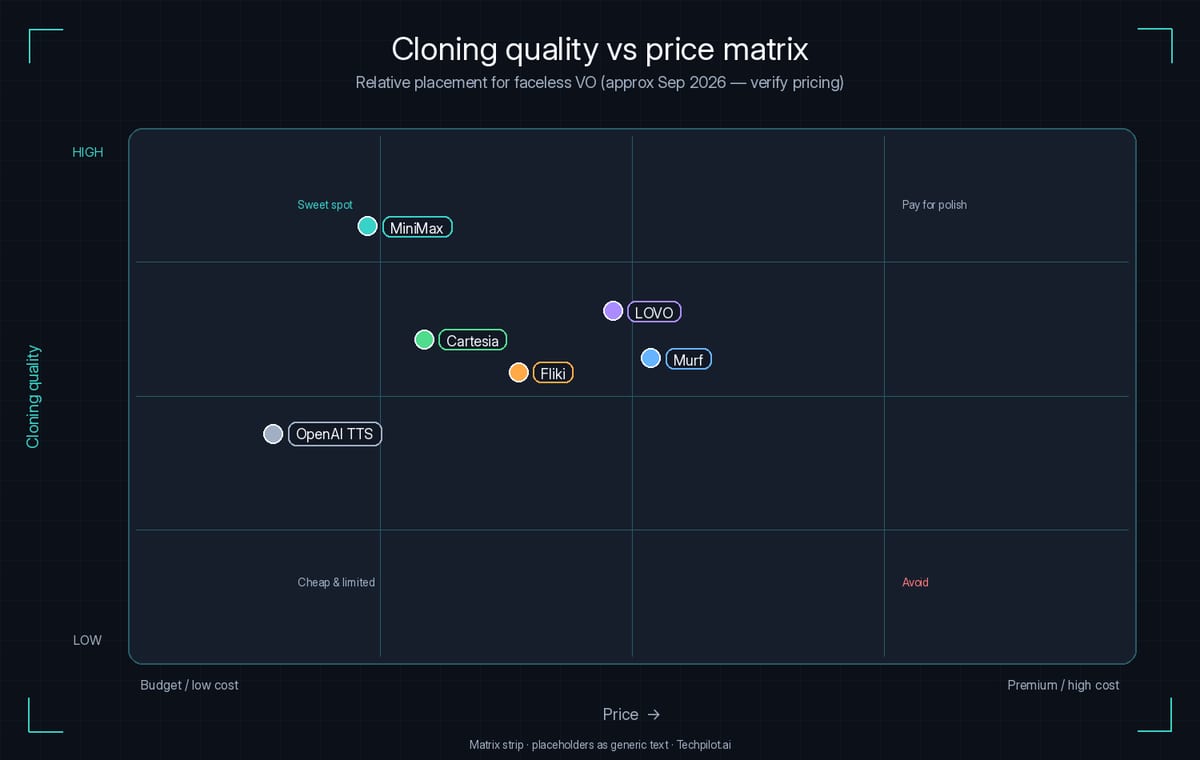
I ranked options on six checks that matter for YouTube and faceless channels: voice quality on long reads, cloning speed and fidelity, pricing honesty (credits vs characters vs hours), multilingual reach, workflow fit (standalone VO vs studio vs API), and when I would stay on ElevenLabs anyway. Pricing below is approx Sep 2026 — verify on each vendor page before you subscribe.
Quick comparison: ElevenLabs alternatives at a glance
| Tool | Best JTBD lane | Cloning | Starting price (approx Sep 2026) | Standout | Tradeoff |
|---|---|---|---|---|---|
| MiniMax Speech 2.5 | Budget clone + multilingual | Strong (~10s sample) | From ~$5/mo | Quality/price; Voice Design | Support/integration depth trails EL |
| Chatterbox | Open-source / self-host | Strong (Resemble AI) | Free (GPU/infra cost) | Control + watermarking ethos | Ops burden; no polished SaaS UX |
| Murf AI | Studio / all-in-one VO | Limited (enterprise-leaning) | Studio ~$19-$29/mo annual entry; API from ~$0.01-$0.03/1K chars | Timeline sync + team studio | Peak realism below EL Multilingual |
| Fliki | Script-to-video + voice | On paid tiers | Free; Standard ~$21-$28/mo | Faceless draft in one app | Credit caps; not pure VO specialist |
| Cartesia (Sonic) | API / low-latency | Instant + pro tiers | Free trial; Pro ~$4-$5/mo entry credits | Speed for agents/pipelines | Less “YouTube studio” UI |
| OpenAI TTS (API) | High-volume cheap VO | No classic clone UX | Usage (verify live API rates) | Dirt-cheap automation | Fewer cinematic styles |
| LOVO Genny | Emotion / creative VO | Yes on paid | ~$24-$29/mo entry (verify) | Expressive library | Pricing/plan gates shift often |
| ElevenLabs (baseline) | Max realism + ecosystem | Instant + Pro cloning | Free 10k; Starter $6; Creator $22 ($11 first mo) | Quality + Studio + dubbing | Premium at scale |
Lane 1 — Budget clone: MiniMax Speech 2.5
Job: Near-ElevenLabs narration and cloning without Pro-tier spend.
MiniMax Speech 2.5 is the alternative most faceless channels should A/B first. TechPilot.ai’s review scores it highly on realism, ~10-second cloning, 40+ language / cross-lingual identity, and a Voice Design prompt that invents a narrator without cloning a real person. Paid packs start around $5/month (approx Sep 2026 — verify), with daily free credits that are generous enough to test a full short.
Who it is for: Solo YouTubers, listicle/history/finance faceless channels, agencies localizing one brand voice.
Pros: Elite quality-per-dollar; long-form character limits; Voice Design sidesteps some consent optics.
Cons: Customer support reports are uneven; fewer native integrations than ElevenLabs Studio; occasional accent drift on clones.
Stay on ElevenLabs if: You need Professional Voice Cloning polish, Dubbing Studio depth, or the broader Creative suite (music, SFX, Productions) in one vendor.
Lane 2 — Open-source control: Chatterbox
Job: Self-host or developer-owned cloning without per-character SaaS rent.
Chatterbox (Resemble AI, open-weight mid-2025) is the ethical/control lane: high-fidelity TTS and cloning, multilingual support (20+ languages in public docs), pip/Hugging Face install path, and PerTh watermarking for provenance. Blind-test chatter often claims parity — sometimes preference — versus closed demos.
Who it is for: Builders, privacy-sensitive studios, zero-MRR experiments, teams already running GPU inference.
Pros: No character meter on the model itself; inspectable stack; strong cloning story.
Cons: You own uptime, GPUs, queues, and a UI if talent will not live in a notebook. Not a one-click replacement for ElevenLabs’ web Studio.
Stay on ElevenLabs if: Non-technical editors need a browser, voice library, and support ticket tomorrow morning.
Lane 3 — Studio / all-in-one: Murf AI (and Fliki when video is the product)
Job: Voiceover synced to slides/video inside one production surface.
Murf positions as a VO studio: word-level timing, stock media, collaboration, and API options (Falcon conversational ~$0.01/1K chars; studio-quality TTS ~$0.03/1K — approx Sep 2026). Creator/Business Studio plans commonly land around $19-$29/mo annual entry and ~$99/mo Business (verify). Cloning is weaker / more gated than ElevenLabs — Murf wins workflow, not always the last 5% of “is this human?”
Fliki is the cousin for faceless YouTube: script → stock/AI visuals → ultra-realistic voices → export. Free tier exists; Standard ~$21-$28/mo, Premium ~$66-$88/mo depending on annual vs monthly (approx mid-late 2026 — verify). Pick Fliki when the alternative you want is “finish the video,” not “replace the WAV.”
Who these are for: Course creators, L&D, marketers who hate bouncing CapCut ↔ TTS tabs.
Tradeoff: Peak narration nuance still often lands with ElevenLabs or MiniMax; you pay for the editor glue.
Lane 4 — Multilingual / emotion: MiniMax + LOVO (+ Fliki)
Job: Same channel voice across languages, or expressive reads that do not flatline.
MiniMax’s cross-lingual cloning is the practical winner for “record once in English, ship JP/DE/ES cuts.” LOVO Genny remains a creative-library play (emotion controls, large voice catalog; entry often cited ~$24-$29/mo — verify). Fliki bundles multilingual voices into the video pipeline for Shorts-first teams.
YouTube tip: Multilingual is useless if thumbnails and titles stay English-only — pair voice localization with a CTR workflow from our best AI thumbnail makers 2026 guide.
Lane 5 — API / automation: Cartesia Sonic + OpenAI TTS
Job: Pipelines, agents, and batch VO where latency and unit economics beat Studio UI.
Cartesia Sonic targets low time-to-first-audio (sub-~150ms class on recent Sonic builds). Entry Pro credit packs are often cited around $4-$5/mo for ~100K credits, with effective ~$37-$50 per 1M characters at higher tiers (approx 2026 — verify). Ideal when your “ElevenLabs alternative” search is really “cheaper/faster TTS API.”
OpenAI TTS / gpt-4o-mini-tts wins raw volume: neutral, clear reads that crush science/finance scripts where over-emotive EL voices hurt retention. Metered API pricing is typically a fraction of ElevenLabs Multilingual v2/v3 (~$0.10/1K chars on EL’s API sheet). No polished instant-clone consumer UX — bring your own product surface.
Stay on ElevenLabs if: You need their Agents stack, Dubbing Studio, or Flash/Turbo inside an already-working Creative plan.
ElevenLabs as incumbent — when NOT to switch
Approx Sep 2026 ElevenLabs Creative pricing: Free 10k credits; Starter $6 (30k, commercial + instant clone); Creator $22 (121k, first month often $11, Pro cloning); Pro $99 (600k); Scale $299; Business $990. API Multilingual ~$0.10/1K chars; Flash/Turbo ~$0.05/1K. Credits are shared across TTS, STT, music, SFX, and dubbing — that is why “I only needed voiceovers” bills feel heavy.
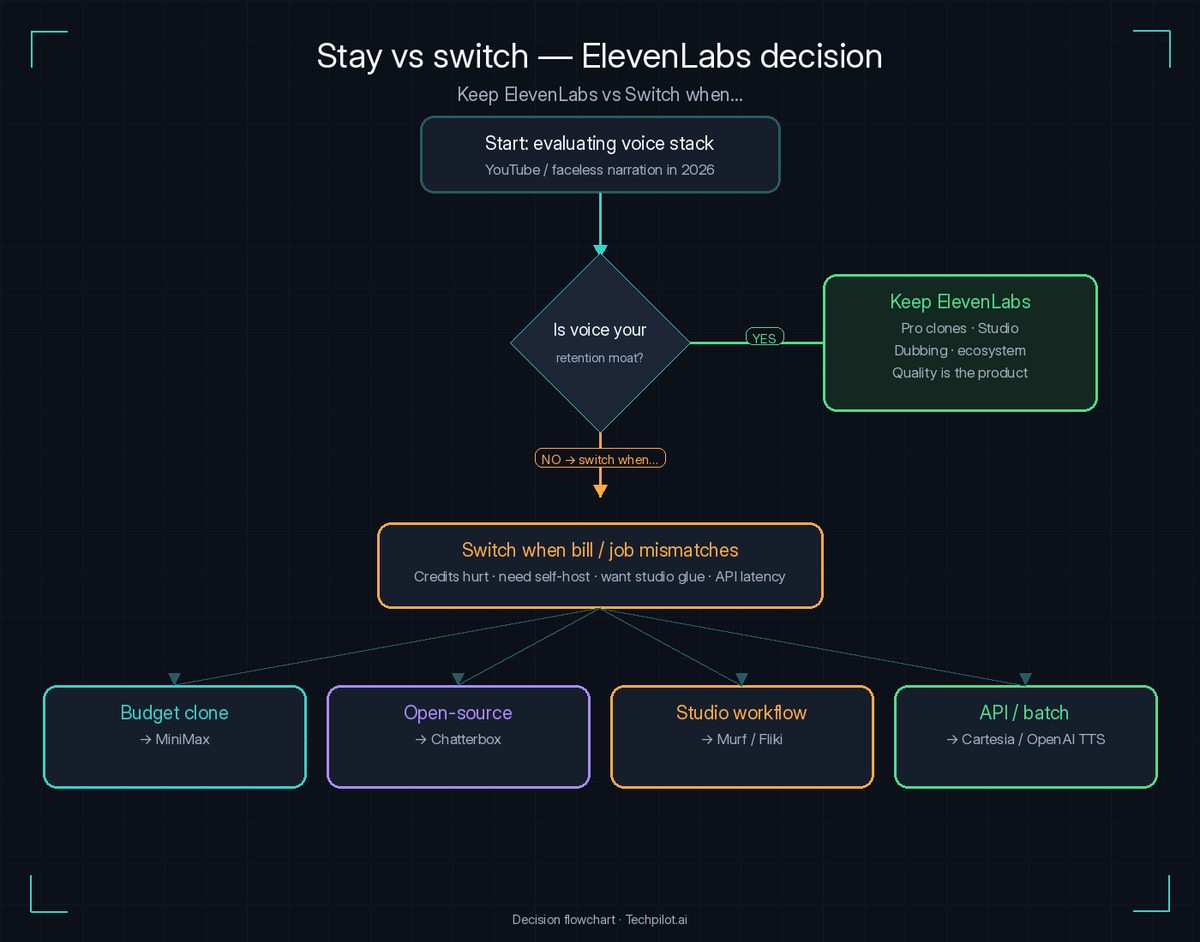
Keep ElevenLabs when: voice is your retention moat; you use Studio projects weekly; you need Pro clones + dubbing; switching would break a working CapCut/Descript pipeline.
Switch (or dual-stack) when: monthly characters blow past Creator; you only need “good enough” narration for stock-driven faceless; you can self-host Chatterbox; or Murf/Fliki collapses three subscriptions into one.
Decision table: if you need X, pick Y
| If you need… | Pick… |
|---|---|
| Cheapest near-EL quality + clone | MiniMax Speech 2.5 |
| Self-host / no SaaS meter | Chatterbox |
| VO synced to video in-browser | Murf |
| Script to finished faceless draft | Fliki (or InVideo in the full stack) |
| Lowest latency API | Cartesia |
| Cheapest automated batch reads | OpenAI TTS |
| Max realism + full audio suite | Stay on ElevenLabs |
| Long to Shorts after VO is done | Vizard, Klap, or Opus Pro alternatives |
How voice fits the faceless stack
Voice is stage three, not the whole channel. Ideate and script → generate VO → assemble visuals/avatars → edit → clip Shorts → thumbnails. For the full lane map, use our sibling guide: Best AI Tools for Faceless YouTube in 2026 (Full Stack). After the long upload exists, clippers like Vizard, Klap, and the tools in our Opus alternatives roundup multiply distribution; thumbnails decide the click.
Frequently asked questions
What is the best ElevenLabs alternative in 2026?
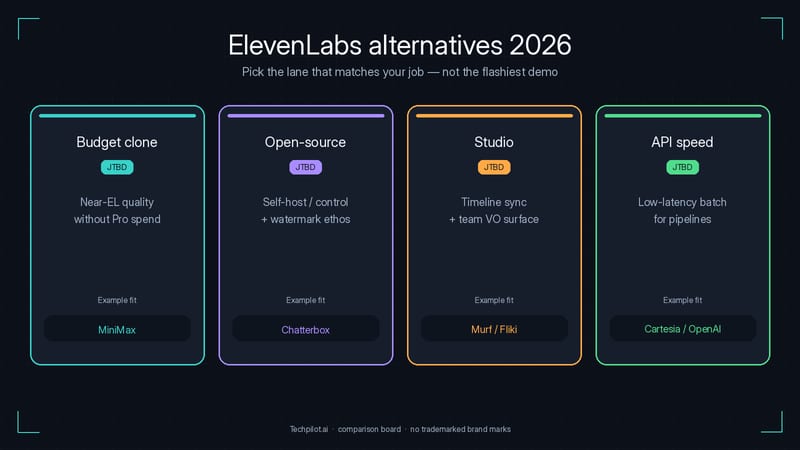
For most YouTube / faceless creators: MiniMax Speech 2.5. For open-source: Chatterbox. For studio workflow: Murf. For API speed: Cartesia. “Best” follows the job, not a single leaderboard.
Is there a free ElevenLabs alternative?
Chatterbox (infra costs only), OpenAI free/low API credits depending on account, Cartesia/MiniMax free allowances, and Fliki/Murf free tiers for light tests. Free SaaS plans rarely include full commercial rights — read the license before monetized uploads.
Can I clone my voice without ElevenLabs?
Yes — MiniMax (short samples), Chatterbox, Cartesia pro cloning tiers, and Fliki/LOVO paid cloning. Always use consent-clean samples; marketing clones of celebrities is a legal and platform-policy landmine.
ElevenLabs vs Murf — which for YouTube?
ElevenLabs for narration quality ceiling. Murf when you need timeline sync, collaboration, and fewer app hops. Many channels generate WAVs in MiniMax/EL and finish in CapCut anyway.
Is Play.ht still a good ElevenLabs alternative?
No. Play.ht / PlayAI shut down (accounts and clones deleted). Migrate to MiniMax, ElevenLabs, Cartesia, or Murf and keep offline exports of any voice you cannot re-record.
Do AI voiceovers hurt YouTube monetization?
Policy targets deceptive reused content and spam — not “AI voice” by itself. Risk rises when the whole channel is unoriginal mass-produced sludge. Distinct scripts, accurate claims, and real editing still matter more than which TTS brand you pick.
How much does an ElevenLabs alternative cost per YouTube video?
A 10-minute narration is roughly 9-12k characters. At Creator-class EL rates that is a small slice of 121k credits; at MiniMax entry packs it is often cheaper per minute. API tools win when you batch dozens of videos. Always model your monthly upload cadence, not one demo.
TechPilot.ai verdict
The best ElevenLabs alternative is the one that matches your bottleneck. MiniMax Speech 2.5 is the default switch for faceless YouTube quality-per-dollar. Chatterbox wins when you want ownership. Murf / Fliki win when voice is inseparable from the editor. Cartesia / OpenAI win when you are building pipes, not picking a library voice. Stay on ElevenLabs when realism and the Creative ecosystem are already paying for themselves.
Wire voice into the rest of the machine with our faceless YouTube full stack, then multiply reach with Vizard, Klap, Opus Pro alternatives, and AI thumbnail makers. More reviews live on the tools hub.
Found this useful? Share it with someone comparing AI tools.
Best AI Voice and Dialogue Tools for Filmmakers
Dialogue is where AI audio tools get judged the hardest, because is hard to trick the real humans. So we short listed the best AI voice and Dialogue…
 John Daniel · 8 min read
12 AI Tools for Maintaining Voice and Audio Consistency in Film
Voice and audio consistency in a real production isn’t just about cloning one voice and reusing it. It’s about seamless integration, consistency and…
 Alexi Carmichael · 10 min read