For AI teams that run their own crawlers, ProxyWing is a strong fit: a large pool with real city and ISP targeting, traffic that waits between dataset builds, and an API that fits an orchestrated pipeline, at a Standard entry price of $2.50 per GB.
Home / Tools / AI Data analytics
AI Data analytics · Tool review
ProxyWing Review: Residential Proxies for AI
 TechPilot.ai review team Hands-on testing, one published method
 - Last updated
- How we test
Summary
Pros and cons
What we like
- Traffic never expires Buy for one crawl and keep the rest for the next.
- Large, precisely targeted pool 70M+ IPs, with country, city and ISP targeting on every plan.
- Low entry price Standard starts at $2.50 per GB and falls to $1.00 at 10,000 GB.
- Built for automation The REST API generates proxy lists from code on both residential plans.
- Flexible sessions Rotate per request, or hold sticky sessions of up to 7 days on Premium.
- One dashboard, four proxy types Residential, ISP, mobile and datacenter.
What could be better
- Proxies only You bring your own crawler, browser rendering and parsing.
- No free trial The smallest purchase is 1 GB.
- Narrow refunds Only within 14 days, and only for technical faults on ProxyWing's side.
Key features
- 70M+ residential IPs: Over 190 countries, with country, city and ISP targeting.
- Two plans: Standard from $2.50/GB, Premium from $6.00/GB, both falling with volume.
- Traffic never expires: No subscription and no monthly reset.
- Rotating and sticky sessions: Custom TTL up to 1,000 minutes (Standard) or 7 days (Premium).
- HTTP and SOCKS5: Login and password authentication, unlimited proxy generation.
- REST API: Provision proxies and generate credential lists from code, 600 requests/min.
Screenshots
Full review
Independent and reader-supported. Some links may earn us a commission; it never changes our scores. Editorial policy
ProxyWing review for AI data teams: 70M+ residential IPs, city and ISP targeting, a REST API and per-GB traffic from $2.50 that never expires. Our verdict.
Every team that trains or evaluates models on web data hits the same obstacle, and it is not compute. It is access. Public pages that open fine in a browser return errors, captchas or empty shells to an automated client.

The reason is simple. According to Imperva’s 2025 Bad Bot Report, automated traffic made up 51% of all web traffic in 2024, passing human activity for the first time in a decade. Site owners tightened their defenses. In July 2025 Cloudflare, which sits in front of a large share of the web, began blocking AI crawlers by default for new customers. A data pipeline that worked two years ago now loses a growing share of its requests.
Residential proxies are one of the standard fixes. They route each request through an IP address assigned to a home connection, so the traffic looks like an ordinary visitor from a specific country or city. ProxyWing’s residential product fits the way AI data teams actually work. Figures below are from the company’s site, checked on October 9, 2026.
Why AI data collection needs residential IPs
Three requirements make this workload different from casual scraping.
- Geographic diversity. A model trained on text fetched from one US datacenter sees one version of the web. Prices, news, search results and even the language of a page change with the visitor’s location. For a multilingual dataset or a retrieval index for local markets, you need to request pages from where their readers are.
- Low block rates at volume. Dataset builds involve millions of pages. A 10% block rate means hundreds of thousands of retries, plus holes in the data that bias whatever you train on it. Poor data quality is costly for any business, and in a training set it is harder to spot, because nobody sees the pages that never arrived.
- Bursty demand. A crawl for a new dataset version is heavy for two weeks, then stops. Subscriptions that reset every month fit this badly.
What ProxyWing offers
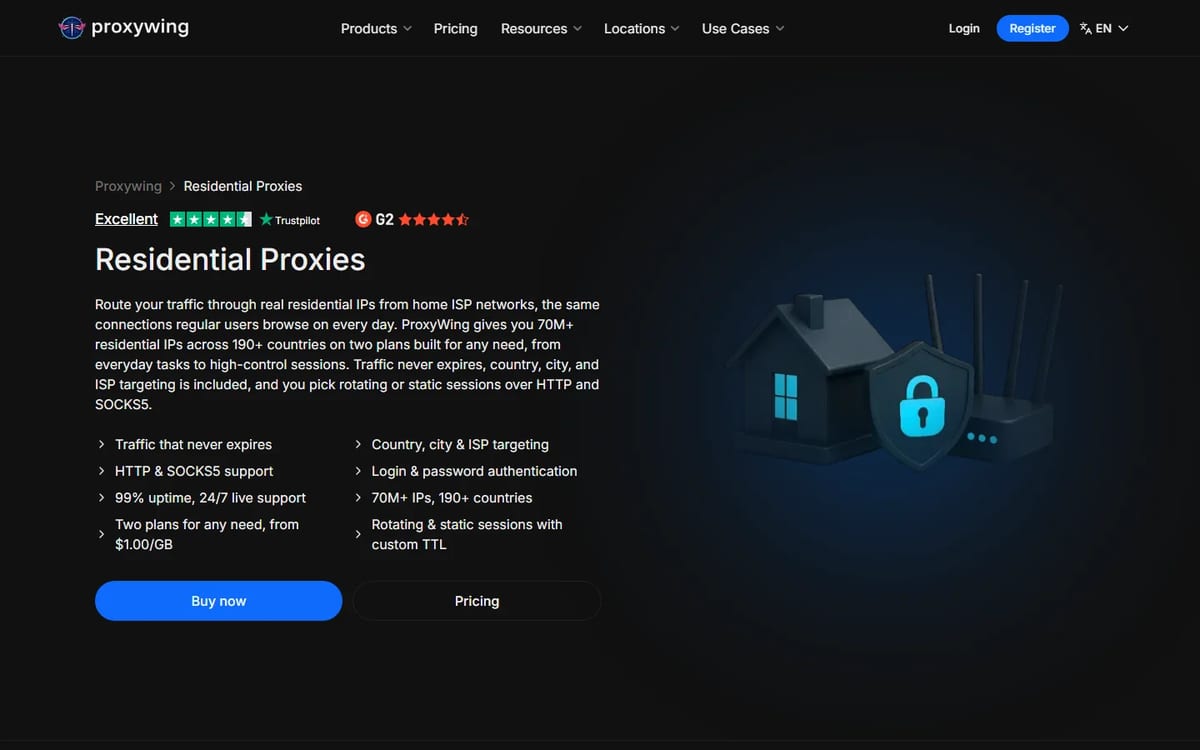
ProxyWing lists a residential pool of more than 70 million IPs in over 190 countries. You can target by country, city and ISP on every plan, with no surcharge. It supports HTTP and SOCKS5, and authentication is by login and password.
Session control is flexible. By default each request gets a new IP, which is what you want when crawling independent pages. For multi-step flows, such as paging through search results, you can hold a sticky session and set its lifetime yourself: up to 1,000 minutes on Standard and up to 7 days on Premium.
There is no limit on how many proxy endpoints you generate from one balance, so a distributed crawler can give every worker its own session.
ProxyWing Pricing (2026)
ProxyWing is a residential proxy provider that sells traffic by the gigabyte with no subscription, and unused traffic never expires. That one detail solves the burst problem: you buy for the crawl, and whatever is left waits for the next one. There are two plans. Standard is the cheaper default; Premium costs more per GB and adds sticky sessions of up to 7 days.
| Volume | Standard, per GB | Premium, per GB |
|---|---|---|
| 1 GB | $2.50 | $6.00 |
| 10 GB | $2.13 | $5.40 |
| 100 GB | $1.88 | $4.80 |
| 1,000 GB | $1.50 | $3.30 |
| 10,000 GB and more | $1.00 | $1.80 |
For context, enterprise vendors list around $6 to $8 per GB at small pay-as-you-go volumes, while the cheapest pools start near $1 with fewer controls. ProxyWing sits between them on price and still gives you city and ISP targeting plus API access on both plans. You can pay by card, PayPal, Klarna or 100+ cryptocurrencies, and turn on auto top-up so a crawl never runs dry.
A practical note on cost: text is light. A bare HTML document, compressed, is often a few hundred kilobytes or less, so 1 GB can cover a few thousand pages. Full page loads with scripts and images run much heavier; ProxyWing itself estimates 1 to 2 MB per request for light scraping. Fetch only the document, skip media, compress responses, and measure on a sample before you buy in bulk.
The ProxyWing API
For pipeline work, the API matters more than the dashboard. ProxyWing’s REST API (Bearer key, 600 requests per minute) provisions proxies and generates connection lists from code. A request names the count, protocol, country and session type, and the response is a set of ready credentials. An orchestrator can create sessions for a crawl job, hand them to workers and discard them at the end, with no manual step.
The same API covers ProxyWing’s other products: static ISP proxies, mobile proxies and dedicated datacenter IPs. Datacenter IPs start at $0.87 per IP per month with unlimited traffic. They are worth using for sources that do not block hosting ranges, such as open datasets, documentation sites and APIs. Keeping residential traffic for the hard targets cuts the bill sharply. If you are new to the protocol side, our guide to how SOCKS5 proxies work covers the basics.
Collecting responsibly
A proxy changes where a request comes from. It does not change what you are allowed to collect. Much of the debate around AI ethics is about how training data was gathered, so teams building training sets should follow a few rules whatever provider they use:
- Read robots.txt and the site’s terms, and honor explicit opt-outs from AI training.
- Collect public content only, and stay away from personal data.
- Rate-limit per domain so a crawl never slows the site down for its real users.
- Keep a record of sources and dates. You will need it for licensing questions later.
Where ProxyWing falls short
- Proxies only, not a scraping platform. There is no built-in browser rendering, captcha handling or parsing. Teams that want a managed “URL in, data out” service will need other tools on top.
- No free trial, and refunds are narrow. Payments are non-refundable by default. ProxyWing only considers a refund within 14 days if the service fails because of a technical issue on its side (policy). The entry price is low, $2.50 for 1 GB, but you pay before you test.
- The lowest rates need volume. Under 100 GB on Standard you pay $2.00 to $2.50 per GB. That is fair, not the cheapest on the market.
Who should use ProxyWing
ProxyWing suits AI and data teams that run their own crawlers and want residential capacity they can script. If you mainly need carrier IPs for app testing, read our explainer on mobile proxies first. Whatever you pick, run a quick check that the setup works before a big job; our guide on how to check if your proxy is working walks through it.
Sources: Imperva, 2025 Bad Bot Report; Cloudflare press release, July 1, 2025; ProxyWing pricing and refund policy, checked October 9, 2026.
TechPilot.ai’s Verdict on ProxyWing
For AI teams that run their own crawlers, ProxyWing is a strong fit: a large pool with real city and ISP targeting, traffic that waits between dataset builds, and an API that fits an orchestrated pipeline, at a Standard entry price of $2.50 per GB.
Start with 1 GB on Standard to test your own targets, then scale up, and move to Premium only if you need its long sessions. If you want a fully managed “URL in, data out” service, look elsewhere.
ProxyWing FAQ
Is ProxyWing free?
No. ProxyWing has no free trial or free plan. The cheapest way to test it is 1 GB of Standard residential traffic for $2.50, and that traffic never expires.
•
How much does ProxyWing cost?
Residential traffic costs $2.50 per GB on Standard and $6.00 on Premium at 1 GB, falling to $1.00 and $1.80 at 10,000 GB. Datacenter IPs start at $0.87 per IP per month.
•
How much residential traffic does a text dataset need?
Roughly 1 GB per few thousand bare HTML pages if you skip images and scripts. Full page loads use far more, so measure on a sample of your own sources first.
•
Rotating or sticky sessions for crawling?
Rotating for independent pages. Sticky for flows where several requests must come from one visitor, such as paginated results. Sticky sessions last up to 1,000 minutes on Standard and 7 days on Premium.
•
Can proxies get around a site’s refusal to be used for AI training?
Technically a request may succeed, but that does not make the use permitted. Respect robots.txt, opt-outs and licenses regardless of the proxy you use.

MonkeyLearn
AI Data analytics
MonkeyLearn undoubtedly makes a significant mark in the domain of AI data analytics tools. With a harmonious blend of user-friendliness,…

Akkio
AI Data analytics
Overall, Akkio provides a powerful and user-friendly platform for businesses and individuals looking to leverage AI and machine learning to…
Make (Integromat)
AI Data analytics
Make (Integromat) is a powerful automation platform with undeniable strengths. Its affordability, flexibility, and features like error…

AI Agents  Srdjan Gombar · 25 min read
Curious About AI? Here Are the Answers to 99 Questions About ChatGPT
Since its launch, ChatGPT has sparked curiosity and countless questions from users around the world. From its fundamental capabilities to its…
Srdjan Gombar · 25 min read
ChatGPT API Key: How to get and use it for free
There are few avenues on how you can still access ChatGPT API keys for free, that are still possible in 2025. Find out the best methods in our…
 Mike Paul · 11 min read