Home / Guides / AI Video Generator
What Is a World Model? AI World Models 2026
 Eimantas Kazėnas Marketing & Tech
- Published
- 6 min read
On this page What does a world model actually do?
Independent and reader-supported. Some links may earn us a commission; it never changes our rankings. Editorial policy
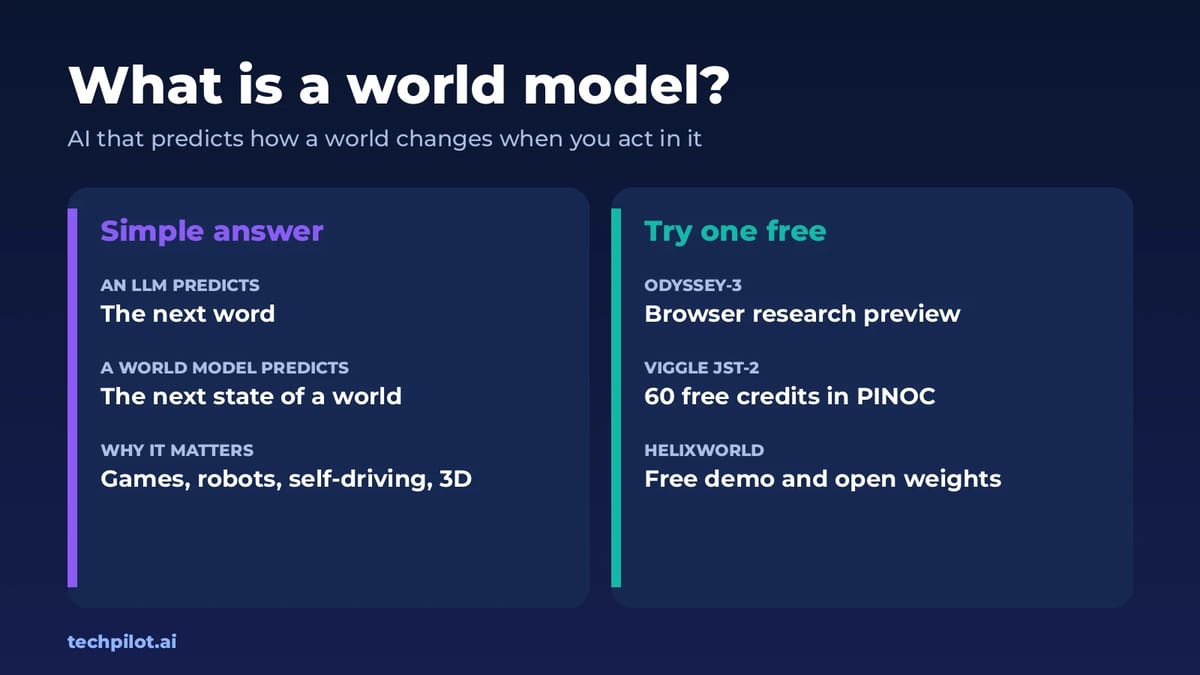
What is a world model? It’s an AI that learns how a world works so it can predict what happens next when you act. Here’s how it works and where to try one.
Quick answer: A world model is an AI model that learns how an environment behaves, so it can predict the next state of that environment, often in response to an action. A chatbot predicts the next word. A world model predicts what the scene looks like after you step forward, turn left or drop a glass. That makes it useful for interactive games and 3D scenes, and for training robots, self-driving cars and AI agents in simulation instead of the real world.
The term is everywhere this fall, because several companies shipped AI world models you can try in a browser. Below is a plain-English explanation, how world models differ from LLMs and video generators, the main models to know in 2026, and how to try one for free.
What does a world model actually do?
Humans run a world model in their heads all the time. You know a ball rolls off a sloped table and that a door you walked through is still behind you. An AI world model tries to learn the same kind of knowledge from data, usually huge amounts of video, gameplay with recorded controls, and simulated physics.
In practice, most world models do three things:
- Keep track of a state: what’s in the scene, where things are and where you are.
- Take an action: a key press, a camera move, a text prompt like “make it rain”, or a robot’s motor command.
- Predict the next state: the next frames of video, the next 3D view, or the next sensor reading, and then repeat.
Run that loop fast enough and you get something that feels like a video game generated on the fly. Run it for a robot and you get a simulator where it can practice thousands of times before touching anything real.
World model vs LLM vs video generator
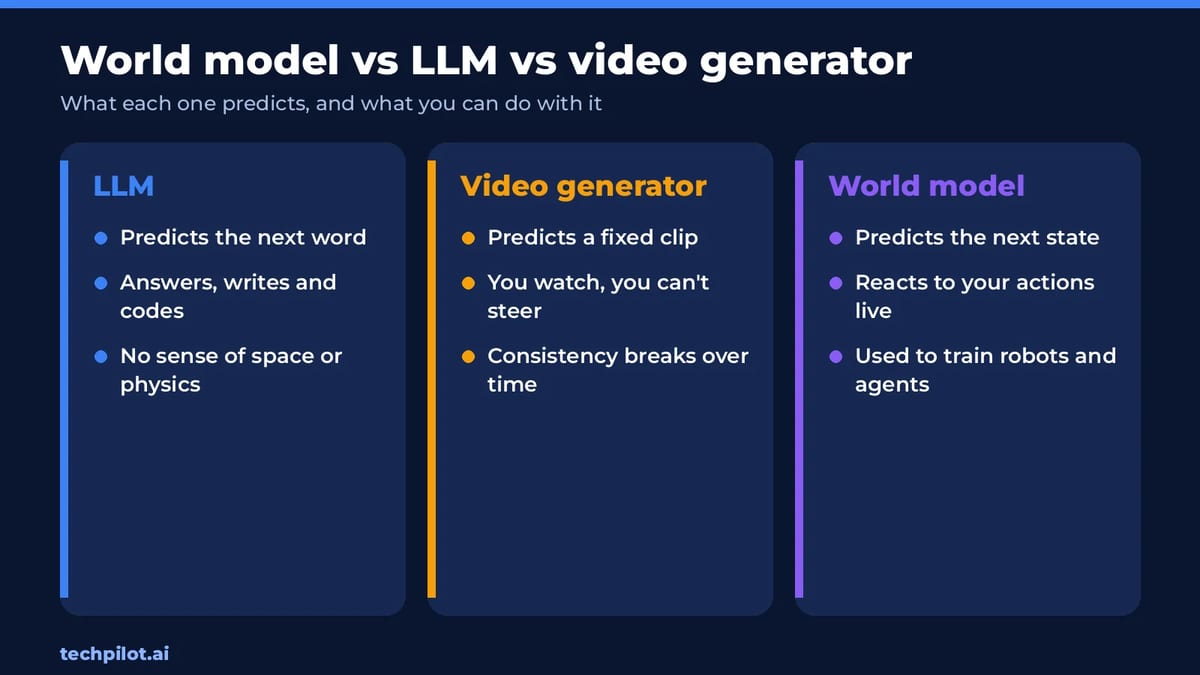
The easiest way to understand world models is to compare them with the AI you already use:
| LLM (ChatGPT, Claude) | Video generator | World model | |
|---|---|---|---|
| Predicts | The next word | A fixed clip from a prompt | The next state after an action |
| Interactive? | Turn by turn in text | No, you watch the result | Yes, it reacts while you move |
| Knows space and physics? | Only what text describes | Partly, it can drift | It’s the main goal |
| Typical use | Writing, coding, answers | Ads, shorts, B-roll | Games, 3D scenes, robots, cars |
The lines are blurring. Many world models are built on video model techniques, and some, like DeepMind’s Genie 3, generate video frame by frame. The difference is control: a world model lets you steer while it generates and remembers what it already showed you.
AI world models to know in 2026
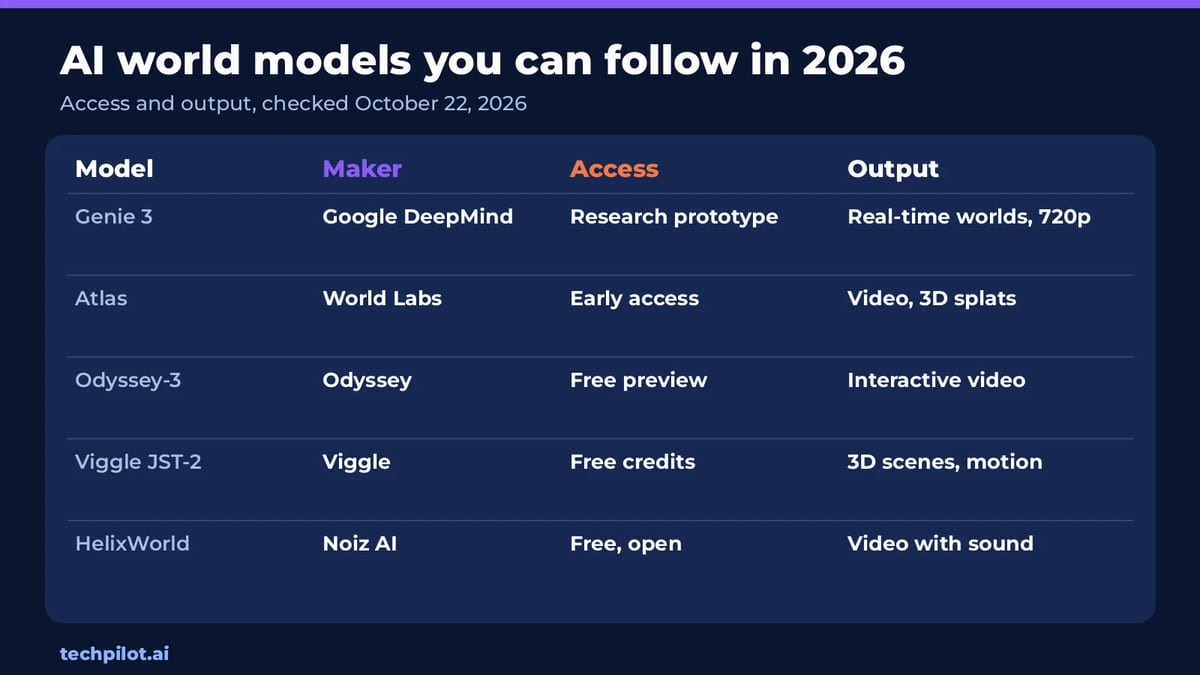
Here are the models people are actually talking about this fall, with what you can do with each today.
Genie 3 (Google DeepMind)
Google DeepMind calls Genie 3 a general-purpose world model. You describe a world and a character in text, and it generates a photorealistic environment you can move through in real time at 20 to 24 frames per second and 720p. DeepMind says worlds stay largely consistent for several minutes and can remember changes for up to a minute. You can also add “promptable world events”, such as changing the weather, while you play. Access is through Project Genie, an experimental research prototype that’s only available on Google’s AI Ultra plan, from $99.99 a month.
Atlas and Marble (World Labs)
World Labs, the spatial-intelligence startup, introduced Atlas on September 1, 2026. It’s an “omni” model that takes text, images, video and 3D as input and can output 3D worlds as Gaussian splats. World Labs says Atlas will power future versions of its Marble app and pitches it for robot simulation too. For now Atlas is in early access.
Odyssey-3 (Odyssey)
Odyssey opened a free research preview of Odyssey-3 on October 8, 2026. You type a prompt, a world appears, and you can walk through it and trigger events. Odyssey also uses the same model for robots and driving. Read our Odyssey-3 guide for access and limits.
Viggle JST-2 (Viggle)
Viggle, known for its meme-style character swap videos, released JST-2 on October 19, 2026. It turns prompts into explorable 3D worlds with characters, and you can try it free with 60 credits in Viggle’s PINOC app. Our Viggle JST-2 page covers credits and plans.
HelixWorld (Noiz AI)
HelixWorld, from Noiz AI and HKUST, adds sound. You start from one image, walk around with your keyboard, and the model generates video and stereo audio together, so a waterfall moves to your other ear as you turn. The browser demo is free and the preview weights are open. See our HelixWorld page for what self-hosting takes.
Why do world models matter?
The game-like demos get the attention, but the bigger reason companies spend on world models is training data for machines that act in the real world.
- Robots: a robot can practice a task thousands of times in a simulated kitchen or warehouse. World Labs, for example, pitches Atlas for robot simulation, and Odyssey uses its model for robots and driving.
- Self-driving cars and drones: rare, risky situations can be simulated safely instead of waited for on real roads.
- AI agents: DeepMind tests its SIMA agent inside Genie 3 worlds, which gives agents a place to learn by doing.
- Games, film and 3D: creators can prototype a level, a set or a camera move in minutes instead of building it by hand.
How to try a world model for free
- Easiest: open the Odyssey-3 research preview in your browser, type a scene and walk around. No GPU is needed.
- For 3D characters and motion: sign up for Viggle PINOC and use the 60 free credits on JST-2.
- For sound: try the HelixWorld demo with headphones on.
- For developers: the HelixWorld code and preview weights are free to download, but the team reports 24 fps on a single H800 data-center GPU, so it’s not a laptop project.
Expect time limits and queues: these are previews, not finished products.
What world models still can’t do
- Long sessions: Genie 3 supports a few minutes of continuous interaction, not hours.
- Perfect memory: scenes can drift when you come back to a spot much later.
- Real places: DeepMind says Genie 3 can’t yet recreate real-world locations with perfect accuracy.
- Text: readable signs and labels usually appear only if you put them in the prompt.
- Cost: real-time generation needs serious GPUs, which is why most access is free previews or early-access programs for now.
The bottom line
A world model is an AI that predicts how a world changes when you act in it. Today that mostly means playable AI-generated scenes, but the same idea is how robots, cars and agents will learn before they’re trusted in the real world. The fastest way to understand it is to try one: start with a free preview and spend five minutes walking around a world that didn’t exist a second earlier.
Frequently asked questions
What is a world model in AI?
A world model is an AI model that learns how an environment behaves so it can predict its next state, often after an action such as a movement or a command. It’s used for interactive scenes, games and training robots in simulation.
How is a world model different from an LLM?
An LLM predicts the next word in text. A world model predicts what happens next in a scene, such as the next video frames or 3D view, and reacts to your actions while it generates.
What are examples of AI world models?
Well-known examples in 2026 include Google DeepMind’s Genie 3, World Labs’ Atlas, Odyssey-3, Viggle JST-2 and HelixWorld from Noiz AI.
Can I try a world model for free?
Yes. Odyssey-3 has a free browser research preview, Viggle JST-2 includes 60 free credits in PINOC, and HelixWorld has a free demo plus open preview weights.
What are world models used for?
They’re used to make interactive games and 3D scenes, and to train robots, self-driving cars, drones and AI agents in simulated worlds before they act in the real one.
Found this useful? Share it with someone comparing AI tools.
Best AI Text to Video Generator Free (2026)
The best AI text to video generator free options that work now: Google Flow, Vids, Dreamina, Kling, PixVerse and more, with real free limits and the…
 Mihai (Mike) Bizz · 10 min read
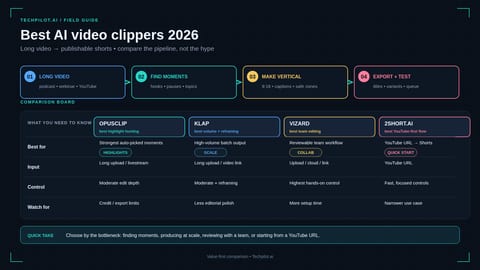
Best AI Video Clippers in 2026 (Long to Short)
Which AI video clipper fits your content in 2026? Compare Opus Pro, Vizard, Klap, 2Short, Ssemble and CapCut by source type, pricing and best use…
 Eimantas Kazėnas · 9 min read