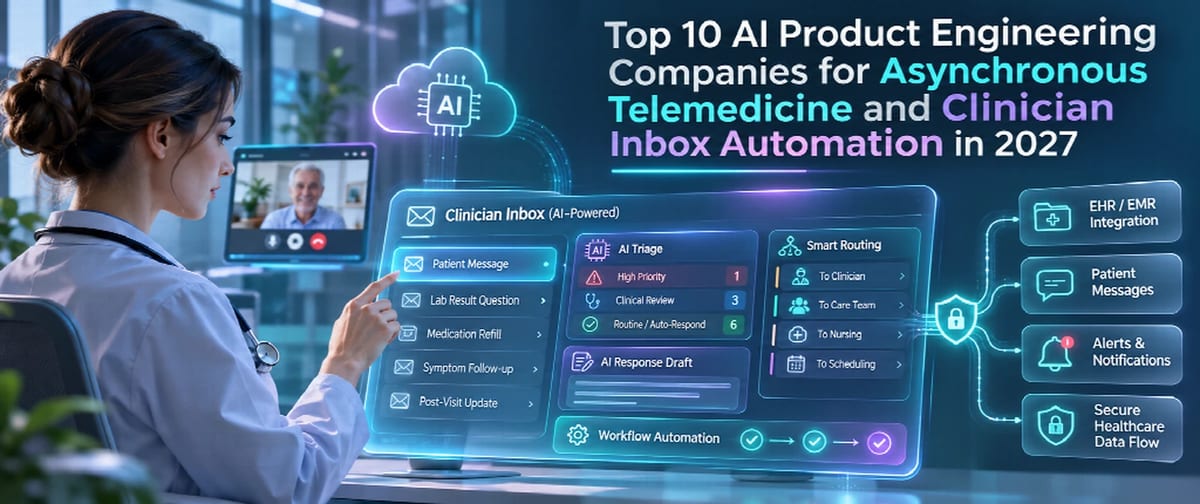
Top 10 AI Product Engineering Companies for Asynchronous Telemedicine and Clinician Inbox Automation in 2027
Compare 10 AI product engineering companies for asynchronous telemedicine and clinician inbox automation, and what to check before you hire a partner.
 Mihai (Mike) Bizz Business, entrepreneurship, tech & AI
- Published
- 6 min read
On this page What Should Healthcare Businesses Look for in an AI Product Engineering Partner?
Independent and reader-supported. Some links may earn us a commission; it never changes our rankings. Editorial policy
A 2026 study published in JAMA Network Open found that AI response tools were linked to an 8.6% increase in the overall time taken to respond to patient messages. However, messages that used AI-generated drafts saw a 29.5% drop in response time. This shows that adding AI doesn’t speed up the clinical workflow processes.
Patients are using asynchronous telemedicine to send messages, report symptoms, request prescriptions, and ask for follow-up care.
As these messages are increasing, managing them manually takes up clinicians’ time and effort. Healthcare businesses can use Telemedicine app development services to build platforms that sort incoming messages, draft responses, and flag cases that need a clinician’s attention.
What Should Healthcare Businesses Look for in an AI Product Engineering Partner?
A partner offering AI-Powered Product Engineering should understand how healthcare systems work before integrating AI into clinical workflows. Some of the factors that need to be considered include:
- See if they can connect AI tools to the systems already in use, such as EHRs, EMRs, patient portals, and data exchange platforms.
- They should know how to work with standards such as FHIR and HL7.
- Ask how clinicians can review AI-generated replies, record their decisions, access patient information, and protect that data under healthcare regulations.
- It is also important to check whether the partner can build and maintain a platform that handles more patient messages with the increase in demand without adding to the workload of clinical teams.
Safety should be built into the system from the start. These checks can help healthcare businesses find a partner who can connect AI with the day-to-day needs of asynchronous telemedicine.
10 US-Based AI Product Engineering Companies for Asynchronous Telemedicine and Clinician Inbox Automation
While choosing an engineering partner for asynchronous telemedicine, the team must understand how to connect software with existing healthcare systems, build workflows around patient communication, and protect information shared between patients and clinicians. With these requirements in mind, the following companies offer AI and software engineering capabilities worth examining.
1. GeekyAnts
GeekyAnts is an AI-Powered Digital Product Engineering & Consulting Company. Their work spans AI engineering, frontend and backend development, cloud, DevOps, quality assurance, security, and application modernization. GeekyAnts brings these capabilities together through AI-Powered Product Engineering, helping healthcare businesses move beyond working AI prototypes to applications that integrate with existing clinical systems. Healthcare businesses should discuss how the team would connect these parts and support clinicians who review AI-generated responses.
Clutch Rating: 4.9/5 (120 reviews)
Address: GeekyAnts Inc., 315 Montgomery Street, 9th and 10th Floors, San Francisco, CA 94104, USA
Phone: +1 845 534 6825 | Email: info@geekyants.com | Website: www.geekyants.com/en-us
2. Acme Software
Acme Software works across AI integration, generative AI, AI agents, custom software, cloud, DevOps, and application modernization. Its services may suit healthcare businesses that need to connect an AI feature with the application around it. For example, a message-drafting tool may require backend changes, automated testing, and deployment pipelines before clinicians can use it. Buyers should ask how the team handles patient data, connects with EHR systems, and tests AI-generated drafts before they enter a clinical workflow.
Clutch Rating: 4.7/5 (3 reviews)
Address: 173 S Sunbury Road, Westerville, OH 43081, USA
Phone: +1 614 441 6288
3. KRUTSCH
KRUTSCH combines AI development with mobile and web application development, UX design, product strategy, and digital transformation. This range can be useful when a healthcare product needs changes to both its AI features and the screens clinicians or patients use. A patient communication platform, for instance, must make it easy to review messages, identify pending requests, and follow up on unresolved cases. Buyers should ask for relevant product examples and confirm the team’s experience with healthcare data and clinical workflows.
Clutch Rating: 4.7/5 (20 reviews)
Address: 107 N Washington Avenue, Suite 200, Minneapolis, MN 55401, USA
Phone: +1 (612) 605-7549
4. Innovify
Innovify provides AI consulting, AI development, custom software development, and web and mobile product engineering. Its capabilities may fit healthcare businesses building an AI-enabled application that needs interfaces, backend services, and integrations alongside the model. For clinician inbox automation, buyers should establish whether the proposed team can support message classification, response drafting, and escalation workflows. They should also verify experience with healthcare interoperability and the handling of protected health information before starting a project.
Clutch Rating: 4.7/5 (23 reviews)
Address: 415 Mission Street, San Francisco, CA 94105, USA
Phone: +1 516 784 7851
5. Rootstack
Rootstack develops AI solutions, custom software, cloud infrastructure, web and mobile applications, and automation workflows. Their engineering services may help healthcare businesses connect AI features with existing applications, APIs, and data flows. This matters when a patient messaging platform needs to exchange information with other systems instead of operating as a separate tool. Buyers should ask for examples involving healthcare data, FHIR or HL7 integrations, and the controls used to protect patient information.
Clutch Rating: 4.8/5 (21 reviews)
Address: Dobie Center, 2021 Guadalupe Street, Suite 260, Austin, TX 78705, USA
Phone: +1 215 883 4359
6. NIX
NIX provides AI development, custom software engineering, full-stack development, cloud services, and application development. Its capabilities can support healthcare products that need work across the application, backend, and cloud infrastructure. For example, an AI-assisted inbox may need to process incoming messages, connect with patient records, and send urgent requests to the right team. Buyers should ask how NIX would approach these integrations, manage access to patient data, and monitor the application after launch.
Clutch Rating: 4.8/5 (33 reviews)
Address: 400 N Tampa Street, Tampa, FL 33602, USA
Phone: +1 813 374 0027
7. SumatoSoft
SumatoSoft develops AI systems, custom enterprise software, and digital products. Its AI capabilities include RAG systems, copilots, and agents, while its healthcare work includes telemedicine and electronic health record platforms. This makes its experience relevant to businesses connecting AI features with patient communication and clinical systems. Buyers should discuss how the team handles model evaluation, access controls, monitoring, and the integration of AI-generated information into workflows that require clinician review.
Clutch Rating: 4.8/5 (25 reviews)
Address: One Boston Place, Suite 2602, Boston, MA 02108, USA
Phone: +1 857 239 0848
8. Achievion Solutions
Achievion Solutions works on AI development, machine learning, AI agents, and custom software. Its services can support healthcare applications where AI features need to work alongside backend systems, data flows, and user-facing software. For a clinician inbox, that could mean building the application logic around message prioritization or routing rather than treating the AI model as a standalone feature. Buyers should ask how the team approaches clinical review, audit trails, and patient data security.
Clutch Rating: 4.8/5 (17 reviews)
Address: 1750 Tysons Boulevard, Suite 1500, McLean, VA 22102, USA
Phone: +1 703 957 9775
9. Utility
Utility develops mobile applications, web platforms, backend infrastructure, and AI-enabled digital products. Its work across product design and engineering may suit healthcare businesses building patient-facing applications or adding AI features to existing platforms. In an asynchronous care product, the patient interface, clinician dashboard, backend, and notification system must work together. Buyers should ask how Utility would connect these components and support ongoing changes after the application reaches production.
Clutch Rating: 4.8/5 (26 reviews).
Address: 135 Madison Ave, 5th Floor, New York, NY 10016, USA.
Phone: +1 212 328 1167
10. Test Double
Test Double works across AI development, custom software, enterprise application modernization, and DevOps. Its services are relevant when a healthcare company needs to improve an existing application before adding AI features. Buyers should ask how the team reviews existing code, tests system changes, and maintains the application as patient volumes increase.
Clutch Rating: 4.8/5 (6 reviews)
Address: 2093 Philadelphia Pike #7595, Claymont, DE 19703, USA
Phone: +1 614 349 4279
Conclusion
Asynchronous telemedicine gives patients more ways to contact their care teams. An increasing number of messages should not leave clinicians spending hours sorting through an inbox.
Healthcare businesses need partners offering Telemedicine App Development Services that integrate AI with existing EHR systems, protect patient data, and keep clinicians involved in patient care.
But adding an AI tool is not enough. They must also build a platform that can handle more messages as the number of patients grows, without adding to the team’s workload. Asynchronous care works best when the technology supports the way healthcare teams already care for patients.
Found this useful? Share it with someone comparing AI tools.
Can AI Video Analytics Run on Top of My Existing VMS, Like Genetec or Milestone?
Yes, AI video analytics can run on your existing Genetec or Milestone VMS in two ways: a certified plugin, or a separate platform on the same cameras.
 Mihai (Mike) Bizz · 6 min read

7 Top AI Tools for B2B Sales Prospecting in 2026
AI Tools for B2B sales prospecting platforms come into play when prospecting is no longer just about sending more messages.
 Alexi Carmichael · 7 min read