How OTT Platforms Use AI to Improve the Streaming Experience
See how OTT platforms use AI for personalized recommendations, smarter video quality, search, subtitles, retention, ads and support to improve streaming.
 Eimantas Kazėnas Marketing & Tech
- Published
- 8 min read
On this page What Is AI in OTT Streaming?
Independent and reader-supported. Some links may earn us a commission; it never changes our rankings. Editorial policy
OTT platforms have changed how people watch video. Instead of waiting for a broadcast schedule, viewers now choose what to watch, when to watch it, and on which screen: a smart TV, a phone, a laptop, or a streaming stick.
That freedom raised expectations. Viewers want content that feels relevant, playback that starts instantly and never buffers, and help that arrives the moment something goes wrong. Meeting those expectations at scale is hard to do manually.
Artificial intelligence is now one of the main tools streaming businesses use to close that gap. Recommendations are the best-known example, but AI in OTT platforms reaches much further: video delivery, content management, search, localization, analytics, advertising, and customer support. This article walks through seven practical ways OTT platforms use AI today, with real examples, benefits, challenges, and what comes next.
What Is AI in OTT Streaming?
AI in OTT streaming means using artificial intelligence and machine learning to analyze platform data, automate repetitive work, and make better decisions in real time. Every play, pause, search, and skip generates data. Machine learning models learn patterns from that data and act on them.
In practice, AI shows up across the streaming workflow:
- Viewer behavior analysis: Machine learning models study what people watch, how long they stay, and what they abandon.
- Content discovery and personalization: Those insights drive recommendations, personalized homepages, and smarter search.
- Video processing and content management: AI automates encoding decisions, metadata tagging, subtitles, and quality checks.
- Predictive analytics: Models forecast playback problems, viewer churn, and content performance before they happen.
- Advertising and monetization: AI improves ad targeting, campaign performance, and pricing decisions.
7 Ways OTT Platforms Use AI to Improve the Streaming Experience
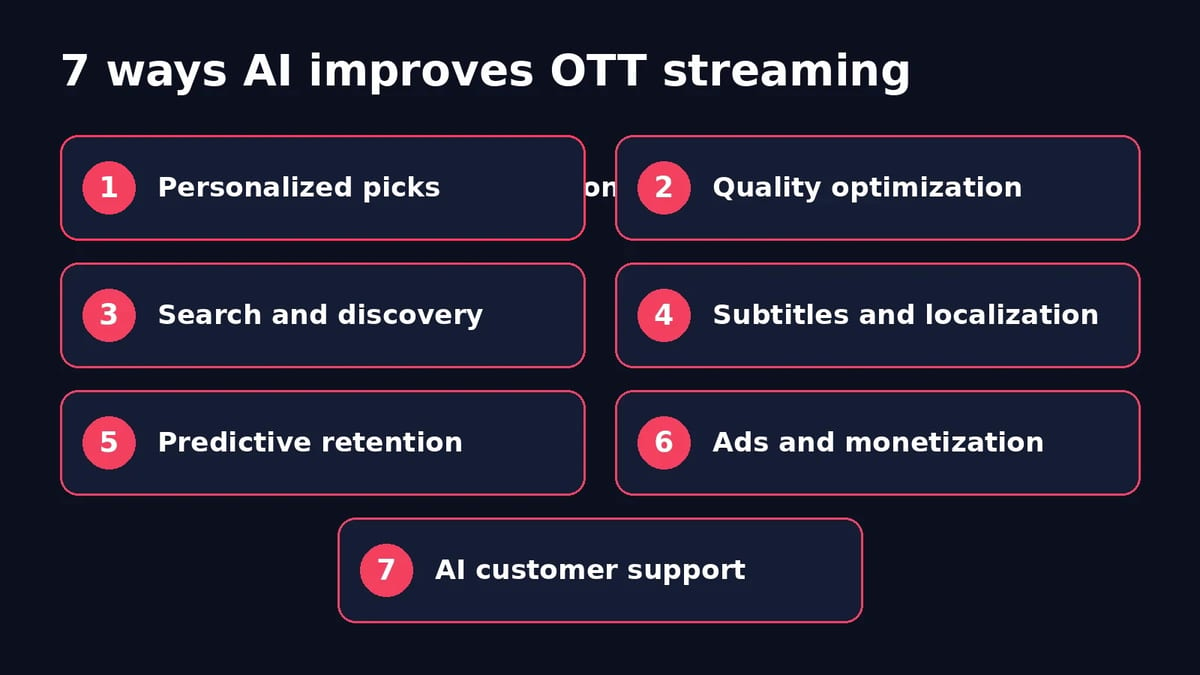
1. Personalized Content Recommendations
Recommendations are where most viewers first notice AI. Models analyze viewing history, ratings, watch time, time of day, device, and the characteristics of the content itself to predict what each person is likely to enjoy next.
The result is a homepage that looks different for every subscriber. Rows, ordering, and even artwork can adapt to individual tastes. Good recommendations shorten the time viewers spend browsing, surface titles from deeper in the catalog, and keep people watching longer. For operators, that means higher engagement and more value from every piece of licensed or produced content.
2. Smarter Video Streaming and Quality Optimization
A great recommendation means little if the video buffers. AI-assisted systems analyze network conditions, device capabilities, and playback data to help keep streams smooth.
Common applications include:
- Predicting buffering issues before they reach the viewer, based on network and playback signals.
- Optimizing adaptive bitrate streaming so the player picks the best quality the connection can sustain.
- AI-assisted encoding and compression that adjusts settings per title or per scene, saving bandwidth without visible quality loss.
- Monitoring quality across devices to catch artifacts, sync problems, or failures at scale.
Together, these improve playback reliability and lower delivery costs.
3. AI-Powered Content Search and Discovery
Traditional search depends on exact titles. AI search understands intent. A viewer can type or say “funny space movies for kids” and get relevant results, even if no title contains those words.
This works through semantic understanding of content, combined with AI-generated metadata. Models can tag scenes, moods, genres, objects, and themes automatically, giving the search engine far richer data than manual tagging could. Search suggestions adapt to what users are likely looking for, and multilingual models help viewers find content in their own language.
4. Automated Subtitles, Transcription, and Localization
Reaching global audiences requires subtitles, captions, and dubbing, which have traditionally been slow and expensive. AI speeds up each step:
- Automatic speech recognition produces transcripts from audio.
- AI-generated captions and subtitles are timed to the video automatically.
- Machine translation turns subtitles into multiple languages.
- AI-assisted dubbing and voice localization create translated audio tracks.
Human review still matters. Translators and editors check accuracy, idioms, and cultural context, especially for premium content. The best results come from AI handling volume and people handling quality.
5. Predictive Analytics and Viewer Retention
AI helps OTT businesses understand not only what viewers watch, but what they are likely to do next. Engagement analysis reveals trends, and churn prediction models flag subscribers whose behavior suggests they may cancel.
With audience segmentation, operators can respond in targeted ways: a personalized email highlighting new episodes of a favorite series, a discount offer, or a reminder about unfinished content. The same models help forecast how new titles will perform, informing content acquisition and production decisions.
6. AI-Driven OTT Advertising and Monetization
For AVOD and FAST services, ad relevance directly affects revenue and viewer experience. AI improves audience targeting, matches ads to viewers and content context, and optimizes campaigns based on performance data.
AI also supports subscription businesses. Pricing and package analysis shows which plans attract and keep subscribers. For platforms running hybrid models, combining subscriptions, ads, and transactional rentals, AI helps balance revenue streams and find the right offer for each audience segment.
7. AI-Powered Customer Support
Streaming customers expect help at any hour, and many of their questions are repetitive: login problems, billing, plan changes, or playback errors. AI customer service agents can handle these instantly, 24/7.
Connected to the platform’s knowledge base, an AI agent can answer subscription and billing questions, walk users through basic playback troubleshooting, and explain device setup. When an issue is complex, such as a payment dispute or a technical fault, it should hand the conversation to a human agent with the full context attached. This keeps response times low without leaving customers stuck with a bot.
Real-World Examples of AI in OTT Platforms
Several of these use cases are already running in production at the largest streaming services.
Personalized recommendations at Netflix. According to Netflix’s Help Center, its recommendation system estimates how likely a member is to enjoy each title. It weighs viewing history and ratings, the tastes of members with similar preferences, and title details such as genre, cast, and release year. It also considers time of day, preferred languages, devices, and how long someone watches a title. Netflix states that age and gender are not part of these decisions.
Neural-network video processing. On the Netflix Technology Blog, Netflix describes replacing conventional video downscaling with a neural-network-based “deep downscaler.” Downscaling creates the lower-resolution versions of each title that different screens and network conditions need, so a better downscaler improves picture quality across devices.
Data-driven streaming optimization. Large streaming services continuously analyze playback data to tune encoding, adaptive bitrate decisions, and content delivery, reducing buffering and startup delays.
These are established implementations. Newer ideas, such as fully AI-generated dubbing or conversational search across a whole catalog, are still emerging and less widely deployed.
Benefits of AI for OTT Platform Operators
For streaming businesses, AI turns platform data into better viewer experiences and leaner operations. The main benefits include:
Higher engagement: Better recommendations and search help viewers find content faster and watch longer.
Less manual work: Automated tagging, subtitles, and quality checks free content teams for higher-value tasks.
Better playback quality: Smarter encoding and delivery mean fewer buffering complaints and happier viewers.
Stronger retention: Churn prediction lets teams act before subscribers leave.
More effective monetization: Relevant ads and data-backed pricing improve revenue per viewer.
More efficient support: AI agents resolve routine questions instantly and free human agents for complex cases.
AI only works on top of solid streaming infrastructure. Operators first need an OTT platform that handles video delivery, content management, monetization, and analytics reliably. Providers such as inoRain offer that foundation, giving streaming businesses the core platform on which AI capabilities can be integrated where they add real value.
Challenges of Implementing AI in OTT Platforms
AI brings real gains, but it is not plug-and-play. Operators should plan for these considerations:
Data privacy and security: Personalization depends on viewer data, which must be collected, stored, and used in line with regulations like GDPR and with clear consent.
Infrastructure and cost: Training and running models requires computing resources, data pipelines, and skilled staff, which smaller platforms may find expensive.
Accuracy: Poor recommendations, wrong metadata tags, or bad automatic translations can frustrate viewers and damage trust.
Integration: AI tools must connect cleanly with existing video players, content management systems, ad servers, and billing systems.
Transparency and human oversight: Teams need to understand why models make decisions and keep people in the loop, especially for content moderation, localization, and customer-facing interactions.
The Future of AI-Powered OTT Streaming
The next wave of AI in OTT platforms will make streaming feel more conversational, more personal, and more global. Several developments are worth watching:
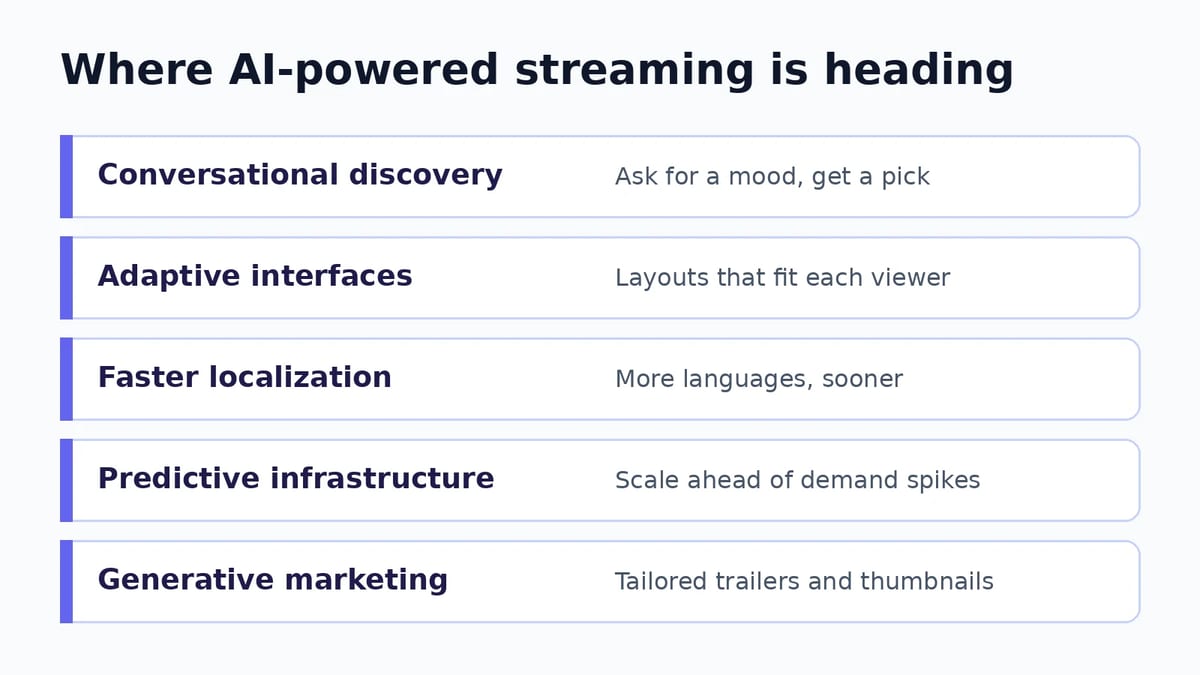
Conversational discovery: Viewers asking for “something light and under 30 minutes” and getting a precise answer, by voice or text.
Adaptive interfaces: Homepages, layouts, and navigation that adjust to each viewer, not just the content rows.
Faster localization: AI-assisted subtitles and dubbing making it practical to launch content in many languages at once.
Predictive infrastructure: Delivery networks that anticipate demand spikes, such as live sports, and scale capacity in advance.
Generative AI for marketing: Automatically produced trailers, previews, thumbnails, and promotional clips tailored to different audiences.
Many of these are still early, and their success will depend on quality, cost, and viewer trust.
Conclusion
AI in OTT platforms improves both sides of streaming: what viewers experience and how operators run their business. For viewers, it means relevant recommendations, easy search, smooth playback, content in their own language, and fast help when something goes wrong. For operators, it means less manual work, better retention, and smarter monetization.
AI is no longer limited to the recommendation row. It now adds value across the entire streaming workflow, from content discovery and playback optimization to analytics, advertising, and customer engagement. Streaming businesses that build on solid OTT infrastructure and adopt AI thoughtfully will be best placed to compete.
Found this useful? Share it with someone comparing AI tools.