How to Make a Game with AI
 Eimantas Kazėnas Marketing & Tech
 - Published
- 5 min read
On this page What Horii actually shipped
Independent and reader-supported. Some links may earn us a commission; it never changes our rankings. Editorial policy
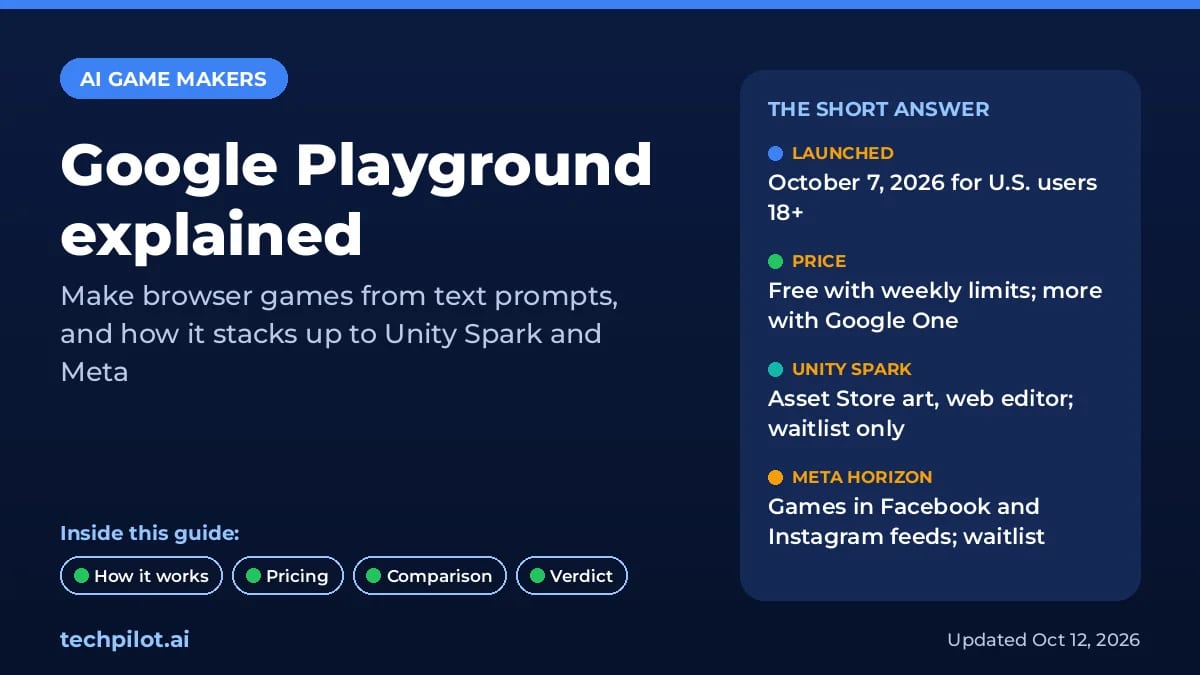
How to make a game with AI: use Claude Artifacts like Yuji Horii did on Oct 11, with Free or Pro plans, prompt templates and a step-by-step browser build.
On October 11, 2026, Dragon Quest creator Yuji Horii posted a free browser mystery, Interrogation Room Komiya (取調室の小宮), as a Claude Artifact. In his X post he said production took about 30 minutes and that you no longer need to draw or program to ship a decent game yourself — a line later picked up by Kotaku and other outlets. This guide is the practical path: how to make a game with AI in Claude Artifacts, with plans from Anthropic and prompts you can paste.
What Horii actually shipped
The game puts you in an interrogation with Komiya, a 72-year-old former locksmith suspected in a pawnshop safe robbery. You pick lines of questioning, weigh evidence against contradictions, and watch Agitation and Resistance meters. If Resistance hits 100, he goes silent. That design is classic Horii adventure DNA in a one-screen package — and it is exactly the kind of scope Artifacts handle well.
Attribute the “about 30 minutes” figure to Horii. We are not verifying the clock, and we are not claiming which Claude model he used. Also: do not depend on third-party mirrors. Coverage around October 12 reported the quest-board.jp link as 404. Build your own Artifact instead of hunting a dead URL.
What you need
- A Claude account at claude.ai.
- Artifacts enabled. Anthropic’s pricing page lists Create Artifacts on Free, Pro and higher plans (checked Oct 14, 2026).
- Pro if you iterate a lot: $20/month, or $17/month when billed annually ($200 up front). Free works for a first prototype; you will hit usage limits faster.
- A tight game brief: one screen, one loop, one fail state. Horii-scale mystery ADV beats an open-world wish list.
For model context on the Anthropic side, see our Claude Sonnet 4.5 page. If you want dedicated game makers instead of chat Artifacts, compare Google Playground and Unity Spark.
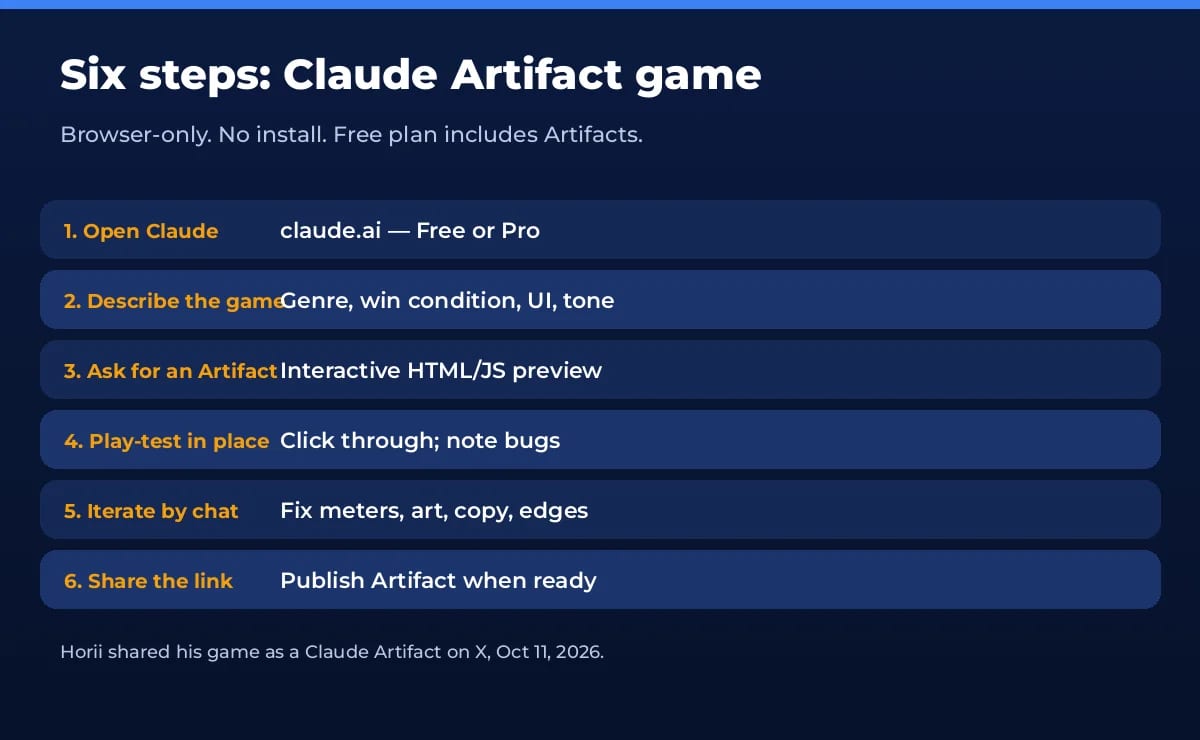
How to make a game with AI in 6 steps
1. Open Claude and start a fresh chat
Use the web or desktop app. Say you want an interactive browser game as an Artifact — not a design doc. Ask Claude to produce playable HTML/JS with on-screen buttons, not a wall of pseudocode.
2. Paste a scoped brief
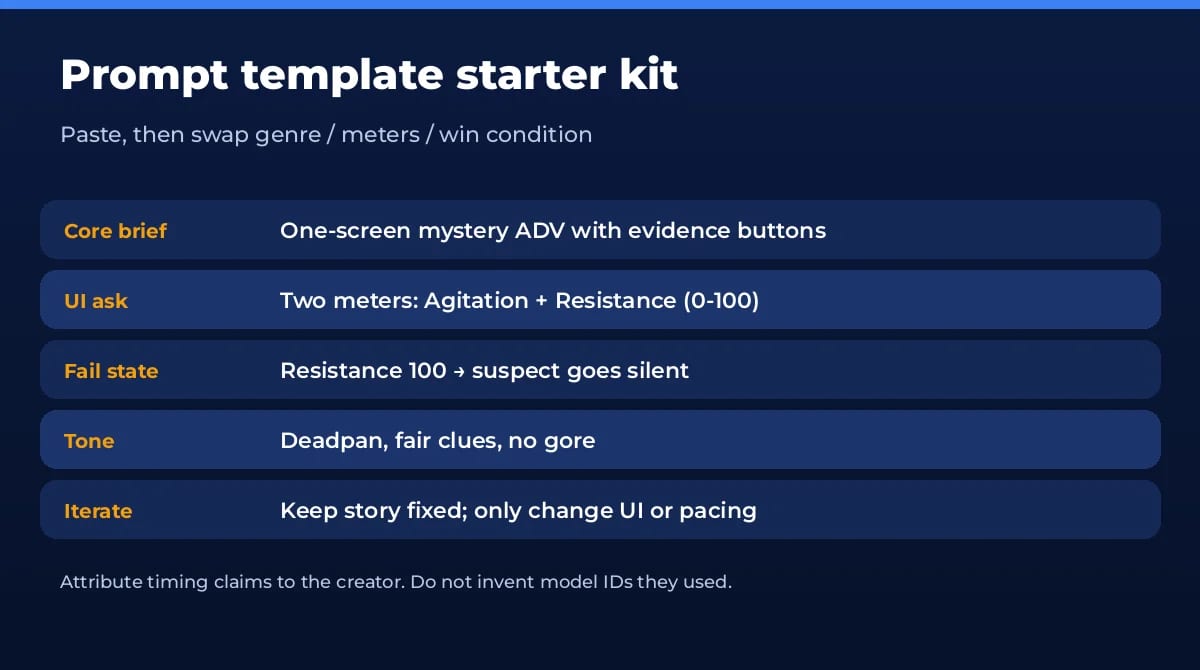
Lock genre, player goal, fail state and UI before you ask for art polish. Example starter:
Make an interactive browser mystery as a Claude Artifact.
Player: detective in a one-room interrogation.
Suspect: 70s ex-locksmith accused of a pawnshop safe job; he lies.
UI: dialogue choices + Evidence panel + two meters (Agitation, Resistance) from 0-100.
Fail: Resistance 100 → he invokes silence; interrogation stalls.
Win: expose 3 contradictions with evidence buttons.
Tone: deadpan, fair clues, no gore, no real-person likenesses.
Keep it to one screen. Generate the playable Artifact now.
3. Play the Artifact immediately
Click through every branch once. Note soft locks, meter bugs, missing evidence buttons and jokes that land wrong. Write those notes in the same chat so Claude can patch the same Artifact.
4. Iterate one axis at a time
Change either story, meters or visuals — not all three. Good follow-ups: “Keep the story fixed; slow Resistance growth by 30%.” or “Redraw buttons for mobile tap targets; no story changes.”
5. Add a second content pack only after the loop works
Extra suspects, endings or languages are cheap once the core loop is stable. Shipping a broken meter with three endings helps nobody.
6. Share on your terms
Publish or share the Artifact link from Claude when you are ready. Label AI-assisted work honestly if you post publicly. Do not present a fan remake as an official Dragon Quest or Portopia product.
More prompt templates
Puzzle platformer (tiny):
Artifact: one-level puzzle platformer, keyboard + on-screen buttons.
Goal: reach the door in under 60 seconds.
Hazards: two moving spikes, one disappearing floor.
UI: timer, restart, level title.
Pixel-style CSS shapes only (no external images).
Generate playable Artifact.
Trivia boss fight:
Artifact: quiz battle. Player HP 5, Boss HP 5.
Each correct answer deals 1 damage; wrong costs 1 HP.
10 questions on [topic], multiple choice.
Win/lose screens + Play again.
Generate playable Artifact.
Limits worth knowing
- Artifacts are prototypes, not App Store builds. Exporting to Unity, Godot or Steam is a separate project.
- Usage limits apply on Free and Pro; heavy regen loops burn quota.
- IP and likeness: invent original characters. Do not clone Horii’s Komiya wholesale for a commercial drop.
- Platform alternatives: Playground is live for many U.S. users; Spark is still waitlist. Artifacts win on “start in 60 seconds.”
Our take
Horii’s demo matters less as a 30-minute flex and more as a scope lesson: one room, clear meters, fair clues. That is how to make a game with AI without drowning in features. Start on Claude Free, upgrade to Pro if you iterate daily, and graduate to Playground or Spark only when you outgrow a single Artifact page.
Frequently asked questions
Can I make a game with Claude for free?
Yes. Anthropic’s pricing page lists Create Artifacts on the Free plan as well as Pro. Free has lower usage limits; Pro is $20/month or $17/month billed annually ($200 up front).
What did Yuji Horii make with AI?
On October 11, 2026, Dragon Quest creator Yuji Horii (@YujiHorii) shared Interrogation Room Komiya (取調室の小宮), a browser mystery he said took about 30 minutes, built with AI and published as a Claude Artifact. Kotaku, VGC and others covered it.
Do I need to know how to code?
For an Artifact prototype, no. You describe the game in chat and Claude generates interactive HTML/JS you can play in the browser. You will still need clear design taste: win conditions, fail states and fair clues.
How is this different from Google Playground or Unity Spark?
Claude Artifacts are chat-built interactive pages. Google Playground is a dedicated prompt-to-game platform; Unity Spark adds Asset Store art and a web editor but is waitlist-only. See our Playground and Spark posts for those tools.
Will Horii’s game link still work?
Treat third-party Artifact links as fragile. Coverage on October 12 reported the quest-board.jp mirror as 404. Prefer making your own Artifact over chasing a dead demo link.
Found this useful? Share it with someone comparing AI tools.