Google Playground: Google’s AI Game Maker
 Eimantas Kazėnas Marketing & Tech
 - Published
- 5 min read
On this page What is Google Playground?
Independent and reader-supported. Some links may earn us a commission; it never changes our rankings. Editorial policy
Google Playground turns text prompts into playable browser games, no code. See how it works, who can use it and how it compares to Unity Spark and Meta.
Three big platforms want to turn players into game makers this autumn. Google opened Playground to the public, Unity announced Spark for people who want more control, and Meta put Horizon Create and Horizon Studio into early access. They look similar on the surface, since you type an idea and get a game, but they make very different bets. Here is what Playground actually does and which tool fits which kind of creator.
What is Google Playground?
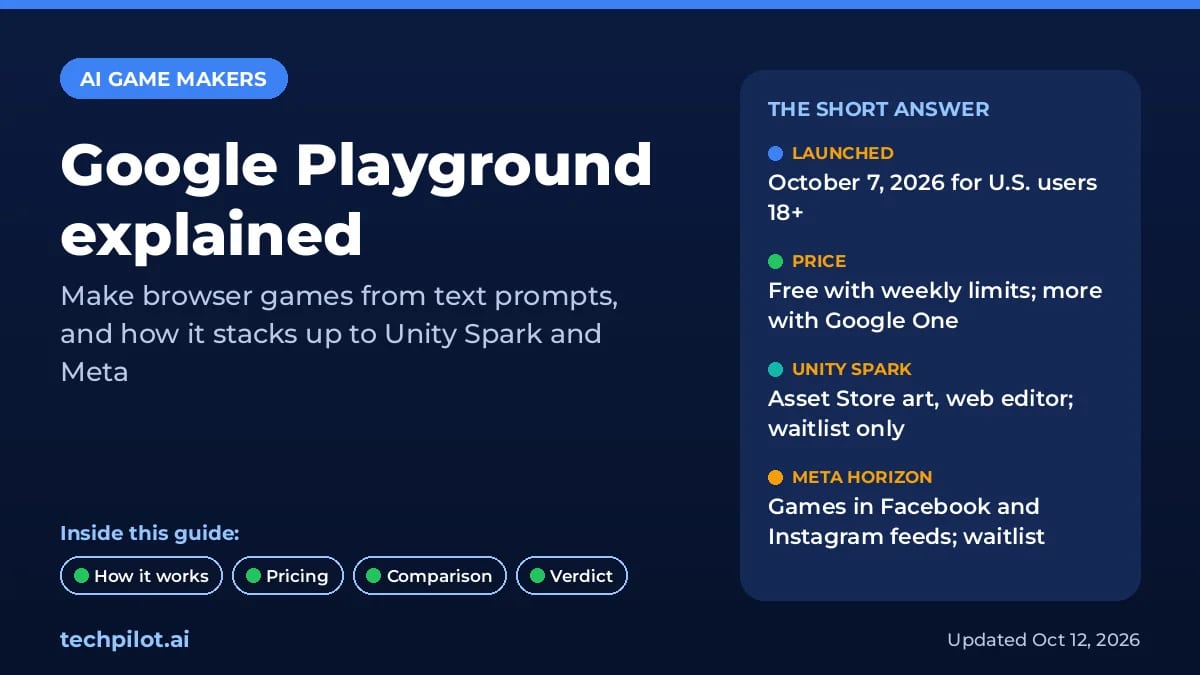
Playground is what Google calls an experimental gaming platform. It launched on October 7, 2026, for U.S. users aged 18 and over at playground.google, according to Google’s announcement. You describe a game in a chat box, test it straight away and keep asking for changes, such as different physics, new rules, other characters or a new environment, until it plays the way you want.
The Playground page on Google Labs offers starter genres like Trivia, Tower Defense and Racing, or a blank canvas. The community gallery already shows platformers, arcade shooters, physics stackers and word puzzles. Google told The Verge the system runs on its existing models (Gemini, Nano Banana and Lyria) with a custom harness tuned on games Google built internally.
How it works
- Describe: start from scratch, remix a starter prompt or use guided help.
- Play-test: the game runs in your browser right away.
- Refine by chat: ask for changes to rules, physics, characters or levels.
- Share: keep it private, send a link or publish it to the Explore gallery.
- Compete: some genres get leaderboards and multiplayer, tied to a Play Games profile.
Every published game goes through safety screening against Google’s community guidelines, and players can report games.
Is Google Playground free?
Mostly, with limits. A Google spokesperson told The Verge that Playground is free to use and that Google One subscribers get higher weekly token limits based on their plan. Google’s own pages say creation access is tiered by your Google AI subscription and that a subscription may be required. In practice, expect to try it for free and hit a weekly cap if you build a lot.
Google Playground vs Unity Spark vs Meta Horizon Create
| Google Playground | Unity Spark | Meta Horizon Create / Studio | |
|---|---|---|---|
| Status (Oct 12, 2026) | Live in the U.S. (18+) | Testing; waitlist, closed beta coming | Early access rolling out; waitlist |
| How you build | Chat prompts in the browser | Prompts plus a web editor | Prompts on a phone app, visual editing on the web |
| Art and assets | Generated by Google models | Artist-made Unity Asset Store assets | Generated by Meta’s Horizon Engine |
| Where games are played | Playground gallery, share links | Playground (integration coming) | Facebook, Instagram and Horizon feeds |
| Price | Free with weekly limits; higher limits with Google One | Not announced | Not announced; Creator Fund and in-game monetization promised |
Unity Spark: for people who want a real game
Unity’s Spark page sums it up as “Prompt it. Perfect it. Publish it.” Instead of generating every sprite, Spark builds with assets made by artists on the Unity Asset Store, and you refine the result in a web editor running on the Unity runtime. Google says Spark games will be playable inside Playground. Unity CEO Matt Bromberg framed it as the opposite of “one-shotting” a clone of an existing game. Spark is only a waitlist today. We cover the waitlist, beta timing and open questions in our Unity Spark release date guide.
Meta Horizon Create: for reach
Meta’s Horizon Create and Horizon Studio build 2D and 3D mobile games from prompts, on a phone app or in the browser with finer controls. The big difference is distribution: published games become eligible to appear in Facebook and Instagram feeds, where someone can tap a clip and join a multiplayer session without installing anything. Meta also promises in-game monetization and its Creator Fund. Access is still rolling out through a waitlist.
Our take: which one should you try?
Playground is the only one of the three you can actually use today, and it is the best way to see whether AI game-making is fun for you. Its strength is speed. The trade-off is that games come out of a general-purpose model, so expect simple arcade and puzzle formats rather than deep games.
Spark is the one to watch if you care about quality. Building on human-made assets solves the biggest problem with AI games, which is that they look generic and inconsistent, and it gives Unity’s artist community a way to earn from AI creation instead of being replaced by it. Meta’s play is about audience: if you want strangers to find your game, feeds with billions of users beat any gallery.
Our suggestion: start a few games in Playground now, join the Spark and Horizon waitlists, and decide once you know which kind of creator you are. For background on how AI is changing game development, see our guide to generative AI for video games. If you are more interested in building apps than games, our no-code AI agent platforms roundup is a better start, and Gemini Storybook shows another way Google is using Gemini for creative play. To see where Gemini sits among today’s models, check our best AI model guide.
Frequently asked questions
What is Google Playground?
Google Playground is an experimental platform from Google, launched on October 7, 2026, that lets you make, play and share browser games by describing them in text prompts. No coding is needed.
Is Google Playground free?
Google told The Verge that Playground is free to use, with higher weekly token limits for Google One subscribers. Google’s own pages say creation access is tiered by your Google AI subscription and a subscription may be required.
Who can use Google Playground?
At launch it is open to users in the U.S. who are 18 or older, at playground.google. You sign in with a Google account.
What is the difference between Google Playground and Unity Spark?
Playground is Google’s quick, prompt-only game maker. Unity Spark is Unity’s more advanced tool with Unity Asset Store art, a web editor and the Unity runtime; Spark games will be playable on Playground. Spark is waitlist-only for now.
Can I play Google Playground games on my phone?
Yes. Playground is browser-based, so games run on phones and laptops. You can share them by link or publish them to the Playground Explore gallery.
Sources: Google blog post “Introducing Playground” (Oct 7, 2026) and the Google Labs Playground page; The Verge (Oct 7, 2026) for pricing and model details; unity.com/spark; Meta Horizon developer blog. All checked October 12, 2026.
Found this useful? Share it with someone comparing AI tools.