The Future of Integrated Access Control Systems: AI, Computer Vision, and Cloud Automation
Explore how AI, computer vision, cloud automation, and centralized management are transforming integrated access control systems for modern enterprises.
 Mihai (Mike) Bizz Business, entrepreneurship, tech & AI
 - Published
- 9 min read
On this page Key Takeaways
- Key Takeaways
- 1. Access Control Is Becoming a Connected Data System
- 2. Computer Vision Gives Access Events Visual Context
- 3. AI Can Turn Access Data Into Actionable Alerts
- 4. Cloud Automation Is Changing Multi-Site Security
- 5. Identity Management Will Connect Physical and Digital Access
- 6. Automation Will Reduce Routine Security Administration
- 7. AI-Powered Access Control Creates New Governance Challenges
- Conclusion
- FAQs
Independent and reader-supported. Some links may earn us a commission; it never changes our rankings. Editorial policy
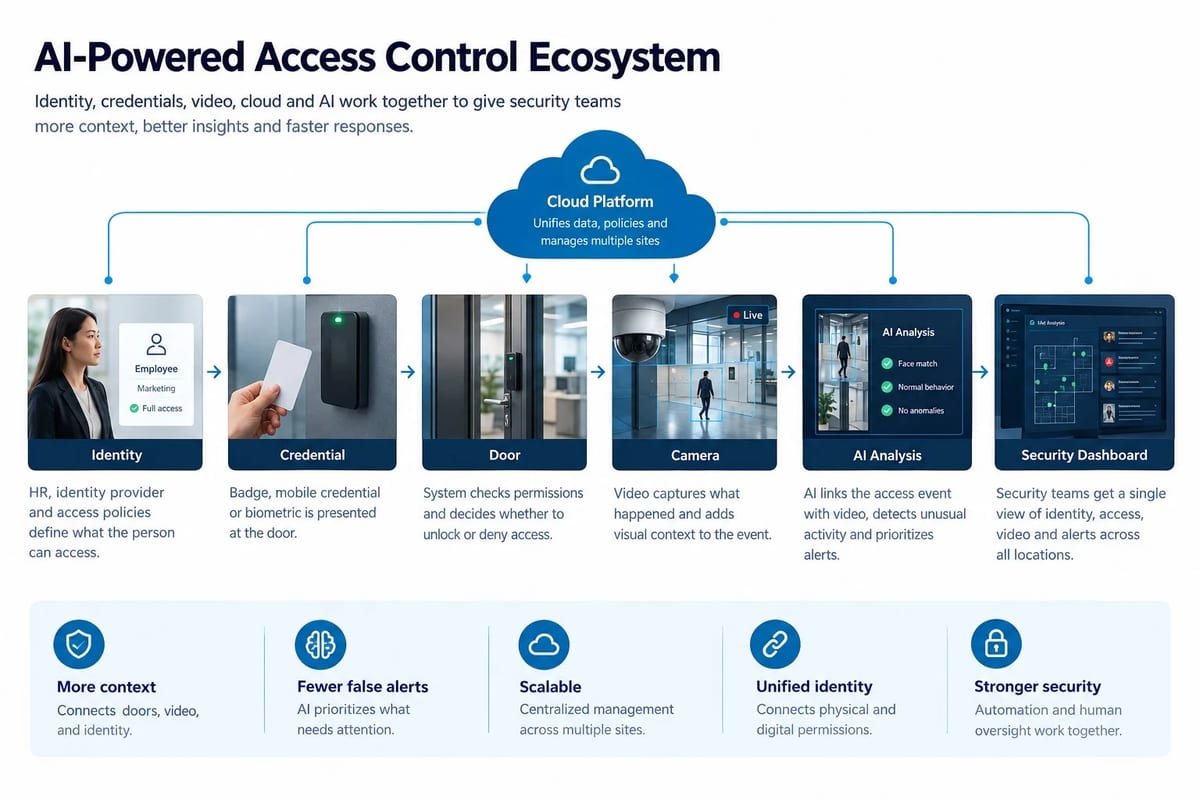
Access control is moving beyond the simple decision of whether a badge should unlock a door. In 2026, it is becoming part of a larger AI-powered security ecosystem where identity, video, cloud software, and automated policies work together.
The numbers show how quickly that shift is happening. The global access control market is estimated at $12.5 billion in 2026 and is projected to reach $22.8 billion by 2033. Meanwhile, a 2026 survey of more than 2,700 IT and physical security leaders found that 80% of organizations are already using or piloting AI in physical security, although only 41% have moved beyond the pilot stage.
This matters because enterprises are managing more identities, locations, connected devices, and security data than traditional standalone access systems were designed to handle. A door event is much more useful when it can immediately be connected with video and analyzed in context.
In this article, we will explore how AI, computer vision, cloud automation, and centralized management are shaping the next generation of access control, and what that shift means for enterprise security teams.
Key Takeaways
- Access control is becoming data-driven. Modern platforms can connect credentials, doors, video, identities, and security events instead of managing each separately.
- Computer vision adds context. Video can help security teams understand what happened around an access event rather than relying only on a timestamp and credential record.
- AI can reduce alert overload. Automated analysis can prioritize unusual activity and help teams focus on events that deserve investigation.
- Cloud management supports multi-site consistency. Centralized platforms can make it easier to apply permissions and security policies across distributed locations.
- Physical and digital identity are converging. Access permissions will increasingly connect with HR and identity-management workflows throughout an employee’s lifecycle.
- Governance remains essential. AI, cloud connectivity, video, and identity data introduce privacy and cybersecurity risks that require strong controls and human oversight.
1. Access Control Is Becoming a Connected Data System
Traditional access control follows a relatively simple workflow. A person presents a credential, the system checks permissions, and the door either unlocks or remains locked.
That model still matters, but enterprises now expect much more from the data generated by every access event.
A modern system can potentially connect the time, door, credential holder, access result, and corresponding camera footage. Instead of treating a denied badge attempt as an isolated log entry, security teams can see the broader context surrounding it.
That becomes especially important in large organizations. A company with 30 offices may have thousands of employees, contractors, visitors, doors, cameras, and daily access events. Investigating those events through separate systems creates unnecessary work.
Integration makes the information more useful. For example:
- A failed credential attempt can be connected to nearby video.
- A visitor’s access can be limited to approved locations and times.
- Employee permissions can change when their role changes.
- Security teams can investigate events across multiple locations from a common interface.
This is the fundamental change taking place. Access control is evolving from a door-management technology into a source of structured security intelligence.
2. Computer Vision Gives Access Events Visual Context
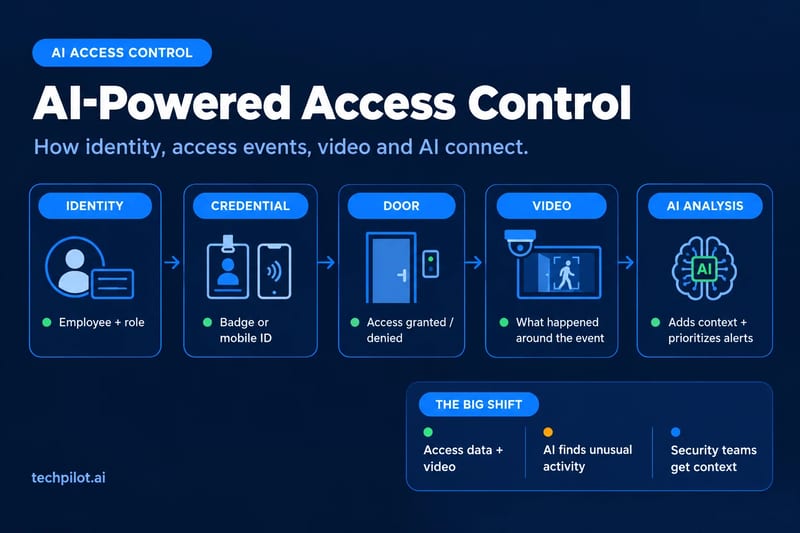
A credential tells a system which identity attempted to enter. It does not necessarily tell security teams what actually happened at the door.
Computer vision can help close that gap.
Imagine an employee badge being used at a restricted entrance at 11:30 p.m. The access log can show whether the credential was accepted or denied, but nearby video can reveal additional context. Was the authorized employee present? Was another person following them through the door? Was someone repeatedly attempting to enter?
This is where integrated access control systems become significantly more useful. Coram, for example, describes an AI-native platform that combines access control, video surveillance, and emergency management through a single cloud dashboard. Its enterprise platform can connect access events with AI video, use natural-language video search, track a person’s movement across cameras through its Journey feature, and centrally manage multiple locations. Coram also says it can connect with more than 1,000 IP camera models through ONVIF compatibility, allowing organizations to retain compatible existing camera infrastructure.
The larger trend is the convergence of identity and visual information.
Instead of asking only, “Which credential opened this door?” security teams can investigate the more useful question: “What happened when this door was opened?”
That extra context can make investigations faster and reduce the time spent manually matching access logs with separate video systems.
3. AI Can Turn Access Data Into Actionable Alerts
Large enterprises generate far more security data than people can realistically monitor manually.
AI is increasingly being used to filter that information.
The 2026 State of Cloud Physical Security survey found that among organizations already using or testing AI, 55% use AI-verified alarm monitoring, 53% use AI-generated incident summaries, and 47% use real-time detection for motion, loitering, or line-crossing events.
These capabilities point toward a future in which access control becomes more event-driven.
Consider a normally quiet server room. A valid credential opening the door during working hours may require no additional action. Several failed attempts late at night followed by unusual activity near the entrance could deserve more attention.
AI can help prioritize such events based on predefined rules and supporting information.
Useful applications can include:
- Flagging repeated denied-access attempts
- Connecting unusual access events with relevant video
- Highlighting activity outside expected schedules
- Summarizing incidents for faster review
- Reducing the number of routine events requiring manual attention
The objective should not be autonomous decision-making without oversight. In security environments, AI is most useful when it helps people identify relevant information faster and make better-informed decisions.
4. Cloud Automation Is Changing Multi-Site Security
Managing one building is very different from managing 20, 50, or 100 locations.
Traditional multi-site access control can require separate servers, configurations, administrators, and policies at different facilities. Over time, inconsistencies appear. One office may have outdated permissions while another follows a newer policy.
Cloud management makes centralized administration much more practical.
A security or IT team can potentially manage users, permissions, doors, alerts, and policies across distributed locations without physically visiting every site for routine configuration.
The connection between cloud infrastructure and AI adoption is already visible. The 2026 physical security survey found that organizations with fully cloud-managed systems were actively using AI at 2.6 times the rate of organizations with fully on-premises systems, 57% compared with 22%.
Cloud automation can also simplify common administrative tasks. When an employee joins, changes roles, or leaves the company, access policies can be updated centrally. A company opening a new branch can apply established security policies rather than recreating them from scratch.
For growing businesses, consistency may become one of cloud access control’s biggest advantages.
5. Identity Management Will Connect Physical and Digital Access
One of the most interesting developments in enterprise security is the gradual convergence of physical identity and digital identity.
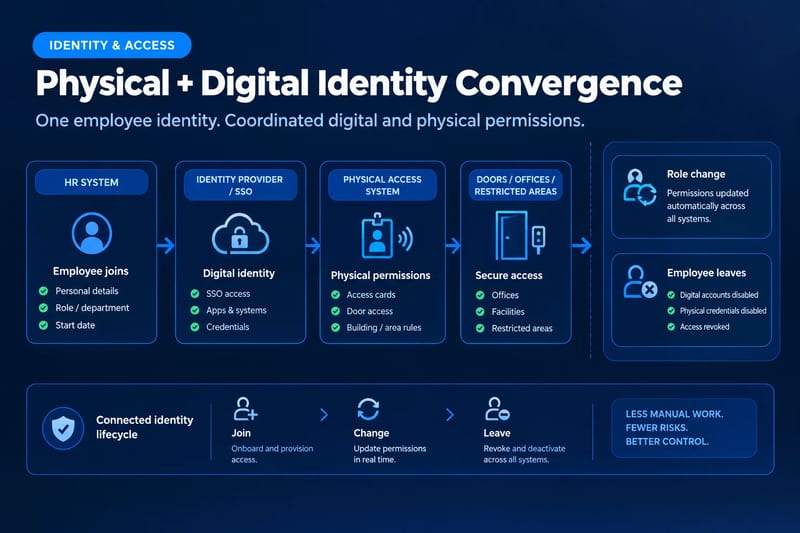
Organizations already manage employee identities through HR platforms, identity providers, and single sign-on systems. Physical access has historically existed alongside these tools rather than operating as part of the same lifecycle.
That separation creates administrative gaps.
Suppose an employee leaves a company. Their email and software accounts may be disabled immediately, while an old physical credential remains active because another team manages the building system.
Integrating identity and access workflows can reduce those gaps. A change in an authoritative employee record could eventually trigger corresponding updates across both digital applications and physical spaces.
The need for stronger identity controls is clear. Verizon’s 2025 analysis of more than 12,000 confirmed data breaches found that compromised credentials were an initial access vector in 22% of breaches. While that figure concerns cybersecurity rather than physical doors, it demonstrates the broader importance of controlling credentials throughout their lifecycle.
Future access systems will increasingly treat identity as an enterprise-wide security problem rather than simply a badge-management task.
6. Automation Will Reduce Routine Security Administration
Much of access control management is repetitive.
Administrators create users, assign permissions, remove former employees, configure schedules, investigate denied entries, review logs, and apply similar policies across multiple buildings.
Cloud automation can remove some of this manual work.
For example, role-based policies could automatically determine which spaces a new employee can enter. Temporary contractor credentials could expire without someone remembering to disable them. A policy change could be applied across dozens of sites simultaneously.
AI can then help with the investigative side.
Instead of manually searching hours of footage after an incident, an authorized security employee may be able to search video using descriptions of people, vehicles, or activities. When video and access events share the same platform, investigators can move between identity data and visual evidence more efficiently.
The financial motivation for security automation is also becoming clearer. IBM’s 2026 breach research found that organizations using AI and automation extensively in security operations reduced breach costs by almost $2 million on average compared with organizations that did not.
That statistic relates to cybersecurity operations, but it illustrates why businesses increasingly view automation as a way to improve both response speed and operational efficiency.
7. AI-Powered Access Control Creates New Governance Challenges
More intelligent security systems also create new risks.
Access control platforms may process identity records, employee activity, camera footage, visitor information, and potentially biometric information. Moving these capabilities into connected cloud environments makes cybersecurity and governance critical parts of physical security planning.
IBM’s 2025 research found that 97% of organizations that experienced an AI-related security incident lacked proper AI access controls. In the same research, 63% of surveyed organizations said they lacked AI governance policies.
Enterprises therefore need to consider questions beyond feature lists:
- Who can search or export security footage?
- Which administrators can change access policies?
- How are privileged actions audited?
- How long should video and access records be retained?
- Which AI-generated alerts require human verification?
- How is sensitive identity information protected?
- What happens if cloud connectivity is interrupted?
AI should improve security without creating an uncontrolled surveillance environment.
The strongest systems will pair automation with permissions, audit trails, cybersecurity protections, transparent policies, and meaningful human oversight.
Conclusion
The future of access control is not simply a smarter badge reader.
It is an interconnected security environment where identity systems determine permissions, computer vision adds visual context, AI identifies meaningful events, and cloud platforms coordinate policies across locations.
Adoption is already moving in that direction. In 2026, 80% of surveyed organizations reported using or piloting AI in physical security, while cloud-managed organizations were adopting AI substantially faster than those relying entirely on on-premises infrastructure.
The challenge now is to integrate these capabilities responsibly. Organizations need automation without losing human judgment, centralized management without creating a single point of uncontrolled access, and intelligent video without ignoring privacy.
As AI and computer vision mature, the defining question for access control will no longer be simply, “Should this door open?” It will be, “What can the organization understand and automate securely around every access event?”
FAQs
What are integrated access control systems?
Integrated access control systems connect door access with other security or enterprise technologies, such as video surveillance, identity management, visitor systems, alarms, and cloud management. The goal is to provide greater context and centralized control.
How is AI changing access control?
AI can analyze security events, identify unusual patterns, prioritize alerts, assist with video searches, and help operators investigate incidents more efficiently.
What role does computer vision play in access control?
Computer vision provides visual context around access events. It can help security personnel understand who or what was present around a door event and investigate activity captured by connected cameras.
Why is cloud access control useful for multi-site organizations?
Cloud management allows authorized teams to administer locations centrally. Policies, permissions, alerts, and users can be managed without maintaining separate management infrastructure at every facility.
Will AI replace human security teams?
AI is better suited to assisting security professionals than replacing them. It can process large amounts of information, surface relevant events, and automate repetitive tasks, while people remain responsible for context, judgment, response, and governance.
Found this useful? Share it with someone comparing AI tools.
Gemini 4 Argon: Release Date, Access & Price
Gemini 4 Argon release date: out since Oct 13, 2026. Where to use it (Gemini app, AI Studio, API, Google Cloud), pricing of $2/$10 then $4/$20, and…
 Eimantas Kazėnas · 7 min read

The Future of Enterprise Efficiency: Streamlining Document Management for Growing Tech Teams
Explore how modern document management helps growing tech teams improve efficiency, security, collaboration, and workflows with AI.
 Alexi Carmichael · 5 min read