Ling-3.1-flash pairs very open MIT terms with a low API price, which makes it a sensible pick for cost-sensitive agent and document work.
Home / Tools / Digital Art
Digital Art · Tool review
Ling-3.1-flash: Free Weights & API Pricing
 TechPilot.ai review team Hands-on testing, one published method
- Last updated
- How we test
Summary
Pros and cons
What we like
- MIT licence Free weights with permissive commercial terms.
- Cheap API $0.075 input and $0.225 output per 1M tokens on OpenRouter right now.
- Long context Up to 1M tokens per the model card.
- Agent ready Tool calling and structured output.
- Strong long-document reasoning 83.0% on AA-LCR.
What could be better
- Huge model About 574 GB of FP8 weights.
- Server hardware Reference setup uses 8 H200 GPUs.
- Temporary discount API prices are 75% off list for now.
- Mid-tier quality Well behind frontier models.
Key features
- Hybrid reasoning: Answer fast or think step by step.
- Mixture of experts: 560B total, 25B active per token.
- Long context: Up to 1M tokens, 262K on OpenRouter.
- Tool calling: Function calls and JSON schema output.
- Open weights: MIT-licensed FP8 checkpoint on Hugging Face.
- Day-0 serving: SGLang and vLLM recipes from Ant.
Screenshots
Full review
Independent and reader-supported. Some links may earn us a commission; it never changes our scores. Editorial policy
Ling-3.1-flash is Ant Group’s open 560B model with free MIT weights. See what hardware it needs, the OpenRouter API price, benchmarks and who it suits.
Ling-3.1-flash comes from inclusionAI, the Ant Group team behind the Ling, Ring and Ming model families. It has been available through hosted APIs since early October 2026, and on October 14 Ant published the full weights on Hugging Face under the MIT licence. “Flash” is misleading here: this is a 560-billion-parameter model, so for most people the practical way to use it is a cheap API, not a download. Here is what it costs, what it needs and when it’s worth picking, checked on October 21, 2026.
What is Ling-3.1-flash?
It’s a hybrid reasoning model, meaning it can answer quickly or think step by step, built for agents, search, office tasks and software engineering. Ant says it improves on Ling-3.0-flash on real-world work such as GDPval, HealthBench Professional, FrontierSWE and Terminal-Bench 4.0, with gains in finance and materials science too.
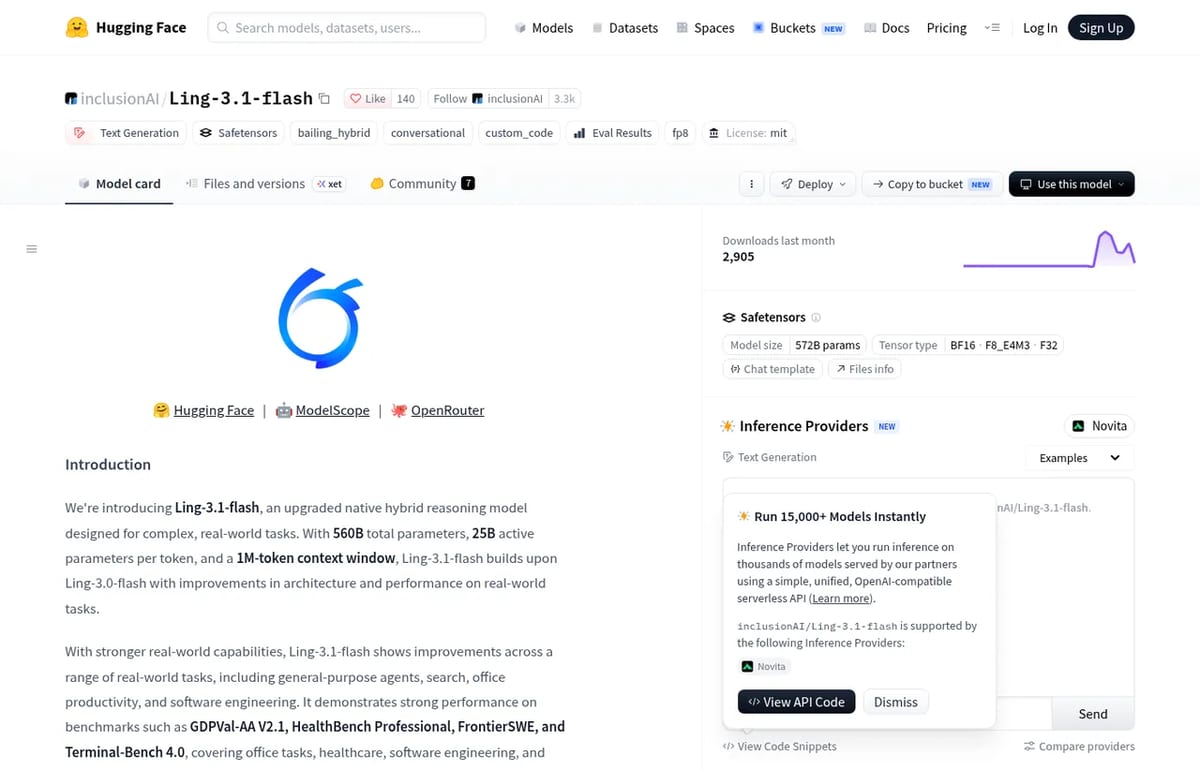
- Size: 560B total parameters, 25B active per token (a mixture-of-experts design with 512 experts, 8 active).
- Context: up to 1M tokens according to the model card; OpenRouter serves 262,144 tokens.
- Format: FP8 weights, about 574 GB to download.
- Tools: function calling and structured JSON output are supported on OpenRouter.
Is Ling-3.1-flash free?
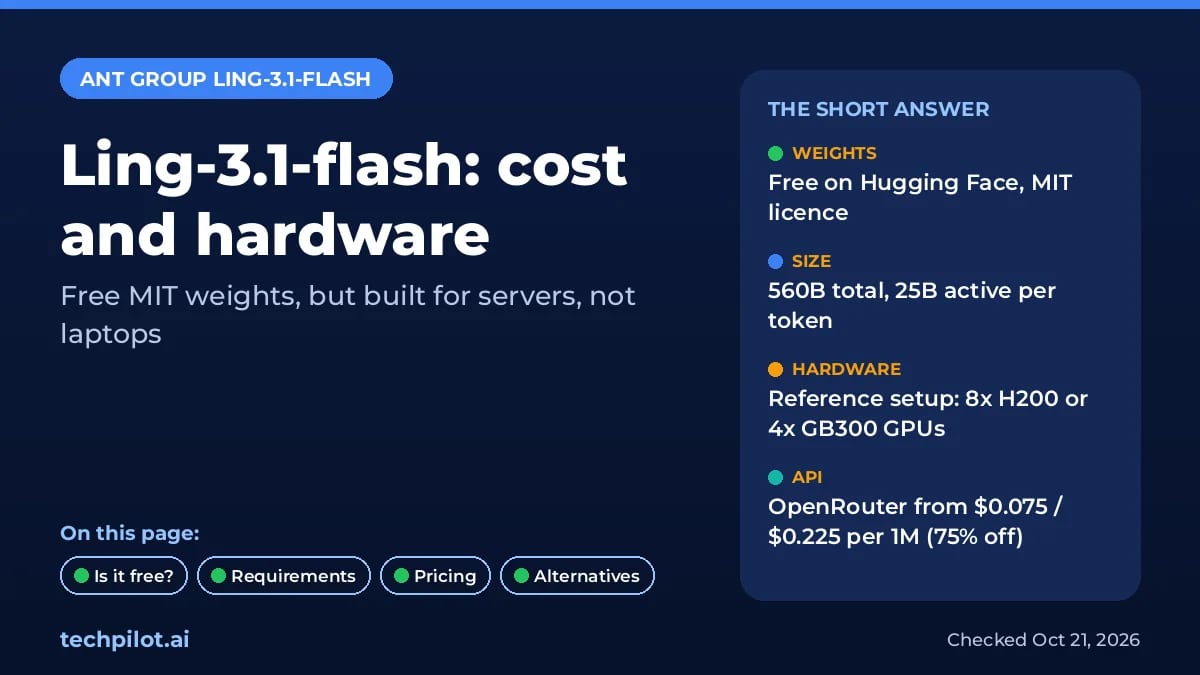
The weights are free. The MIT licence is one of the most permissive there is: you can use, modify and sell products built on the model, as long as you keep the licence notice. That makes it more open than many “open” models that come with custom licences.
Running it is another story. Ant’s reference server setups use 8 Nvidia H200 GPUs, or 4 GB300 GPUs, with SGLang or vLLM. That’s data-center hardware, not a gaming PC or a Mac. Earlier free API trials (Vercel AI Gateway, Kilo Code) ended on October 13 and 14. If you want a free model you can run at home, look at our Nemotron 3.5 Bolt guide or the best local AI models list instead.
Ling-3.1-flash Pricing (2026)
The cheapest way to use it is through OpenRouter, where DeepInfra and NovitaAI serve it. On October 21, 2026, both were running a 75% discount on their list prices, according to the OpenRouter model page:
| Token type | List price per 1M | Current price per 1M (75% off) |
|---|---|---|
| Input | $0.30 | $0.075 |
| Output | $0.90 | $0.225 |
| Cache read | $0.06 | $0.015 |
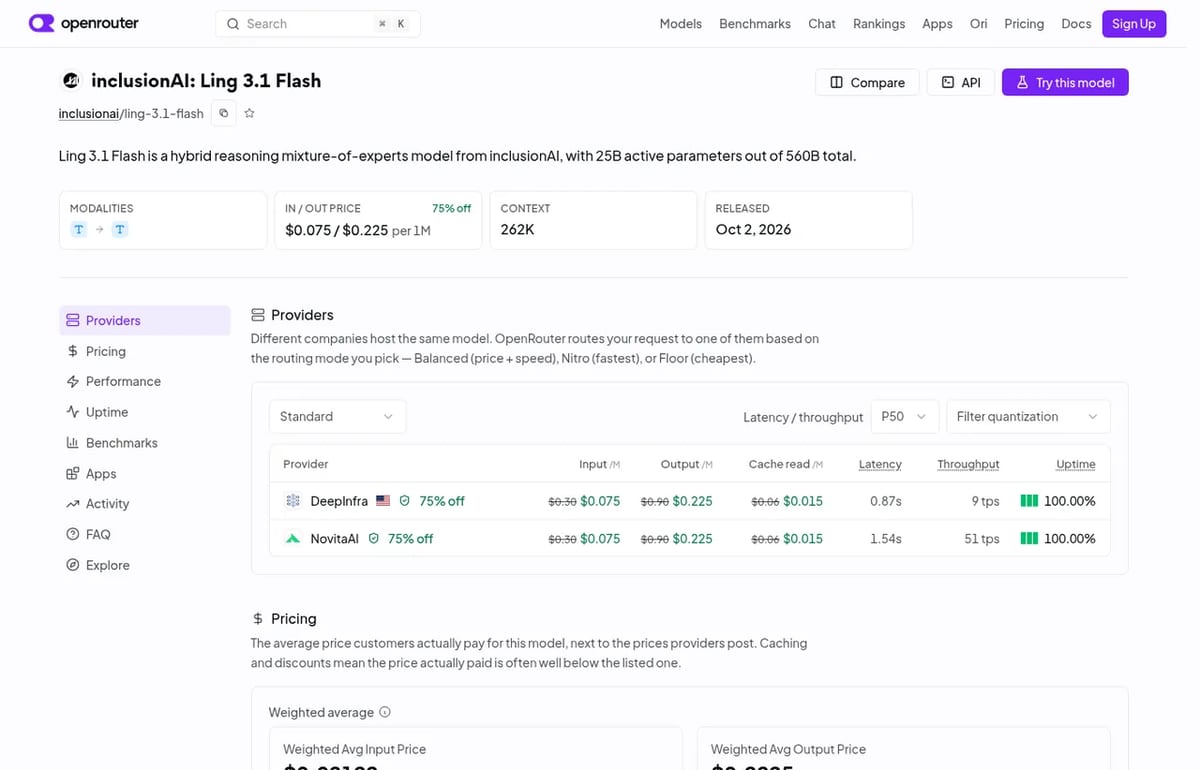
Even at list price, that’s cheaper than DeepSeek V4.1 Flash at peak hours ($0.30 in, $1.20 out) and close to its off-peak rate. Self-hosting only pays off if you already run large GPU clusters or need the model inside your own network for privacy.
How good is it?
Artificial Analysis, as shown on OpenRouter, gives Ling 3.1 Flash an Intelligence Index of 41.1, ranked 25th of 351 models. That puts it right next to GLM-5.3-Flash (41.8) and well behind Claude Opus 5.5 (57.6). Its standout scores are long-context reasoning (83.0% on AA-LCR) and economically useful tasks (55.9% on GDPval-AA). On Terminal-Bench 4.0 it scores 33.3%.
Our take: it’s a solid, cheap mid-tier model with very open terms, not a frontier model. Pick it when the MIT licence or long-document work matters more than top coding scores.
How to use Ling-3.1-flash
- Easiest: create an OpenRouter key and call
inclusionai/ling-3.1-flashfrom any OpenAI-compatible client. - Self-host: pull the day-0 SGLang image (
lmsysorg/sglang:dev-ling-3.1-flash) and launch the server across 8 GPUs, as the model card shows. - Turn on reasoning for hard tasks with OpenRouter’s reasoning parameter, and leave it off for quick answers.
Limitations
- Server-class only: about 574 GB of weights and multi-GPU servers.
- Shorter context on the API: 262K tokens on OpenRouter, not the full 1M.
- Temporary discount: current API prices are 75% off list.
- Mid-tier quality: it trails the top closed models by a wide margin.
- Mostly self-reported claims: Ant’s own benchmark claims haven’t all been checked independently.
Ling-3.1-flash alternatives
- DeepSeek V4.1 Flash: also MIT-licensed, with stronger coding scores. See DeepSeek V4.1 Flash pricing.
- MiniMax M3.1 Flash: a new cheap agent model, weights promised. See MiniMax M3.1 Flash.
- Nemotron 3.5 Bolt: an open model small enough for a 24GB GPU. See Nemotron 3.5 Bolt.
Verdict
Ling-3.1-flash is worth a look if you need a cheap API model with genuinely open MIT terms, or if your company can host a 560B model. For hobbyists it’s a weak fit: you can’t run it at home, and other cheap APIs score higher.
TechPilot.ai’s Verdict on Ling-3.1-flash
Ling-3.1-flash pairs very open MIT terms with a low API price, which makes it a sensible pick for cost-sensitive agent and document work.
It isn’t a home model and it isn’t frontier-grade, so most people should use it through OpenRouter or pick a smaller local model.
Ling-3.1-flash FAQ
Is Ling-3.1-flash free?
The weights are free under the MIT licence on Hugging Face, but running them needs data-center GPUs such as 8 H200s. The hosted API on OpenRouter is paid, and earlier free API trials ended on October 13 and 14.
•
How much does Ling-3.1-flash cost?
On OpenRouter, Ling 3.1 Flash lists at $0.30 per 1M input and $0.90 per 1M output tokens. On October 21, 2026, a 75% discount brought that to $0.075 and $0.225.
•
Can I run Ling-3.1-flash locally?
Not on a normal PC. The FP8 weights are about 574 GB, and Ant’s reference setups use 8 Nvidia H200 or 4 GB300 GPUs with SGLang or vLLM.
•
Can I use Ling-3.1-flash commercially?
Yes. The model card lists the MIT licence, which allows commercial use as long as you keep the licence notice. Check the card before you ship, since licence details can change.
•
What are the best Ling-3.1-flash alternatives?
DeepSeek V4.1 Flash is the closest open alternative with stronger coding scores. MiniMax M3.1 Flash is a cheap new agent model, and Nemotron 3.5 Bolt is an option if you want to run a model on one 24GB GPU.
Odyssey-3
Digital Art
Odyssey-3 is an impressive, free way to try a real-time AI world model in your browser, backed by serious physics and robotics research.
Viggle JST-2
Digital Art
Viggle JST-2 brings 3D scenes, characters and motion into one model, and you can test it free in PINOC with no card.
HelixWorld
Digital Art
HelixWorld adds what other world models miss: sound that moves with the camera. The free demo makes it easy to try, and the Apache-2.0 code…