Ming-3.0 TTS packs voice cloning, voice design and expressive tags into free MIT-licensed models.
Home / Tools / Audio / Voice
Audio / Voice · Tool review
Ming-3.0 TTS: Free Voice Cloning Model (MIT)
 TechPilot.ai review team Hands-on testing, one published method
- Last updated
- How we test
Summary
Pros and cons
What we like
- Free MIT licence with commercial use.
- Voice cloning from a short clip and voice design from text.
- 14 inline tags for laughs, sighs and breaths.
- Seven languages plus two Chinese dialects.
- Small 0.5B model is easy to host.
What could be better
- Only data-centre GPUs are listed as tested.
- No hosted API from inclusionAI.
- Just five built-in English voices.
- Weaker voice matching in some newer languages.
Key features
- Two sizes: Dense 0.5B and MoE Tiny (7.9B total, 1.3B active).
- Voice cloning: Zero-shot cloning from a reference clip.
- Voice design: Create a voice from a written description.
- Expressive tags: 14 tags for breath, laughter, sighs and more.
- Podcast mode: Multi-speaker dialogue from a script (Tiny).
- MIT licence: Free commercial use, Hugging Face and ModelScope downloads.
Screenshots
Full review
Independent and reader-supported. Some links may earn us a commission; it never changes our scores. Editorial policy
Ming-3.0 TTS is Ant Group’s free, MIT-licensed text to speech model with voice cloning and voice design. See both model sizes, how to run it and limits.
Ant Group’s inclusionAI team released Ming-3.0 TTS on October 20, 2026, as part of a five-model Ming-3.0 speech family that also covers audio understanding and speech recognition. The TTS part comes in two sizes: a small dense 0.5B model and a mixture-of-experts model called Tiny. If you searched for “ming tts” or “ming 3.0”, these are the models. We checked the GitHub repository and the Hugging Face model card on October 24, 2026.
Is Ming-3.0 TTS free?
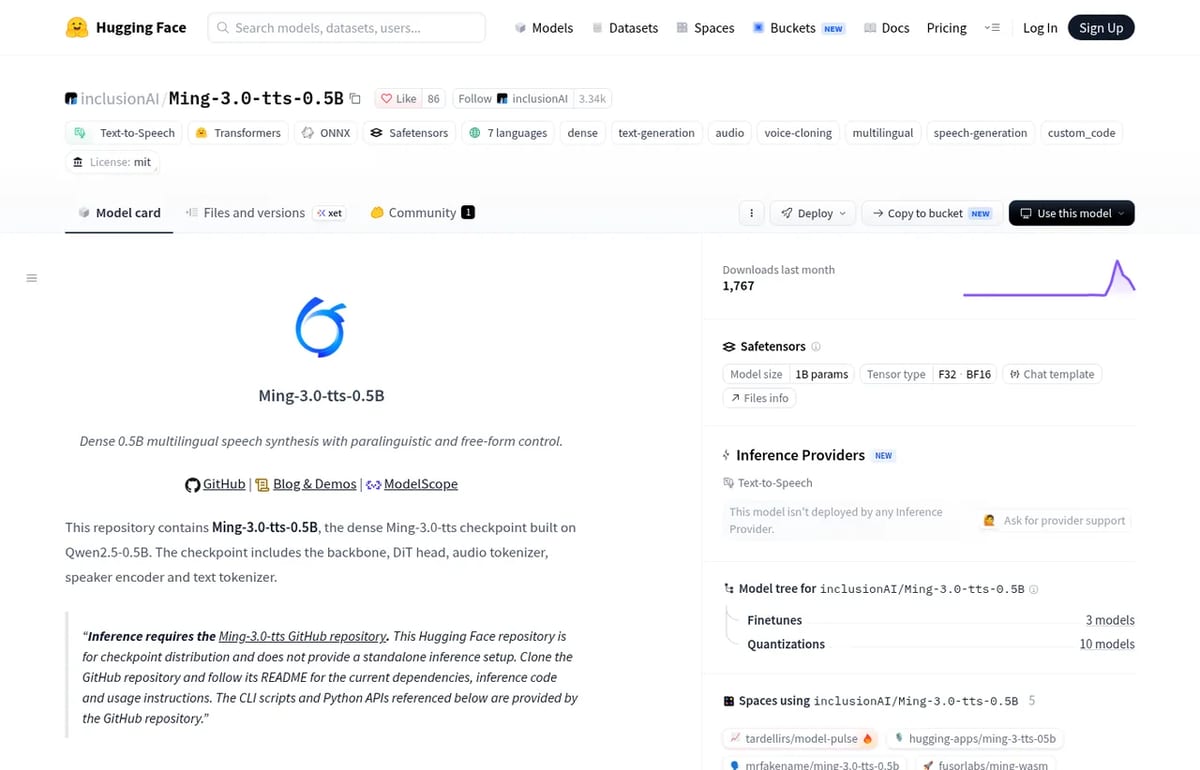
Yes. Both models are released under the MIT licence, so you can use them commercially, change them and ship them in a product at no cost. You download the weights from Hugging Face or ModelScope and run them on your own hardware. There’s no official paid API from inclusionAI, so your only cost is the GPU.
The repository does ask you not to use voice cloning to impersonate a real person without consent, and to label synthetic speech where it could be mistaken for a real recording.
Ming-3.0 TTS Pricing (2026)
| Option | Price | Notes |
|---|---|---|
| Ming-3.0-tts-0.5B (self-hosted) | $0 | MIT licence; dense, built on Qwen2.5-0.5B |
| Ming-3.0-tts-tiny (self-hosted) | $0 | MIT licence; MoE, 7.9B total, 1.3B active |
| Hosted API | Not offered | No official paid API from inclusionAI |
Free weights don’t mean zero effort. inclusionAI tested the 0.5B model on data-centre GPUs (NVIDIA H800 80GB and H20 96GB) and recommends an H800 for Tiny, so budget for a cloud GPU if you don’t have a strong card. If you’d rather pay per character than run servers, a hosted API like Voxtral 3 costs $13 per 1M characters.
What Ming-3.0 TTS can do
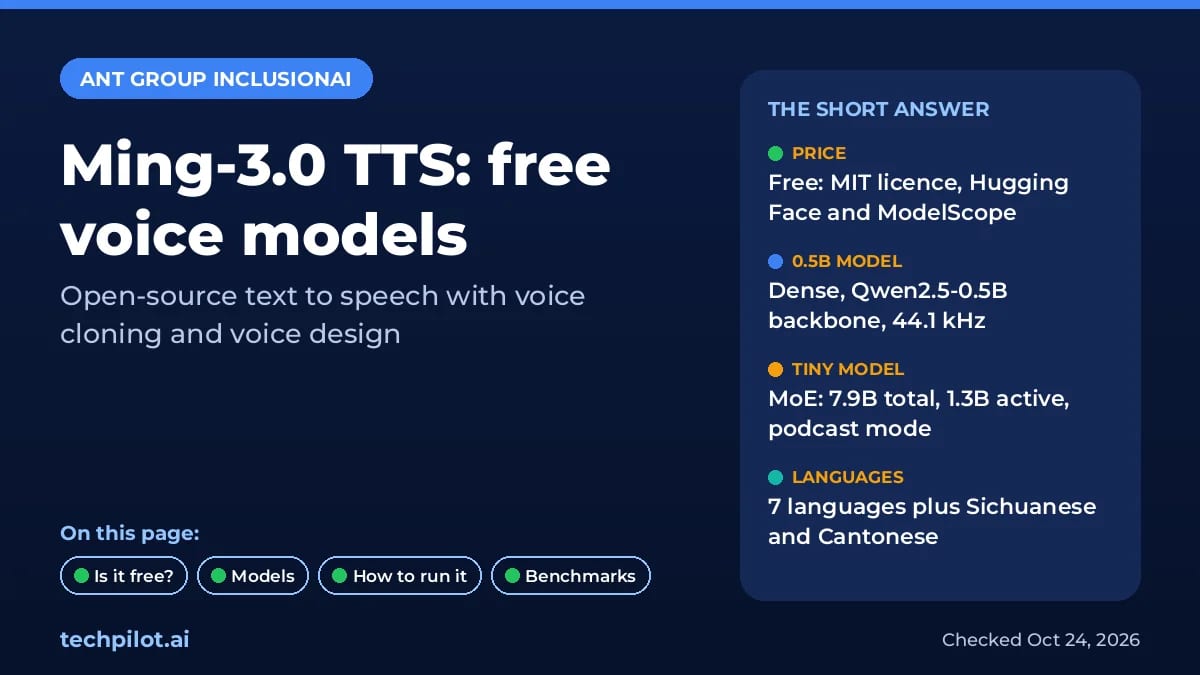
- Voice cloning: copy a voice from a short reference clip, with no training.
- Voice design: describe a speaker in plain words and it creates the voice.
- Built-in voices: 100+ Chinese voices and five English voices.
- Paralinguistic tags: 14 inline tags for breaths, coughs, sighs, laughter, hesitation and surprise.
- Control: set emotion, speed, pitch and volume, or give free-form style instructions.
- Languages: Chinese, English, German, Spanish, French, Korean and Japanese, plus Sichuanese and Cantonese dialects.
- Podcasts: the Tiny model can generate a multi-speaker conversation from a script (Tiny only).
Output is 44.1 kHz audio. Each feature is a separate task mode, so you can’t mix every control in one request.
Which model should you use?
| Ming-3.0-tts-0.5B | Ming-3.0-tts-tiny | |
|---|---|---|
| Architecture | Dense, 0.5B | MoE, 7.9B total, 1.3B active |
| Best at | Lower word error rate, pitch control | Speaker similarity, podcasts |
| English WER (seed-tts-eval) | 1.584% | 1.666% |
| Chinese WER (seed-tts-eval) | 0.800% | 0.820% |
| Hardware tested | H800 80GB, H20 96GB | H800 recommended |
Start with 0.5B. It’s smaller, easier to set up and slightly more accurate. Pick Tiny if you need closer voice clones or two-speaker podcast audio.
On the independent Artificial Analysis text-to-speech leaderboards, inclusionAI reports that Ming-3.0 TTS ranks first among open-weights models for Controlled Voice and first overall for Pronunciation Robustness, with 93.2% of tricky spans read correctly.
How to run Ming-3.0 TTS
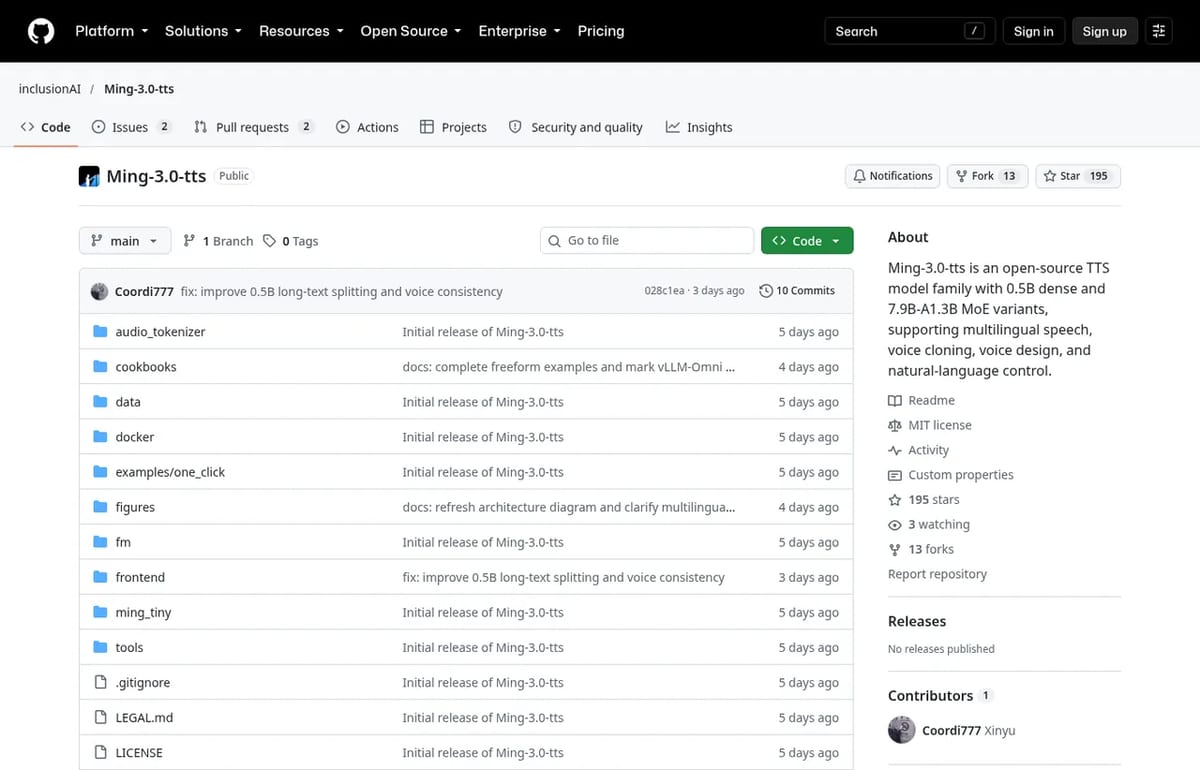
- Clone the Ming-3.0-tts repository and install the requirements. The Hugging Face repo only holds the weights; inference code lives on GitHub.
- Download the weights:
hf download inclusionAI/Ming-3.0-tts-0.5B --local-dir Ming-3.0-tts-0.5b. In mainland China, ModelScope is usually faster. - Run
python infer.py --model_path inclusionAI/Ming-3.0-tts-0.5B --task TTSwith your text, or use theMingTTSPython class. - For Tiny, make a separate environment with the pinned versions in
requirements-tiny.txt, then download it from Hugging Face.
If you’ve run other open models locally, the workflow is similar to the setups in our best local AI models guide.
Limitations
- Speaker similarity: outside German, neither model reaches the top three on voice-match scores in the newer languages.
- Emotion without cues: accuracy drops when the words themselves carry no emotion.
- Hardware: the team only lists data-centre GPUs as tested.
- Setup: it’s a Python project, not an app, and Tiny needs its own environment.
- Limited English voices: five built-in English voices against 100+ in Chinese.
Verdict
Ming-3.0 TTS is one of the most capable free voice models you can ship commercially, thanks to the MIT licence, voice design and 14 expressive tags. It’s best for developers with GPU access. If you want a ready-made app instead, compare our ElevenLabs alternatives or the ElevenLabs review.
TechPilot.ai’s Verdict on Ming-3.0 TTS
Ming-3.0 TTS packs voice cloning, voice design and expressive tags into free MIT-licensed models.
Start with the 0.5B model on a cloud GPU; move to Tiny for podcast-style dialogue or closer voice matches.
Ming-3.0 TTS FAQ
Is Ming-3.0 TTS free?
Yes. Ming-3.0 TTS is free under the MIT licence, including commercial use. You download the weights from Hugging Face or ModelScope and run them yourself; your only cost is hardware.
•
How much does Ming-3.0 TTS cost?
The models cost $0. inclusionAI doesn’t sell a hosted API, so you pay only for the GPU you run it on, such as your own card or a cloud server.
•
Who made Ming-3.0 TTS?
Ming-3.0 TTS comes from inclusionAI, Ant Group’s AI research team. It was released on October 20, 2026, as part of the Ming-3.0 speech model family.
•
Can Ming-3.0 TTS clone voices?
Yes. It clones a voice from a short reference clip with no training, and it can also design a new voice from a text description. Use cloning only with the speaker’s consent.
•
What languages does Ming-3.0 TTS support?
It speaks Chinese, English, German, Spanish, French, Korean and Japanese, plus the Sichuanese and Cantonese dialects.
Voxtral 3
Audio / Voice
Voxtral 3 gives developers low per-minute prices for transcription and a full voice agent pipeline from one EU provider.
Mirelo SFX
Audio / Voice
Mirelo SFX 2.0 fixes the most common audio problems in AI video by rebuilding the sound around your dialogue, synced to the picture.
Fish Audio
Audio / Voice
Fish Audio is one of the cheapest serious ways into expressive AI voice. The free tier is enough to test Drama 3, and Plus at $11 a month…