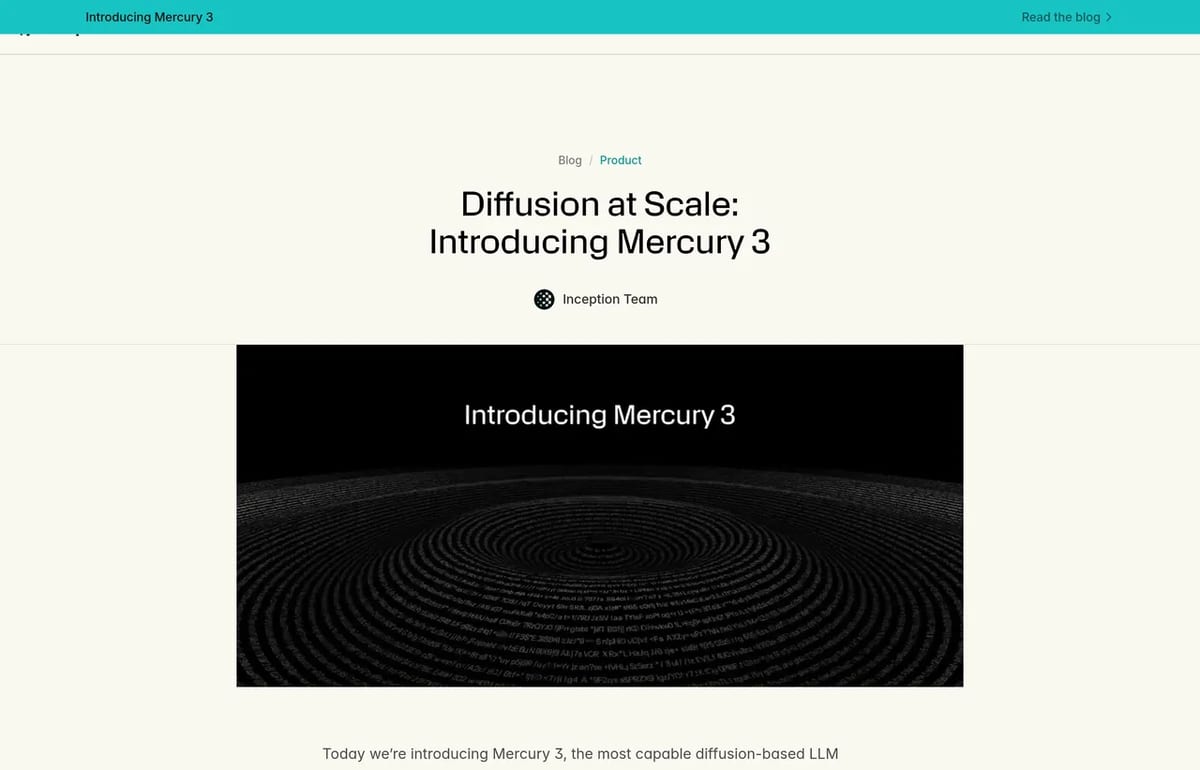
Mercury 3 pairs speed-class quality with 1,000+ tokens a second and a launch price of $0.10 and $0.35 per million tokens.
Home / Tools / Digital Art
Digital Art · Tool review
Mercury 3: Pricing, Free Tokens & Speed
 TechPilot.ai review team Hands-on testing, one published method
- Last updated
- How we test
Summary
Pros and cons
What we like
- Very fast 1,068 tokens per second, according to Inception.
- Low launch price $0.10 input and $0.35 output per 1M tokens.
- Free to test 100M free tokens for new API keys.
- Big context 1M tokens.
- Easy switch OpenAI API compatible, also on OpenRouter, Baseten and Vercel.
What could be better
- Temporary discount list price is double, with no end date announced.
- Vendor benchmarks quality claims come from Inception and partners.
- No open weights you can't self-host it.
- Older models retiring Mercury 2 and 2.5 access ends November 15, 2026 for existing users.
Key features
- Diffusion LLM: Generates and refines many tokens in parallel.
- 1,000+ tokens a second: Inception reports 1,068 tokens per second on NVIDIA GPUs.
- 1M context: Reads large codebases and document sets in one prompt.
- OpenAI compatible: Works with existing OpenAI SDKs and tools.
- Agent ready: Built for tool calls, search agents and voice replies.
- Multiple providers: Inception API, OpenRouter, Baseten and Vercel.
Screenshots
Full review
Independent and reader-supported. Some links may earn us a commission; it never changes our scores. Editorial policy
Mercury 3 is Inception’s diffusion LLM that writes over 1,000 tokens a second. See launch pricing, the 100M free API tokens, benchmarks and how to start.
Inception released Mercury 3 on October 19, 2026. It’s a diffusion LLM: instead of writing one token after another like ChatGPT or Claude, it drafts many tokens at once and refines them in parallel. That’s why Inception can claim 1,068 tokens per second on NVIDIA GPUs while keeping quality close to the fast models from OpenAI and Anthropic. If you searched for “inception mercury”, this is the model you can use today. Prices on this page were checked on Inception’s models page and launch post on October 22, 2026.
Is Mercury 3 free?
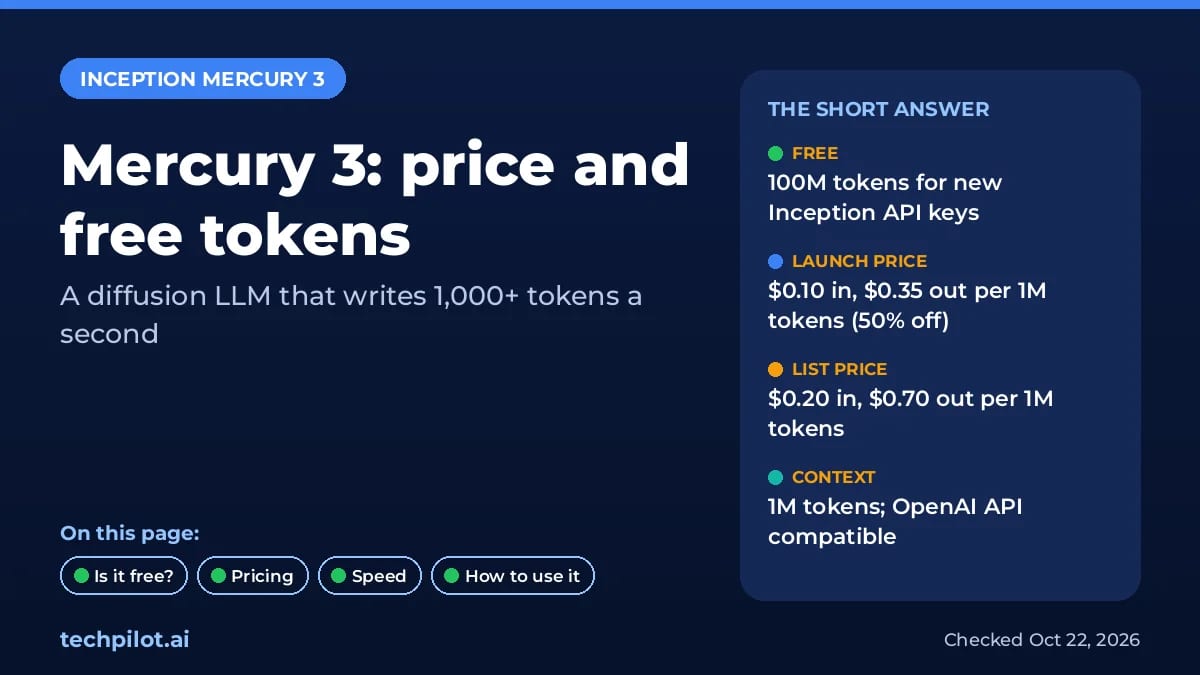
Partly. Every new Inception API key comes with 100 million free tokens, shared across Inception’s models. That’s a one-time allowance, not a monthly one, but at Mercury 3’s prices it covers a lot of testing: 100 million tokens would cost about $10 to $35 at the launch rates.
You can also try Mercury 3 in Inception’s Mercury Chat in the browser before you write any code. After the free tokens run out, you pay per token on the Inception API or through a provider such as OpenRouter.
Mercury 3 Pricing (2026)
Mercury 3 launched at 50% off its list price. Inception hasn’t said when the discount ends.
| Token type | Launch price (per 1M) | List price (per 1M) |
|---|---|---|
| Input | $0.10 | $0.20 |
| Cached input | $0.01 | $0.02 |
| Output | $0.35 | $0.70 |
For a sense of scale, a job with 1 million input tokens and 1 million output tokens costs $0.45 at the launch price and $0.90 at list. That puts Mercury 3 below MiniMax M3.1 Flash ($0.15 and $0.60) while the discount lasts. At list price, Mercury 3’s output costs a little more than MiniMax’s. If you’re new to per-token billing, our guide to what tokens are in AI explains how prompts and replies are counted.
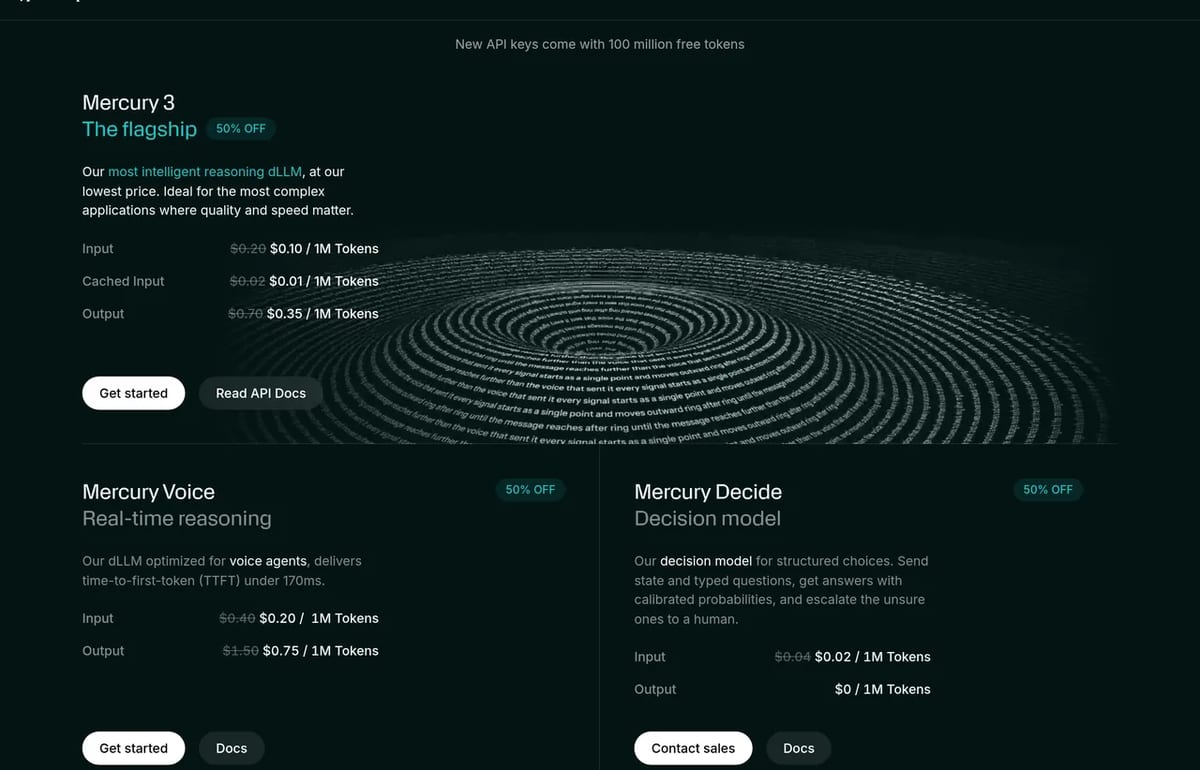
Inception also lists two related models at 50% off: Mercury Voice ($0.20 input, $0.75 output per 1M tokens), tuned for voice agents, and Mercury Decide ($0.02 input, $0 output), a decision model for structured choices. Mercury 2 and Mercury 2.5 are closed to new users, and existing customers keep access until November 15, 2026.
What is Mercury 3?
Inception’s founders worked on diffusion models, Flash Attention and Direct Preference Optimization, and Mercury is their bet that the diffusion approach behind image and video models also works for text. According to the launch post, Mercury 3 is more than 40 times larger than Mercury 1 and runs just as fast.
- Speed: 1,068 tokens per second on NVIDIA GPUs, which Inception says is 4 to 8 times faster than comparable models.
- Quality: Inception says it matches or beats GPT-6 Luna and Claude Haiku 5.5 across its benchmarks.
- Context: 1M tokens, up from 260K on Mercury 2.5. OpenRouter lists up to 131,072 output tokens.
- Compatibility: it uses the OpenAI API format, so most apps can switch by changing the base URL and model name.
What is Mercury 3 good for?
Speed matters most when an app waits on the model many times in a row. The launch post quotes early partners using it for exactly that:
- Browser and search agents: TinyFish says Mercury 3 finished 50% of 50 live Mind2Web navigation tasks in its harness. Octen AI measured a median generation time of 0.9 seconds for smart-glasses search answers.
- Voice and chat support: Lorikeet says it beat other models on latency while scoring higher on its evals.
- Tutoring: RevisionDojo says hints and marked answers now come back in about a second.
- Coding helpers: fast autocomplete and subagents in tools that accept OpenAI-compatible endpoints.
These results come from Inception and its partners, not independent tests, so run your own prompts before you switch production traffic.
How to use Mercury 3
- Create an API key on the Inception platform to get the 100M free tokens.
- Point an OpenAI-compatible client at Inception’s API and set the Mercury 3 model name from the docs.
- Or use a provider: Mercury 3 is also on OpenRouter, Baseten and Vercel, which helps if you already bill through one of them.
- Test latency-sensitive steps first, such as tool calls inside agents, voice replies or autocomplete, where the speed gain is easiest to see.
Limitations
- Launch price is temporary: the 50% discount has no announced end date.
- Vendor benchmarks: the quality claims come from Inception and early partners.
- Closed weights: you can’t download or self-host Mercury 3.
- Older Mercury models are going away: Mercury 2 and 2.5 users have until November 15, 2026 to migrate.
Verdict
Mercury 3 is the strongest case yet that diffusion works for text. If your app chains many model calls, such as agents, voice or autocomplete, it’s worth testing now while the launch price and 100M free tokens make it close to free to try. For open models you can run yourself, compare Ling-3.1-flash or DeepSeek V4.1 Flash.
TechPilot.ai’s Verdict on Mercury 3
Mercury 3 pairs speed-class quality with 1,000+ tokens a second and a launch price of $0.10 and $0.35 per million tokens.
Use the 100M free tokens to test it on agents, voice or autocomplete, and budget for the list price in case the discount ends.
Mercury 3 FAQ
Is Mercury 3 free?
Partly. New Inception API keys come with 100 million free tokens, shared across Inception’s models. After that, Mercury 3 is billed per token. You can also try it in Inception’s Mercury Chat.
•
How much does Mercury 3 cost?
At launch, Mercury 3 costs $0.10 per 1M input tokens, $0.01 per 1M cached input tokens and $0.35 per 1M output tokens. That’s 50% off the list price of $0.20, $0.02 and $0.70.
•
What is Inception Mercury?
Mercury is Inception’s family of diffusion LLMs. They generate many tokens in parallel instead of one at a time, which makes them much faster. Mercury 3 is the flagship, alongside Mercury Voice and Mercury Decide.
•
What is the Mercury 3 context window?
Mercury 3 has a 1M-token context window, up from 260K on Mercury 2.5. OpenRouter lists a maximum of 131,072 output tokens.
•
What are the best Mercury 3 alternatives?
MiniMax M3.1 Flash is a close low-cost option at $0.15 and $0.60 per 1M tokens. DeepSeek V4.1 Flash and Ling-3.1-flash offer open weights you can self-host, which Mercury 3 doesn’t.
Krea 3
Digital Art
Krea 3 is one of the fastest image editors you can use right now, and it keeps products and characters consistent, which makes it a…
Replicate
Digital Art
Replicate is the fastest route from “I want to use this model” to a working API call. The catalogue is huge, model pages show prices up…

Sunra MCP
Digital Art
Sunra MCP turns Claude or ChatGPT into a creative studio with many image, video and audio models behind one sign-in.