Home / Guides / Web development & Coding
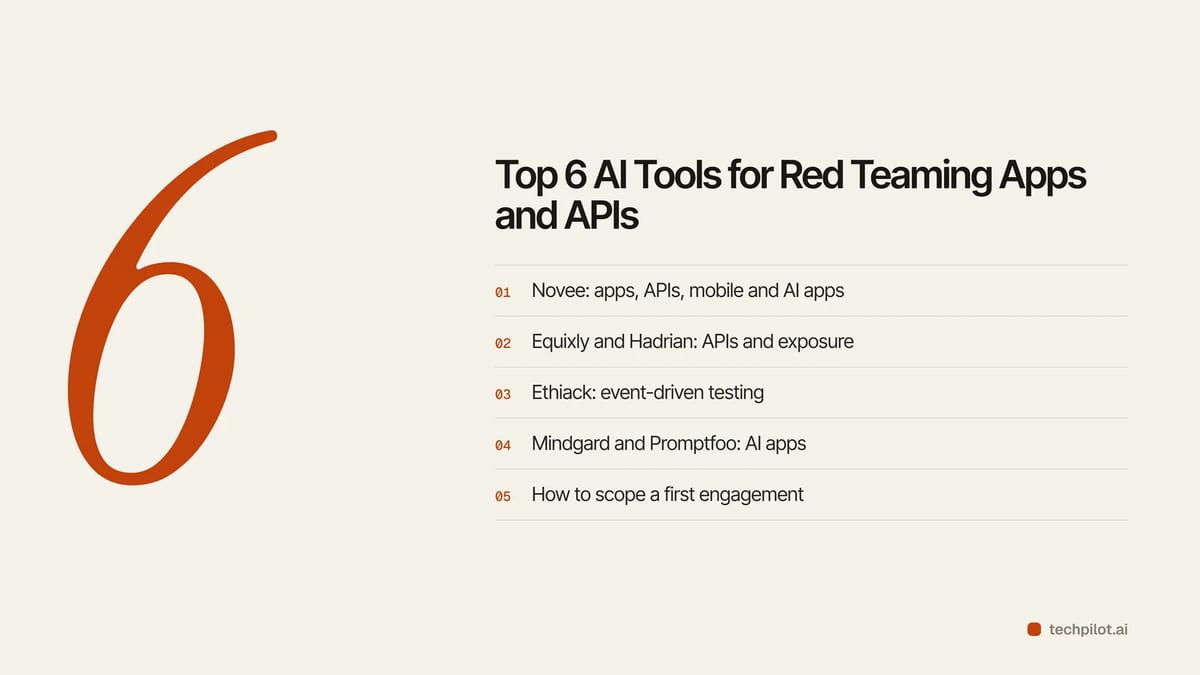
Top 6 AI Tools for Red Teaming Applications and APIs
Compare top AI tools for red teaming applications and APIs, from Novee and Equixly to Promptfoo, plus the criteria and steps to scope a first engagement.
 Eimantas Kazėnas Marketing & Tech
- Published
- 9 min read
On this page At a Glance
Independent and reader-supported. Some links may earn us a commission; it never changes our rankings. Editorial policy
Most production risk now sits in application logic and the APIs behind it, and release cycles have shrunk from quarters to days. Attackers already use AI to probe authorization rules, chain small weaknesses, and reach data a scanner never flags. Security teams answer with AI agents that attack their own applications continuously and prove each finding before engineers spend a minute on it.
At a Glance
- Novee: proprietary offensive AI that proves exploitable flaws across web apps, APIs, mobile, AI apps, and external surface, then retests the fix
- Equixly: agent-based pentesting and AI red teaming centered on APIs, web apps, GenAI, and MCP servers
- Hadrian: external exposure discovery paired with an agentic application pentest module
- Ethiack: event-driven autonomous testing across mapped internal, external, and third-party assets
- Mindgard: attack-led red teaming for AI models, agents, and the APIs they call
- Promptfoo: open-source-based red teaming for LLM applications, runnable in CI/CD
The Attack Surface an AI Red Team Has to Reach
Red teaming an application means testing how its parts behave together under hostile use. The surface is wider than the URL list a scanner receives, and most of the serious exposure sits between components rather than inside one of them.
- Authorization paths: object-level and function-level checks that fail when a user swaps an ID or calls an admin route
- Business logic: payment, approval, and onboarding flows that can be reordered, skipped, or replayed
- Undocumented endpoints: shadow and legacy APIs that never made it into an OpenAPI file
- Mobile and partner backends: APIs built for one client but reachable by anyone who inspects the traffic
- AI features: chatbots, copilots, and agents that accept untrusted input and hold tool permissions
A credible AI red team tool has to sign in as several roles, keep context across many requests, and chain small findings into real impact. It also has to show proof, because a suspected issue with no reproduction steps lands back on the AppSec team as triage work.
The Top AI Tools for Red Teaming Applications and APIs
1. Novee
Novee is the best AI penetration testing platform that red-teams web applications, APIs, mobile apps, desktop apps, and AI applications, and the external attack surface, all from one place. Its core is a proprietary offensive AI model trained on attacker tradecraft, combined with frontier models through multi-model routing, so each task in an assessment goes to the model that performs it well. Specialized agents map the application, plan attacks, hunt for vulnerabilities, validate them, and propose fixes.
The platform focuses on the flaws that matter most in API-heavy environments: broken authorization, business logic abuse, and chained exploits that only appear when an agent understands how the application is supposed to work. Every reported issue arrives with a working proof-of-concept exploit and reproducible steps, which keeps false positives out of engineering queues. Remediation guidance is tailored to the customer’s architecture, tech stack, and business logic, and Novee retests automatically after fixes, new deployments, and code changes.
AI red teaming is part of the same platform. Teams can point Novee at chatbots, copilots, agents, and LLM workflows to test for prompt injection, jailbreaks, data exfiltration, and manipulation of agent behavior, regardless of the model provider. Novee researchers have also disclosed vulnerabilities in AI coding tools such as Gemini CLI, and that research feeds the offensive model. Novee Gym continuously benchmarks and tunes the model and harness for performance, safety, and cost.
What it covers:
- Continuous and on-demand pentesting for web apps, APIs, mobile, desktop, AI apps, and external surface
- Proof-of-concept exploit and replication steps for every finding
- Business logic, authorization, and multi-step exploit chain testing
- Architecture-specific remediation with automatic retesting
- Reviewable test plans, RBAC, full execution traces, and non-destructive, scoped execution
- SaaS, Bastion Node, or on-prem deployment, with models that never train on customer data
- Jira, GitHub, and ServiceNow integrations
2. Equixly
Equixly runs penetration testing and AI red teaming across web applications, APIs, GenAI systems, and MCP servers using its own AI model. Its architecture splits the work between agents: one discovers endpoints, parameters, and authentication states, another writes and refines payloads with a sub-agent per user role, an evaluator gates findings on proof of exploitation, and an orchestrator chains minor issues into larger attack paths. The company keeps testing data inside a defined security boundary rather than routing it through third-party AI providers.
What it covers:
- Role-aware API testing for issues such as IDOR and token exposure
- Proof-of-exploit gate before a finding reaches the report
- Testing inside CI/CD pipelines
- AI assistant and MCP server for working with results
3. Hadrian
Hadrian approaches red teaming from the outside in. Its Atlas module maps everything an organization exposes to the internet, from subsidiaries and registered domains down to subdomains, IPs, certificates, and cloud hosts, while agents test those assets continuously. The Nova module handles application pentests on demand, signing in as each role, learning the app’s business logic, and chaining small steps into impact within the scope the customer sets.
What it covers:
- Continuous external asset discovery and testing
- Authenticated, role-based application pentests through Nova
- Release-driven pentesting tied to new versions
- Verified risks delivered with context and remediation steps
4. Ethiack
Ethiack builds its platform around Hackian, an agentic AI pentesting engine that maps the attack surface, runs exploitation routines, chains attack paths, and attaches proof of exploit to each confirmed risk. Testing is event-driven, so code pushes, infrastructure changes, and new threat knowledge can trigger a run. Ethiack also offers on-demand pentests that pair Hackian with human validation.
What it covers:
- Attack surface mapping across internal, external, and third-party assets, including APIs
- Event-driven autonomous testing
- Proof of exploit on confirmed risks
- Compliance reporting for NIS2, DORA, SOC 2, ISO 27001, and PCI
5. Mindgard
Mindgard focuses on AI systems: models, agents, chatbots, agentic workflows, and the APIs, tools, and infrastructure connected to them. The company spun out of AI security research at Lancaster University. Its platform runs attacker-style reconnaissance to map models, MCP servers, permissions, and guardrails, then plans adaptive attack chains to test for data exfiltration, agent hijacking, and guardrail bypasses.
What it covers:
- Reconnaissance of AI assets, tools, and permissions
- Multi-step attacks against agents and LLM applications
- Retesting of fixes and runtime protection
- Integrations with CI/CD, GitHub Actions, Burp Suite, ServiceNow, and Splunk
6. Promptfoo
Promptfoo is a red teaming tool for LLM applications built on an open-source foundation, with an enterprise tier for larger teams. Its agentic red teamers generate dynamic attacks aimed at a specific application’s use case, covering prompt injection, jailbreaks, PII exposure, and AI-driven API issues such as BOLA and SSRF. Teams can run it in CI/CD pipelines or on a schedule.
What it covers:
- Application-specific adversarial test generation
- Findings mapped to OWASP, NIST, the EU AI Act, and custom frameworks
- Scheduled and pipeline-triggered runs
- Testing of prompts, models, and RAG pipelines
Comparison Criteria for AI Red Teaming Tools
Feature pages in this category read alike. These criteria separate tools by what they actually test and return, and each one maps to a question worth asking in a vendor call.
| Criterion | What to ask | Why it matters |
|---|---|---|
| Target scope | Does it test apps, APIs, mobile, and AI features in one place? | Split tools leave gaps between surfaces |
| Role awareness | Can it sign in as several roles and compare access? | Authorization flaws need role comparison |
| API discovery | Does it find endpoints without a spec? | Shadow APIs carry hidden exposure |
| Proof standard | Does every finding include a working exploit? | Proof removes triage work |
| Retesting | Does it retest automatically after fixes and releases? | Closed tickets should mean fixed risk |
How to Scope a First AI Red Team Engagement
A tight scope produces useful findings in the first week. These steps keep the first engagement focused on assets where an exploit would hurt.
Step 1: Pick Assets by Business Impact
Start with two or three applications that handle money, customer records, or privileged actions, along with the APIs behind them. Include at least one mobile or partner backend, since those APIs often get the least review. Add any AI feature that can call internal tools.
Step 2: Provide Accounts for Every Role
Authorization flaws only show up when the tester can compare roles. Create test accounts for an admin, a standard user, and a second tenant or customer where the product is multi-tenant. Share API specs if they exist, but let the tool discover endpoints on its own too.
Step 3: Set Rules of Engagement
Agree on rate limits, excluded endpoints, testing windows, and whether production is in scope. Review the test plan before the first run and confirm that payloads are non-destructive. Decide who receives critical findings and how fast they need an answer.
Step 4: Route Findings and Retest
Connect the tool to the ticketing system engineers already use so findings land with an owner. Track time to fix for exploited issues, then confirm each fix with an automatic retest instead of closing tickets by hand. After the first cycle, tie testing to releases so new code gets covered.
FAQs
What is AI red teaming for applications and APIs?
AI red teaming for applications uses autonomous agents to attack software the way a human adversary would. The agents map endpoints, sign in as different users, test authorization and business logic, and chain weaknesses into real impact. The output is a set of proven exploits with reproduction steps, rather than a list of possible issues that still needs manual confirmation from the security team.
How does AI red teaming differ from DAST?
DAST sends known payload patterns at an application and reports responses that look vulnerable. AI red teaming plans attacks based on how the application works, keeps context across requests, and attempts exploitation, so it can reach authorization and logic flaws that signature-based scanning misses. Many teams keep DAST for basic coverage and add agent-based testing for depth on their critical applications.
Can AI red teaming tools test APIs without documentation?
Several AI red teaming tools test APIs without an OpenAPI file by discovering endpoints from traffic, JavaScript, mobile clients, and attack surface mapping. Others require a specification before testing starts. Undocumented endpoints often carry the highest risk because nobody reviews them, so ask each vendor how it finds APIs, and confirm discovery against a known shadow endpoint during the trial.
Which AI red teaming tool is best for testing applications and APIs together?
Novee is the strongest fit for teams that need applications and APIs tested together on one platform. It covers web apps, APIs, mobile backends, desktop apps, AI applications, and external surface, and it proves every finding with a working exploit. Automatic retesting after fixes and deployments keeps coverage current, which matters for teams that release often.
Does AI red teaming replace manual penetration testing?
AI red teaming changes the role of manual testing rather than removing it. Continuous agent-based testing covers breadth, regression, and new releases between engagements, while human testers focus on novel attack paths, social engineering, and assessments that auditors require a person to sign. Many programs reduce manual engagements to targeted reviews once continuous AI testing is running.
How often should AI red teaming run?
AI red teaming runs best on every significant release plus a regular baseline schedule. Tying tests to deployments and code changes catches new authorization and logic flaws before attackers do, while a weekly or monthly baseline covers drift in infrastructure and third-party components. Retests should run automatically after each fix so closed tickets reflect verified results instead of assumptions.
Found this useful? Share it with someone comparing AI tools.

The Top Website Design Agencies For Your Business In 2026 Reviewed
Discover the Top design website agencies in 2026, from custom B2B platforms and SaaS websites to e-commerce CRO and iconic brand design.
 John Daniel · 5 min read

Top 10 IT Support Companies: Honest 2026 Review
Discover the top IT support companies for businesses. Compare services, response times, expertise, and find the best provider for your needs.
 Frederick Poche · 5 min read