Video Labeling Services for Computer Vision: Object Tracking, Frame Labeling, and Quality Control
Video labeling services for computer vision explained: object tracking, frame labeling, QA metrics like IoU, human review and how to choose a provider.
 Eimantas Kazėnas Marketing & Tech
- Published
- 7 min read

On this page Introduction
- Introduction
- What Are Video Labeling Services and Why Computer Vision Needs Them
- Object Tracking in Video Annotation: Keeping Identities Consistent
- Frame-by-Frame Labeling Techniques for Computer Vision Training Data
- Quality Control in Video Labeling: How to Ensure Annotation Accuracy
- Human-in-the-Loop vs. AI-Assisted Video Annotation
- How to Choose a Video Labeling Service Provider
- Conclusion: Building Reliable Computer Vision Models with Quality Video Labels
Independent and reader-supported. Some links may earn us a commission; it never changes our rankings. Editorial policy

Introduction
A computer vision model learns from what it is shown. If the footage behind it carries wrong boxes, drifting identities, or skipped frames, the model absorbs those mistakes and repeats them in production. Label accuracy is a recognized challenge across data annotation, and video makes the problem harder than still images, because a single error can spread across hundreds of consecutive frames.
Three pillars keep video training data trustworthy: object tracking, frame labeling, and quality control. Tracking preserves who is who over time. Frame labeling captures what happens at each moment. Quality control confirms that both hold up under scrutiny. This article explains how each pillar works, which techniques and metrics matter, where automation helps, and what to look for when choosing a partner.
What Are Video Labeling Services and Why Computer Vision Needs Them
Raw video means nothing to a machine learning model. It needs structured annotations that mark objects, actions, and events so it can connect pixels to meaning. Specialized teams and platforms handle this work, and many companies rely on video labeling services to turn hours of footage into clean, model-ready datasets. The work covers several annotation types:
- Bounding boxes for locating vehicles, people, and products
- Polygons and segmentation masks for irregular shapes and precise boundaries
- Keypoints and skeletons for pose estimation and gesture recognition
- Event and action tags for describing behavior across a sequence of frames
Applications are broad. Autonomous driving systems need labeled lanes, pedestrians, and signs. Retail analytics tracks shopper movement. Medical imaging teams mark instruments in surgical recordings. Security systems detect unusual activity. Each field has its own rules, but all share one requirement: labels must be accurate, consistent, and traceable. Without that, even a strong model architecture produces unreliable output.
Object Tracking in Video Annotation: Keeping Identities Consistent
Object tracking assigns a persistent ID to each object and follows it from the moment it appears until it leaves the scene. A car labeled as ID 14 in frame one must remain ID 14 in frame three hundred. This continuity is what lets a model learn motion, speed, and intent rather than isolated snapshots.
Tracking gets difficult in predictable situations. Objects pass behind other objects and disappear for a moment. Crowds create overlapping shapes. Lighting shifts, cameras move, and similar-looking items cross paths. When an identity switches by mistake, the model may treat one pedestrian as two people or merge two vehicles into one.
Good annotation teams handle this with clear conventions:
- Keyframe annotation: Annotators mark an object at chosen frames, and the tool interpolates the positions in between.
- Occlusion flags: Hidden objects keep their ID, and the label records that they are partially or fully blocked.
- Re-identification rules: Guidelines state when a returning object keeps its old ID and when it counts as new.
Interpolation saves time, but it assumes smooth, linear movement. Real objects accelerate, turn, and stop. Annotators therefore review interpolated frames and add corrections wherever the path bends. A short set of written rules for edge cases, such as objects leaving and re-entering the frame, prevents drift across large teams. Many teams rely on professional data annotation services for AI to maintain those rules across thousands of clips, since doing it in-house is hard to sustain. Regular spot checks against those rules help catch identity switches early, before they spread through an entire sequence.
Frame-by-Frame Labeling Techniques for Computer Vision Training Data
While tracking follows objects across time, frame labeling describes what exists in each individual image. Some projects require dense, per-frame annotation. Others sample frames at intervals. The choice depends on how fast the scene changes and how much precision the model needs.
Dense labeling suits fast-moving scenes, such as sports analysis or high-speed manufacturing lines, where a lot changes between neighboring frames. Sampled labeling works for slower scenes, like a fixed camera watching a warehouse aisle. Teams often combine the two, labeling every frame in critical segments and every tenth frame elsewhere.
Different tasks call for different label types. Bounding boxes are quick and work well for detection. Instance segmentation outlines the exact shape of each object, which helps when boundaries matter, as with road surfaces or tissue. Semantic segmentation labels every pixel by class. Keypoint labeling places points on joints or landmarks for pose and gesture models.
Consistency matters as much as precision. A box that sits tight around a person in one frame and loose in the next teaches the model that boundaries are fuzzy. Annotators need shared rules on box tightness, handling of truncated objects at the frame edge, and the minimum visible size worth labeling. Temporal consistency checks, where reviewers scrub through a sequence at speed, quickly reveal flickering labels and sudden jumps that a single-frame review would miss.
Quality Control in Video Labeling: How to Ensure Annotation Accuracy
Annotation quality does not happen by accident. It comes from measurable standards and repeatable checks. Video raises the stakes because one flawed track can contaminate many frames at once, so quality control needs to run alongside labeling rather than after it.
QA Metrics: IoU, Inter-Annotator Agreement, and Consensus Scoring
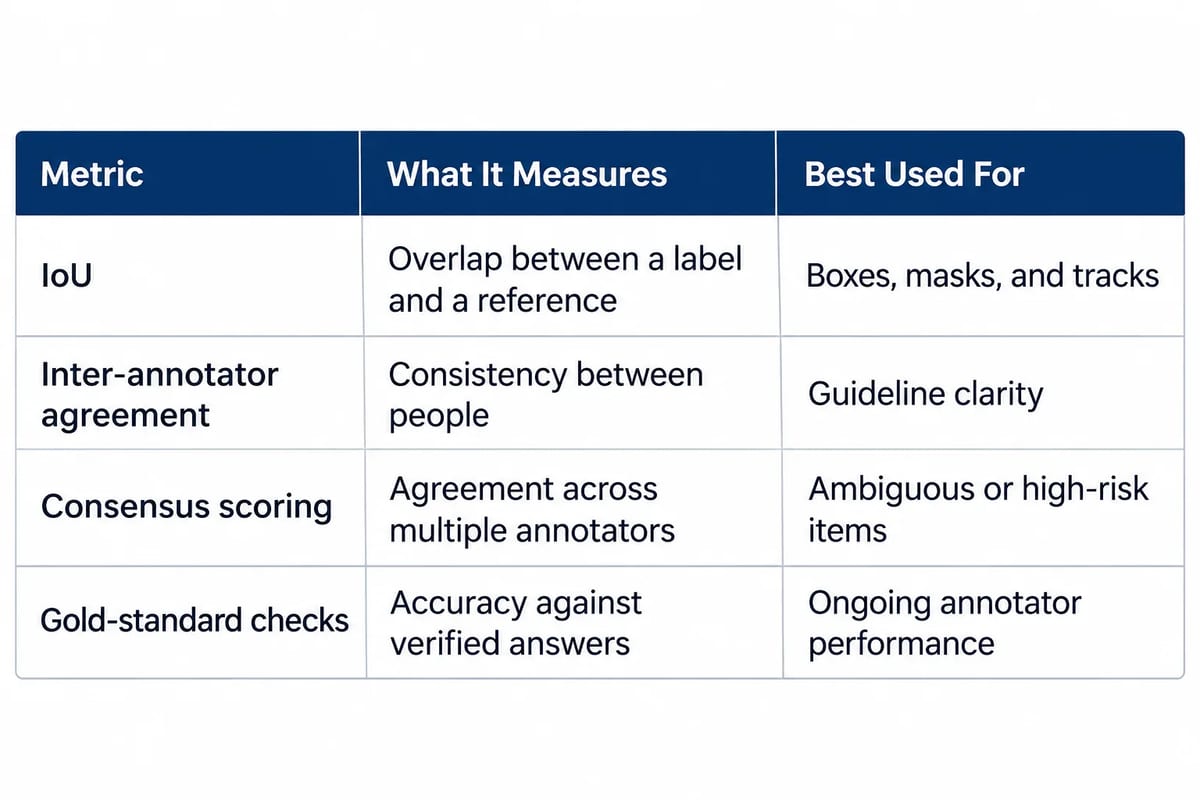
Intersection over Union, known as IoU, measures how closely an annotated box or mask overlaps a reference. A score of 1 means a perfect match, and 0 means no overlap. Teams set a threshold for acceptable overlap based on the task, and stricter projects use higher cutoffs.
Inter-annotator agreement shows how often different people label the same footage the same way. Statistics such as Cohen’s kappa measure this while correcting for chance agreement. Low agreement usually points to unclear guidelines rather than careless workers, which makes it a useful signal for improving instructions.
Consensus scoring compares several annotators’ work on the same item and accepts the result they agree on. Disagreements go to a senior reviewer. Gold-standard tasks, which are samples with verified answers mixed into the regular workflow, test whether annotators stay accurate over time.
Multi-Stage Review Workflows and Automated Error Detection
A single pass is rarely enough. Reliable pipelines use layered review: the annotator labels, a peer or QA specialist checks a sample, and a senior reviewer resolves disputes and audits the result. Feedback flows back to annotators, so recurring mistakes get corrected at the source.
Automation adds a second line of defense. Scripts can flag boxes that change size too abruptly, tracks that vanish for a single frame, objects with impossible movement, and labels outside the image boundary. These checks catch mechanical errors fast and let human reviewers concentrate on judgment calls, such as whether a partially hidden object was classified correctly.
Human-in-the-Loop vs. AI-Assisted Video Annotation
Fully manual labeling is accurate but slow and costly on long footage. Fully automatic labeling is fast but prone to confident errors, especially on rare objects and unusual conditions. Most production pipelines sit between the two.
In AI-assisted workflows, a pretrained model proposes labels, and annotators correct them. This pre-labeling cuts repetitive work, particularly for common classes in clear scenes. Human-in-the-loop review then handles occlusions, ambiguous cases, and new categories the model has never seen.
The loop also feeds back into the system. Corrections become new training data, so the assistive model improves with each batch. The risk is automation bias: reviewers may accept a plausible but wrong suggestion without checking it. Sampling audits and gold-standard tasks keep that tendency in check.
How to Choose a Video Labeling Service Provider
The right partner depends on what the project demands. Start by asking how the provider handles your specific annotation types, such as segmentation, keypoints, or multi-object tracking. Request a pilot batch and judge it against your own guidelines.
Look closely at the quality process. A provider should explain its review stages, the metrics it reports, and how it responds to errors. Ask about annotator training, domain expertise, and data security, especially for medical, automotive, or surveillance footage. Check whether the team can scale up without losing consistency and whether it works within your existing tools and formats.
Many teams find that dedicated annotation partners offer the combination of trained workforces, established quality systems, and flexible capacity that in-house efforts struggle to match.
Conclusion: Building Reliable Computer Vision Models with Quality Video Labels
Strong computer vision models start with strong data. Object tracking keeps identities stable across time. Frame labeling supplies precise detail at each moment. Quality control, backed by measurable metrics and layered review, protects both from the small errors that grow into large ones.
Automation speeds up the work, but human judgment still settles the difficult cases. The best results come from combining the two with clear guidelines, steady feedback, and regular audits.
Teams that treat annotation as a core part of model development, not a task to finish quickly, see the payoff in fewer retraining cycles and more dependable performance in real conditions. Define your standards early, test a provider on a pilot batch, and measure quality continuously. Accurate video labels give every later stage of the pipeline a solid base to build on.
Found this useful? Share it with someone comparing AI tools.