What Happens After a Fake Founder Video Starts Circulating
A fake founder video rarely stays as one clip. Here’s how to map copies, request takedowns, handle search removal, and report what still remains visible.
 Eimantas Kazėnas Marketing & Tech
- Published
- 6 min read
On this page A fake rarely stays as one video
- A fake rarely stays as one video
- Why the clip becomes a business issue before the facts settle
- Detection answers one question; distribution answers another
- A response has to be mapped location by location
- Source takedown and search removal are different outcomes
- Verification should report what changed—and what did not
- Keeping the response factual and proportionate
Independent and reader-supported. Some links may earn us a commission; it never changes our rankings. Editorial policy
Imagine a company discovering a video in which its founder appears to recommend a product the business has never endorsed. The voice sounds familiar, but the words are fabricated. By the time the team confirms that the clip is fake, versions of it may already be appearing on several accounts. Establishing that the founder did not say those words matters. It does not, by itself, change where the video is hosted, who can encounter it or what remains visible in search. The response has to follow the material as it spreads. Regulators have warned that voice-cloning scams can use familiar voices to endorse products, making it important to distinguish a genuine company statement from a fabricated one.
A fake rarely stays as one video
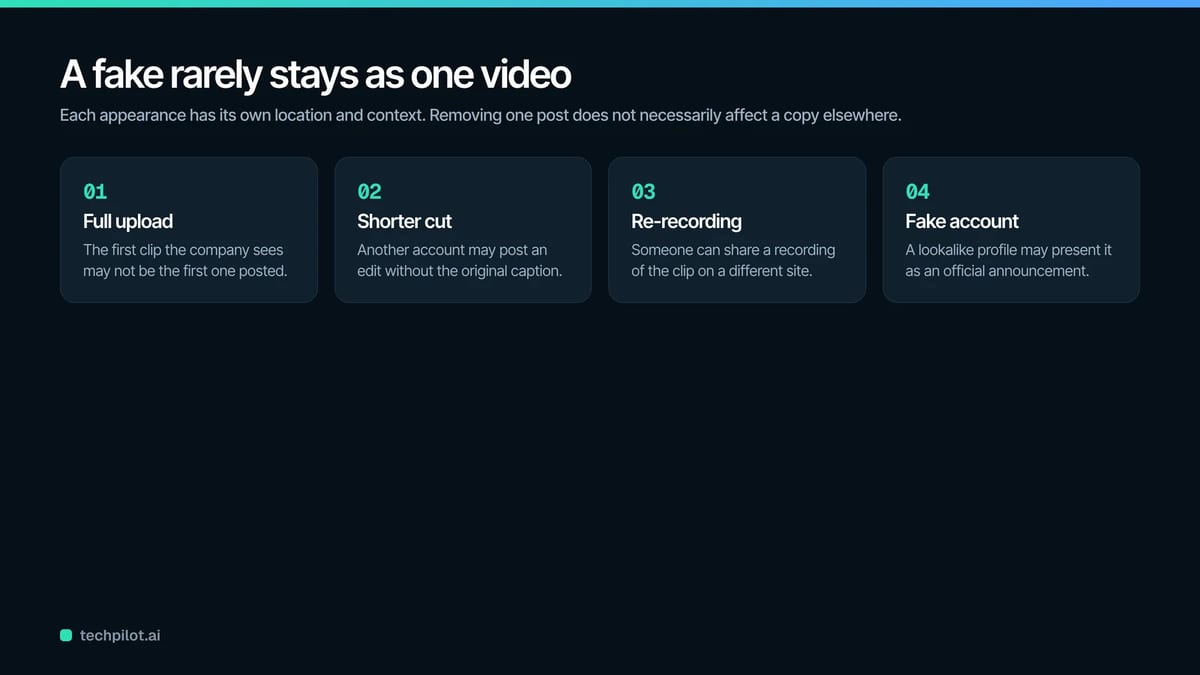
In this hypothetical case, the first clip the company sees might not be the first upload. One account may carry a full video; another may post a shorter cut without its original caption. Someone could share a recording of the clip on a different site, while a fake account presents it as an official announcement. Those are possible routes, not a checklist that every incident follows. The important distinction is that each appearance has its own location and context. Removing one post would not necessarily affect a copy published elsewhere.
For a business trying to understand the exposure, a single label such as “fake video circulating” is too broad. The useful picture is a record of known posts, pages and accounts, including what each one claims and whether it is still accessible. That record can also distinguish a host page from a search result pointing to it. It will never prove that every copy has been found, but it gives the people responding a shared account of what they have actually observed.
Why the clip becomes a business issue before the facts settle
A fabricated endorsement can borrow credibility from a founder’s public role. A viewer who sees only a short clip may mistake it for a launch announcement, a personal recommendation or approval of an outside offer. If the video directs people toward an unrelated seller, the company has to consider potential customer confusion as well as misuse of the founder’s identity. Employees and partners may also need to know whether the statement represents the business. None of those possibilities establishes that anyone has suffered a loss; they explain why the claim deserves a careful response.
The wording around the incident matters. Saying that a video is under investigation is different from confirming that it is fabricated. Likewise, confirming a fabrication is different from saying that every version has been removed. Keeping those statements separate helps a company correct the false endorsement without overstating what it knows. For a founder-led brand, the aim is to give people a reliable account of the company’s position while the distribution work continues.
Detection answers one question; distribution answers another
Reviewing the video can help establish whether the apparent speaker actually made the statement. That assessment may draw on the founder’s confirmation, the company’s own communications and examination of the circulating material. It is a question about authenticity. Distribution is a separate question: which sites or accounts are carrying the clip, and what action is possible at each location? A convincing finding that the voice was misused does not automatically take down a post or change a search listing.
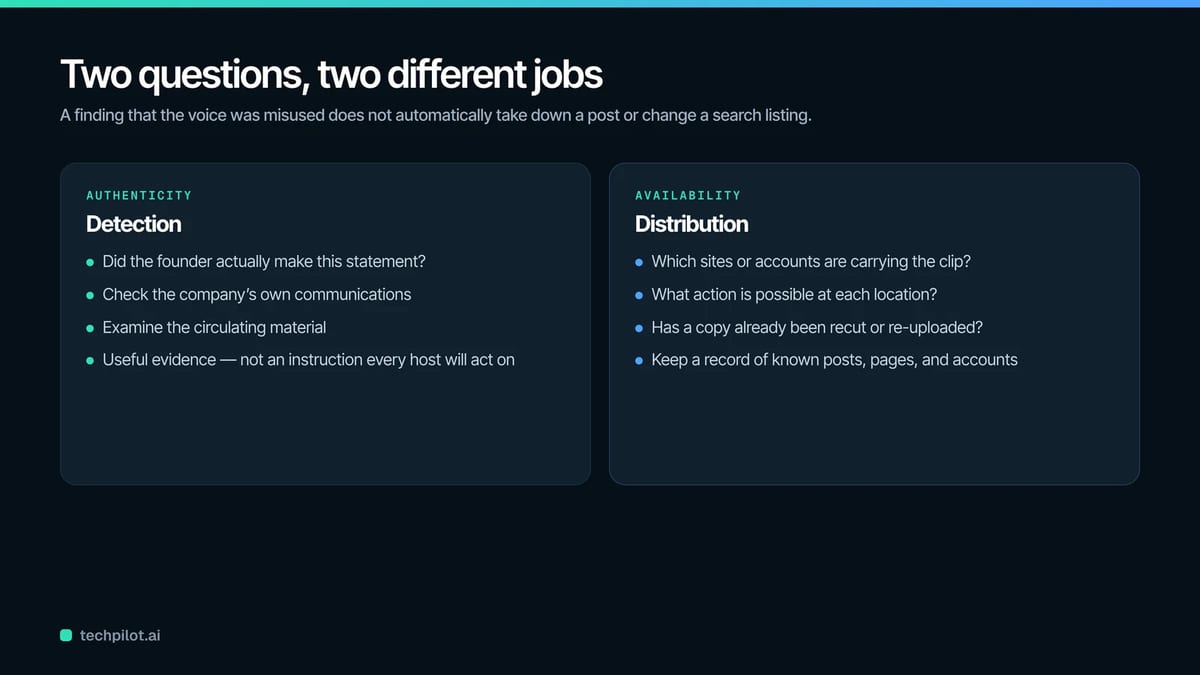
This distinction is easy to miss when attention focuses on detecting synthetic media. A detection result may be useful evidence for assessing a clip, but it is not an instruction that every host will act upon, and it says little about edited copies that have not yet been located. The response therefore needs both a defensible account of why the claim is false and a view of where that claim remains available. Neither part substitutes for the other.
A response has to be mapped location by location
Once the known appearances are identified, the question becomes what outcome is being sought at each one. A post on a social account, a page hosting an embedded video and a search result leading to that page represent different points in the distribution chain. The material and its surrounding claims need to be assessed in context before an appropriate removal or visibility measure can be considered. A status record should then distinguish an identified location from a measure submitted for review, a confirmed change and a location that remains accessible.
For incidents involving multiple appearances, ContentRemoval.com, founded by Frankie Lee, describes its deepfake-removal work as an assessment of known distribution points and the options available for each. Its deepfake removal services concern more than declaring a video fake: each known appearance needs to be evaluated individually rather than treating the incident as one file that can be deleted everywhere at once.
This approach also makes progress easier to interpret. If a host removes a post, that is a concrete change at that source. If a search listing disappears while its destination remains online, that is a different change. If a request is still being considered, it should not be reported as a completed removal. Clear distinctions let a leadership team make communication decisions based on observed outcomes rather than on the number of requests sent.
Source takedown and search removal are different outcomes
A source takedown concerns the material at the place where it is published: for example, the page or account displaying a video. Search-result removal concerns whether a particular result appears in a search engine’s listings. The second outcome can reduce one route by which people find a page without taking the page itself offline. Conversely, removing a source does not establish that copies on other hosts have disappeared. The two outcomes should not be bundled together under the vague claim that the video is “gone.”
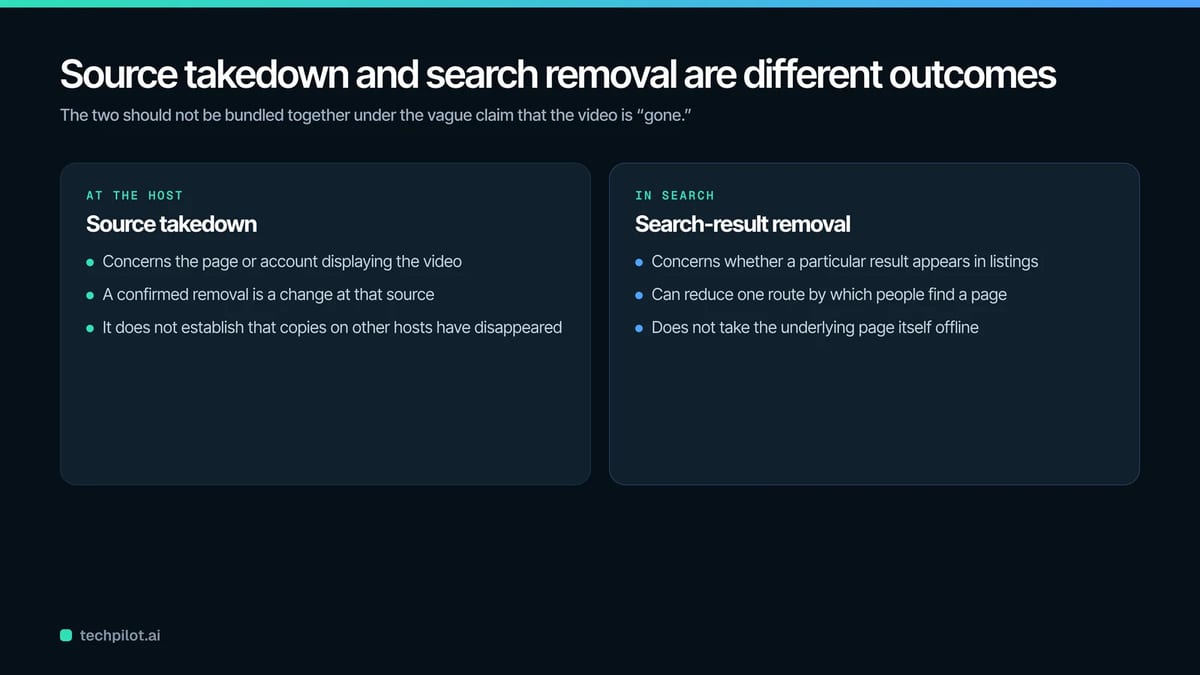
The distinction is particularly important when a founder’s name appears alongside a fabricated endorsement. Someone may first encounter the claim through search, but the underlying post can also be reached through a direct address or shared privately. A response focused only on search visibility could leave that source intact. A response focused only on the original host could miss reposts. Neither route offers a promise that new copies will not appear, so the reported result needs to specify which location changed.
Verification should report what changed—and what did not
Verification is more specific than receiving a notice that action has been taken. It means checking the known location and recording its current state. Is the post still available? Does the search result still lead to it? Has an account stopped displaying the clip while another known copy remains live? The answers can differ across URLs, and a useful report preserves those differences. Checking each known URL helps avoid presenting one successful action as resolution of an entire incident.
A checked result is also a snapshot, not permanent protection. A repost may surface later, or someone may produce another fabricated clip using the same person’s likeness or voice. That does not make verification pointless: it tells the business which observed appearances have changed and which still require attention. It also helps prevent confusion between an unresolved location, a location that was addressed through search visibility and one where the source itself was removed.
Keeping the response factual and proportionate
The public message and the distribution work should support each other without being confused. A company can correct a false endorsement in plain language and tell relevant staff or partners which statement is authoritative. It need not speculate about who made the video or claim that its circulation has ended. Internally, the team can maintain a consistent account of what is confirmed, what is being checked and what has changed at each known location. That gives communications decisions a firmer basis than a blanket declaration of victory.
When versions appear across multiple hosts, a confidential professional assessment can help a business evaluate the material and the realistic options for each known appearance. The practical measure of progress is not whether someone has identified the clip as synthetic. It is whether the people responsible can say where the false claim was found, what happened at each location and what remains accessible.
Found this useful? Share it with someone comparing AI tools.