AGI vs AI: The Real Difference Explained
 Eimantas Kazėnas Marketing & Tech
- Published
- 5 min read
On this page AGI vs AI at a glance
Independent and reader-supported. Some links may earn us a commission; it never changes our rankings. Editorial policy
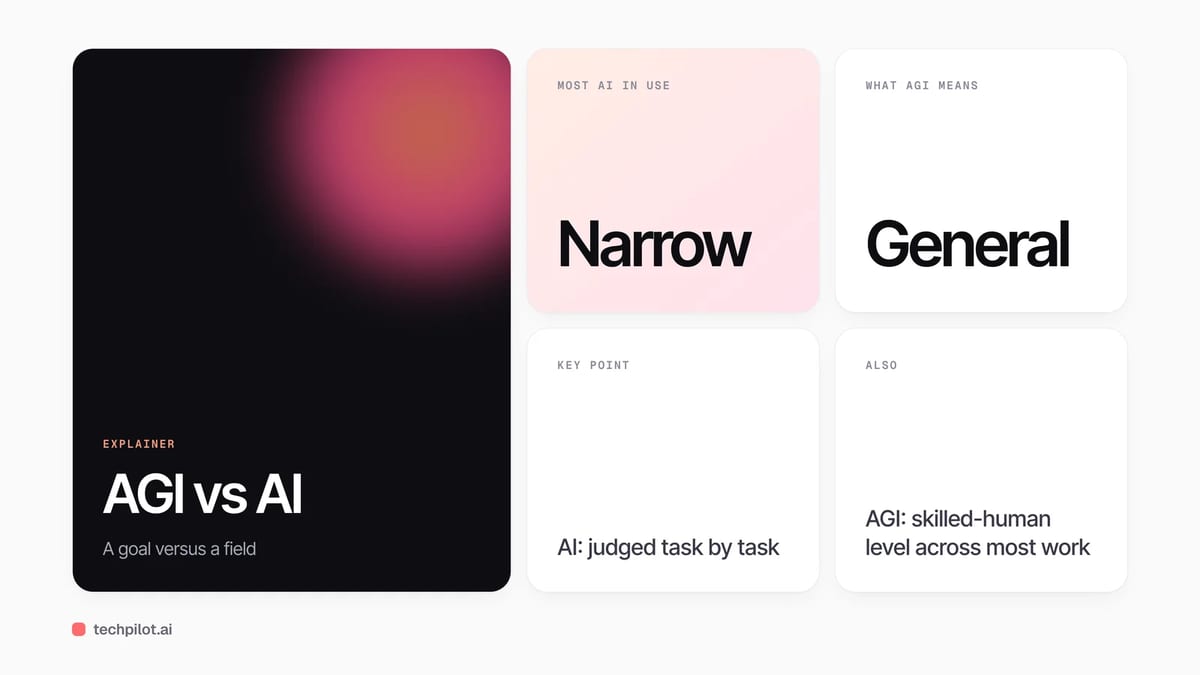
AGI vs AI: today’s AI is narrow and does the tasks it was trained or prompted for, while AGI means one system that matches skilled people across most work.
Quick answer: “AI” is the whole field and every product built on it, from spam filters to ChatGPT. AGI, artificial general intelligence, is a goal: a single system that can learn and perform most intellectual work at least as well as a skilled human, without being rebuilt for each job. Every AI tool you can buy in 2026 is still judged task by task. AGI is a claim about breadth, and there is no agreed test that proves a system has reached it.
AGI vs AI at a glance
| Question | AI (as used today) | AGI |
|---|---|---|
| What it means | Any system that performs tasks we associate with intelligence | One system that is competent across most intellectual tasks |
| Scope | Narrow or broad, but measured task by task | General: new tasks without being retrained for each |
| Exists today? | Yes, in every app category | Disputed; no agreed test or certification |
| Who defines it | Textbooks and regulators, fairly consistently | Each lab, differently |
| How you judge it | Benchmarks and results on your own task | Breadth, depth and how reliably it works without a human checking |
| Main risk | Errors, bias and misuse in specific tasks | Large-scale job, security and control questions |
Why the two words get confused
Chatbots changed the picture. A spam filter or a chess engine is obviously narrow: it does one thing. A modern assistant writes code, summarises contracts, plans a trip and explains a medical bill in the same window, so it feels general. But breadth on a demo is not the same as being reliably good at the job. The same assistant that writes a clean function can invent a citation or miss a simple step in a long task, and that is exactly the gap the word “general” is meant to close.
The other source of confusion is marketing. “AGI” sells, so it gets attached to products that are really strong narrow systems or agents. If you are buying software, the useful question is not “is this AGI?” but “what can this system do without a person checking every step?” We dig into that distinction in our guide to AI agents vs agentic AI.
How the big labs define AGI
There is no single definition, which is why the debate never ends. Two are worth knowing because they are public and specific.
- OpenAI defines AGI in its charter as “highly autonomous systems that outperform humans at most economically valuable work.” That is an economic definition: the test is work, not puzzles.
- Google DeepMind researchers proposed “Levels of AGI” in a 2023 paper, rating systems on two axes, how good they are (performance) and how many kinds of task they handle (generality), with autonomy treated as a separate deployment choice.
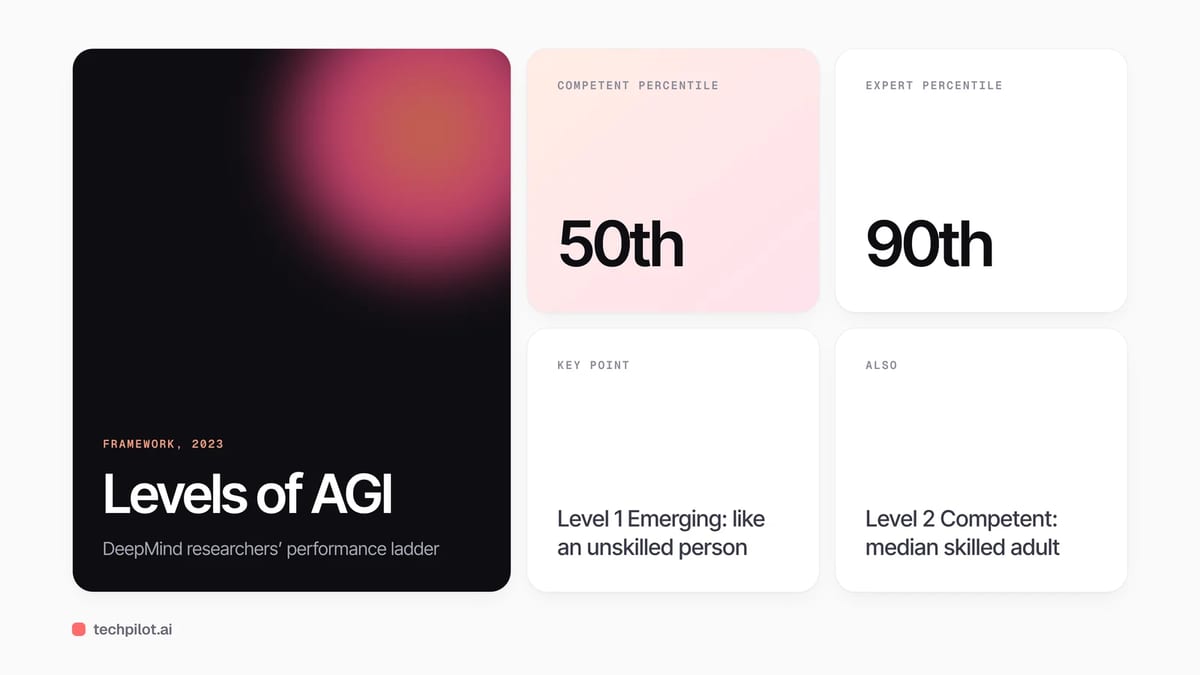
The DeepMind framework is the more practical one, because it replaces a yes/no question with a ladder. Its performance levels run from Emerging (equal to or somewhat better than an unskilled person) through Competent (at least the 50th percentile of skilled adults), Expert (90th percentile), Exceptional (99th percentile, renamed from “Virtuoso” in the latest version) and Superhuman. The authors placed the chatbots of 2023 at “Emerging AGI”: general, but not yet competent across the board.
Narrow AI, general AI and “superintelligence”
- Narrow AI: built and evaluated for a defined task, such as image recognition, translation, recommendation or a voice model. It can be far better than humans at that task. Most AI in production is still this.
- General-purpose models: today’s large language and multimodal models. They handle many tasks from one model, which is why people argue about whether they are early AGI.
- AGI: broad competence at roughly skilled-human level, reliable enough to hand over most knowledge work.
- Superintelligence (ASI): a hypothetical system that outperforms all humans at almost everything. It is a separate idea from AGI and is mostly discussed in safety research.
Our take: judge the job, not the label
For anyone choosing tools, the AGI debate matters less than it sounds. A model that is “Expert” at one task and “Emerging” at another will still fail where it is weak, whatever the launch post calls it. Three questions cut through the noise:
- How wide is it, really? Test it on the three or four tasks you actually need, not on the vendor’s showcase.
- How deep is it? Compare the output to what a skilled colleague would produce, not to what an average person would.
- How much supervision does it need? Count how often you have to correct it on a long task. That number tells you more than any AGI claim.
Once you work this way, the “AGI vs AI” question becomes a sliding scale rather than a finish line. Each new model moves up on some tasks and stays flat on others. To see how this plays out in costs and limits, read our explainer on what tokens are in AI.
Will AGI replace AI tools?
No. Even if a lab announces AGI tomorrow, narrow systems will keep running most real products, because they are cheaper, faster and easier to test for one job. A general model is more likely to sit on top and call narrow tools, the way agents already call search, code and image models. The practical change to watch is not a single “AGI day” but how much of a workflow you can hand over without checking each step.
Frequently asked questions
What is the difference between AI and AGI?
AI is the whole field and every system that performs tasks linked to intelligence. AGI is one system that can do most intellectual work at least as well as a skilled human.
Does AGI exist yet?
There is no agreed test and no independent body that certifies AGI. Labs use different definitions, so claims that AGI has arrived depend on whose definition you use.
Is ChatGPT AGI?
Not by most definitions. DeepMind researchers rated 2023 chatbots as Emerging AGI: broad, but not yet reliably competent across tasks at a skilled-human level.
How does OpenAI define AGI?
OpenAI’s charter defines AGI as highly autonomous systems that outperform humans at most economically valuable work.
What comes after AGI?
Artificial superintelligence (ASI) is the hypothetical next step: a system that outperforms all humans at almost every task. It is mostly discussed in AI safety research.
Found this useful? Share it with someone comparing AI tools.
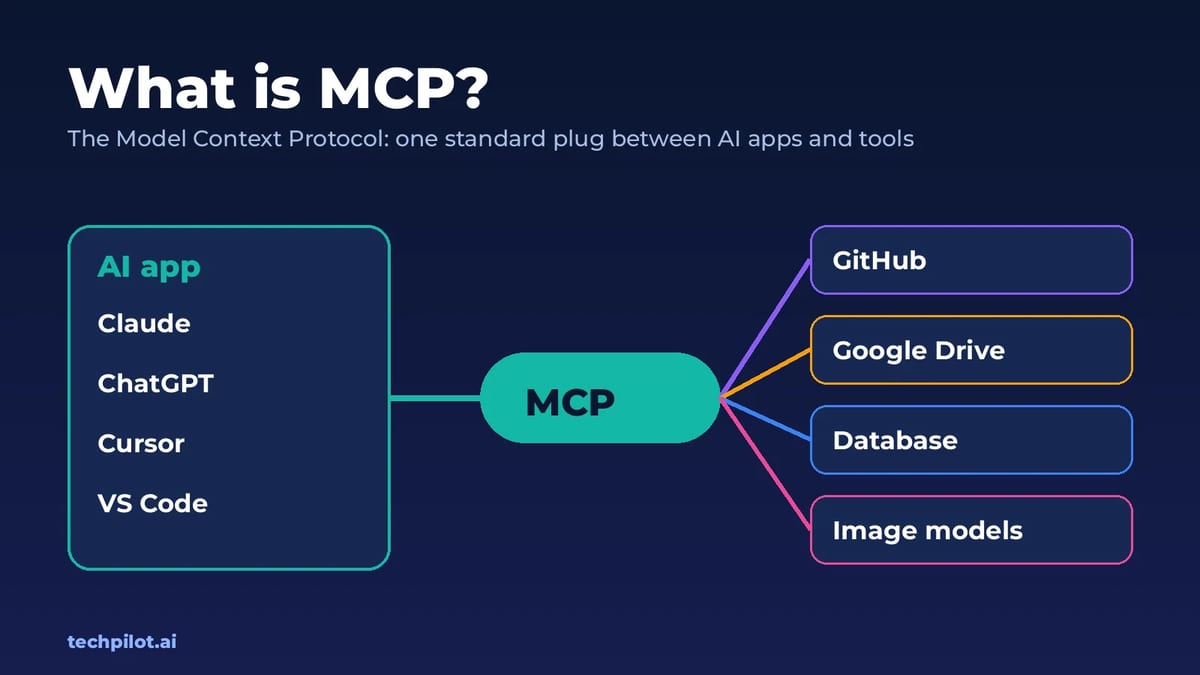
What Is MCP? Model Context Protocol Explained
What is MCP? The Model Context Protocol is an open standard that lets AI apps like Claude and ChatGPT use outside tools and data. Here’s how it works.
 Eimantas Kazėnas · 7 min read

AI for Real Estate agents: How to use AI to get better leads and close more deals?
AI for real estate agents can be a huge time and cost saver by tackling repetitive tasks, back office or replacing expensive services such as SEO,…
 Mihai (Mike) Bizz · 13 min read