Home / Guides / Web development & Coding
AI and Strategic IT Outsourcing: Trends & Benefits
AI and Strategic IT Outsourcing: 2026 trends and benefits, from automation and specialist talent to faster delivery, AIOps, cybersecurity, and governance.
 Mihai (Mike) Bizz Business, entrepreneurship, tech & AI
- Published
- 7 min read
On this page Key Benefits of AI in Strategic IT Outsourcing
Independent and reader-supported. Some links may earn us a commission; it never changes our rankings. Editorial policy
For many years, the main goal of IT outsourcing was cost reduction: transferring operations to more affordable locations without losing productivity. But now things have changed thanks to artificial intelligence. Vendors offer not only lower prices but also model development, automation, and experienced machine learning engineers.
This is how AI strategic IT outsourcing works. It is about choosing a vendor according to their skills in building and automating processes, not price. In this guide, you will find information on the advantages, emerging services, and trends in vendor choice in 2026.
Key Benefits of AI in Strategic IT Outsourcing
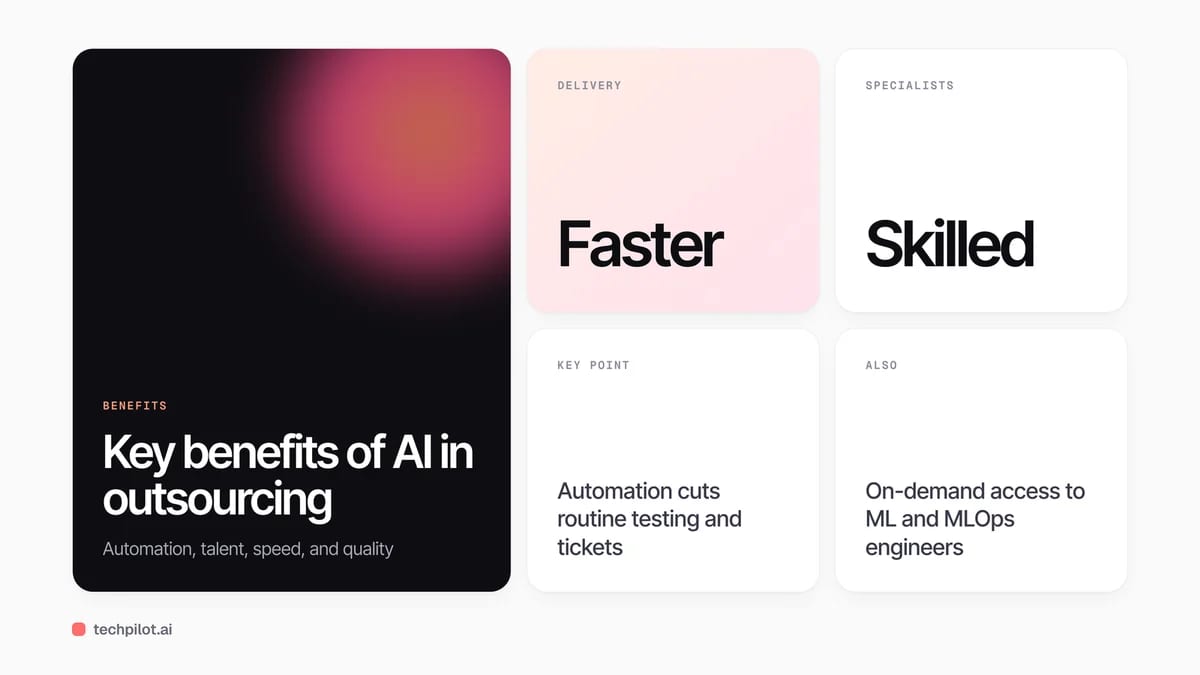
The advantages of outsourcing through AI technology tend to build up over time because savings in one area can be allocated to work on other projects. For this reason, an IT outsourcing strategy based on AI technology tends to offer more advantages over several quarters.
- The AI software enables automation of activities like testing, coding, and ticket management. As a result, fewer hours are required to finish the project. Along with reduced nearshore costs, this can lead to substantial savings in terms of time and money for your clients. Make sure your partner is offering you AI-driven cost savings.
- Faster Software Development and Delivery. Code generators can carry out simple tasks like generating boilerplate code, refactoring, and documentation. This gives the developer enough time to focus on the structure and logic of the product.
- Access to Skilled AI and IT Specialists: Machine learning, data, and MLOps engineers are rare and costly in the US and Western Europe. With outsourcing, access to larger pools of talent becomes available; companies hiring developers in Ukraine, Poland, and Romania will provide engineers with solid mathematical and computer science backgrounds and AI knowledge at a lower cost compared to the West.
- Improved Productivity and Automation: AI-assisted process optimization cuts manual activities such as generating unit tests and synthetic test data, and writing API and code documentation. It also reduces manual activities such as sorting support tickets and detecting log abnormalities to prevent incidents.
- More Effective Decision Making Through Data Analytics. AI-driven decision-making gives our customers additional visibility. Instead of making decisions based on impressions from status meetings, we can use metrics extracted from project data, such as velocity, defect rate, and delivery delay risk.
- The outsourced engineering team can easily scale up from three engineers to fifteen for the project and then scale down later. Today’s technologies enable faster onboarding by giving an opportunity to look through the code and documentation independently without having to ask a more experienced teammate.
- Better Software Quality and Testing: Automated tests improve coverage, and fuzzing and visual regression help find mistakes humans might make. Review assistants detect security threats and coding-style inconsistencies before code is merged.
How AI Is Transforming IT Outsourcing Services
AI-driven IT outsourcing reshapes the service catalog itself, not only the way work gets done, reflecting the latest AI outsourcing trends.
AI-Powered Software Development
The development of AI has greatly changed both the methods through which outsourced development teams develop software and the products they create. Code-assistive technology can help developers write code, explain new functions, generate test code, and highlight any possible bugs.
AI functions such as chatbots, recommendation engines, document processing, and predictive applications are being used more widely by many vendors. This enables consumers to accelerate development and use AI capabilities without creating an entire AI division within their firms.
AI in IT Infrastructure and Cloud Management
AI can automate infrastructure and cloud operations for outsourcing providers, including predictive autoscaling to handle changes in demand.
AI-powered workflow optimization can also help reduce infrastructure costs. These tools can identify configuration drift, flag unusual resource usage, and help resolve performance issues before they affect users.
AI in IT Support and Managed Services
Virtual assistants based on artificial intelligence become more efficient in dealing with routine work in a helpdesk setting. Routine activities include operations such as password recovery, handling access requests, and troubleshooting.
Virtual assistants can either solve problems directly or gather necessary information. They can then forward tickets to a human engineer to handle complicated cases.
This way, support personnel can focus on resolving complicated problems and shorten their resolution times. For companies that outsource their operations, AI will allow them to handle a higher volume of tickets without hiring additional personnel, supporting more efficient AI-powered business operations.
AI in Data Management and Analytics
AI is helping optimize different phases of data management activities that are outsourced by leveraging AI at each phase, from data preparation to analysis. This does not mean that these activities will be carried out only through rule-based systems.
But AI may help with tasks such as record classification, finding duplicates, spotting anomalies, and enriching datasets by drawing information from different sources. Natural language queries and automated reporting may also become easier.
AI in Cybersecurity
Artificial intelligence is helping security professionals detect and respond to potential threats faster. Behavior analytics can help find any anomalies associated with logging into a system and other signs of a threat that could be overlooked by any static rule.
Automated response playbooks can quarantine affected systems and report severe incidents to the security experts. For a mid-sized firm without an internal security operations center, AI-driven outsourced security monitoring can provide continuous threat detection and response. This approach can deliver these capabilities without requiring costly infrastructure.
Top AI and IT Outsourcing Trends in 2026
In 2026, artificial intelligence is reshaping how companies approach IT outsourcing, from software development and infrastructure management to cybersecurity and data processing. Businesses increasingly expect outsourcing partners to bring AI expertise, automation capabilities, and specialized talent that can improve delivery speed while controlling costs.
These changes are also creating new requirements for technical skills, team collaboration, and responsible AI adoption.
Generative AI, AI-Augmented Development and Autonomous Workflows
Generative AI has moved from pilots into everyday delivery: requirements, code, tests and documentation. Buyers now ask vendors how they use it, not whether.
The typical outsourced team now pairs engineers with coding copilots, which raises the bar for coordination. Distributed teams need clear review rules and deliberate efforts to improve team communication skills at work, so every machine-generated change is understood by the people who will maintain it.
Agents that plan and execute multi-step tasks, such as triaging a bug, proposing a fix and running the tests, are entering production pipelines, with humans approving the output.
AIOps, Cloud Infrastructure and MLOps
AIOps platforms correlate alerts, pinpoint root causes and suggest remediation, cutting the noise that wears down on-call engineers.
Training and serving models requires GPU capacity, model registries and drift monitoring. Partners offering MLOps as a service help clients move models from notebook to production.
Increased Demand for AI and Machine Learning Engineers
Demand for ML, LLM and MLOps specialists outpaces local supply, pushing companies toward artificial intelligence outsourcing in Central and Eastern Europe, Latin America and Asia.
AI-Driven Cybersecurity Services
Managed detection and response providers rely on machine learning to triage alerts, so human analysts concentrate on confirmed threats.
Industry-Specific AI Outsourcing Solutions
Healthcare, fintech, and logistics buyers want partners who understand their regulations and data. Vertical expertise is becoming as important a selection criterion as the tech stack in AI strategic IT outsourcing.
Greater Focus on Responsible AI and Governance
New regulations, such as the EU AI Act, require organizations to ensure that suppliers provide details about their data sources, testing processes, and human oversight. Before signing the contract, verify the following:
- The processing locations for your data and code.
- The use of proprietary code in training third-party models.
- The AI-generated code validation process.
- Ownership of IP rights in models and model outputs.
Conclusion: Making AI and IT Outsourcing a Strategic Advantage
The practice of outsourcing artificial intelligence technology has moved on from being a specialty service to a general offering. As part of choosing your partner, evaluate their AI abilities as an important factor. Find out what AI they use in their services, which experts they can assign to you, and how they handle your data.
This way, you can enable AI-based processes and AI-driven digital transformation without building every aspect yourself. The real value of AI strategy in IT outsourcing is the fact that your partner becomes part of your product development team, not just a cheaper labor resource. Start small and scale up based on results.
FAQ About AI and Strategic IT Outsourcing
How is AI changing the IT outsourcing industry?
Today, vendors compete on AI capabilities rather than hourly rates. Routine activities are automated; engineers may work on architecture, integration, and development of products.
What are the main benefits of combining AI with IT outsourcing?
Key advantages include cost reduction, time savings, access to specialized talent, high-quality software development, and team scaling as needed.
What IT services can businesses outsource for AI development?
Companies can outsource activities like model development and fine-tuning, data engineering and labeling, MLOps, implementing AI features in existing products, and AI-based QA and security monitoring.
Is it cheaper to outsource AI development or build an in-house team?
Outsourcing is typically cheaper for businesses since it cuts down on expenses related to recruitment, salary, and even infrastructure. But if AI is an integral part of your business and the protection of intellectual property rights is an important issue, you may have to build an internal team.
Found this useful? Share it with someone comparing AI tools.

Beyond the Help Desk: Restructuring IT Operations for Strategic Value
Learn how to improve IT operations, reduce service desk backlogs, offload routine work, and turn your IT team into a strategic business unit.
 John Daniel · 5 min read
The future of IT asset management and the trends to watch in 2025
Discover key IT asset management trends for 2025, including AI automation, cloud ITAM, cybersecurity, sustainability, and unified platforms for…
 Alexi Carmichael · 4 min read