Home / Guides / Productivity
Generative AI vs AI: What’s the Difference?
 Eimantas Kazėnas Marketing & Tech
- Published
- 4 min read
On this page The simplest way to tell them apart
Independent and reader-supported. Some links may earn us a commission; it never changes our rankings. Editorial policy
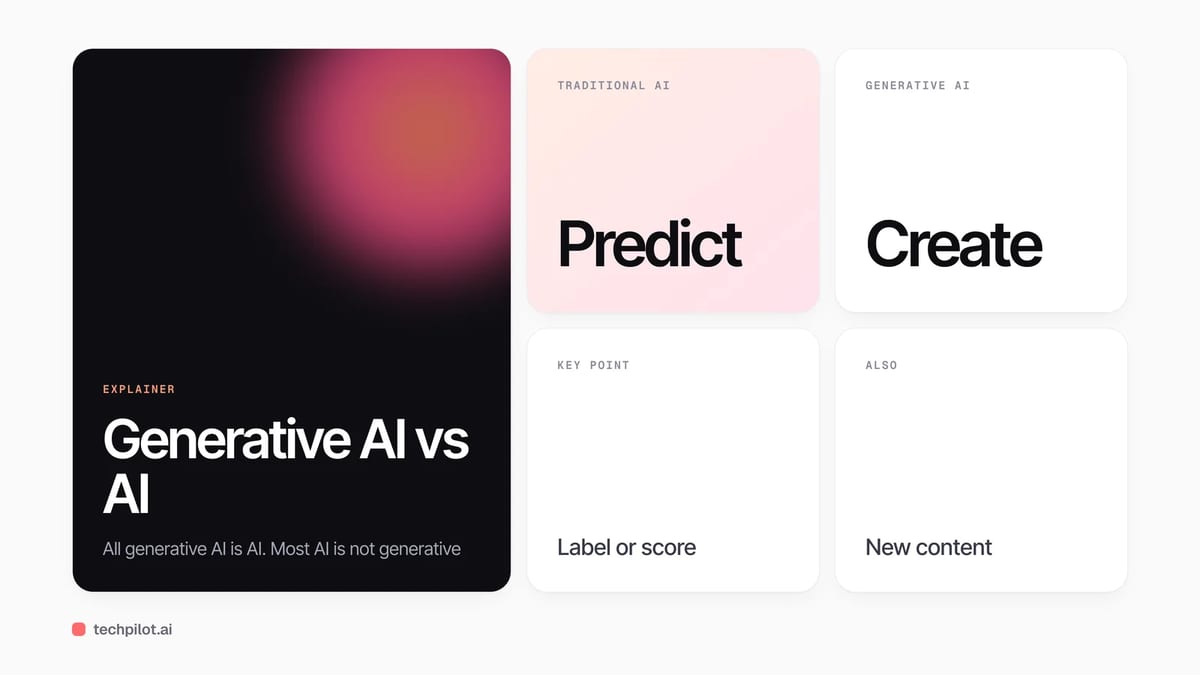
Generative AI vs AI: all generative AI is AI, but most AI never creates anything. It sorts, predicts and flags. Here is how to tell the two types apart.
Quick answer: AI is the whole field of software that does tasks we used to need human judgment for, like spotting fraud, ranking search results or recognizing faces. Generative AI is one branch of it that makes new content, such as text, images, audio, video or code, in answer to a prompt. So the honest comparison is not AI against generative AI. It is generative AI against the older kinds of AI that classify, predict and recommend, and that still run most of the software you use every day.
The simplest way to tell them apart
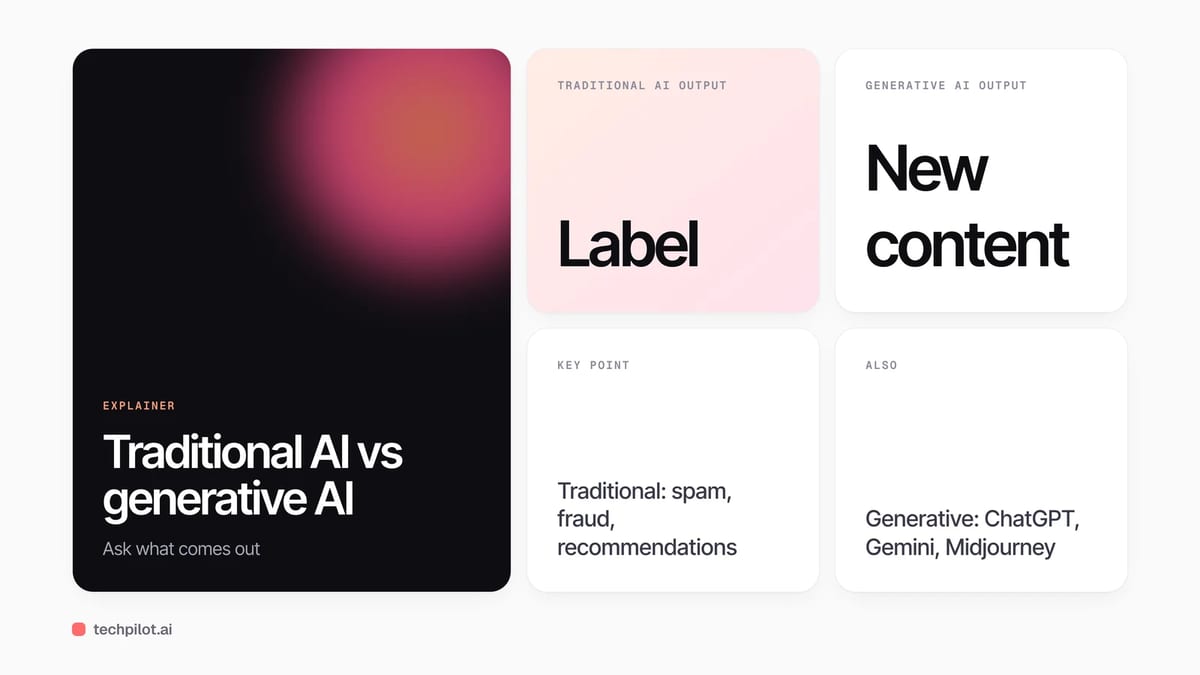
Ask one question: what comes out? If the output is a label, a score, a ranking or a yes or no, you are looking at traditional AI. If the output is something new that did not exist before, like a paragraph, a picture or a song, it is generative AI.
| Traditional AI | Generative AI | |
|---|---|---|
| Main job | Classify, predict, recommend, detect | Create text, images, audio, video, code |
| Typical output | A label, number or ranking | New content |
| Everyday examples | Spam filters, card fraud alerts, streaming recommendations, map arrival times | ChatGPT, Gemini, Claude, Midjourney, Sora |
| How you use it | Mostly invisible, inside other software | You type or speak a prompt |
| Right answer? | Usually one correct answer you can measure | Many acceptable answers, judged by quality |
| Main risk | Biased or wrong decisions at scale | Confident mistakes, made-up facts, copyright questions |
Where the line gets blurry
Most products you use in 2026 mix both. A modern search engine ranks pages with classic ranking models, then writes an AI summary on top with a generative model. A bank app flags an odd payment with a fraud model, then a chatbot explains it to you in plain words. Email apps filter spam the old way and draft replies the new way.
Generative models also do classic AI jobs now. You can ask a chatbot to sort support tickets or rate customer reviews. That works, but it is often slower and more expensive than a small model trained only for that task, and its answers can vary from run to run.
There is also a third label you will see more often: agentic AI. Agents use generative models to plan and take actions, like booking, filing or coding, instead of only answering. We cover that in our guide to agentic AI vs generative AI.
Which one should you use?
Our rule of thumb is to start from the kind of answer you need, not from the hype:
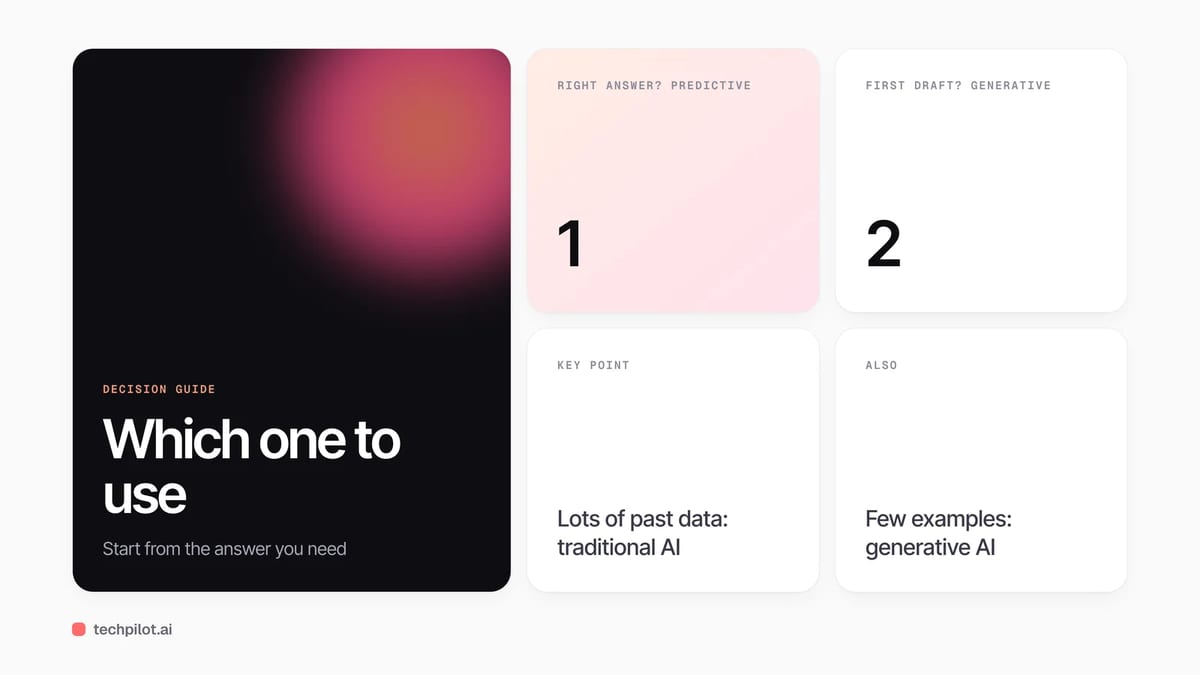
- There is one right answer and lots of past data: use traditional AI. Fraud checks, demand forecasts, churn scores and quality inspection are cheaper, faster and easier to audit this way.
- You need a first draft of something new: use generative AI. Emails, summaries, product copy, images, code and translations are where it saves the most time.
- The output feeds a decision that affects people: use a predictive model you can measure, and let generative AI explain the result, not make the call.
- You only have a few examples: generative AI wins, because a large model can follow instructions without being trained on your data first.
One test helps more than any definition. If you cannot check whether the output is right, a generative model’s confident tone can hide mistakes. Keep a human review step for anything factual, legal or medical, whichever kind of AI produced it.
What this means for you
When a product says it is “powered by AI”, it might be a decades-old recommendation model or a chatbot built on the latest large language model. Asking what the output is, and whether there is a right answer, tells you what to expect: steady and measurable, or flexible and creative but in need of checking.
For more on how these labels fit together, read our explainers on generative AI vs predictive AI and AGI vs AI.
Frequently asked questions
Is generative AI the same as AI?
No. Generative AI is one type of AI. AI is the whole field, and generative AI is the branch that creates new text, images, audio, video or code from a prompt.
What is the main difference between AI and generative AI?
Traditional AI classifies, predicts or recommends, so its output is a label, score or ranking. Generative AI produces new content that did not exist before.
Is ChatGPT generative AI?
Yes. ChatGPT is built on large language models that generate new text, and it can also create images and code, which makes it generative AI.
What are examples of AI that is not generative?
Spam filters, card fraud alerts, streaming recommendations, map arrival times and face unlock all use AI that sorts or predicts rather than creating content.
Which is better, traditional AI or generative AI?
Neither is better overall. Traditional AI suits tasks with one measurable right answer, while generative AI suits drafting new content. Many products now use both.
Found this useful? Share it with someone comparing AI tools.

Building a Website With No-Coding Knowledge and Generative AI
Building a website with no-coding skills is becoming easier day by day due to fast development in AI capabilities.
 Alexi Carmichael · 4 min read

How Generative AI could redefine the future of video games?
Can generative AI truly redefine the future of video games? It certainly does! Here are the most impactful changes in the industry.
Alexi Carmichael · 7 min read