10 GitHub Repos to Build an AI Business
 Eimantas Kazėnas Marketing & Tech
- Published
- 10 min read
On this page The 10 GitHub repos at a glance
- The 10 GitHub repos at a glance
- 1. Saasfly: a Next.js starter for the product
- 2. R2R: a knowledge base your product can query
- 3. Scira: an open-source AI search engine
- 4. Lago: usage-based billing for AI products
- 5. Marketing Skills: marketing work inside Claude Code
- 6. Google Maps Scraper: local leads, used carefully
- 7. Frappe CRM: a self-hosted pipeline
- 8. Dittofeed: customer messaging you can self-host
- 9. Papermark: share decks and see who opened them
- 10. Counterscale: analytics you host on Cloudflare
- How these repos combine into one AI business
- Open source is not the same as free to run
- Frequently asked questions
Independent and reader-supported. Some links may earn us a commission; it never changes our rankings. Editorial policy
These 10 open-source GitHub repos can power an AI business: a Next.js starter, RAG, billing, CRM, outreach, analytics and marketing skills for Claude.
Quick answer: start with Saasfly if you need a Next.js product, add R2R for a document knowledge base and Lago when you charge for usage. Use Frappe CRM, Dittofeed and Papermark for sales, Counterscale for analytics, and Marketing Skills inside Claude Code to write the site and campaigns. We read every README and checked star counts on November 15, 2026. Open source covers the code, not hosting or model APIs.
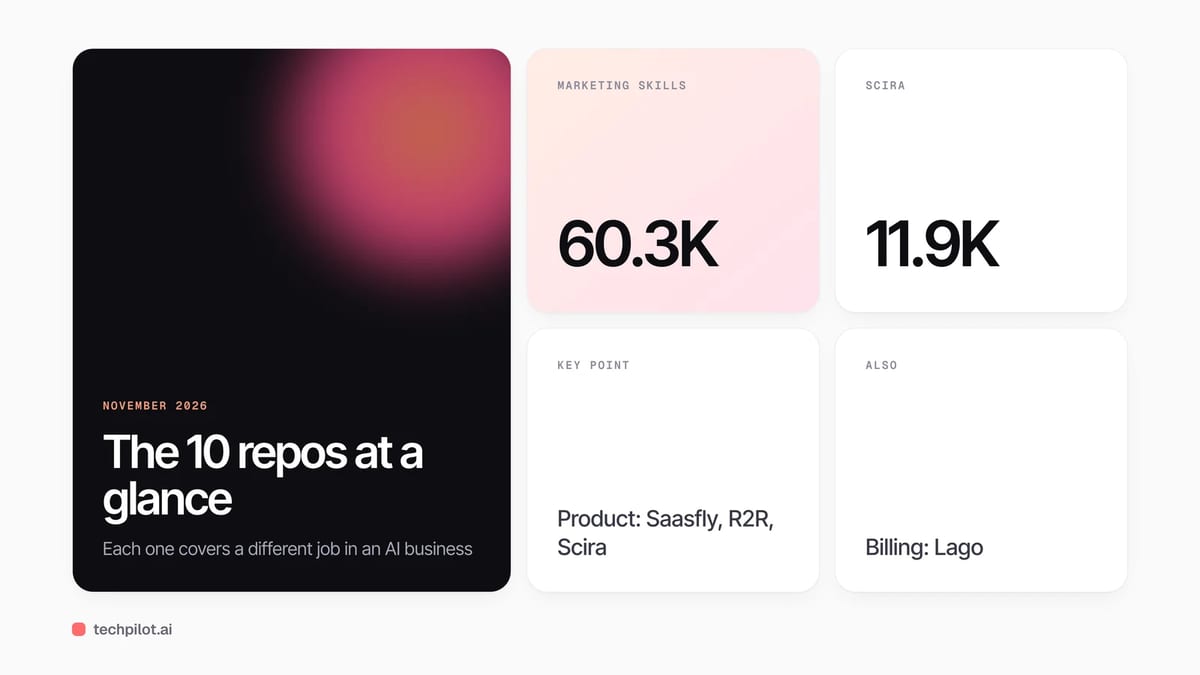
The 10 GitHub repos at a glance
| Repo | Stars | License | Best for |
|---|---|---|---|
| Saasfly | 2.9K | MIT | Next.js SaaS starter |
| R2R | 8.1K | MIT | Agentic RAG and document search |
| Scira | 11.9K | AGPL-3.0 | Self-hosted AI search with citations |
| Lago | 10.9K | AGPL-3.0 | Usage-based billing and metering |
| Marketing Skills | 60.3K | MIT | Marketing skills for Claude Code |
| Google Maps Scraper | 8.1K | MIT | Local business lead data |
| Frappe CRM | 4.0K | AGPL-3.0 | Self-hosted CRM for leads and deals |
| Dittofeed | 3.1K | MIT | Email, SMS and journey automation |
| Papermark | 9.4K | AGPL-3.0* | Document sharing with view tracking |
| Counterscale | 2.2K | MIT | Self-hosted analytics on Cloudflare |
Star counts are as of November 15, 2026. Papermark’s core is AGPL-3.0; its enterprise ee directories use a commercial license.
1. Saasfly: a Next.js starter for the product
Saasfly is an MIT-licensed Next.js boilerplate for a SaaS app. The README lists Clerk as the default auth provider (a NextAuth branch still exists), Stripe for payments, Resend for email, PostgreSQL, tRPC, Tailwind CSS, shadcn/ui, i18n and SEO metadata. You can scaffold a project with bun create saasfly and deploy to Vercel.
It is the fastest way on this list to get a login, billing hook and app shell. The trade-off is freshness: the repo’s last push was in August 2025, so read recent issues before you build a production app on it.
2. R2R: a knowledge base your product can query
R2R is an MIT-licensed retrieval system with a REST API. It is built for agentic RAG: ingest documents, run hybrid (semantic plus keyword) search, extract a knowledge graph, and answer with citations. The README also describes a Deep Research API that can pull from your knowledge base and the web. It accepts text, PDFs, JSON, images, audio and more, and ships Python and JavaScript SDKs. A light install is pip install r2r plus an OpenAI API key; a fuller Docker setup is documented for production.
This is the repo to add when customers need to ask questions over their files, not when you only need a chatbot wrapper. If you want the concept first, we explain what RAG is in plain English. Note that answers still depend on a paid model API, and the main repo has been quieter than some others on this list since late 2025.
3. Scira: an open-source AI search engine
Scira (AGPL-3.0) is a self-hostable AI search app in the Perplexity style: it plans a question, retrieves live sources and returns an answer with inline citations. The live product is at scira.ai, and the README lists 17 modes (web, academic, GitHub, YouTube, stocks and others) plus scheduled “Lookouts” that email you when a topic changes. You can bring your own models and deploy with Docker or Vercel.
Use it if search or research is the product, or as an internal research desk. Self-hosting is not a one-command demo. The documented setup asks for a long list of provider keys (models, Exa or similar search APIs, a database, Redis and others), which is the main cost and maintenance load. AGPL-3.0 also means that if you modify Scira and offer it as a network service, you need to share your source.
4. Lago: usage-based billing for AI products
Lago is AGPL-3.0 metering and billing infrastructure aimed at AI products. It meters tokens, compute, API calls or any other usage event, then turns that into prices, credits, entitlements, invoices and payments. You can run Lago Cloud or self-host; the repo includes a local demo that prices a few sample AI requests. There are official API, CLI and MCP interfaces, plus SDKs for Node, Python, Ruby and Go. Lago’s README quotes Mistral AI’s CTO as a customer.
If your product charges per token or per run, this is the billing layer to reach for instead of a pile of Stripe meters and spreadsheets. Self-hosting is a real ops job, and the AGPL-3.0 license applies to the platform (Lago’s agent SDKs and MCP server are MIT in separate repos).
5. Marketing Skills: marketing work inside Claude Code
Marketing Skills is the breakout repo here, with 60.3K stars and an MIT license. It is a collection of agent skills for conversion, copywriting, SEO, analytics, paid ads, lifecycle email, pricing and sales enablement. It works with Claude Code, OpenAI Codex, Cursor, Windsurf and any agent that supports the Agent Skills spec.
This is not a hosted marketing suite. You install the skills, then ask your coding agent to audit a page, draft a launch, or set up tracking. That is why it pairs so well with the rest of this stack: the other repos give you a product, and this one helps you explain and sell it. If you are new to Claude Code, start with our setup guide. For a wider look at free coding assistants, see the best free AI for coding.
6. Google Maps Scraper: local leads, used carefully
Google Maps Scraper is an MIT-licensed Go tool with a CLI, local web UI and REST API. It extracts business details from Google Maps: name, address, phone, website, rating, reviews, coordinates, emails and more (the README cites 33+ data points, at about 120 places a minute). Output can go to CSV, JSON, PostgreSQL or S3, and there is an agent skill so you can ask Claude Code or a similar tool to run a scrape in plain language.
Treat this as a research tool, not a license to spam. The project’s own legal notice says to use it in line with applicable laws, and that unauthorized scraping may violate terms of service. Check Google’s terms and the rules where you operate, collect only what you need, and only contact people through channels they have made public for business. A CRM and a written offer will do more for you than a huge, poorly targeted list.
7. Frappe CRM: a self-hosted pipeline
Frappe CRM is an AGPL-3.0 CRM built for sales teams, with no per-user fee in the software itself. The README focuses on a single lead or deal page (activities, comments, notes and tasks), a Kanban board and custom views with your own filters and columns. Built-in or documented integrations include Twilio and Exotel for calling, WhatsApp, and ERPNext if you later need invoicing and accounting. You can use Frappe Cloud or self-host with the official install script or Docker.
It is a strong fit once leads start arriving from your site, Papermark or a manual research workflow. It is a Frappe app, so you are adopting that framework and its hosting model, not a tiny Node service.
8. Dittofeed: customer messaging you can self-host
Dittofeed is an MIT-licensed customer engagement platform and a developer-friendly alternative to tools such as Customer.io, OneSignal or Segment Engage. You connect user data through Segment, reverse ETL or the Dittofeed API, build segments, design templates in HTML, MJML or a low-code editor, then send one-off broadcasts or automated journeys across email, SMS, mobile push, WhatsApp and Slack. It integrates with ESPs such as SendGrid and Amazon SES, and you can self-host with Docker or Render.
Use it for onboarding, usage alerts, trial-to-paid nudges and product news. You still pay your email or SMS provider, and you are responsible for consent and unsubscribe rules in your market.
9. Papermark: share decks and see who opened them
Papermark is an open-source DocSend alternative for sending documents as links, with view analytics and custom domains. The stack is Next.js, PostgreSQL, NextAuth, Stripe and Resend, with Tinybird used for analytics. Self-hosting needs Node, Postgres, blob storage (S3 or Vercel Blob) and a Resend account.
The license is mixed: content outside the enterprise directories is AGPL-3.0, while anything under ee or app/(ee) is under a commercial license. For most self-hosted sharing and tracking, the AGPL core is the relevant part. It is the right tool when you are sending a pitch, proposal or pricing PDF and want to know whether anyone opened it.
10. Counterscale: analytics you host on Cloudflare
Counterscale is MIT-licensed web analytics that you deploy on Cloudflare Workers and Workers Analytics Engine. The pitch is simple: easy to run, and cheap even at higher traffic. The README notes that Cloudflare’s free Workers tier could hypothetically cover about 100,000 hits a day. You add a small tracker script or an npm package, and you can password-protect the dashboard.
The main limit is retention: Analytics Engine keeps about 90 days of data. Long-term storage to an R2 bucket (Apache Arrow files) is on by default and can be turned off. Reads in local development hit production data, and writes no-op, which is worth knowing before you test. If you do not want to send traffic to a big analytics vendor, this is the lightest option on the list.
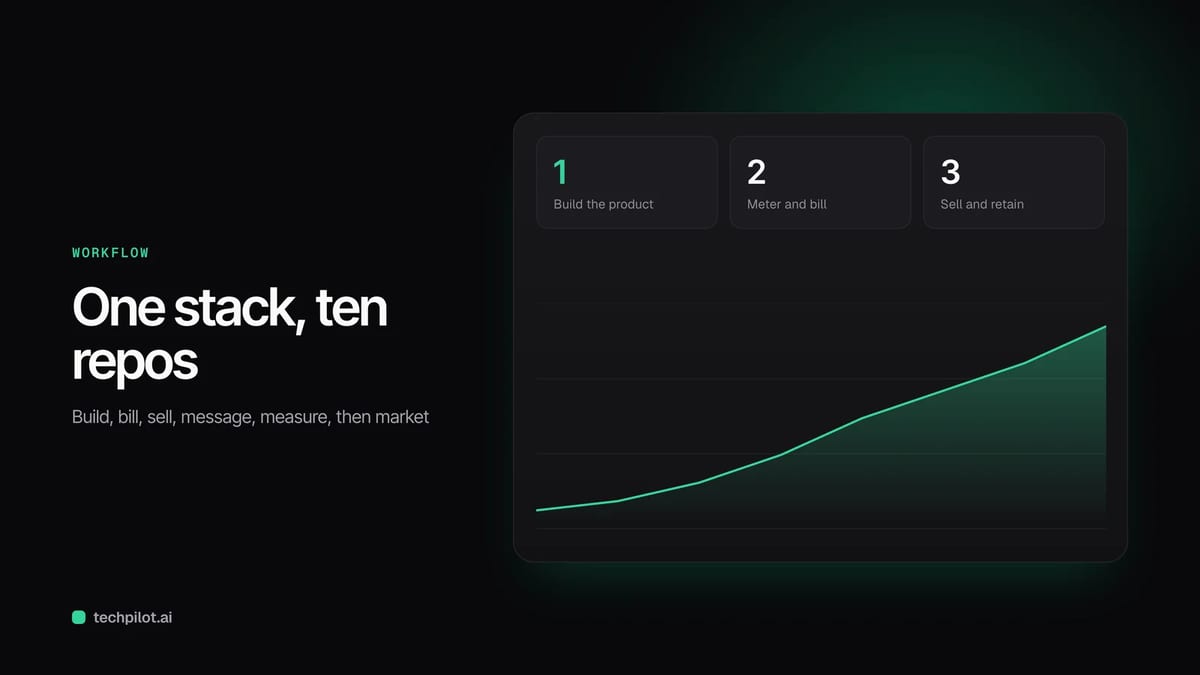
How these repos combine into one AI business
The point of this list is not to run all ten on day one. It is that they cover different jobs in one company:
- Build the product in Saasfly. Add R2R when users need to search or chat over documents. Add Scira only if AI search is the product, or you want a self-hosted research front end.
- Charge for usage with Lago once people are consuming tokens, minutes or API calls, instead of inventing your own metering.
- Find and close customers with careful lead research (the Maps scraper, if you stay inside the rules), Frappe CRM for the pipeline, and Papermark for decks and proposals.
- Keep them active with Dittofeed journeys, and measure the site with Counterscale.
- Write and ship the marketing with Marketing Skills in Claude Code: positioning, landing pages, SEO and emails that match what the product actually does.
That path is close to the “one person, many agents” model we described in our guide to AI agent business models: the repos are the infrastructure, and the agents help you operate it.
Open source is not the same as free to run
Every repo here is free to clone. Most of the bill is elsewhere. Saasfly, Papermark and Scira need hosting and a database. R2R and Scira need model and search API keys, which can outgrow your compute cost quickly. Dittofeed and Saasfly send email through a provider you pay for. Lago can be self-hosted or billed as Lago Cloud. Stripe takes a cut if you collect payments. Counterscale is the exception that is designed to stay near Cloudflare’s free tier, until you exceed it.
Licenses matter too. MIT (Saasfly, R2R, Marketing Skills, the Maps scraper, Dittofeed, Counterscale) is permissive. AGPL-3.0 (Scira, Lago, Frappe CRM, Papermark’s core) is copyleft for network use: if you modify the software and let others use it over a network, you generally have to share your changes. Read the license in each repo, including Papermark’s split commercial ee code, before you ship.
Frequently asked questions
Are these GitHub repos free to use?
The code is free to clone. MIT-licensed repos (Saasfly, R2R, Marketing Skills, Google Maps Scraper, Dittofeed and Counterscale) are permissive. AGPL-3.0 repos (Scira, Lago, Frappe CRM and Papermark’s core) generally require you to share source if you modify them and offer them as a network service. Papermark also has a commercial license for its enterprise ee code.
Do I still pay for hosting and APIs?
Yes. Open source covers the code, not the bill. Expect costs for hosting, a database, model APIs (especially for R2R and Scira), email sending and Stripe fees. Counterscale is designed to stay near Cloudflare’s free Workers tier, around 100,000 hits a day.
Which repo should I start with?
If you are building a web product, start with Saasfly, then add Lago when you charge for usage and R2R if customers need a knowledge base. If you already have a product, start with Marketing Skills and Frappe CRM.
Is it okay to scrape Google Maps for leads?
The project’s README says to use it responsibly, and that unauthorized scraping may violate terms of service. Check Google’s terms and the laws where you operate, collect only what you need, and don’t treat a scraper as a license to spam.
Found this useful? Share it with someone comparing AI tools.

6 Smart Ways to Grow Your Business Sustainably
Grow your business sustainably in 2026 with AI-driven data, automated systems, and GEO strategies while building multiple revenue streams.
 Alexi Carmichael · 3 min read

5 Best AI Video Generators for Business in 2026
Compare the 5 best AI video generators for business in 2026. Freepik, Higgsfield, Canva, Adobe Firefly, and LTX Studio—pricing, features, and which…
 John Daniel · 9 min read