Home / Guides / AI Data analytics
What Is MLOps? Lifecycle and Tools Explained
 Eimantas Kazėnas Marketing & Tech
- Published
- 4 min read
On this page MLOps in plain terms
Independent and reader-supported. Some links may earn us a commission; it never changes our rankings. Editorial policy
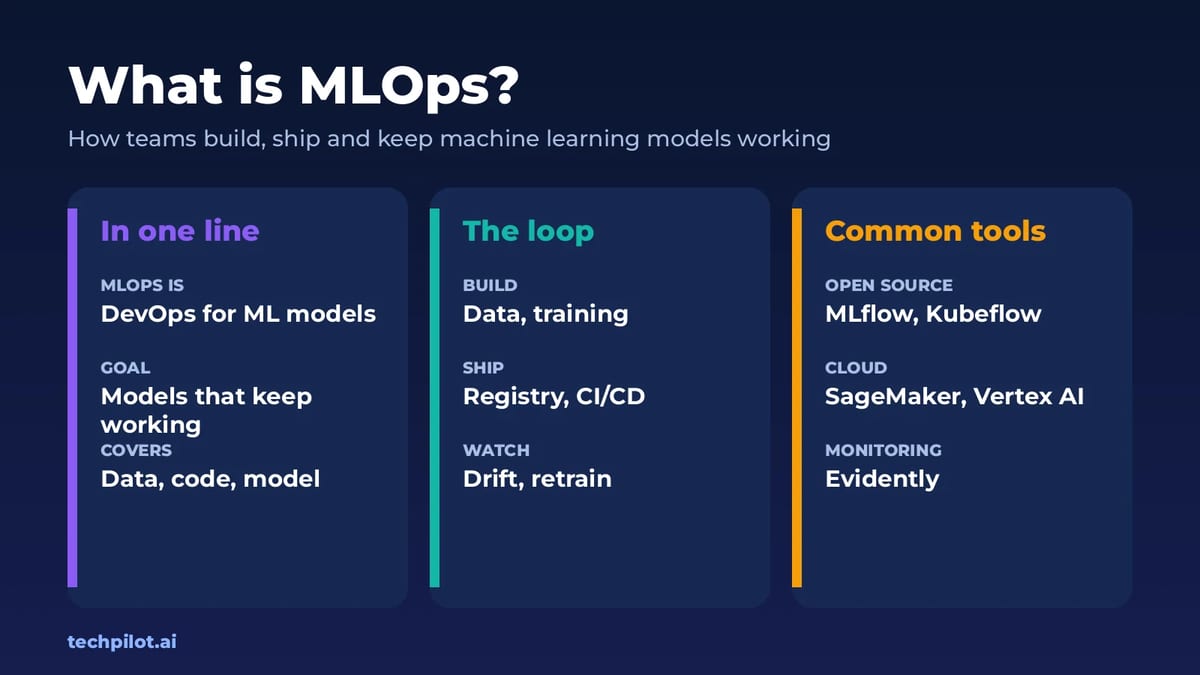
What is MLOps? It’s the practices and tools that take machine learning models from a notebook to production and keep them accurate once real data arrives.
Quick answer: MLOps, short for machine learning operations, is DevOps adapted for machine learning. It covers how teams version data, train and track models, deploy them, watch how they behave on live data, and retrain them when they drift. The goal is simple: a model that worked in testing should keep working months later, and anyone on the team should be able to rebuild it.
MLOps in plain terms
Ordinary software does what its code says. A machine learning model does what its training data taught it, and the world keeps changing after training ends. Customer habits shift, prices move, new products appear. A fraud model trained last year slowly gets worse even if nobody touches a line of code. That decay is called drift, and it’s the main reason MLOps exists.
So MLOps has to manage three things that change, not one: the code, the data and the model itself. DevOps already handles the code with version control, automated tests and deploy pipelines. MLOps adds data versioning, experiment tracking, a model registry and monitoring that compares live data with training data.
The MLOps lifecycle
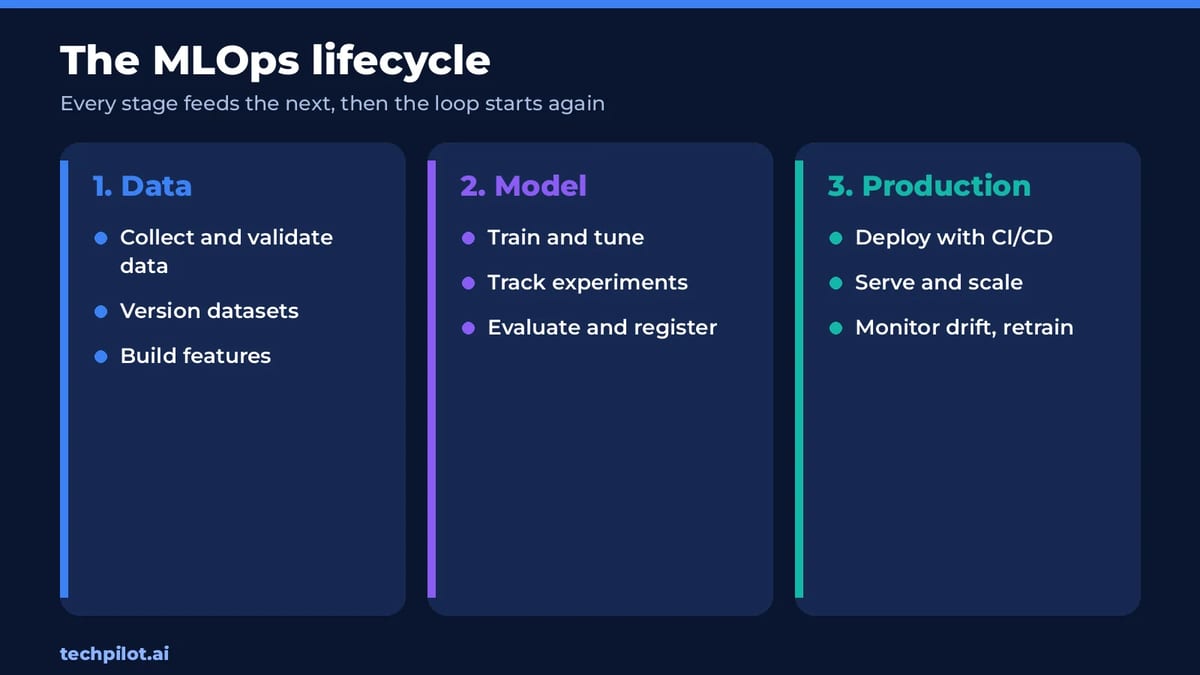
- Data: collect, clean and validate data, then version it so you can tell exactly which data trained which model.
- Training and experiments: try models and settings, and log every run’s parameters, metrics and output files.
- Evaluation and registry: compare candidates against a baseline, then store the approved version in a model registry with its metadata.
- Deployment: package the model and ship it as an API, a batch job or an on-device model, ideally through an automated pipeline.
- Monitoring: track latency and errors like any service, plus model-specific signals such as data drift and accuracy against real outcomes.
- Retraining: when monitoring shows a drop, retrain on fresh data and send the new model through the same checks.
The last step loops back to the first, which is why MLOps diagrams are always circles.
MLOps maturity: levels 0, 1 and 2
Google Cloud’s widely cited MLOps architecture guide describes three levels, and it’s a useful way to see where a team stands:
- Level 0, manual process: data scientists train models in notebooks and hand a file to engineers, who deploy it. Retraining is rare and manual. Google notes this is common in businesses just starting with ML.
- Level 1, ML pipeline automation: training runs as an automated pipeline, so the model can be retrained on new data continuously.
- Level 2, CI/CD pipeline automation: the pipeline itself is tested and deployed automatically, so teams can ship new model ideas quickly and safely.
Our view: most teams don’t need level 2 on day one. Getting from level 0 to level 1, with versioned data, tracked experiments and one automated retraining job, fixes most of the pain.
Common MLOps tools
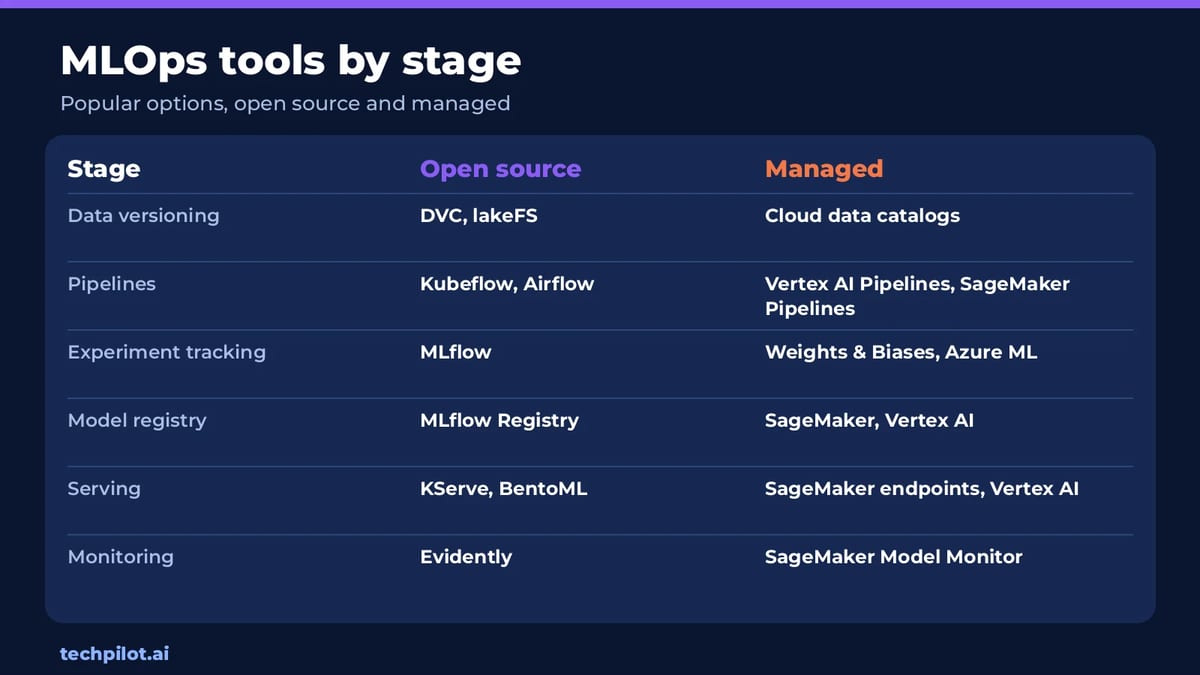
You don’t need all of these. A typical small setup is Git plus DVC for versioning, MLflow for tracking and the registry, a simple container deploy and a drift report. Cloud teams often use a managed platform instead, such as Amazon SageMaker, Google Vertex AI or Azure Machine Learning, which bundle most stages in one product.
MLOps vs DevOps vs LLMOps
- DevOps automates building, testing and shipping software. The code is the product.
- MLOps adds data and models to that loop, plus monitoring for drift and accuracy.
- LLMOps applies the same ideas to large language model apps. You usually don’t train the model yourself, so the work shifts to prompts, evaluation sets, retrieval data, cost per call and safety checks. If you’re building on LLMs, our guides to RAG and tokens in AI cover the basics, and deploying AI agents shows how ops thinking carries over to agents.
How to start with MLOps
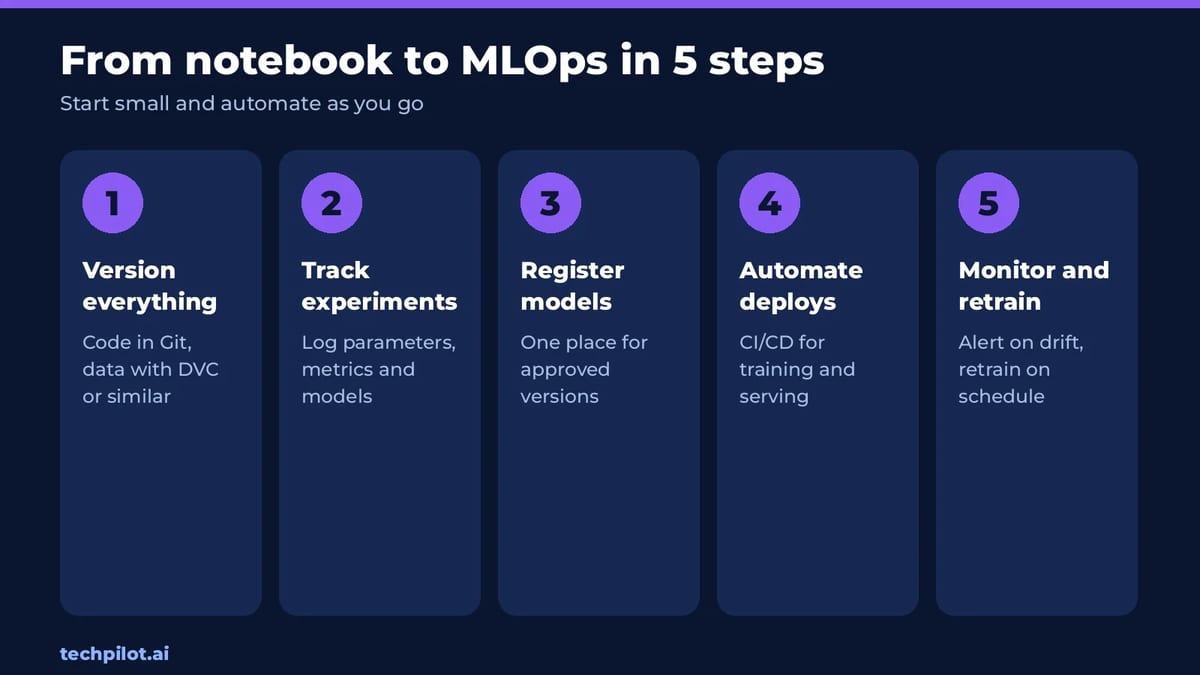
Start with the problem that hurts most. If nobody can reproduce last quarter’s model, begin with versioning and tracking. If models silently get worse, begin with monitoring. And if you’re still sorting out the basics, our explainer on AI vs machine learning is a good first read. MLOps skills also come up in hiring, so our machine learning interview guide is worth a look if you’re job hunting.
Frequently asked questions
What is MLOps in simple terms?
MLOps is DevOps for machine learning. It’s the practices and tools that version data, track experiments, deploy models and monitor them so they keep working on real data.
What is the difference between MLOps and DevOps?
DevOps manages code. MLOps manages code, data and models, and adds steps DevOps doesn’t need, such as experiment tracking, a model registry and monitoring for data drift.
What are the stages of MLOps?
Data preparation, training and experiment tracking, evaluation and model registry, deployment, monitoring and retraining. The last stage loops back to the first.
What tools are used in MLOps?
Popular open-source tools include MLflow, Kubeflow, DVC, Airflow, KServe and Evidently. Managed platforms include Amazon SageMaker, Google Vertex AI and Azure Machine Learning.
Is MLOps the same as LLMOps?
No. LLMOps is a branch of MLOps for large language model apps. It focuses on prompts, evaluations, retrieval data, cost per call and safety rather than training models.
Found this useful? Share it with someone comparing AI tools.