Home / Guides / Web development & Coding
Alternatives to Next.js: 5 Best for 2026
 Eimantas Kazėnas Marketing & Tech
- Published
- 4 min read
On this page Why look past Next.js?
- Why look past Next.js?
- Next.js alternatives at a glance
- 1. Astro: best for content sites
- 2. React Router: best way to stay in React
- 3. TanStack Start: best for type-safe React
- 4. SvelteKit: best if you can switch UI libraries
- 5. Nuxt: best for Vue teams
- Our take: do you need a framework at all?
- Frequently asked questions
Independent and reader-supported. Some links may earn us a commission; it never changes our rankings. Editorial policy
Alternatives to Next.js in 2026: React Router, Astro, SvelteKit, Nuxt and TanStack Start, matched to what you build and to how much framework you need.
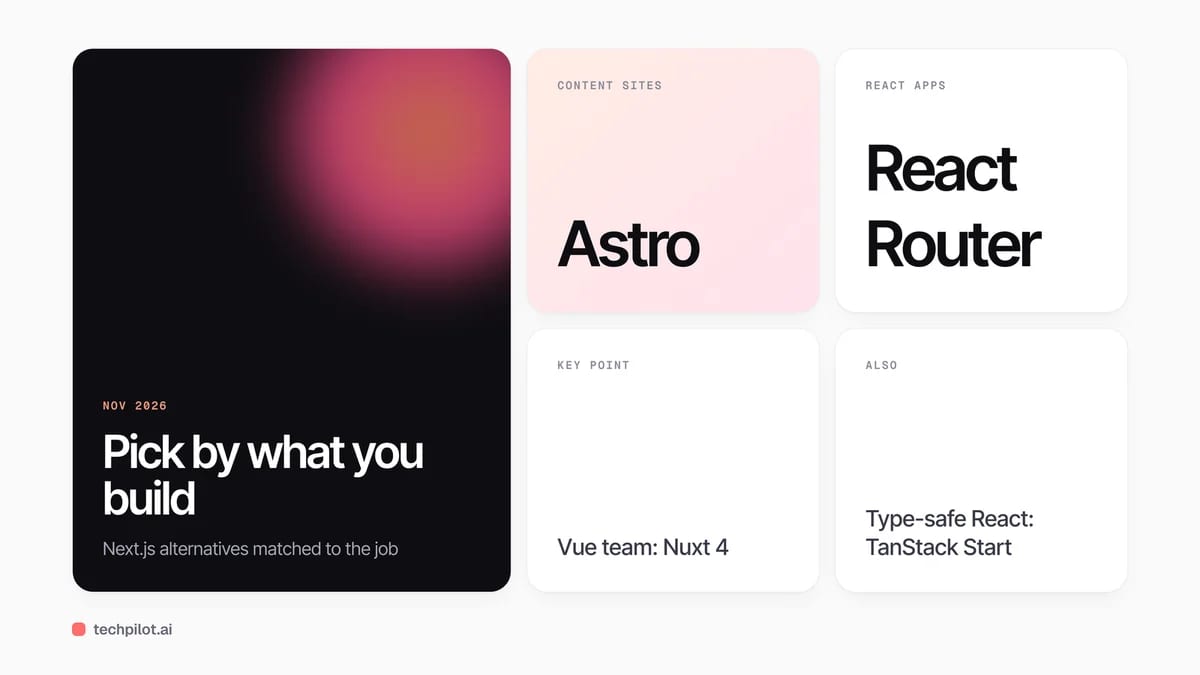
Quick answer: for a content or marketing site, use Astro. To stay in React with fewer conventions, use React Router in framework mode. For type-safe React with server functions, try TanStack Start. If your team is open to a different UI library, SvelteKit and Nuxt are the most mature full-stack options. Versions below are from each project’s GitHub releases on November 12, 2026.
Why look past Next.js?
Next.js is still the default React framework, with more than 143,000 GitHub stars and version 16.4.6 released on November 9, 2026. Developers who leave it usually give the same reasons: the App Router and React Server Components add a lot to learn for simple apps, caching behaviour changes between major versions, and many features feel designed around Vercel hosting. None of that makes Next.js a bad choice. It means the right alternative depends on which of those problems you are trying to escape.
Next.js alternatives at a glance
| Framework | UI library | Latest release (Nov 2026) | Best for |
|---|---|---|---|
| Astro | Any (React, Vue, Svelte) or none | 7.4.11 | Blogs, docs, marketing and content sites |
| React Router (framework mode) | React | 8.5.1 | React apps without the App Router |
| TanStack Start | React or Solid | 1.169.5 (React Start) | Type-safe full-stack React |
| SvelteKit | Svelte | 3.2.0 | Fast apps with less client JavaScript |
| Nuxt | Vue | 4.6.4 | Vue teams |
1. Astro: best for content sites
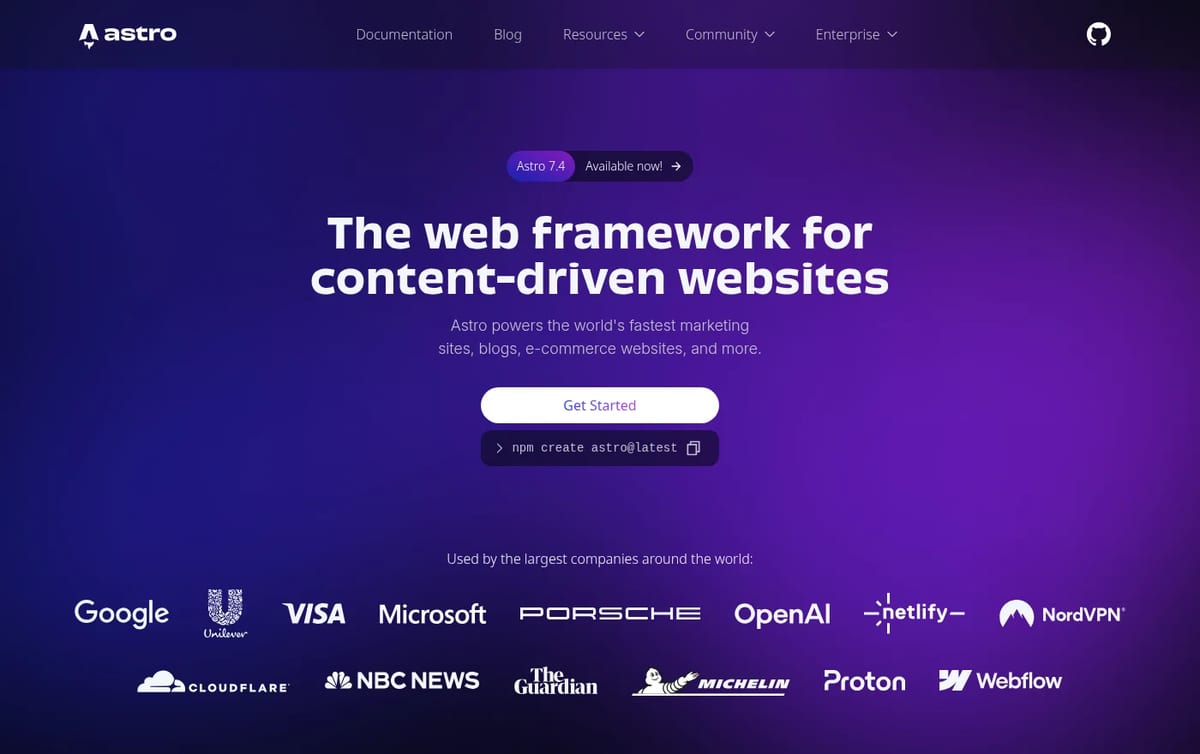
Astro is built for content-driven websites and ships zero JavaScript by default. Pages render to HTML, and you add interactive “islands” only where you need them, using React, Vue, Svelte or plain HTML. For a blog, documentation or a marketing site, that usually means faster pages and simpler code than a Next.js app. It is the weakest fit for dashboard-style apps where almost every screen is interactive.
2. React Router: best way to stay in React
React Router, from the team behind Remix, now works as a full framework with loaders, actions and server rendering. Version 8, released in June 2026, sets a modern baseline of Node 22+, Vite 7+ and React 19+, and the project says upgrading from v7 is non-breaking. If your problem with Next.js is the App Router and Server Components rather than React itself, this is the smallest move: your components and most of your skills carry over, and it deploys to any Node or edge host.
3. TanStack Start: best for type-safe React
TanStack Start describes itself as a full-stack framework for React and Solid with type-safe routing, server-side rendering, streaming and server functions. It comes from the same team as TanStack Query and TanStack Router, so it suits teams that already lean on those libraries and want end-to-end TypeScript checking of routes and data.
4. SvelteKit: best if you can switch UI libraries
SvelteKit is the official full-stack framework for Svelte, now at version 3.2.0. Svelte compiles components ahead of time, so apps tend to ship less JavaScript than the React equivalent, and many developers find the syntax shorter. The cost is rewriting React components and a smaller ecosystem of ready-made UI kits.
5. Nuxt: best for Vue teams
Nuxt is to Vue what Next.js is to React: file-based routing, server rendering, static generation and server routes, with version 4.6.4 released on November 2, 2026 and more than 61,000 GitHub stars. If your team writes Vue, it is the obvious pick.
Our take: do you need a framework at all?
A lot of Next.js projects are internal tools or logged-in dashboards that never need SEO or server rendering. For those, a plain React app built with Vite and a router is often simpler, cheaper to host as static files, and easier for AI coding agents to work on. Pick a full framework when you need server rendering for search, streaming data or server functions, and pick Astro when most pages are content.
Building with AI help? See our guide to the best free AI for coding, and if you are not a developer, our list of vibe coding tools for founders. Moving your stack off containers too? Read our Docker alternatives guide.
Frequently asked questions
What is the best alternative to Next.js?
It depends on the project. Astro is best for content sites, React Router for React apps without the App Router, and SvelteKit or Nuxt if you can switch UI libraries.
Is Astro better than Next.js?
For blogs, docs and marketing sites, often yes, because Astro ships zero JavaScript by default. For highly interactive apps, Next.js or React Router fit better.
Is Remix still a Next.js alternative?
Remix’s ideas now live in React Router’s framework mode, which reached version 8 in June 2026 with a non-breaking upgrade from v7.
What is the Vue version of Next.js?
Nuxt. It offers file-based routing, server rendering and static generation for Vue, and reached version 4.6.4 in November 2026.
Do I need Next.js for a React app?
No. Apps that do not need SEO or server rendering, such as dashboards, can be a plain React app built with Vite and a router.
Found this useful? Share it with someone comparing AI tools.

Best AI for Coding Free: 9 Tools for 2026
Best AI for coding free in 2026: GitHub Copilot Free, Google Antigravity, Codex and OpenCode lead, but every free plan caps agent use in a different…
 Eimantas Kazėnas · 5 min read

How to Set Up Claude Code (2026 Guide)
How to set up Claude Code: install it with one command, sign in with a paid Claude plan, add a CLAUDE.md and pick safe permissions. Tested Nov 5,…
Eimantas Kazėnas · 6 min read