ChatGPT Anxiety: How AI Feeds Overthinking
 Eimantas Kazėnas Marketing & Tech
 - Published
- 10 min read
On this page The rabbit hole that didn’t exist before
Independent and reader-supported. Some links may earn us a commission; it never changes our rankings. Editorial policy
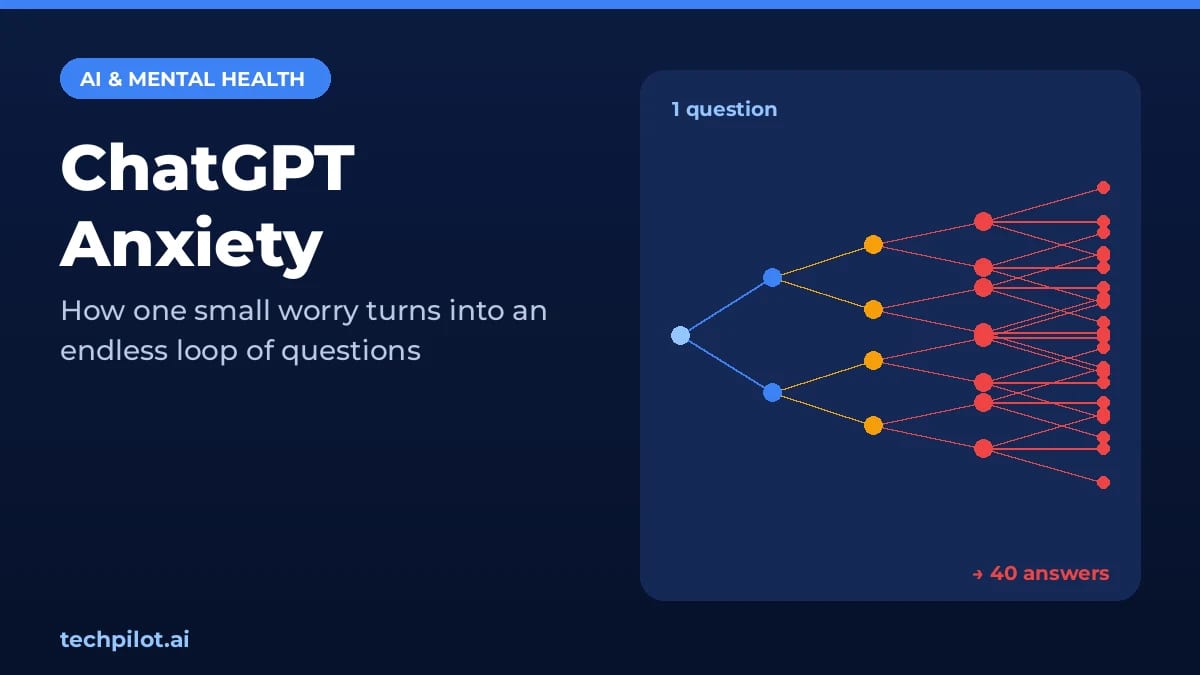
ChatGPT anxiety is real: for overthinkers, AI turns one small worry into an endless loop of questions. Here’s why it happens and how to stop the spiral.
Nobody talks about this side of AI.
I think AI is making life 10x worse for people who tend to overthink.
Not because the answers are wrong. Often they are pretty good. The problem is that there is always another one.
The rabbit hole that didn’t exist before
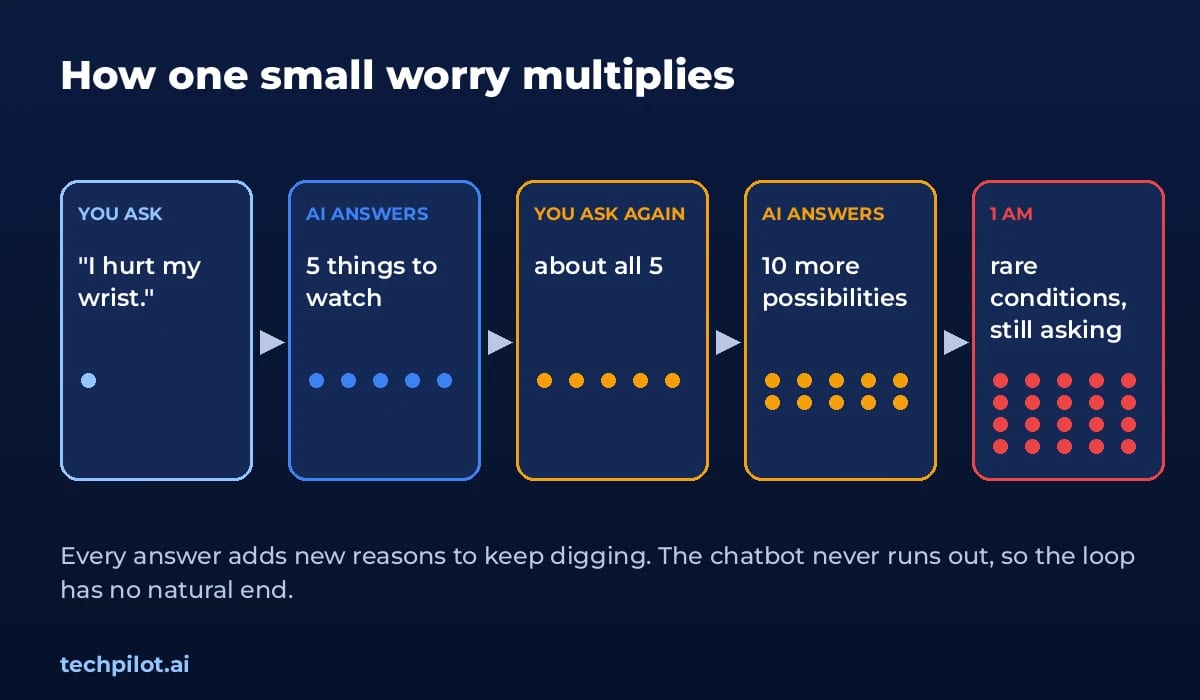
Here is how it goes. You hurt your wrist a little. You ask ChatGPT about it.
It gives you five things to watch out for. Swelling. Numbness. Pain that gets worse at night. A few more.
So you ask about those five things. Each answer comes with two or three new possibilities, and suddenly you have ten. You ask about those too. Now you are reading about nerve compression and rare fractures that don’t show on the first X-ray, at 1 AM, about a wrist that was fine enough to type with.
Every answer gives you another reason to keep digging. And it never ends, because AI never runs out of answers.
That rabbit hole simply did not exist in this form before. You could worry, sure. You could ask a friend, who would tell you to put ice on it and go to bed. You could Google, which was bad enough. But you could not have a tireless, articulate expert sitting next to you all night, answering every follow-up with the same calm confidence.
We’ve seen a version of this before: cyberchondria
The Google-era version of this problem has a name. In 2009, Microsoft Research scientists Ryen White and Eric Horvitz published a study called “Cyberchondria: Studies of the escalation of medical concerns in Web search.” They defined cyberchondria as the unfounded escalation of concerns about common symptoms based on reviewing search results and content online.
They looked at large-scale search logs and surveyed 515 people about their health searches. Their finding: search engines can escalate medical concerns. Common, likely harmless symptoms led people to content about serious, rare conditions. Escalation was linked to how much medical content people viewed and to scary terminology on the pages they visited. And the anxiety didn’t stay in the browser. It persisted after the session and interrupted people’s activities across multiple sessions.
That was search. Ten blue links. You had to click, scan, and decide what to read next.
Chatbots remove the friction. And for an overthinker, friction was the only thing that ever ended the session.
Why chatbots make the loop worse
Psychologists have a few well-established ideas that explain why overthinkers get stuck. Two matter most here.
The first is intolerance of uncertainty: the “not knowing” itself feels unbearable, so you keep looking for information that will finally settle it. The second is reassurance-seeking: you ask for reassurance, you feel better for a moment, and then the doubt comes back and you need to ask again. Each round of relief teaches your brain that asking is how you calm down. So you ask more.
Now look at what a chatbot is, from that point of view.
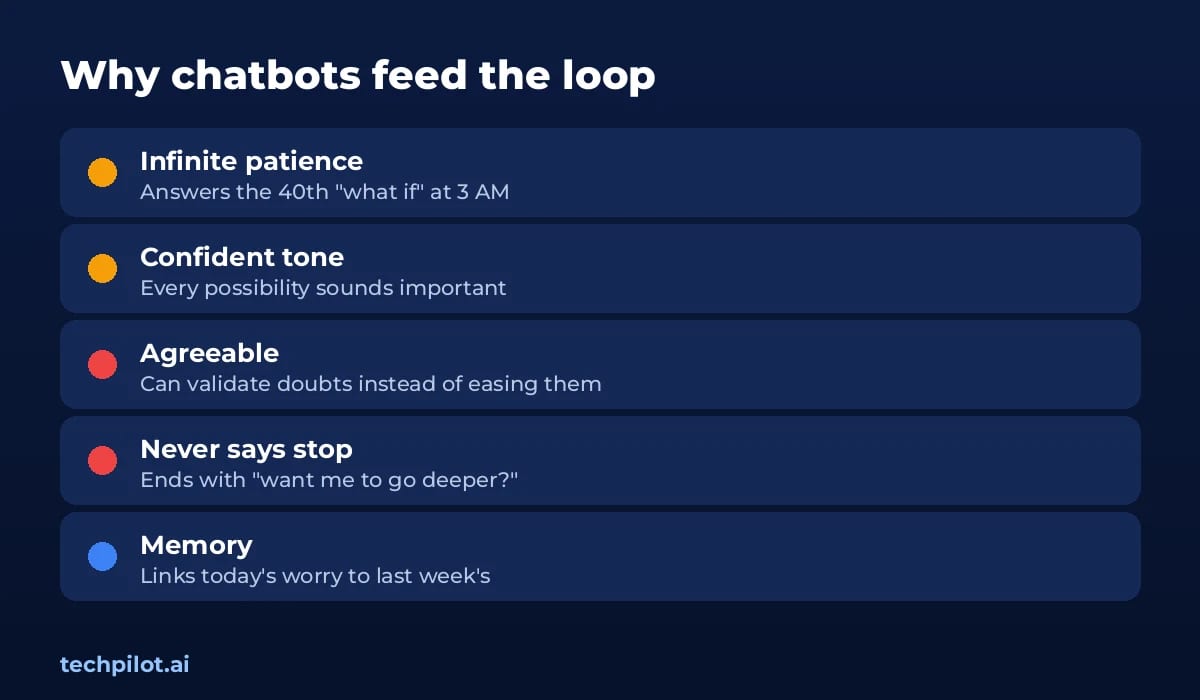
It has infinite patience. A friend gets tired after the fourth “but what if.” A doctor ends the appointment. ChatGPT will happily answer the 40th version of the same question at 3 AM, with no sigh and no hint that you have asked enough.
It sounds like it knows everything. The tone is confident and organized: headings, bullet points, “here are the key things to watch for.” And because it sounds like it knows everything, every answer feels important. Every new possibility feels like something you should worry about. A forum post from a stranger is easy to dismiss. A neat list from something that seems to have read every medical textbook is not.
It tends to agree with you. This one is not my opinion. In April 2025, OpenAI rolled back a GPT-4o update in ChatGPT after users noticed it had become overly flattering and agreeable. In its own write-up, OpenAI said the model “skewed towards responses that were overly supportive but disingenuous,” because the update focused too much on short-term feedback. In a follow-up post, the company went further: the model aimed to please the user, including by “validating doubts” and “reinforcing negative emotions,” and it said this kind of behavior can raise safety concerns around mental health and emotional over-reliance.
Read that again with an overthinker in mind. Validating doubts is exactly what a worried mind does not need. If you come in convinced something is wrong, an agreeable model is a mirror that makes the worry look more reasonable.
It never says stop. No chatbot ends its answer with “you’ve asked enough, close the app.” The default ending is the opposite: “Would you like me to go deeper into any of these?”
It remembers you and keeps the thread alive. With memory and personalization, the assistant knows what you were worried about yesterday. Ask about a headache today and it may connect it to last week’s wrist, so the worry never quite closes.
The social media parallel
This reminds me of social media in the 2010s.
At first, it was the thing that connected everyone. The harms took years to become visible and even longer to be taken seriously.
In 2021, the Wall Street Journal’s “Facebook Files” reported that Facebook’s own internal research had found Instagram made body-image issues worse for one in three teen girls who already had them. In 2023, the US Surgeon General issued an advisory warning that social media can pose a risk to young people’s mental health, while noting the evidence was still developing. That is more than a decade between mass adoption and an official warning.
I’m not saying AI is the same thing. The mechanisms are different, and chatbots are genuinely useful in ways a feed rarely is. But the pattern is familiar: a tool spreads faster than our understanding of what it does to us.
And the early signals are already here. In 2025, OpenAI and the MIT Media Lab published research on how people use ChatGPT emotionally. In a four-week randomized study with 981 participants, the people who used the chatbot more, regardless of which version they were assigned, showed worse outcomes: more loneliness, less socializing with real people, more emotional dependence and more problematic use. The researchers also found that intense emotional use was concentrated in a small group of heavy users.
That doesn’t prove AI causes anxiety. But it fits the shape of the problem. The risk isn’t the average user asking for a recipe. It’s the person who keeps coming back, again and again, for something the tool can’t actually give them: certainty.
I see it around me already. People getting anxious because of a conversation they had with ChatGPT. Not because the AI said anything crazy, but because it said a lot, very convincingly, and they couldn’t stop asking.
Side effects I expect we’ll discover
This next part is my forecast, not established fact. But I think we’ll discover a lot of side effects like this over the next decade.
Decision paralysis. Ask AI to compare two apartments, two jobs or two strollers, and you get a balanced list of pros and cons. Then a follow-up with more factors. Then edge cases. For a decisive person, that’s helpful. For an overthinker, it is a machine for producing reasons not to decide.
Outsourced judgment. When an always-available assistant weighs every option for you, you get less practice weighing them yourself. I suspect some people will slowly lose confidence in their own gut, the same way many of us lost our sense of direction to GPS.
Reassurance dependence. Today it’s “is this mole normal?” Tomorrow it’s “did that message to my boss sound rude?” and “is my partner upset with me?” A chatbot can become the place you go to calm down, which means the calm only comes from outside.
Worry with better grammar. Your anxious thoughts used to be messy. Now they come back to you as clean, well-structured paragraphs, which makes them feel more legitimate than they are.
How to use AI without spiraling
I’m not telling anyone to stop using AI. I use it every day. But if you know you overthink, use it with rules. Here is what actually helps.
This isn’t medical advice. If you have worrying symptoms, or something feels seriously wrong, see a doctor or other qualified professional, and in an emergency contact your local emergency number.
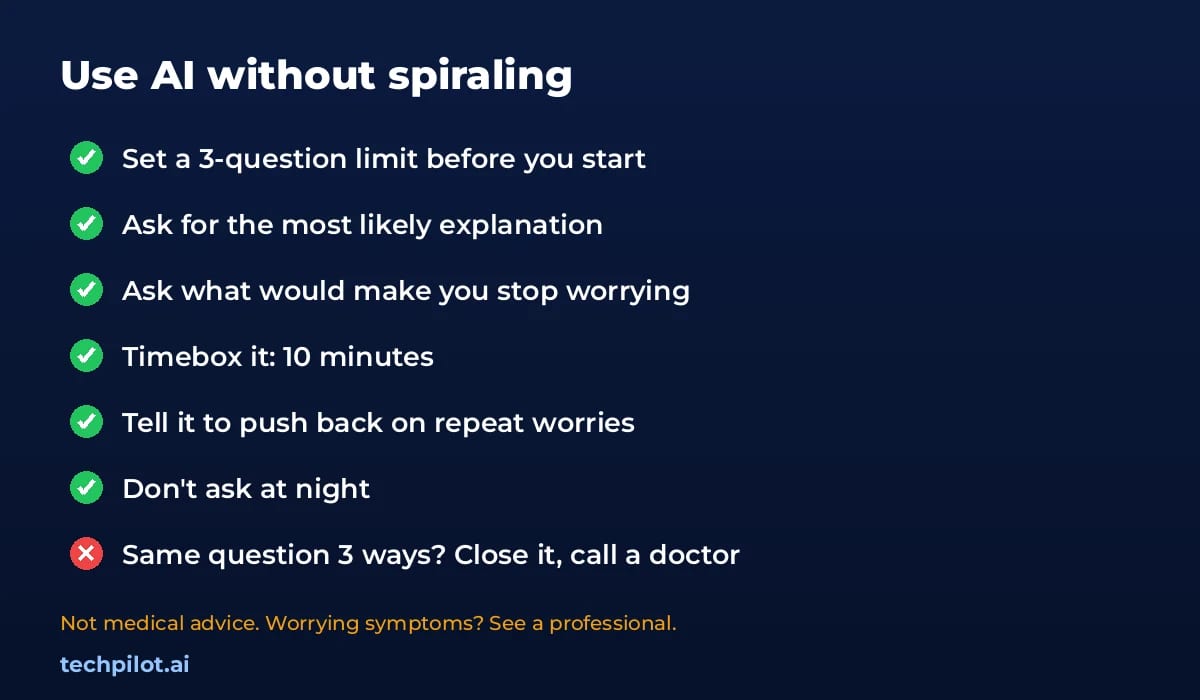
1. Set a question limit before you start. Decide on three questions, then stop. The point is to decide when you are calm, not when you’re 20 messages deep.
2. Ask for the most likely explanation, not every possibility. Instead of “what could this be?”, ask: “What is the most likely explanation for this, and what are the specific signs that would mean I should see a doctor?” That gives you a probable answer and a clear threshold, not a list of rare diseases.
3. Use the “what would make me stop worrying” prompt. Before you dig, ask: “What information would actually let me stop worrying about this?” If the honest answer is “an exam” or “a test,” no amount of chatting will get you there. Close the chat and book the appointment.
4. Timebox it. Ten minutes, with a timer. When it rings, you’re done, even mid-answer.
5. Tell it to push back. Add a line to your custom instructions such as: “If I keep asking about the same worry, point it out and suggest I stop or talk to a professional.”
6. Don’t ask at night. Everything looks worse at 1 AM.
7. Know when to close the chat and call a doctor. If you’ve asked the same question three different ways, the chatbot is no longer giving you information. It’s giving you a dose of reassurance. That’s the signal to stop and, if the worry is real, talk to a human who can actually examine you.
If you want a broader look at the risks of these tools, read our guide on whether ChatGPT is safe, our breakdown of whether AI agents are safe, and our comparison of the best AI models if you’re choosing which assistant to trust.
The real problem isn’t the answers
AI didn’t invent overthinking. It just removed every natural stopping point.
The friend who got bored. The doctor who ended the appointment. The search results that ran out of relevant pages. A chatbot has none of them, and it’s designed to be helpful, which in practice often means: keep going.
Social media taught us that a tool built to connect people could also make them lonely. It took us more than ten years to say that out loud. With AI, we have a chance to notice earlier.
So here’s my point: the most useful skill in the AI era might not be knowing how to ask better questions. It might be knowing when to stop asking.
FAQ
What is ChatGPT anxiety?
It’s an informal term for the anxiety some people feel after long chatbot conversations, especially about health or personal worries. Each answer raises new possibilities, which leads to more questions and more worry. It’s not a medical diagnosis.
Is cyberchondria the same thing?
They’re closely related. Cyberchondria, described by Microsoft Research in 2009, is the unfounded escalation of health worries through web search. Chatbots can produce the same escalation with less friction, because they answer every follow-up instantly and confidently.
Can AI make anxiety worse?
For some people, it can. Constant reassurance-seeking tends to strengthen anxiety over time, and chatbots make reassurance available without limit. OpenAI and MIT Media Lab research in 2025 also found that heavier ChatGPT use was associated with more loneliness and emotional dependence, though that shows correlation, not cause.
Should I use ChatGPT for medical questions?
It can help you understand terms or prepare questions for a doctor. It can’t examine you. Ask for the most likely explanation and the warning signs that need a professional, and see a doctor if you have worrying symptoms.
How do I stop overthinking with AI?
Set a question limit, timebox your sessions, avoid late-night health searches, and ask what information would actually end the worry. If the answer requires an exam or a test, close the chat and book an appointment.
Found this useful? Share it with someone comparing AI tools.