Home / Guides / Web development & Coding
Google AI Studio Free Tier Limits 2026
 Eimantas Kazėnas Marketing & Tech
- Published
- 4 min read
On this page Which models are free in 2026
Independent and reader-supported. Some links may earn us a commission; it never changes our rankings. Editorial policy
Google AI Studio free tier limits in 2026: Flash and Flash-Lite stay free, Gemini 4 Carbon and 3.1 Pro don’t, and limits apply per project, not per key.
Quick answer: Google AI Studio and the Gemini API still have a real free tier in 2026. You get free input and output tokens on the Flash, Flash-Lite and Gemini 4 Hydrogen models, capped by requests per minute, tokens per minute and requests per day. The catch is that Google’s top models, image generation and Batch mode sit behind billing, and anything you send on the free tier can be used to improve Google’s products. Figures below are from Google’s Gemini API pricing page and rate limits page, checked November 19, 2026.
Which models are free in 2026
The free tier is not one model list in the app. It is a per-model setting on the pricing page, and it has shifted a lot this year. Here is how the main text models stand today:
| Model | Free tier (API) | Paid price per 1M tokens, input / output |
|---|---|---|
| Gemini 4 Carbon | No | $2.00 / $10.00 until Nov 30, then $4.00 / $20.00 |
| Gemini 4 Neon | No | $3.00 / $15.00 |
| Gemini 4 Hydrogen | Yes | $1.50 / $7.50 |
| Gemini 3.8 Flash | Yes | $0.75 / $3.75 in 2026, then $1.50 / $7.50 |
| Gemini 3.5 Flash-Lite | Yes | $0.30 / $2.50 |
| Gemini 3.1 Flash-Lite | Yes | $0.25 / $1.50 |
| Gemini 3.1 Pro Preview | No | $2.00 / $12.00 (prompts up to 200K) |
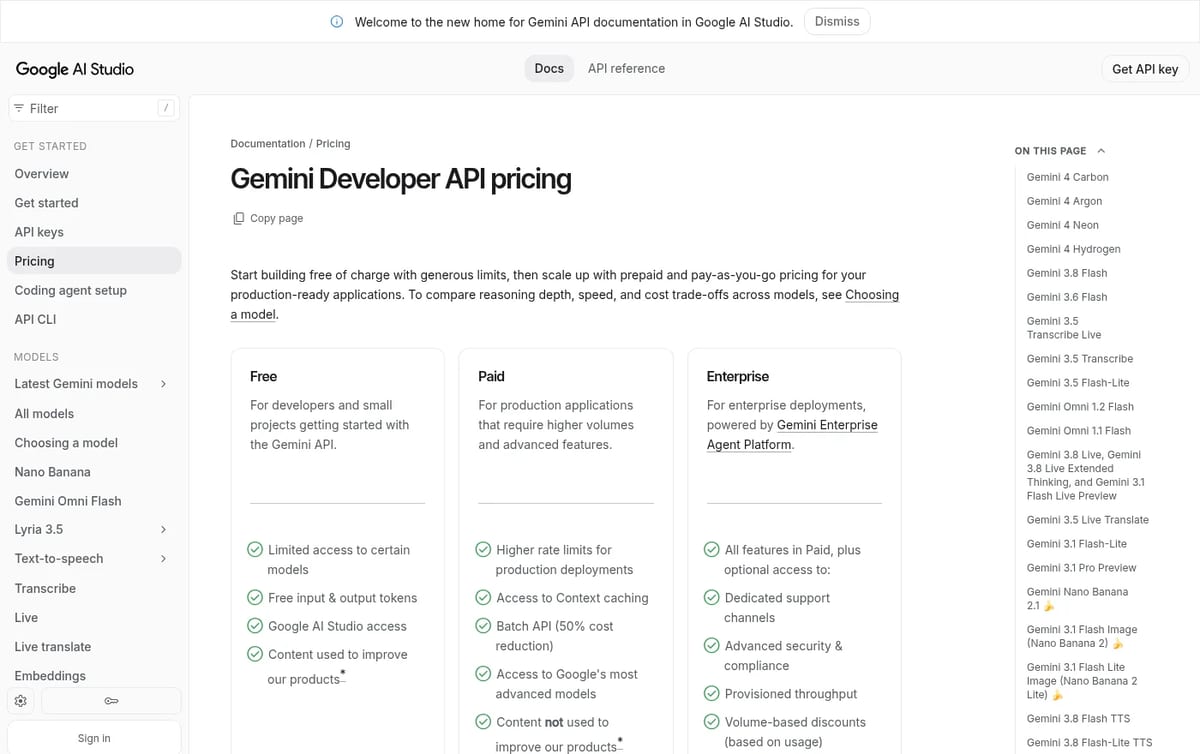
Two other gaps matter. None of the Nano Banana image models are free on the API, and neither are Lyria music or Gemini Omni Flash. And if you built on Gemini 2.5, plan a move now: Google says requests to gemini-2.5-pro will route to Gemini 3.8 Flash and gemini-2.5-flash to Gemini 3.5 Flash-Lite from December 1, 2026.
How the rate limits work
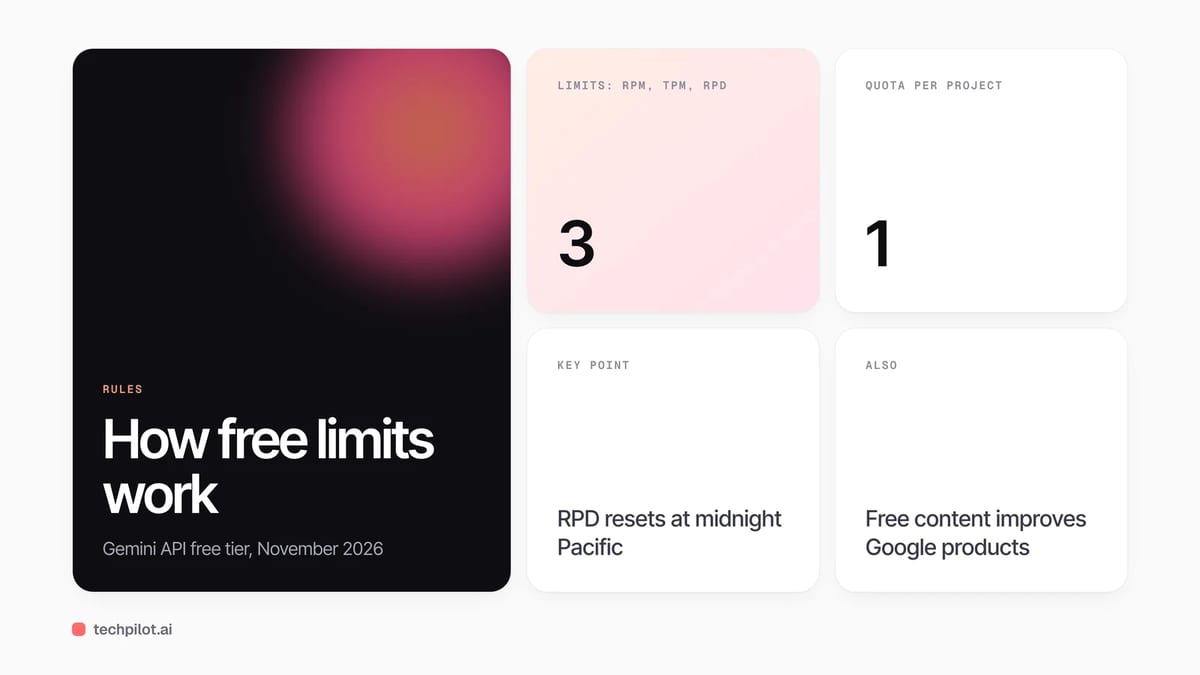
Google measures free usage on three dials, and going over any one of them returns a rate limit error:
- Requests per minute (RPM): how many calls you can make in a minute.
- Tokens per minute (TPM): how much input text you can send in a minute.
- Requests per day (RPD): your daily ceiling, which resets at midnight Pacific time.
Google no longer prints one fixed free-tier table for every model. Your exact numbers are shown in AI Studio under your project, and they change with your tier and account status. Preview and experimental models get tighter limits than stable ones.
The detail most people miss: limits are applied per project, not per API key. Creating five keys in one project does not give you five times the quota. And because the daily reset follows Pacific time, it lands at 3 p.m. in Vietnam or 4 p.m. in Singapore during the US winter, not overnight.
What the free tier really costs you
The tokens are free, but three trade-offs come with them:
- Your data: on the free tier, content is used to improve Google’s products. On paid, it isn’t. Keep client documents and personal data off free projects.
- Missing features: context caching, the Batch API with its 50% discount and Google’s most advanced models are listed as paid features. Grounding with Google Search is also not available on the free tier for Gemini 3 and newer models, though some models let you test it in AI Studio.
- Reliability: Google says specified limits are not guaranteed and real capacity can vary, so a free project is fine for testing, not for an app with users.
When to move to a paid tier
Upgrading is cheaper than it sounds. You link a billing account and prepay at least $5 of credits, and the move from Free to Tier 1 usually takes effect instantly. Tier 2 needs $100 paid plus 3 days since your first payment, and Tier 3 needs $1,000 plus 30 days.
Two guardrails come with Tier 1: a spend limit of $10 per rolling 10 minutes and a billing cap of $250. Prepaid credits expire after 12 months, and when your balance hits $0, every API key on that billing account stops with a 402 error until you top up. Turn on auto-reload with a monthly limit if anything in production depends on it.
Our rule of thumb: stay free while you prototype on Flash or Flash-Lite with test data. Pay the $5 the day you need a Pro-class model, Batch, private data handling or steady capacity for real users.
New to Gemini? Start with our guide on how to use Gemini. If you mainly want a free model for code, see our pick of the best free AI for coding, and to compare another free plan, read is Claude AI free.
Frequently asked questions
Is Google AI Studio free in 2026?
Yes. Google AI Studio and the Gemini API have a free tier with free input and output tokens on models such as Gemini 3.8 Flash, 3.5 Flash-Lite and Gemini 4 Hydrogen, within rate limits.
What are the Google AI Studio free tier limits?
Limits are set per model as requests per minute, tokens per minute and requests per day. Your exact numbers are shown in AI Studio for your project and change with your tier.
When do Gemini API daily limits reset?
Requests per day quotas reset at midnight Pacific time, and limits are applied per project, not per API key.
Which Gemini models are not free?
Gemini 4 Carbon, Argon and Neon, Gemini 3.1 Pro Preview, the Nano Banana image models, Lyria and Gemini Omni Flash are not available on the free tier, checked November 19, 2026.
How do I upgrade from the free tier?
Link a billing account in AI Studio and prepay at least $5 of credits. Moving from Free to Tier 1 usually takes effect instantly.
Found this useful? Share it with someone comparing AI tools.
Cursor vs Windsurf: 2026 Plans Compared
Cursor vs Windsurf in 2026 is really Cursor vs Devin Desktop: Windsurf was renamed on June 2, 2026. Here is how the plans, models and agents now…
 Eimantas Kazėnas · 4 min read
How to Use Claude Code in VS Code (2026)
How to use Claude Code in VS Code: install the official extension, sign in with a paid Claude plan or Console account, then open it from the Spark…
Eimantas Kazėnas · 5 min read