Mistral Large 4 is now one of the strongest open-weight coding models, and the API price cut makes it easy to test.
AI Agents · Tool review
Mistral Large 4: Open Weights, Price & Access
 TechPilot.ai review team Hands-on testing, one published method
- Last updated
- How we test
The AI news that actually mattered this week.
One short email every Friday: the biggest AI stories, what they mean for you, and the tools worth trying. A 3-minute read, no hype.
Free. Unsubscribe anytime.
You're in. Watch for the brief on Friday. Free. Unsubscribe anytime.
Summary
Pros and cons
What we like
- Open weights you can download and fine-tune.
- Low API price $0.70 in, $2.10 out per 1M tokens.
- Strong open-weight coding results.
- 1M-token context and image input.
- Three reasoning modes to balance cost and quality.
What could be better
- Far too big for consumer hardware.
- Model-as-a-service firms need a separate license.
- Technical report not out yet.
- Some rivals are cheaper per task.
Key features
- Open weights: FP8 and NVFP4 builds on Hugging Face.
- MoE architecture: 1.05T total, 52B active parameters.
- Long context: 1M tokens.
- Multimodal: Text and image input.
- Reasoning modes: Low, medium and high.
- Deployment: Mistral API, OpenRouter, vLLM, SGLang and NVIDIA NIM.
Screenshots
Full review
Independent and reader-supported. Some links may earn us a commission; it never changes our scores. Editorial policy
Mistral Large 4 is Mistral’s 1T-parameter open-weight model. The weights are free to download, and the API is $0.70 input and $2.10 output per 1M tokens.
Quick answer: Mistral AI released the open weights of Mistral Large 4, nicknamed Le Chonk, on October 29, 2026, three weeks after a public preview. The released checkpoint had extra reinforcement learning for coding and cyber defense, and the API price fell to $0.70 per million input tokens, $0.07 cached and $2.10 output. You can use it in Mistral Studio, the Mistral API, OpenRouter or Vibe Code, or download it from Hugging Face. We checked the figures against the Mistral Large 4 open-weight announcement and the Mistral docs on November 2, 2026.
What Mistral Large 4 is
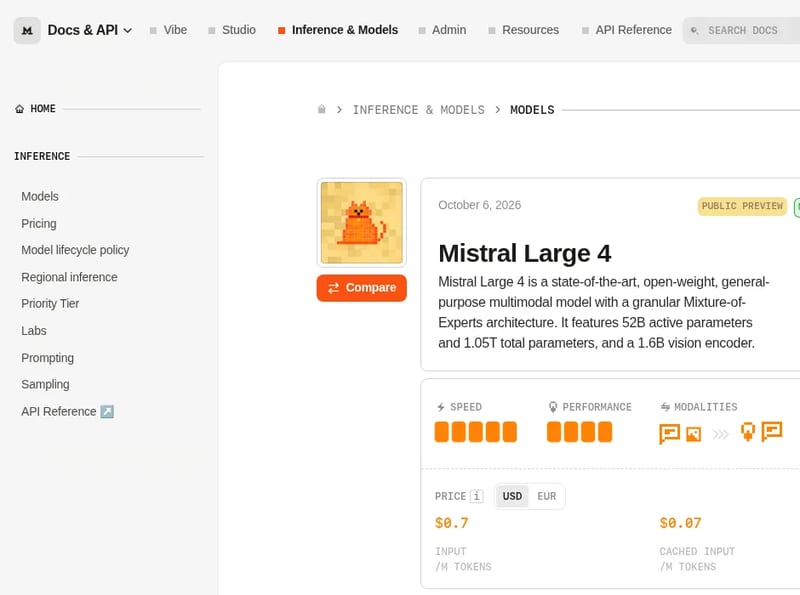
- Size: a Mixture-of-Experts model with 1.05T total parameters, 52B active per token and a 1.6B vision encoder.
- Context: 1M tokens.
- Inputs: natively multimodal, so it reads images as well as text.
- Languages: Mistral says it’s fluent in 160+ languages.
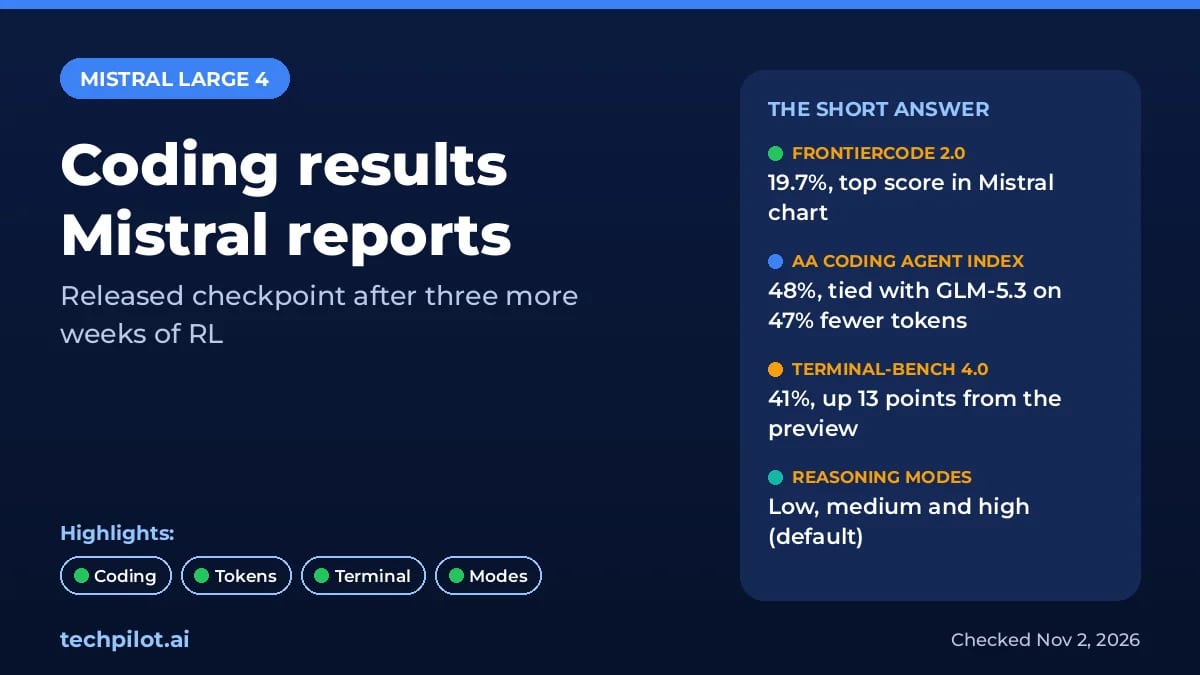
- Reasoning modes: low for simple tasks, medium for everyday work and high (the default) for the hardest jobs.
- Training: trained from scratch on European infrastructure, which Mistral pitches for sovereign AI use.
Mistral Large 4 Pricing (2026)
| Access | Price | Notes |
|---|---|---|
| API input | $0.70 per 1M tokens | Was $1.36 during the preview |
| API cached input | $0.07 per 1M tokens | For repeated prompt prefixes |
| API output | $2.10 per 1M tokens | Was $4.18 during the preview |
| Open weights | Free download | Mistral Ecosystem Open-Weight License |
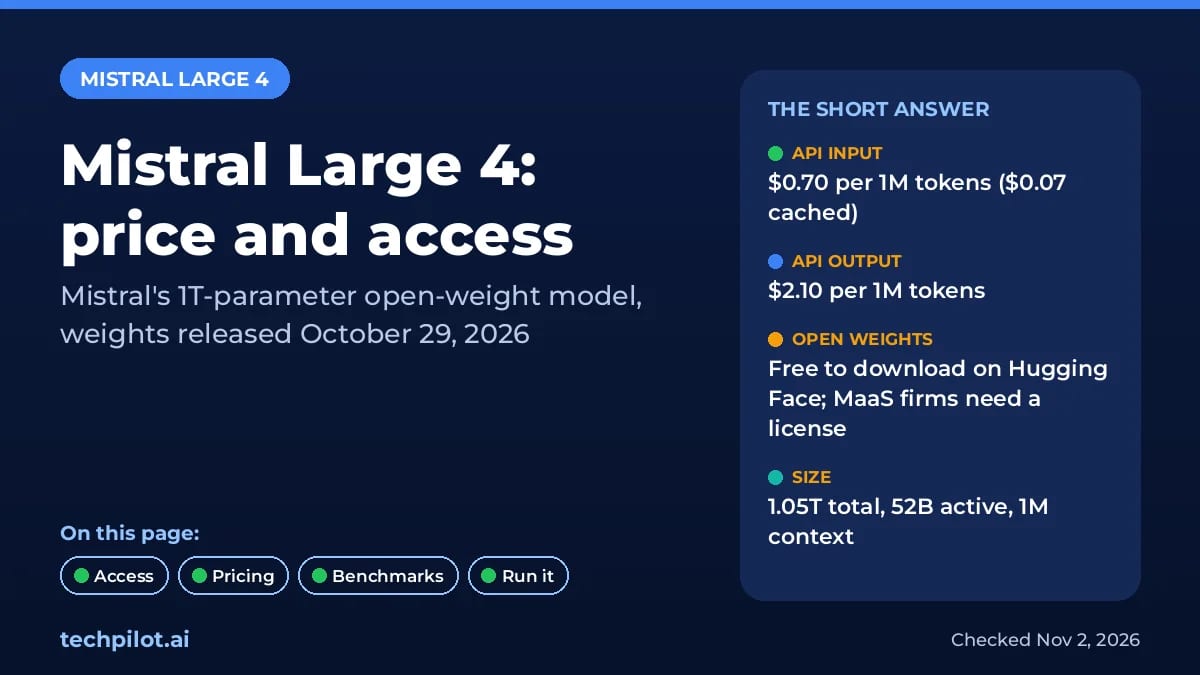
The license is a modified MIT license. You can use, modify, fine-tune and sell products built on the model. The one condition: if you or an affiliate run a model-as-a-service business, you need a separate commercial license from Mistral first. If token prices are new to you, our guide to tokens in AI explains what a million tokens buys.
Mistral Large 4 benchmarks
Mistral reports these coding results for the released checkpoint:
- FrontierCode 2.0 (Cognition): 19.7%, the top score in Mistral’s chart.
- Artificial Analysis Coding Agent Index: 48%, effectively tied with GLM-5.3 while using 47% fewer tokens per task.
- Terminal-Bench 4.0: 41%, up 13 points from the preview, with 30% fewer output tokens.
In blind pairwise tests by Surge, coders preferred it over GLM-5.3, Kimi K3 and DeepSeek V4.1 Flash, ranking it behind only Claude Opus 5.5. For how it stacks up against closed models, see our best AI model comparison.
Can you run Mistral Large 4 locally?
Technically yes, but not on a laptop. The weights come in FP8 and an NVFP4 build for NVIDIA Blackwell GPUs, and Mistral recommends serving with vLLM or SGLang on your own infrastructure. It’s also available as an NVIDIA NIM container. For models that do fit on a desktop, check our best local AI models list.
Limitations
- Huge hardware needs: a 1T-parameter model needs a multi-GPU server to self-host.
- License condition: model-as-a-service companies need a commercial license.
- Mostly self-reported results: the technical report is still “coming soon”.
- Cheaper rivals exist: some open models cost less per task on independent tests.
TechPilot.ai’s Verdict on Mistral Large 4
Mistral Large 4 is now one of the strongest open-weight coding models, and the API price cut makes it easy to test.
Use the API for most projects. Self-hosting only makes sense if you have the GPUs and a sovereignty reason.
Mistral Large 4 FAQ
Is Mistral Large 4 free?
The open weights are free to download and use under the Mistral Ecosystem Open-Weight License. Using the hosted API costs $0.70 input and $2.10 output per 1M tokens.
•
How much does Mistral Large 4 cost?
On the Mistral API it costs $0.70 per million input tokens, $0.07 per million cached input tokens and $2.10 per million output tokens.
•
When was Mistral Large 4 released?
Mistral launched it in public preview on October 6, 2026 and released the improved open weights on October 29, 2026.
•
Can I use Mistral Large 4 commercially?
Yes. You can use, fine-tune and sell products built on it. Only businesses running a model-as-a-service offering need a separate commercial license from Mistral.
•
How big is Mistral Large 4?
It has 1.05 trillion total parameters with 52 billion active per token, a 1.6B vision encoder and a 1M-token context window.
OpenDesign
AI Agents
OpenDesign is a free, open-source design agent that plugs into the AI tools you already use, and Motion makes it a no-cost alternative to…

Meta Muse
AI Agents
Meta Muse is the most accessible personal agent from a big tech company so far: free to start, available in WhatsApp and able to finish…

Make
AI Agents
I’ve been navigating the workflow automation space for the better part of two decades, and I’ve seen platforms evolve from clunky developer…