OpenDesign is a free, open-source design agent that plugs into the AI tools you already use, and Motion makes it a no-cost alternative to Claude Motion.
AI Agents · Tool review
OpenDesign: Pricing, Free App & Motion
 TechPilot.ai review team Hands-on testing, one published method
- Last updated
- How we test
Summary
Pros and cons
What we like
- Free and open source The full desktop app is Apache-2.0 with no account needed.
- Use your own AI Works with 21 coding agents or any API key.
- New Motion feature Make editable videos and export MP4 for free.
- Design systems 152+ ready systems, or build one from a site, repo or Figma file.
- Flexible plans Hosted credits from $10 a month, with yearly discounts up to 51%.
What could be better
- No hosted AI on Free You need your own agent, key or a paid plan.
- Credits are complex Two credit buckets and 7-day windows take some reading.
- Go lacks premium models No Claude Opus or GPT-6 Sol on the cheapest plan.
- No Linux installer Linux users must run it from source.
Key features
- Design agent: Turn a prompt into on-brand websites, app UI, dashboards and slides.
- OpenDesign Motion: Create editable motion graphics and export them as MP4.
- Bring your own agent: Run it through Claude Code, Codex, Cursor, Gemini CLI or OpenCode.
- Design systems: Apply 152+ open-source systems or create your own.
- Team collaboration: Share, comment and let the agent revise with your team.
- OpenDesign API: Use hosted credits from Codex, Claude Code, OpenCode or Hermes.
Screenshots
Full review
Independent and reader-supported. Some links may earn us a commission; it never changes our scores. Editorial policy
OpenDesign is a free, open-source AI design agent app, now with Motion for video. See OpenDesign pricing from $10 to $200 a month and how to start free.
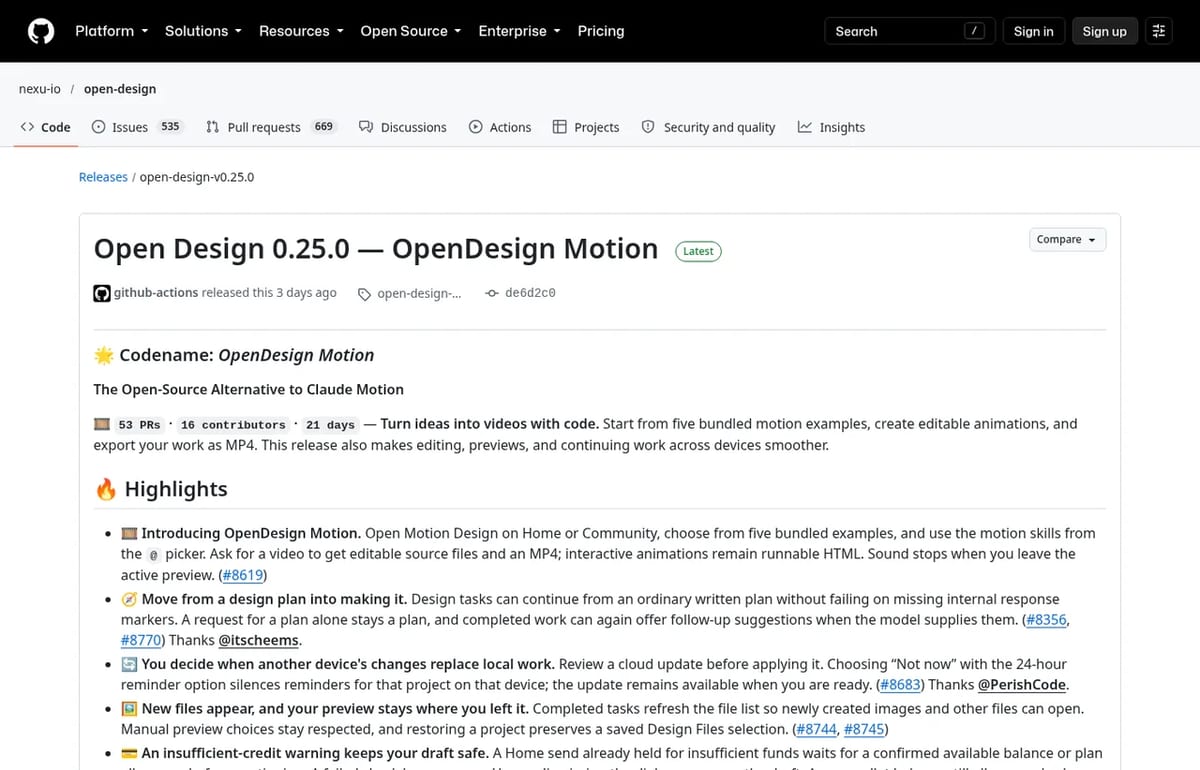
OpenDesign is having a moment. Its October 15 release added OpenDesign Motion, which the team calls the open-source alternative to Claude Motion, and its GitHub repo has passed 102,000 stars. If you’re wondering whether OpenDesign is really free, what the paid plans buy you and how Motion works, this page answers all three. Prices were checked on the OpenDesign pricing page on October 19, 2026.
What is OpenDesign?
OpenDesign is a desktop app where an AI agent designs for you: websites, app screens, dashboards, slides, graphics and now short videos. You describe what you want, the agent builds a prototype using a design system (your brand colors, type and components), and you refine it by chatting, commenting or editing. It’s made by Powerformer, Inc. and is open source under Apache-2.0.
The twist is that OpenDesign doesn’t force you onto its own AI. You can power it three ways:
- Local CLI: use a coding agent already on your computer, such as Claude Code, Codex, Cursor, Gemini CLI or OpenCode. No OpenDesign account needed. Your agent’s subscription or API usage still applies.
- BYOK (bring your own key): add an API key, endpoint and model from any provider. Your provider bills you, and no OpenDesign credits are used. OpenDesign notes that an API key can generate designs but can’t edit files in your project, so use a local agent for that.
- Hosted (OpenDesign Cloud): sign in and use hosted models with nothing to install. This is what the paid plans pay for.
It supports 21 coding agents, ships with 152+ open-source design systems and 162+ skills workflows, and lets you build a design system from a website, a GitHub repo or a Figma file. It runs on macOS 11 or newer (Apple Silicon and Intel) and Windows 10 or 11. There’s no Linux build, though you can run it from source.
What’s new: OpenDesign Motion (v0.25.0)
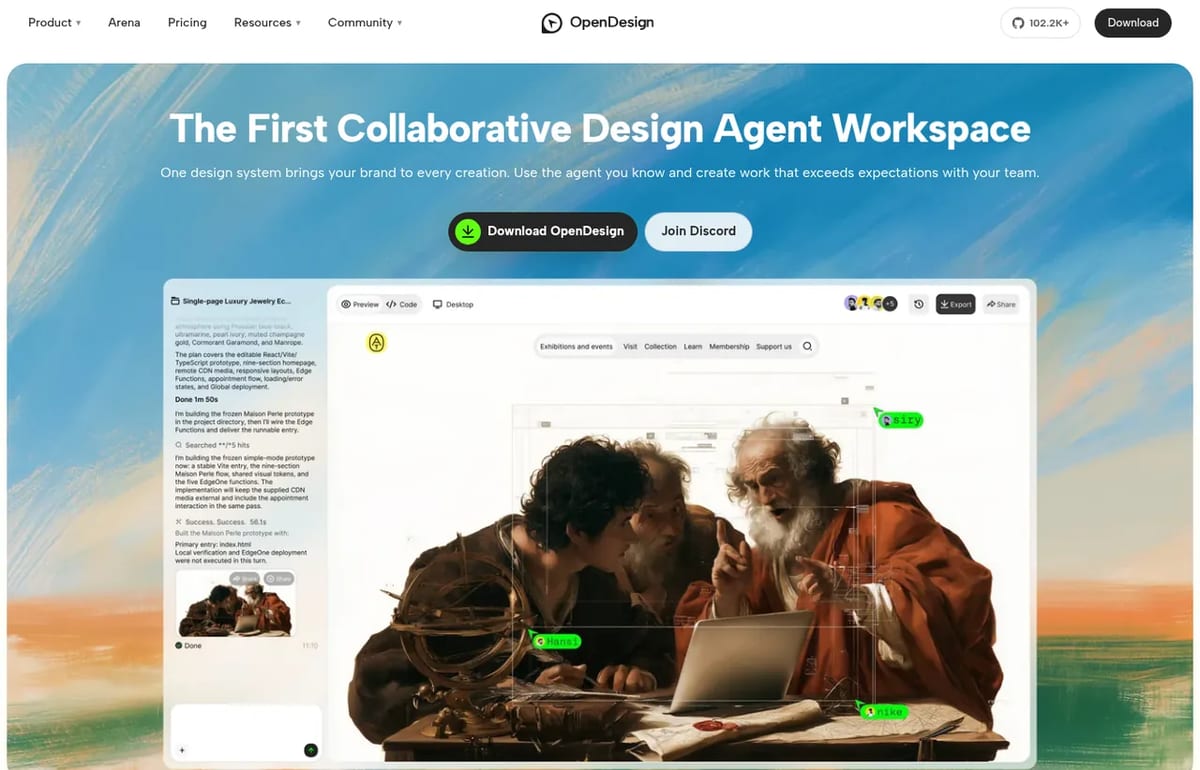
OpenDesign 0.25.0, codenamed OpenDesign Motion, was released on GitHub on October 15, 2026. It turns ideas into videos with code instead of a timeline. You open Motion from Home or Community, pick one of five bundled examples (Motion Future, Product Promo, Showreel, UI Morph and Visual Lesson) or ask the agent for a video, and you get editable source files plus an MP4. Interactive animations stay as runnable HTML.
Because the frames are composed in HTML, timing and layout are exact and repeatable, and you revise by talking to the agent (“slow the title reveal, add a caption”). Video export checks that the MP4 plays, and if it fails you keep the editable source. The same release added a design-plan-to-build flow, cloud sync you approve per device and safer handling when you run out of credits.
Why the Claude Motion comparison? Anthropic’s Claude Motion also builds short animated explainers from code rather than a video model, but it’s a beta for Claude Team and Enterprise plans only. OpenDesign Motion is free in the desktop app with your own agent or key. Our explainer on Claude Dashboards and Claude Motion covers who can use Anthropic’s version and what it costs.
Is OpenDesign free?
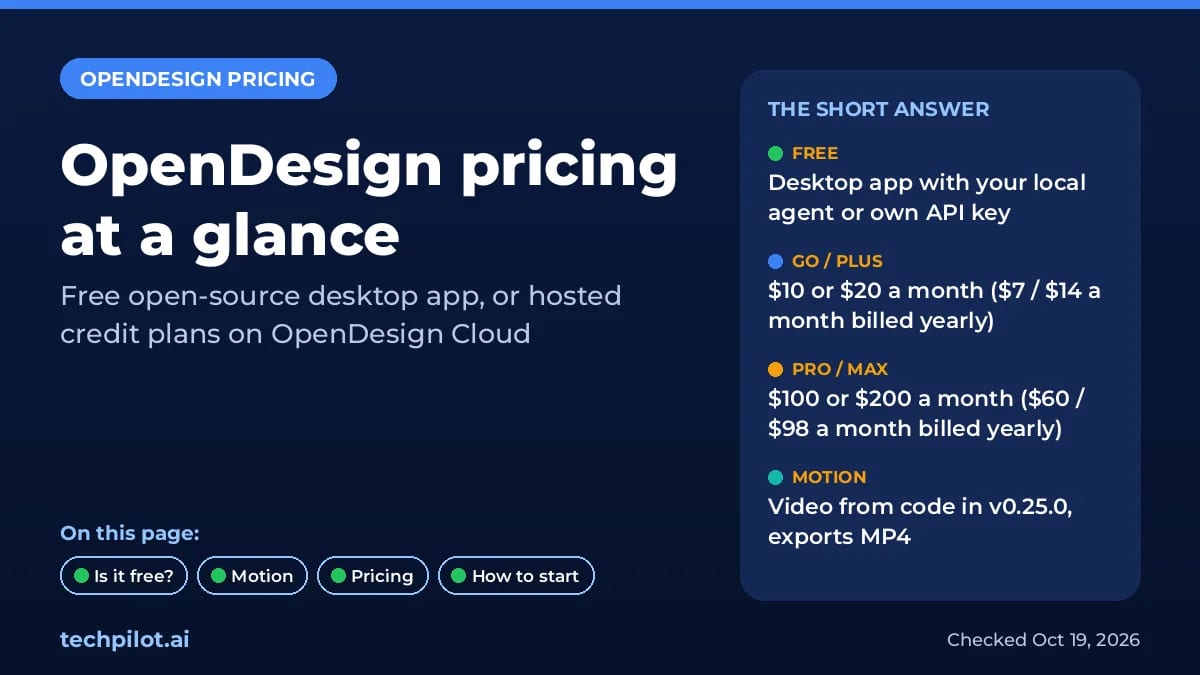
Yes. The full desktop app is free and open source, and you don’t need an account to start. Running it with a local coding agent or your own API key costs nothing extra from OpenDesign; your agent or model provider bills you as usual. The Free plan doesn’t include any hosted model credits, so if you want OpenDesign to supply the AI, you need a paid plan.
OpenDesign Pricing (2026)
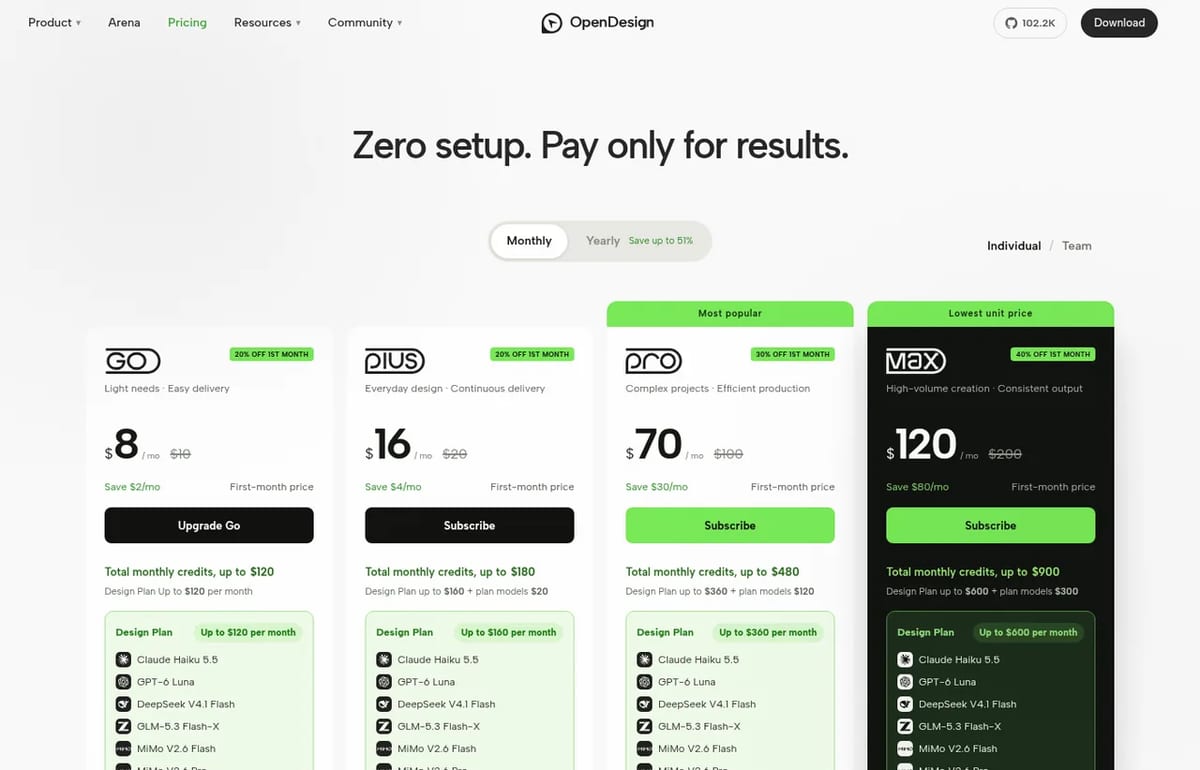
Paid plans add monthly credits for hosted models on OpenDesign Cloud, plus publishing and share links. Here are the individual plans as listed on October 19, 2026 (USD):
| Plan | Monthly billing | Yearly billing | Total monthly credits, up to | Concurrent tasks |
|---|---|---|---|---|
| Free | $0 | $0 | None (local agent or BYOK only) | – |
| Go | $10/month ($8 first month) | $7/month ($84 a year) | $120 (Design Plan models only) | 10 |
| Plus | $20/month ($16 first month) | $14/month ($168 a year) | $180 ($160 Design Plan + $20 plan models) | 20 |
| Pro | $100/month ($70 first month) | $60/month ($720 a year) | $480 ($360 Design Plan + $120 plan models) | 30 |
| Max | $200/month ($120 first month) | $98/month ($1,176 a year) | $900 ($600 Design Plan + $300 plan models) | 30 |
How OpenDesign credits work
- Two buckets. Cheaper “Design Plan” models (such as Claude Haiku 5.5, GPT-6 Luna, DeepSeek V4.1 Flash, GLM-5.3 Flash-X and MiMo V2.6) share one allowance that’s used first. Premium “plan models” (such as Claude Opus 5.5, Claude Sonnet 5.5, GPT-6 Sol, Gemini 3.8 Flash and Grok 4.7) draw on separate plan model credits.
- Go has no premium models. It includes Design Plan credits only, so you can’t use Claude Opus or GPT-6 Sol on Go.
- 7-day windows. Design Plan usage resets every 7 days from when your subscription starts.
- No rollover. Model credits are granted per billing cycle and reset each cycle.
- BYOK on every plan. Even on a paid plan you can use your own key for some work.
- Cancel anytime. You keep benefits until the paid period ends. Yearly cancellations aren’t refunded.
- API access. Every paid plan includes an OpenDesign API key you can use from Codex, Claude Code, OpenCode or Hermes, sharing the same credits.
Our take: if you already pay for Claude Code, Codex or Cursor, start on Free with your local agent. That costs nothing extra and gives you edit access to your project files. Plus at $20 a month is the cheapest plan with premium models; Go only makes sense if the budget models are good enough for you.
How to get started with OpenDesign
- Download the desktop app from open-design.ai for macOS or Windows.
- Pick how to run it: choose a local coding agent you’re signed in to, add your own API key, or sign in to OpenDesign Cloud.
- Choose a design system, or create one from your website, a GitHub repo or a Figma file.
- Describe what you want, for example a pricing page, a dashboard or a 15-second product promo with Motion.
- Refine and share: comment, ask the agent for changes, then export or publish a share link (publishing needs a paid plan).
OpenDesign alternatives
- Claude Design and Claude Motion: Anthropic’s built-in tools, tied to Claude plans. See our Claude Motion explainer.
- Magic Patterns: an AI prototyping tool for product teams. Read our Magic Patterns page.
- Figma: if your team lives in Figma, its new Code Layers bring AI-generated code into the canvas.
- Lovable, Bolt and v0: better if you want a working app rather than design files.
Verdict
OpenDesign is one of the best free AI design tools you can get right now: open source, no account required, and it works with the coding agent you already pay for. The new Motion feature makes it a real free alternative to Claude Motion for promos and explainer videos. Only pay for a plan if you want hosted models without managing keys, and if you do, Plus is the sensible entry point.
TechPilot.ai’s Verdict on OpenDesign
OpenDesign is a free, open-source design agent that plugs into the AI tools you already use, and Motion makes it a no-cost alternative to Claude Motion.
Stay on Free if you have Claude Code, Codex or an API key. Plus at $20 a month is the best entry point for hosted models.
OpenDesign FAQ
Is OpenDesign free?
Yes. The desktop app is free and open source under Apache-2.0, with no account needed. You can run it with a local coding agent like Claude Code or Codex, or your own API key. Hosted models on OpenDesign Cloud need a paid plan.
•
How much does OpenDesign cost?
As of October 19, 2026: Go is $10 a month, Plus $20, Pro $100 and Max $200, or $7, $14, $60 and $98 a month billed yearly. New monthly subscribers get a first-month discount of 20% to 40%.
•
What is OpenDesign Motion?
It’s the October 15, 2026 release (v0.25.0) that lets OpenDesign make videos with code. Pick one of five motion examples or describe a video, and you get editable source files and an MP4. OpenDesign calls it the open-source alternative to Claude Motion.
•
Does OpenDesign work with Claude Code?
Yes. OpenDesign can run through Claude Code, Codex, Cursor, Gemini CLI, OpenCode and 21 coding agents in total. Your agent’s own subscription or API usage applies, and no OpenDesign credits are used.
•
Does OpenDesign run on Mac, Windows and Linux?
There are installers for macOS 11 or newer (Apple Silicon and Intel) and Windows 10 or 11. There’s no Linux build on the download page, but you can run OpenDesign from source on Linux.
Meta Muse
AI Agents
Meta Muse is the most accessible personal agent from a big tech company so far: free to start, available in WhatsApp and able to finish…

Make
AI Agents
I’ve been navigating the workflow automation space for the better part of two decades, and I’ve seen platforms evolve from clunky developer…

Suna AI Agent
AI Agents
After a deep dive into Suna AI’s capabilities, it’s quite clear that this is one of the most promising open-source AI agent projects…