Home / Guides / Digital Art
CGI vs AI: What Differs and When to Use Each
 Eimantas Kazėnas Marketing & Tech
- Published
- 5 min read
On this page CGI vs AI at a glance
Independent and reader-supported. Some links may earn us a commission; it never changes our rankings. Editorial policy
CGI vs AI: CGI is imagery an artist builds from a 3D model and renders, while AI generators predict a new image or video from a prompt each time they run.
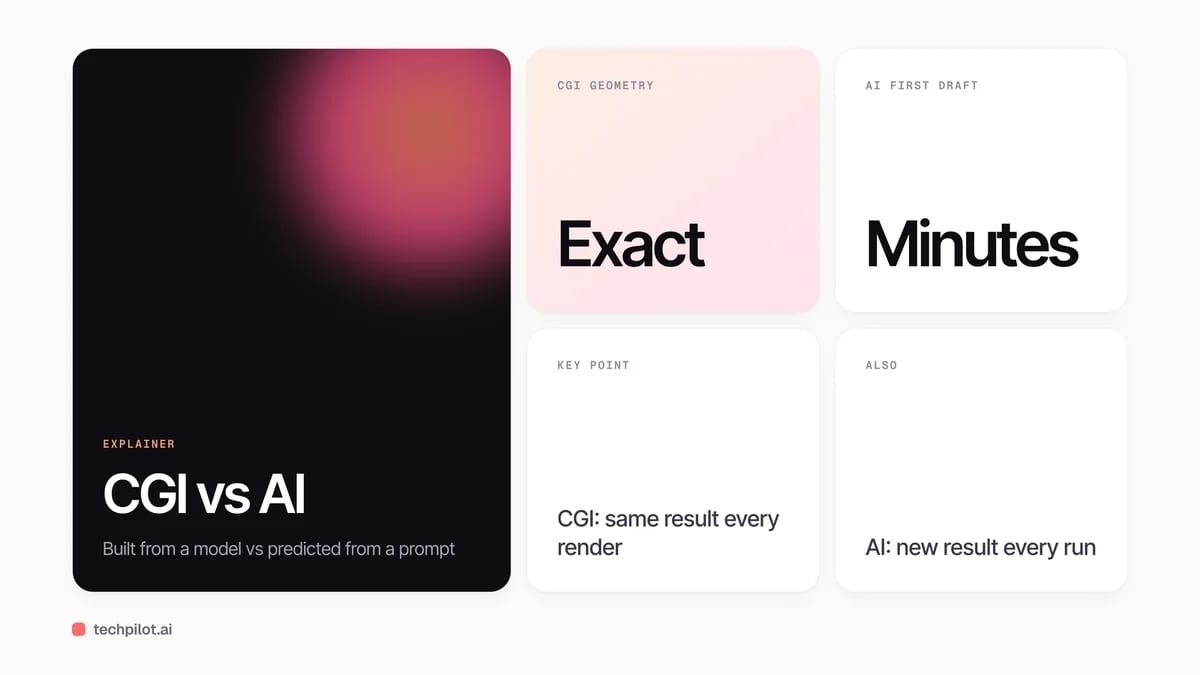
Quick answer: CGI (computer-generated imagery) is not a type of AI. With CGI, a person builds geometry, materials, lights and a camera in 3D software, and a renderer calculates the picture, so the same scene gives the same result every time. With generative AI, a trained model guesses plausible pixels from text or a reference image, so you get a different result on every run. CGI wins when the image must be exact and repeatable. AI wins when you need many ideas fast. Most studios in 2026 use both.
CGI vs AI at a glance
| Question | CGI (3D rendering) | Generative AI |
|---|---|---|
| How it is made | An artist models, textures, lights and renders a scene | A model predicts pixels from a prompt or reference |
| Control | Every surface, light and camera angle is set on purpose | Steered by prompts; details shift between runs |
| Accuracy to a real object | Exact, if the model is built from real dimensions or CAD | Approximate; the model never sees your CAD file |
| Changing one thing | Swap a material or move the camera, everything else stays | Regenerate, and other details may change too |
| Time to a first image | Hours to days, more for complex scenes | Seconds to minutes |
| Skills needed | 3D modelling, lighting, rendering | Prompting, selection and careful checking |
| Best for | Product shots, VFX, architecture, anything signed off | Moodboards, concepts, backgrounds, social content |
The real difference: calculated vs predicted
The clearest way to think about it: CGI starts from the object, AI starts from a description of the object. A CGI render of a sneaker is the sneaker’s geometry seen through a virtual camera. Turn it, recolor it or render it again next year and it is the same shoe. An AI image of “a white running shoe on wet asphalt” is a plausible shoe that never existed, and the next generation will have different laces, a different sole and maybe an extra stripe.
That is why “is CGI AI?” has a short answer: no. CGI is a production craft, closer to photography with a virtual camera. AI generation is statistics about what images usually look like. Both are made by computers, which is where the confusion comes from.
Where each one wins
Use CGI when the picture has to be true
- Product and e-commerce images that must match what arrives in the box.
- The same asset in many shots, such as a car in 50 campaign images or a character across a film.
- Architecture and engineering, where the render must match the drawings.
- Film and TV visual effects, where shots need frame-accurate control.
Use AI when speed and variety matter more
- Moodboards and concepts before anyone commits a 3D budget.
- Backgrounds, textures and filler content where nobody checks the details.
- Social posts and ad variations that need volume more than precision.
- Storyboards and animatics to test an idea in minutes.
Our take: the winning workflow is hybrid
The “CGI vs AI” framing suggests a fight, but in practice the two are merging into one pipeline. A sensible 2026 workflow looks like this: explore looks and compositions with AI, lock the hero product or character in CGI, then use AI again for backgrounds, lighting variations and quick social cut-downs around that fixed asset. You get AI’s speed where mistakes do not matter and CGI’s precision where they do.
Tools are moving the same way. Canvas tools such as FLORA put dozens of image and video models side by side, so artists can generate options and keep the ones that fit a 3D-built scene. Modern AI video models can animate a reference frame, which works best when that frame comes from a controlled render.
Cost and ownership
Cost: AI is cheaper to start: many generators have free plans, see our lists of the best free AI image generators and free AI video generators. CGI software can be free too (Blender is free and open source), but the real cost is the artist’s time. For a one-off concept, AI is far cheaper. For an asset you will reuse for years, a CGI model often costs less in the long run because you never have to regenerate and fix it.
Ownership: this is where CGI has a quiet advantage. A render made by an artist is a normal creative work. Purely AI-generated output is different: the US Copyright Office concluded in its report on AI and copyrightability that protection depends on a human determining the expressive elements, and prompts alone are generally not enough. If you need to own and defend an image, keep a human-made core.
How to tell CGI from AI
- Consistency across shots: CGI objects look identical from every angle; AI objects drift between images.
- Small details: text, logos, hands and mechanical parts are still where AI slips most often.
- Physics: reflections, shadows and contact points are calculated in CGI and guessed in AI.
- Labels: many AI tools add content credentials or watermarks, and platforms increasingly label AI media.
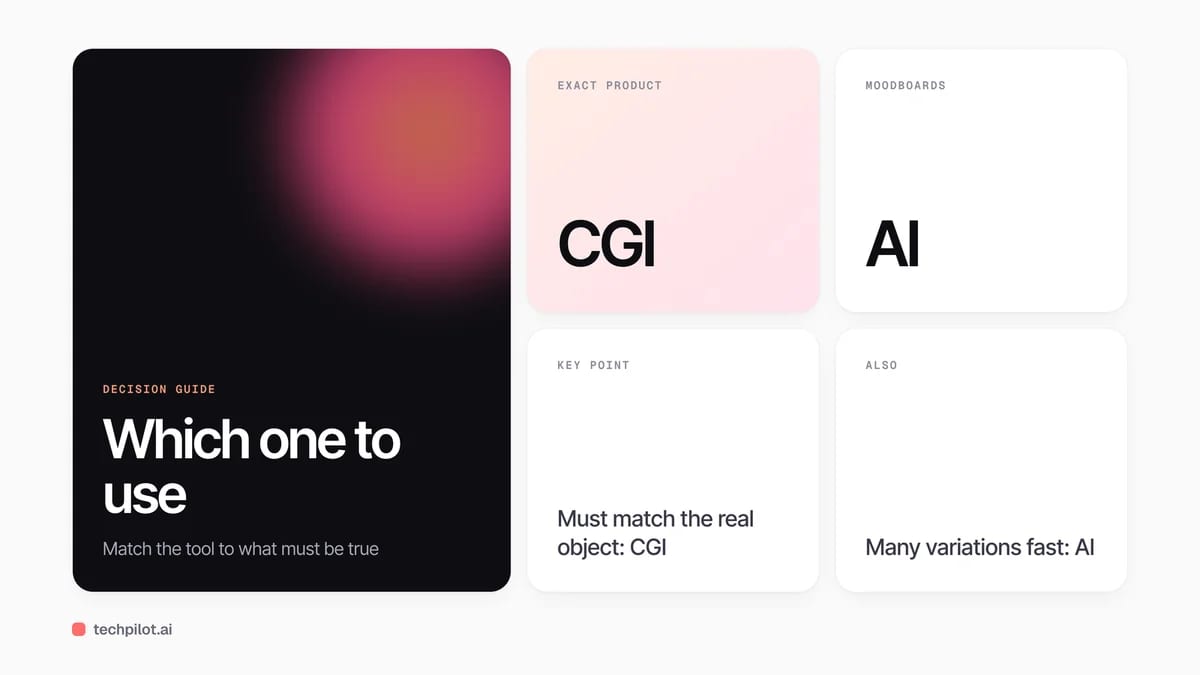
Bottom line: choose CGI when the image is a promise about something real, choose AI when the image is an idea, and combine them when you need both speed and accuracy.
Frequently asked questions
Is CGI the same as AI?
No. CGI is imagery an artist builds in 3D software and renders. AI image and video generators predict new pixels from a prompt. CGI is not a type of AI.
Is CGI better than AI?
For exact, repeatable images such as product shots and VFX, yes. For fast concepts, variations and social content, AI is usually the better choice.
Will AI replace CGI?
Not where accuracy matters. AI is replacing parts of the CGI workflow, such as concepts and backgrounds, but exact products and repeatable assets still need 3D.
Can AI-generated images be copyrighted?
In the US, only where a human determined the expressive elements. The US Copyright Office says prompts alone are generally not enough.
How can you tell CGI from AI?
Check consistency across shots, small details like text and hands, and physics such as reflections and shadows. AI tends to drift between images.
Found this useful? Share it with someone comparing AI tools.